
Working with vintage bagpipes is as much a hobby as a business for me. I enjoy the process of turning up old pipes and making sure they will be played for years to come. I think it is a good thing for piping. As such, I take great care in purchasing, examining and restoring old pipes.

My refurbisher is J. Dunbar Bagpipe Maker in St. Catharines, Ontario. Not only do they do masterful restorations, they have eagle eyes for examining 150-year-old wood and discovering replacement pieces and flaws that should be addressed before you play the pipes. If a set of pipes has a replacement or repaired piece, you will know about it before you buy.
You should know from the get-go that pretty much every bagpipe made before 1930 has required or will require repairs of some sort, especially if they are ebony. Ebony and cocuswood are superb woods from which to make bagpipes but they are less resilient than African blackwood. I suspect there is hardly an ebony bagpipe in the world made before 1920 that hasn’t experienced at least one crack.
Photos and descriptions of all instruments featured since October 2010
-
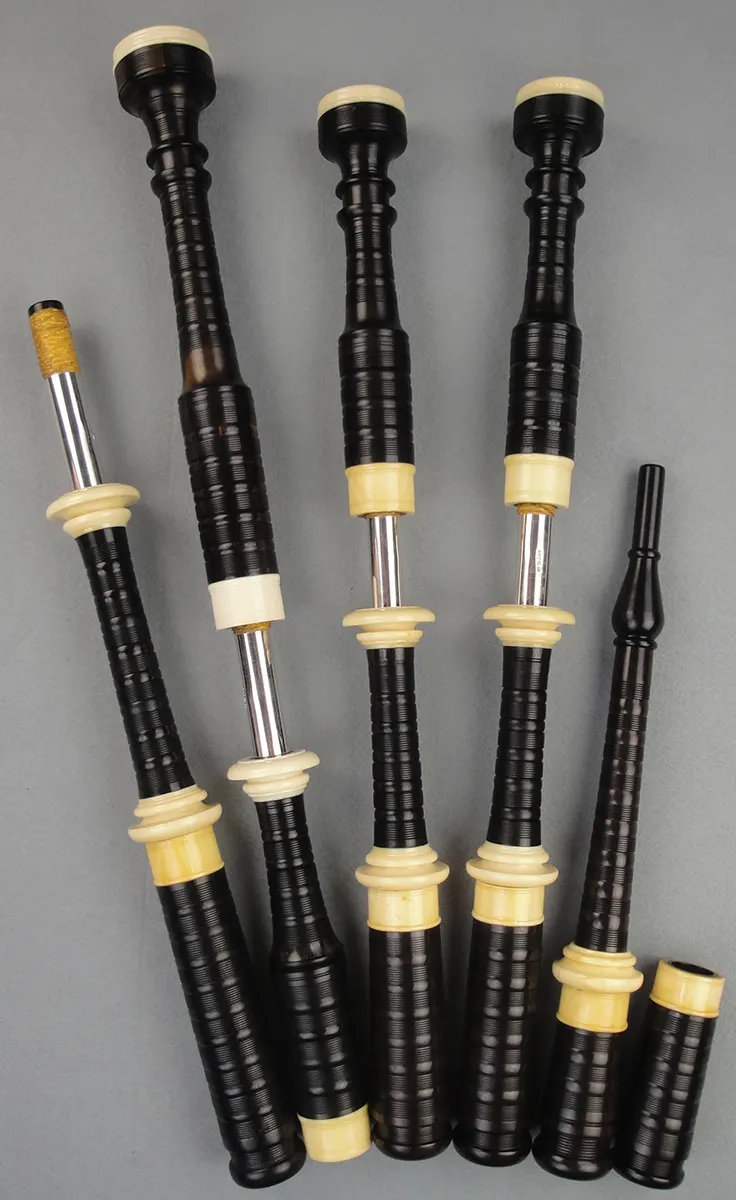
Duncan Macdougall, Circa 1890s, Ebony, Full Ivory
SOLD – This ebony MacDougall set is difficult to date, but probably originated in Duncan MacDougall’s shop in the 1890s. Duncan liked customers to come to the shop to order a bagpipe, and it was there that customers probably chose minor tweaks to their instruments. The Edinburgh-style cut beads on the projecting mounts on this set are a likely example, as Duncan rarely did this.
The set was in such good shape when I acquired it that I was convinced it had replacement pieces, but in fact all pieces are original ebony except for the blowstick and blowstick stock. The ferrule on the bass top might be a replacement, but if so, it is a perfect ivory replica.
The bass bottom was cracked and required invisible whipping. A number of ferrules had the usual tiny cracks in the tenons that come with age, and these were whipped under the ferrules to prevent future cracking.
The set came with what looked like old Robertson slides that didn’t suit the pipes at all and impeded the tuning chambers, so these were replaced with plain Sterling silver slides hallmarked 2016.
The set played in typical MacDougall fashion: robust but not booming, very steady, and with a sonorous bass sound.
-
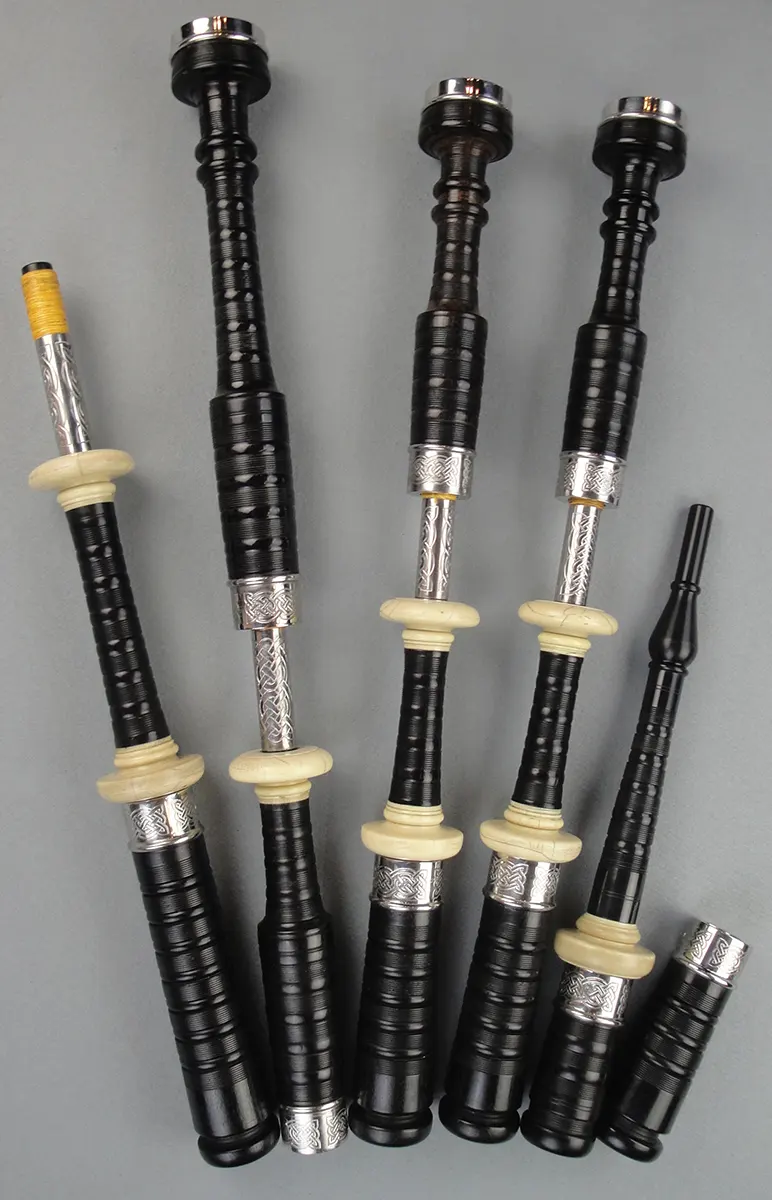
Robertson, Circa 1930s/40s, Polished Casein, Engraved Nickel
SOLD – This is a rare Robertson set with non-ivory (casein) mounts that have been polished and have not deteriorated into a gray, chalky material. The engraved nickel mounts were added at some point in the recent past.
The set had some hairline cracks in a couple of pieces that have been invisible whipped so that they would not spread. The stocks don’t appear to be original to the set. The are extremely well made, are almost certainly Starck stocks. All match but for the blowpipe stock, which also is a recent replacement. The blowstick itself was missing, so a polypenco replica was made and a matching casein mount found and installed. At least a couple of drone pieces could be Brazilwood, a wood frequently used by James Robertson. The casein shows numerous spider lines but all mounts are solid.
The set locked into tune immediately with my Kinnaird Edge drone reeds, and the sound was robust and steady within seconds. In terms of manufacturing standards and sound, Robertson was the most consistent maker I know of through the entire life of the company; materials may differ, but the quality of work and sound is always exemplary.
-
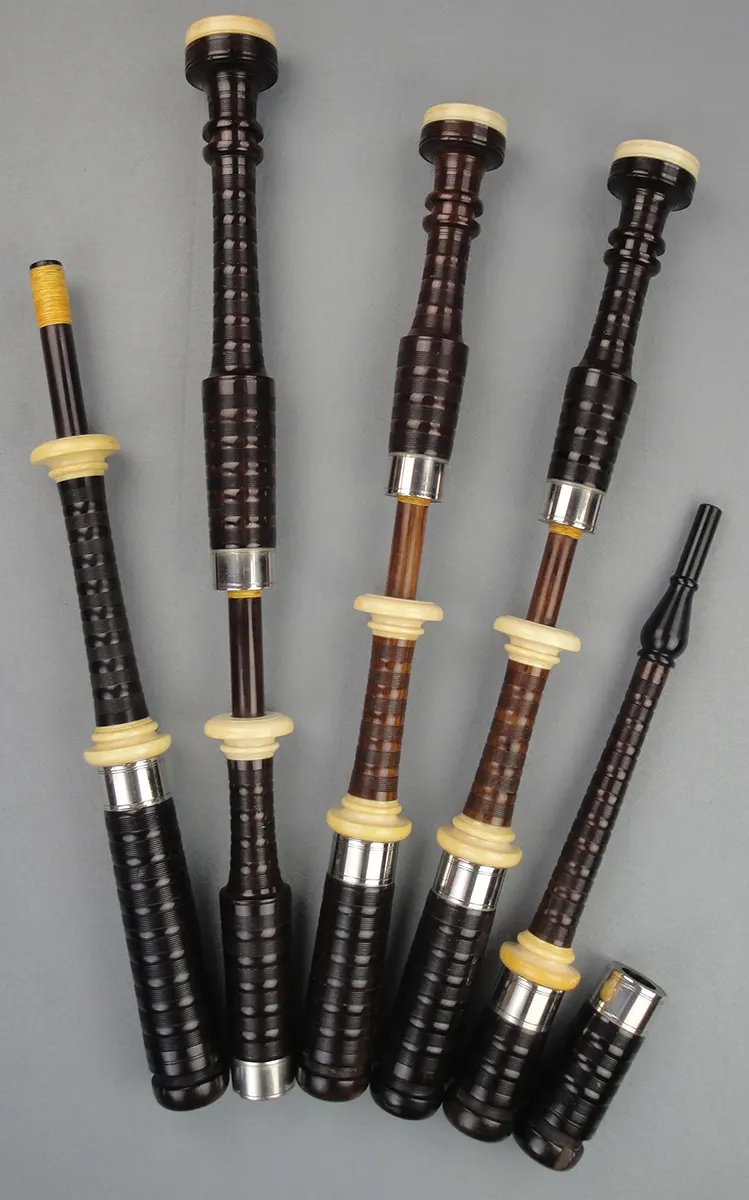
Henderson, Circa 1915, Cocuswood, Nickel, Ivory
SOLD – We’ve had quite a number of cocuswood Hendersons on the site over the years, but few in such great shape. Cocuswood is stupendous for pipes and it is sad that it is no longer available in instrument-grade. The use of cocuswood, along with the profiles of this set, indicate a manufacturing date likely within five years either way of the Great War.
The set needed no work but for re-truing of the tenor tuning chambers and reaffixing of the nickel ferrules. The colouring is sublime and the ivory and nickel are in lovely condition.
Tonally, these pipes are premier: robust and steady, with a seamless overall blend typical of the great Henderson sets.
This set would make any piper happy, from the serious hobbyist to a Gold Medal contender.
-
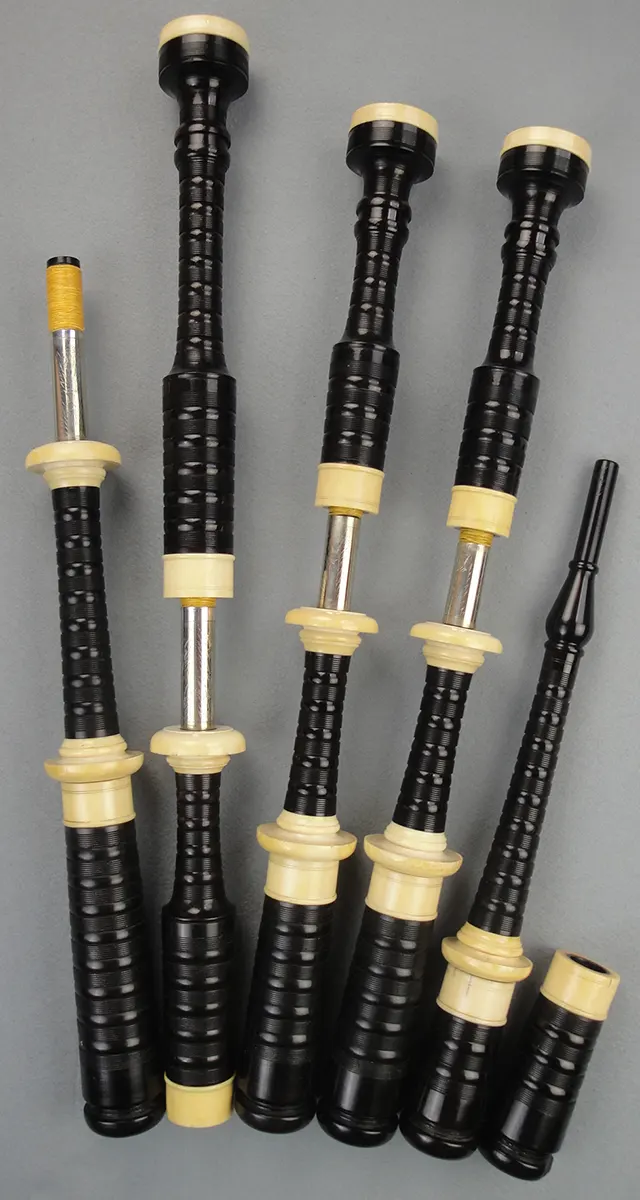
Starck, Circa 1930s, Ivory, Engraved German Silver
SOLD – The Starck firm began business in the early 19th century as a woodwind maker. In 1889, Henry Starck was convinced by William Ross, the Queen’s piper, to make bagpipes. The firm made absolutely superb instruments, and many of the pre-1950s sets are as good as those of any other maker.
This set is thought to date into the 1930s. It is blackwood, mounted in full ivory, and has engraved German silver slides. German silver is the name given to a widely used alloy of the time similar to today’s nickel.
The pipes are in excellent condition and required invisible whipping only along a hairline crack in the blowstick. The finish needed only polishing and appears to be original. There are some small, filled cracks in the ivory mount of the blowpipe stock.
I tested this set along with two sets of Hendersons and was impressed by the fact that it was easily as good as the Hendersons in terms of steadiness, richness, blend, volume and proper tuning positions. This is a superb set of pipes.
-
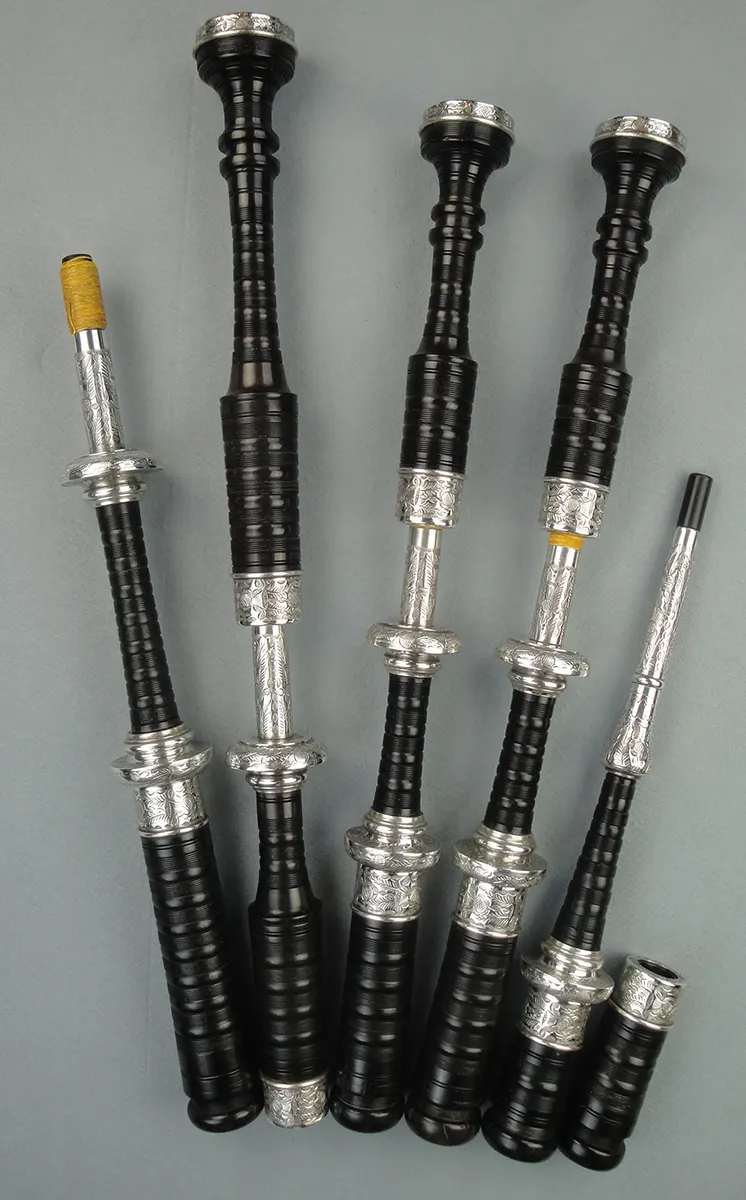
R. G. Lawrie, Full Silver, Hallmarked 1965
SOLD – Full silver pipes of any kind are uncommon. If they happen to be Lawries: bonus.
This set is hallmarked with “RGL” silver on each piece, and the date is 1964-65. All pieces are original.
One tenor stock and one tenor top had hairline cracks that have been repaired invisibly. The finish on the pipes was in good shape. I prefer to leave pipes as original as possible if I possibly can, so the pipes were not refinished. The blowpipe has at some point had a copper insert installed and a crack repaired and this has held up well.
Note that the dark blotches appearing on the ring cap silver in a couple of the photos are reflections from my lights, not blemishes.
Tonally the set is full and steady, tuning up quickly with my current Kinnaird Edge drone reeds.
If you long for a head-turning set with good tone and a quality name like Lawrie for a reasonable price, you won’t do better than this one!
-
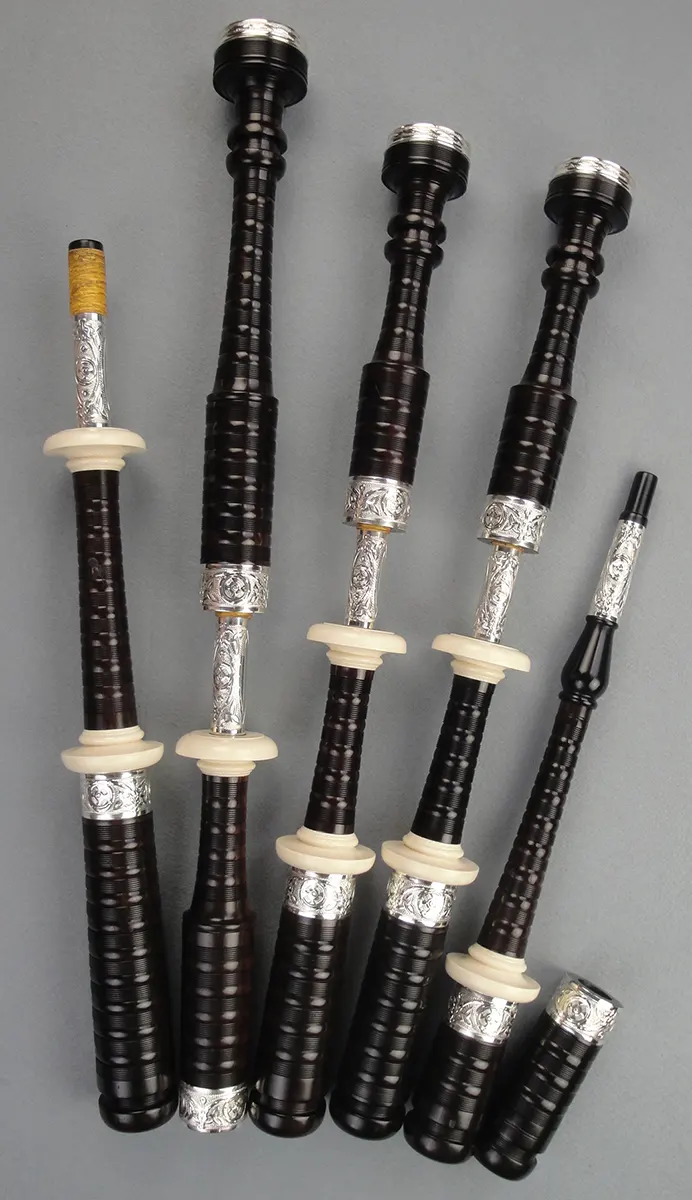
Henderson, Cocuswood, Circa 1916, Remounted in Engraved Silver, Imitation Ivory
SOLD – This cocuswood Henderson set is stamped in the cord guides. It came to me mounted in nickel and casein. The wood and profiles suggest a manufacturing date within a few years of the Great War.
The casein was not in good shape so it was decided to remount the entire set in imitation ivory and Sterling silver engraved in Ancient Celtic by Truehand engraving. The pipes came out beautifully after refinishing and the cocuswood gives them a lovely burgundy hue.
They played beautifully from the first blow, locking into tune in the correct tuning positions and filling the room with a classic, bold, seamless Henderson sound.
-
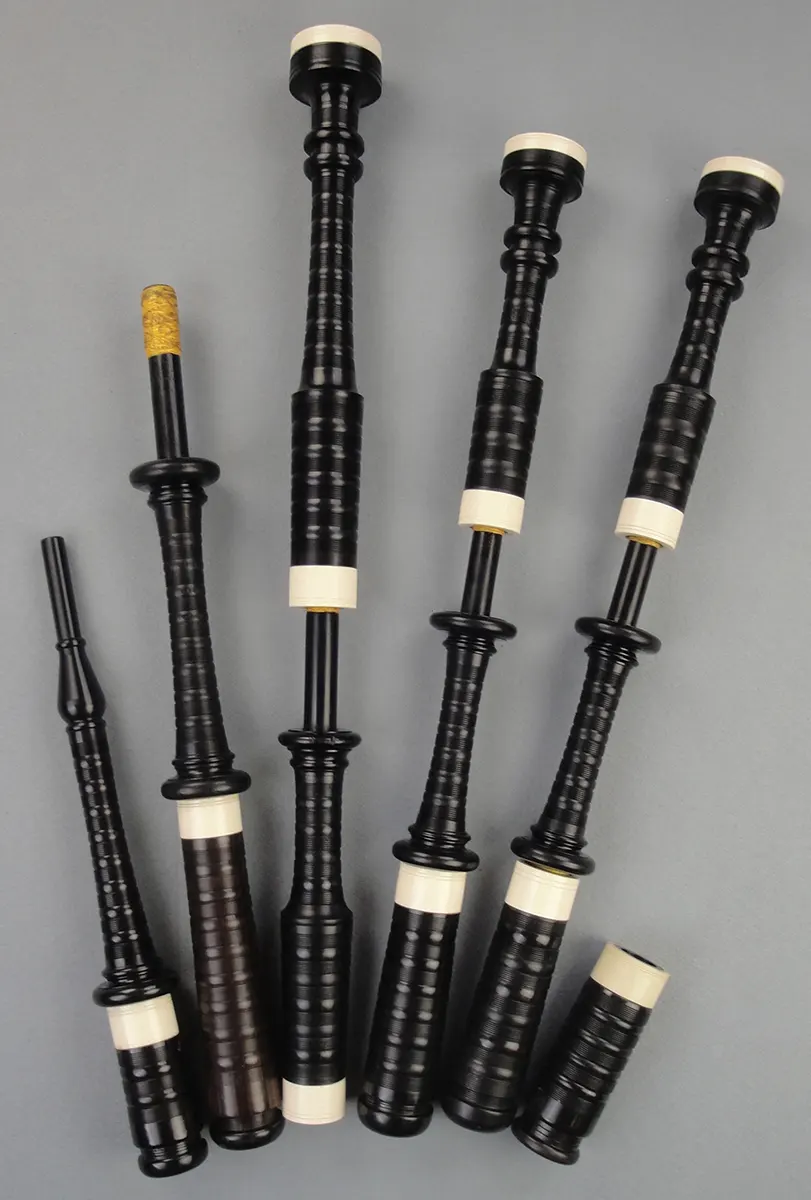
Lawries, Circa 1915, Ebony, Imitation Ivory Ferrules, Caps
SOLD – This set came to me with the imitation ivory mounts added. The stocks are replica Lawrie stocks, except for the chanter stock, with came from a different set and is mounted in holly. The blowpipe is also a replica.
The drones are all original, and the projecting mounts are ebony or African blackwood. Some hairline cracks have been repaired pro-actively to prevent later troubles. When these pictures were taken I had lost the chanter stock and took the photos with a replacement. The original has since been found — it had rolled off the worktable and into a Kleenex box on the end table….
Tonally this set is extraordinary: very full, very steady, and with superb chanter blend. This ivory-free set would sound great on any stage.
-
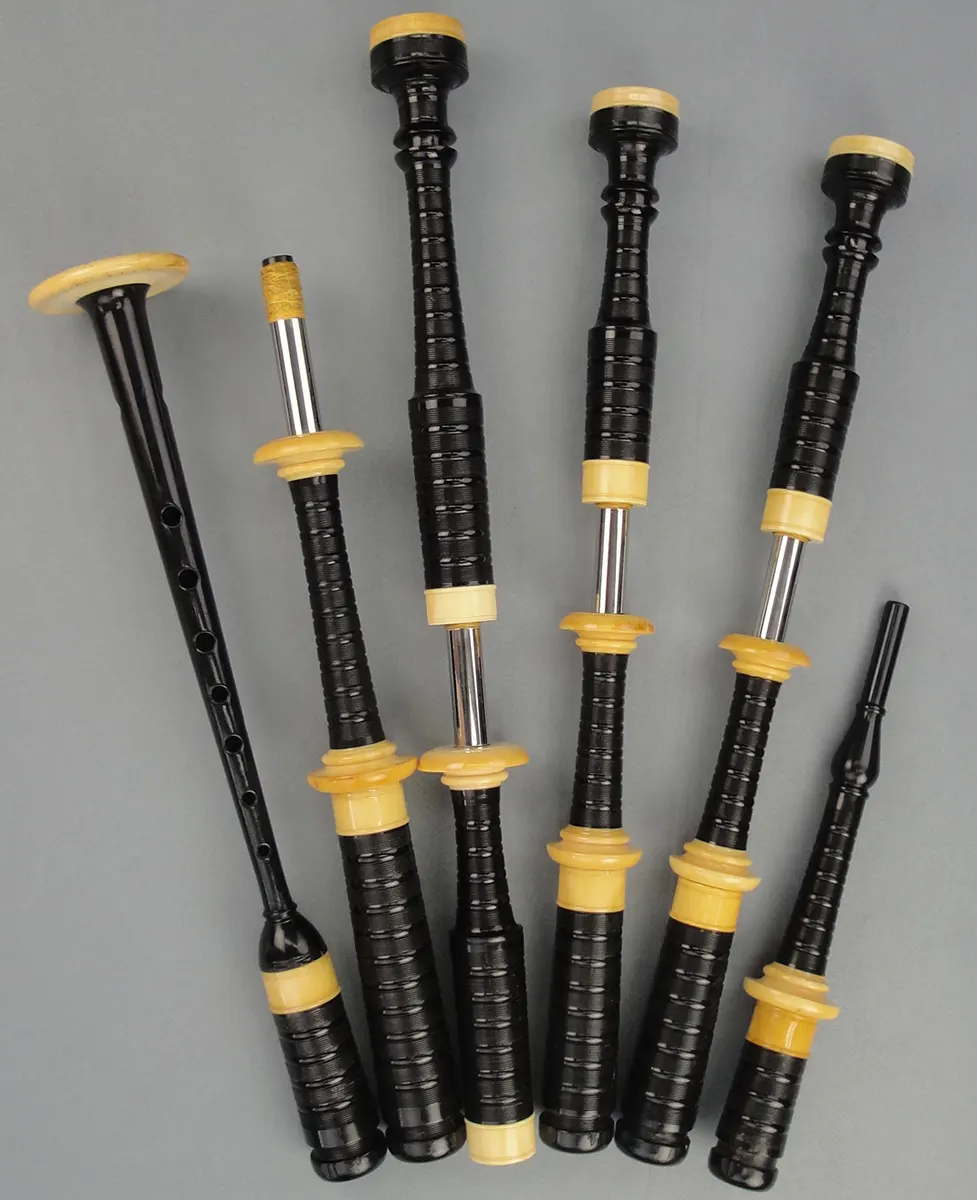
Donald Macphee, Circa 1876, Ebony, Full Ivory, Nickel Slides
SOLD – This set immediately struck me as a Donald MacPhee set when I first saw it two years ago. I sent photos of it to Ron Bowen. By a remarkable coincidence, he just happened to have a set of pipes in his possession that had its original 1876 bill of sale from Donald MacPhee’s shop in Glasgow. The two sets of pipes were identical in every respect. The chanter that is with the set is a very old Henderson, probably made early in the life on the Henderson shop. Of course, Donald MacPhee’s shop became the Peter Henderson shop when MacPhee died at 37 in 1880.
I’ve been playing this set as my primary bagpipe for the past year. As I tend to do, I’m moving on to a different set that has come into my collection. This MacPhee set is robust, steady, rich, and has an excellent blend with the drones. I have enjoyed playing it immensely. I just noticed a small crack in the blowpipe stock. This will be invisible whipped and will never be a problem again.
The set was refinished a year ago.
This is a first-class set from one of the great figures in piping history.
-

Circa 1910 MacRae, Nickel, Ivory
SOLD – The Duncan MacRae firm made pipes in Glasgow from 1897 to 1952. One of their patented innovations was the “hempless slide.” This is a nickel tuning slide sheath with grooves cut near the top that can be sprung slightly to act just like a hemped tuning slide. Most of them lose their shape after some decades and folks have them cut short in favour of a hemped tenon. Some forward-thinking soul was smart with this set and left the upper bass slide “hempless” as original. It is quite firm and perfect for the bass upper. There is no telltale patent number on any of the nickel slides, suggesting the pipes were made around the time or before the patent was approved. Patent-numbered slides give 1909 as the date of the patent. The use of blackwood would suggest a manufacturing date later in the first decade of the last century.
Another distinctive MacRae feature of this set are slightly different bore measurements between the two tenor drone tops.
This set has typical, beaded MacRae nickel and ivory mounts. The tone is also typically MacRae: boomingly robust and steady, locking in nicely with my Kinnaird Edge reeds. The set was polished, but not stripped and refinished. A crack was invisible-whipped under one tenor stock. A slight separation in one ivory ring was filled. There is a little-fingernail-sized chip in one projecting mount.
MacRae has become a popular name in recent years, and every MacRae bagpipe I have through the shop confirms for me why.
-

Circa 1950s Lawrie, Full Imitation Ivory Mounts
SOLD – This is a slightly unusual set in having artificial ivory material I have never encountered before. It varies in clarity — some mounts polished up brighter than others — and has the texture almost of porcelain. The bottom projecting mount on one tenor piece was broken on arrival, but I was able to replace it with an old ivory mount that matches quite nicely, to the point where you would have to look very, very closely to know it’s ivory.
The wood is a rich, reddish-brown. It almost looks like cocuswood, though I think it is African blackwood. The pipes needed a polish and the reedseats needed opening out, as many Lawries of this vintage do. But they cleaned up beautifully. The cork on the tuning pins instead of hemp is perfectly sized, and with a little cork grease provides quite a lovely tuning action.
Tonally the drones locked in from the get-go with a rich, mellow sound not as voluminous as earlier Lawries: quite a Hardie-like tone. These would make an excellent starter pipe, or a work-a-day, foul weather or travel set
-
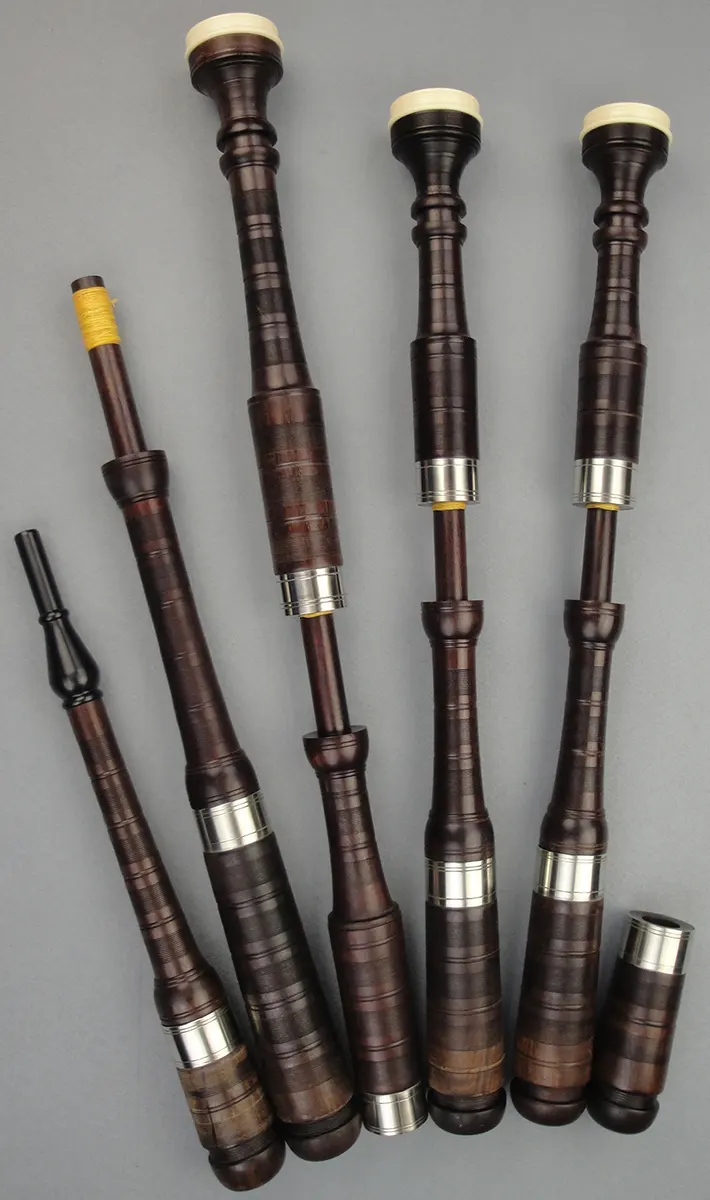
Circa 1950s Lawrie (?), American Rosewood, Nickel and Imitation Ivory Mounts
SOLD – This flat-combed bagpipe is a bit of a puzzle. For all intents and purposes it is a button-mount Lawrie, but the wood may well be Amercian rosewood, and there are no other known Lawries made of this wood. However, it may also be particularly rich-coloured cocobola, which would be more in keeping with pipemaking.
The ferrules are nickel and the ring caps are imitation ivory which replaced orange catalin at some point in the past.
The pipes are in excellent shape, with a full (but not booming) and quite warm tone that locked in nicely with my Kinnaird Edge drone reeds. The pipes are slightly lighter in weight than a blackwood set.
This resilient little number would make an excellent starter pipe, or a work-a-day, foul weather or travel set.
-
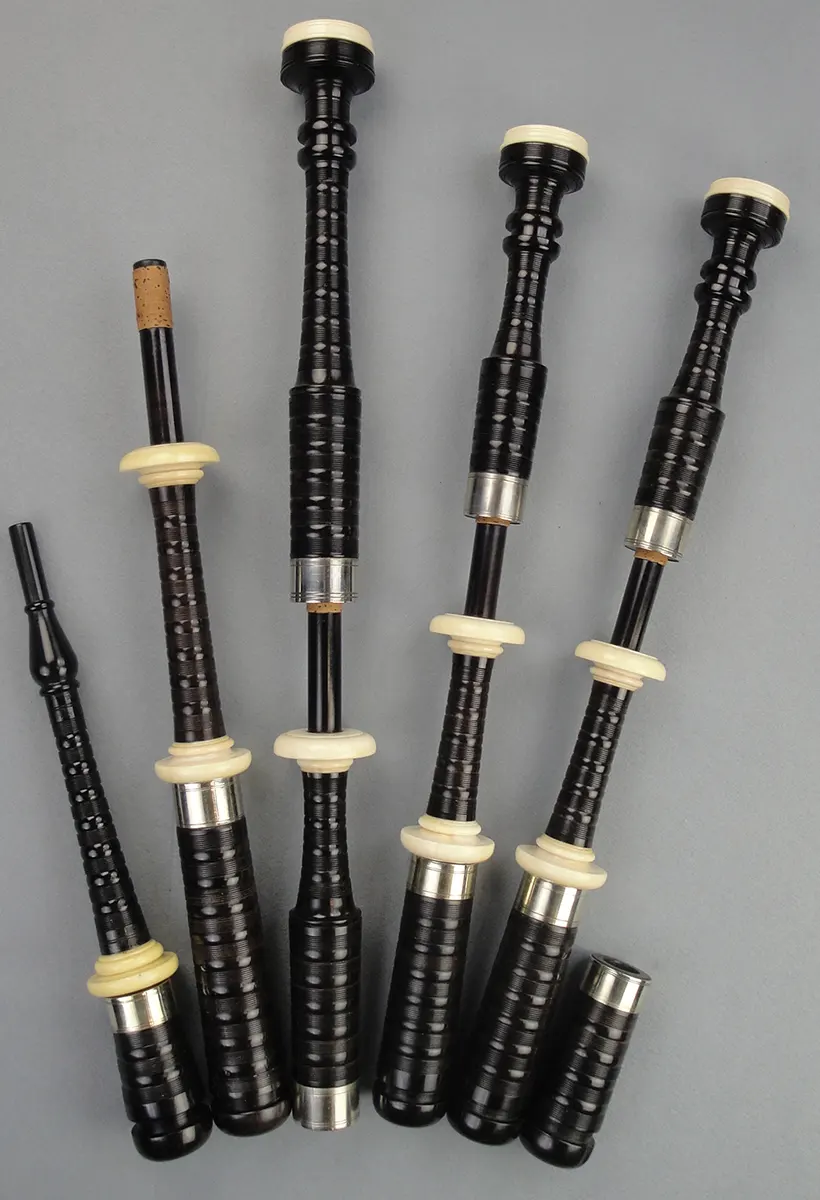
Circa 1930 Henderson, African Blackwood, Nickel and Ivory
SOLD – This old Henderson came to me in spectacular condition. It had been refurbished some years ago and needed no additional work. Profiles suggest a manufacturing date close to either side of 1930, and the exquisite drone tone would confirm that they are from the great Henderson years.
The wood colour suggests cocuswood, and although we can’t be sure without stripping the wood, I believe the pipes are African blackwood.
The tuning pins were recently fitted with cork joints. The fit is absolutely perfect provided a bit of cork grease is applied. Cork grease is provided with the pipes. The sound is robust, seamless, rich and steady as a rock with my Kinnaird Edge drone reeds — what the old Hendersons are renown for.
This set is classic Henderson and would do well on any competition stage in the world, including the major gatherings at Oban or Inverness.