
Working with vintage bagpipes is as much a hobby as a business for me. I enjoy the process of turning up old pipes and making sure they will be played for years to come. I think it is a good thing for piping. As such, I take great care in purchasing, examining and restoring old pipes.

My refurbisher is J. Dunbar Bagpipe Maker in St. Catharines, Ontario. Not only do they do masterful restorations, they have eagle eyes for examining 150-year-old wood and discovering replacement pieces and flaws that should be addressed before you play the pipes. If a set of pipes has a replacement or repaired piece, you will know about it before you buy.
You should know from the get-go that pretty much every bagpipe made before 1930 has required or will require repairs of some sort, especially if they are ebony. Ebony and cocuswood are superb woods from which to make bagpipes but they are less resilient than African blackwood. I suspect there is hardly an ebony bagpipe in the world made before 1920 that hasn’t experienced at least one crack.
Photos and descriptions of all instruments featured since October 2010
-
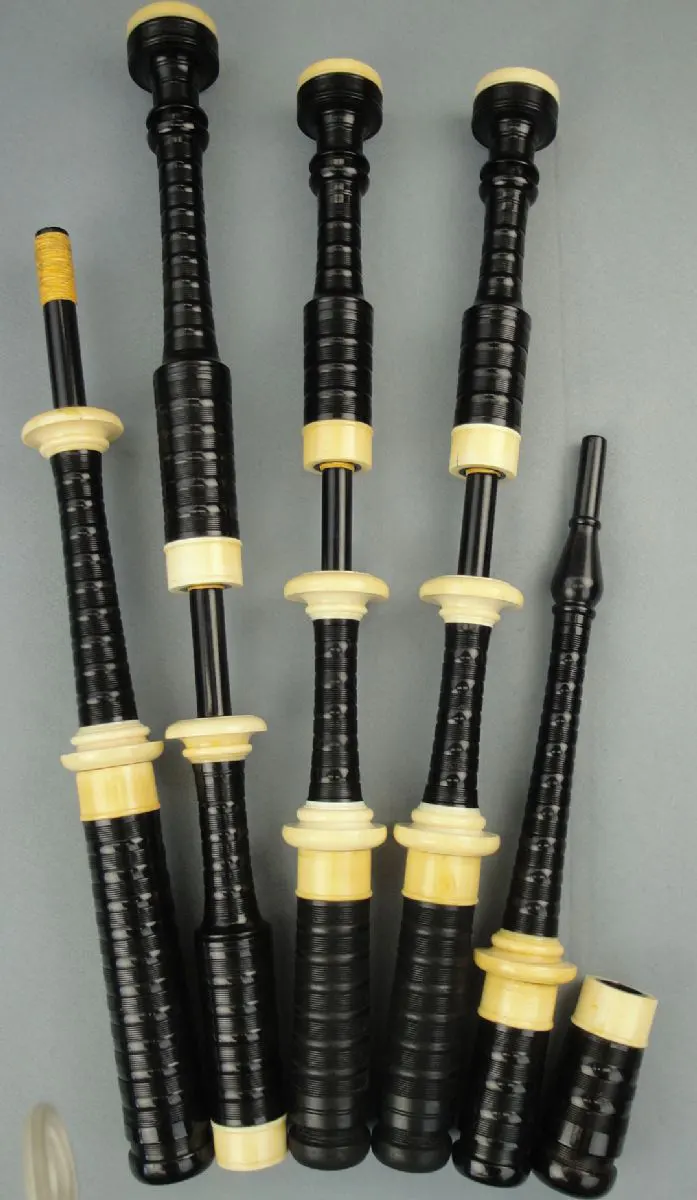
Henderson, Circa 1890s, Ebony, Full Ivory
SOLD – This is one of the older sets of Henderson pipes we’ve had on the site for a while. They likely date to around the 1890s or earlier as suggested by the narrow beading and the much finer bead on the ferrule. The pipes are ebony, with ivory mounts that are in excellent shape except for a couple of rice sized chips.
There are a couple of anomalies with these pipes. The two tenor bottoms appear on closer inspection to be Lawrie pieces rather than Henderson, though the vintage of the pieces looks quite similar to the Henderson. I double-checked my own knowledge of Henderson and Lawrie pipes of that era with Rick Pettigrew, who runs Dunbar Bagpipes and is my refurbisher. He confirmed that back in these days Henderson and Lawrie were making pretty much exactly the same instrument except for cosmetic differences. They were known even to job out to one another.
Rick measured up the two tenor bottoms and they match up perfectly with Henderson tenor bottoms from that era. The bass drone stock and blowpipe look like they may be Lawrie as well through the mounts appear original.
As is usual with ebony that is more than 100 years old there were a couple of cracks that have been invisible whipped and will give no trouble again.
The slight differences in pieces have no detrimental effects on the tone of this instrument, which is classic, refined, bold, seamless Henderson.This is a lovely set for any level of serious piper who would like a vintage bagpipe with character and tone.
-
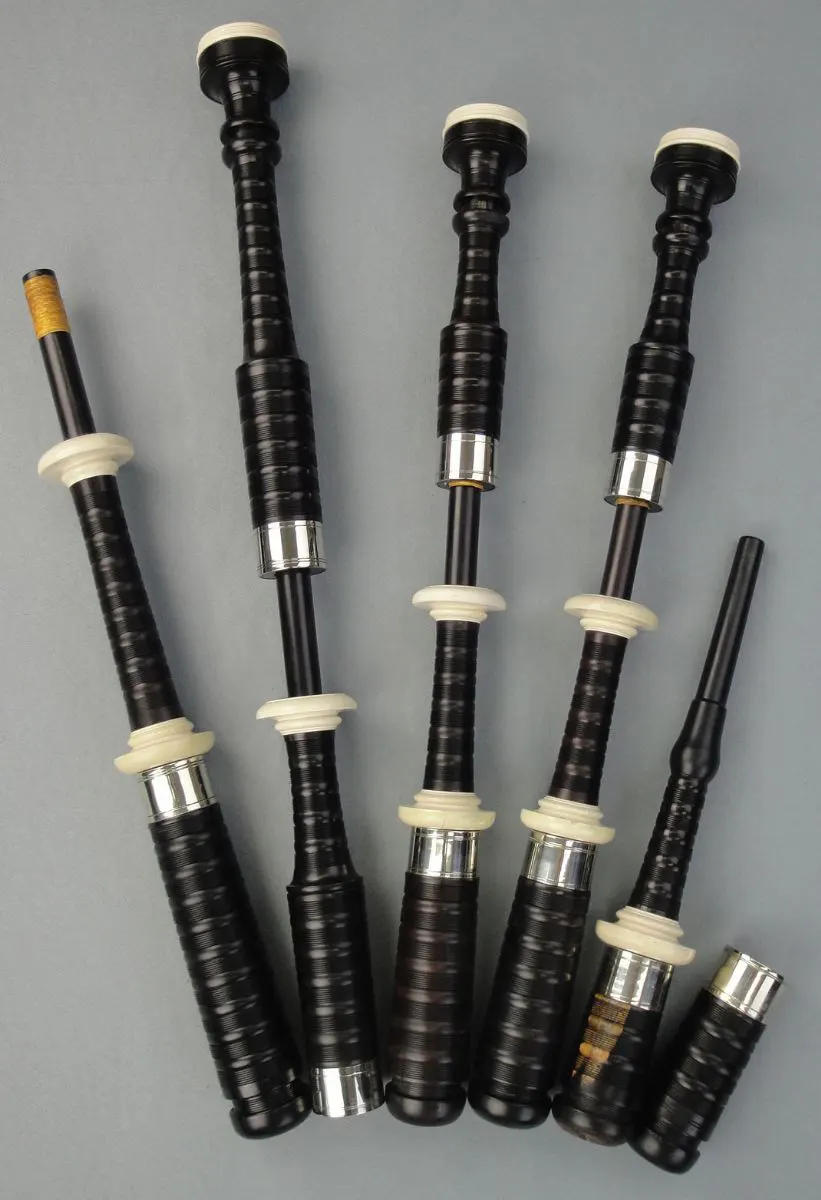
Henderson, WWI, Cocuswood, Nickel and Casein
SOLD – This set of cocuswood Hendersons is tonally exceptional, to the point where I have enjoyed it myself for the past several months, giving my number one bagpipe a rest.
It was likely made in the years around WWI, perhaps a bit earlier. It has nickel ferrules and casein projecting mounts, ring caps and bushes. Unlike the chalky and discoloured casein we often see on old Robertson pipes, this material is white enough to be mistaken for modern imitation ivory. So the pipes are ivory-free and can be transported across borders without a certificate.
One piece of casein has a small brown discolouration on it, and the bead on one projecting mount has a tiny split that has been filled.
The blowstick was too badly cracked to repair so the projecting mount was installed onto a replica polypenco blowpipe.
The cord guides on both tenor drones are stamped “P Henderson.” Although there is no stamp on the bass drone, there is no doubt it is original to the pipes.
I was extremely impressed with the seamless, robust sound of these pipes and their exceptional steadiness.
-
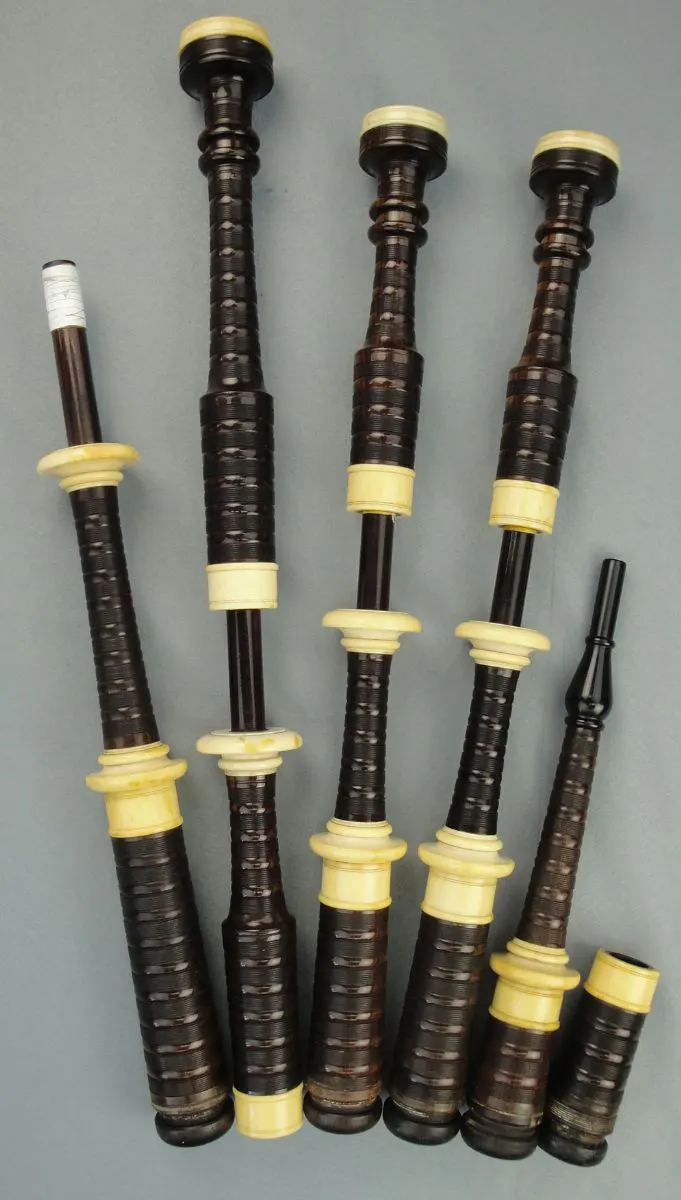
R. U. Brown Hendersons, Cocuswood, Full Ivory, Circa WWI
SOLD – This is one of the most historic and well authenticated bagpipes we have ever had on the Vintage page. Robert Urquhart Brown (aka R. U. Brown, Bob Brown) was one of the great players and piobaireachd authorities of the 20th century. A pupil of John MacDonald of Inverness and one of the famous “Bobs of Balmoral,” he made his living along with Robert Nicol as a gamekeeper and Royal Estate Piper at Balmoral Castle. He and Nicol are immortalized in the “Masters of Piobaireachd” CD series released some years ago. Very few taught as many great pipers as the Bobs.
This set of cocuswood Hendersons was owned by Bob Brown throughout his life and remained in the family afterwards until I purchased them about three years ago. The history of the pipes is documented in a letter written by Bob’s daughter that has been with the pipes since 2002. It reads, in part:
These bagpipes were the first bagpipes owned by my father, the late Pipe Major Robert Urquhart Brown, M.B.E. of Balmoral. He was piper to H.M. King George V, H.M. King George VI and H.M. Queen Elizabeth.
These bagpipes were a gift to him as a boy after winning the first major Piobaireachd competition he entered, which was the Argyllshire Gathering Junior Competition. Thereafter he played them for about 10 years until he won the Inverness Gold Medal Competition in 1928. He was then given a set of silver mounted bagpipes which he played until his death in 1972. These bagpipes have remained with the Brown family since then….
We don’t know if the pipes were new or not when Brown acquired them, but they are certainly WWI or earlier.
I have played this set as my #1 bagpipe for the past three years, not just because it was Bob Brown’s bagpipe, but because it is one of the best sets of Hendersons I have ever played. I always said I would never sell it, but I’ve said that about other amazing instruments I have acquired, and when a new remarkable set comes up (this time a lovely full ivory Donald MacPhee set, circa 1870s) I pass the previous set on and get to know the new one. It’s a pattern I’m sure I will continue. I’m not one to hoard bagpipes.
No repairs were required to this set when I acquired them, and as far as I know the finish is original.
If it looks like it’s been played recently, that’s because it has. I removed the bag minutes before these photos were taken.
-
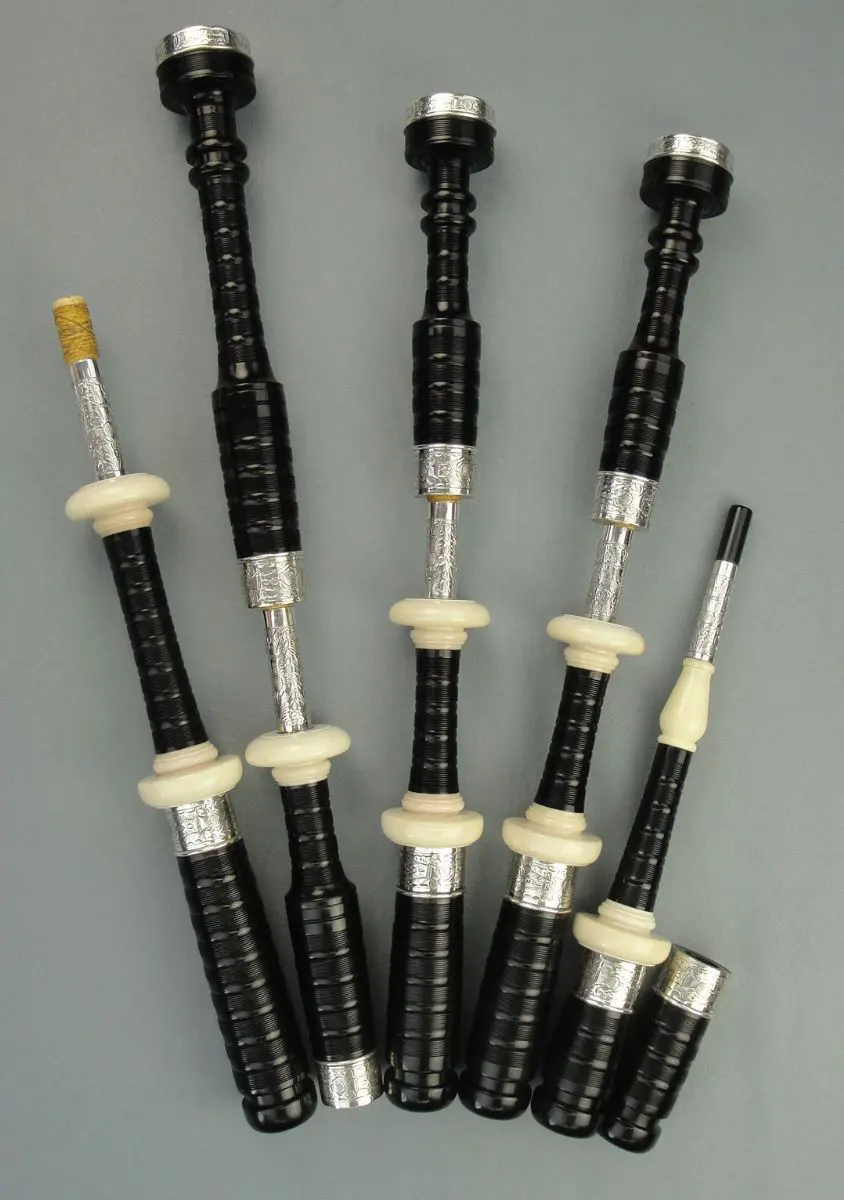
Robertson, Silver and Ivory, Hallmarked 1954-55
SOLD – This stunning set of Robertson pipes, mounted in Sterling silver and ivory, is hallmarked 1954-55.
It is in remarkable condition for a bagpipe made the year I was born — probably better condition than me. All pieces are original except for the mouthpiece bulb, which is new imitation ivory and an excellent match for the ivory on the pipes. The silver mouthpiece sleeve is original. Even the original hemp stops are still present on the four tuning pins.
The pipes were stripped and refinished and required two minor whippings under two of the silver stock ferrules where hairline cracks were just beginning.
I’m always raving about the remarkable consistency of Robertson pipes, both in terms of tone and manufacturing standards. This bagpipe is no exception. The tone is robust and the drones are steady and easy to reed. And the instrument is gorgeous.
This is as nice a Robertson set as we’ve ever had on the Vintage page.
-
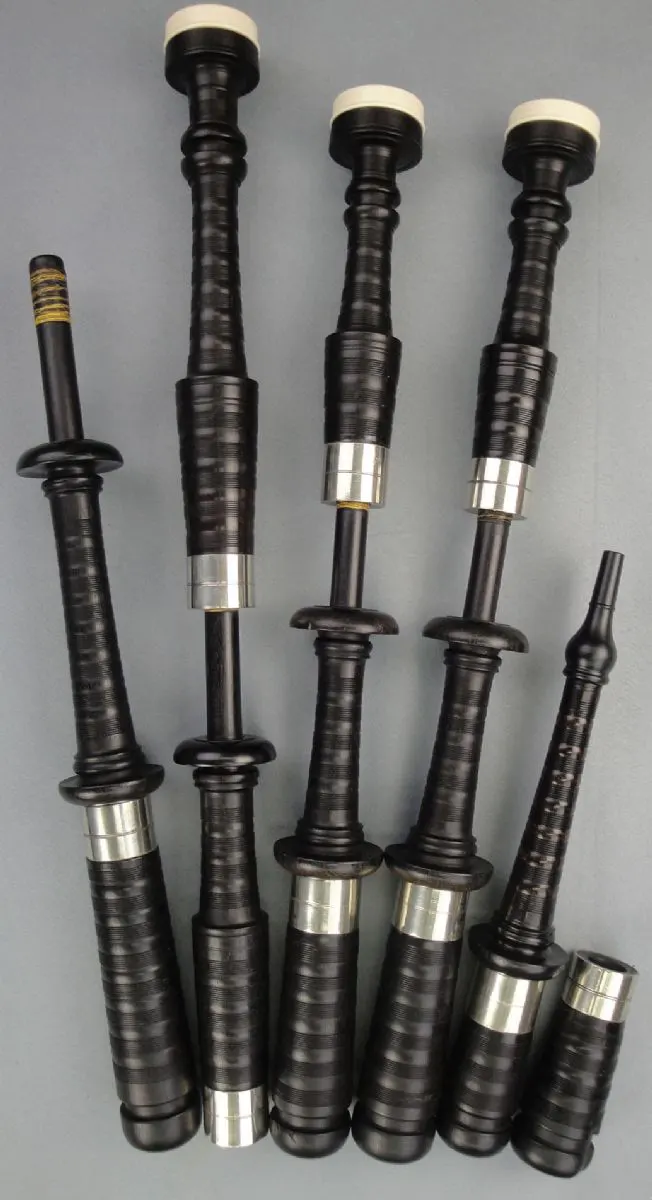
Circa 1920 Robertson, Ebony, Nickel Ferrules, Artificial Ivory Ring Caps
SOLD – James Robertson was one of the most consistent makers ever. All Robertson pipes — even for the 20 years after his passing in 1948 — are superb. However, the sets made from around 1915 until 1925 were close to magical, especially the ebony sets.
This is one of those sets. The robust, rich and vibrant tone and steadiness of this ebony Robertson are absolutely exceptional.
The set originally had chalky casein tops. These have been replaced with artificial ivory that has a remarkably realistic grain. The nickel ferrules with the scribe line around the middle are typical of circa 1920s sets.
All pieces are original. The projecting mounts are ebony. The blowstick had a hairline crack down its length that has been invisible whipped and will give no further trouble. The projecting mount on the bass mid-joint broke in half in transit. This has been replaced by an excellent blackwood replica, virtually undetectable as a replacement.
This is a tonally exceptional set that would be comfortable on any stage.
-
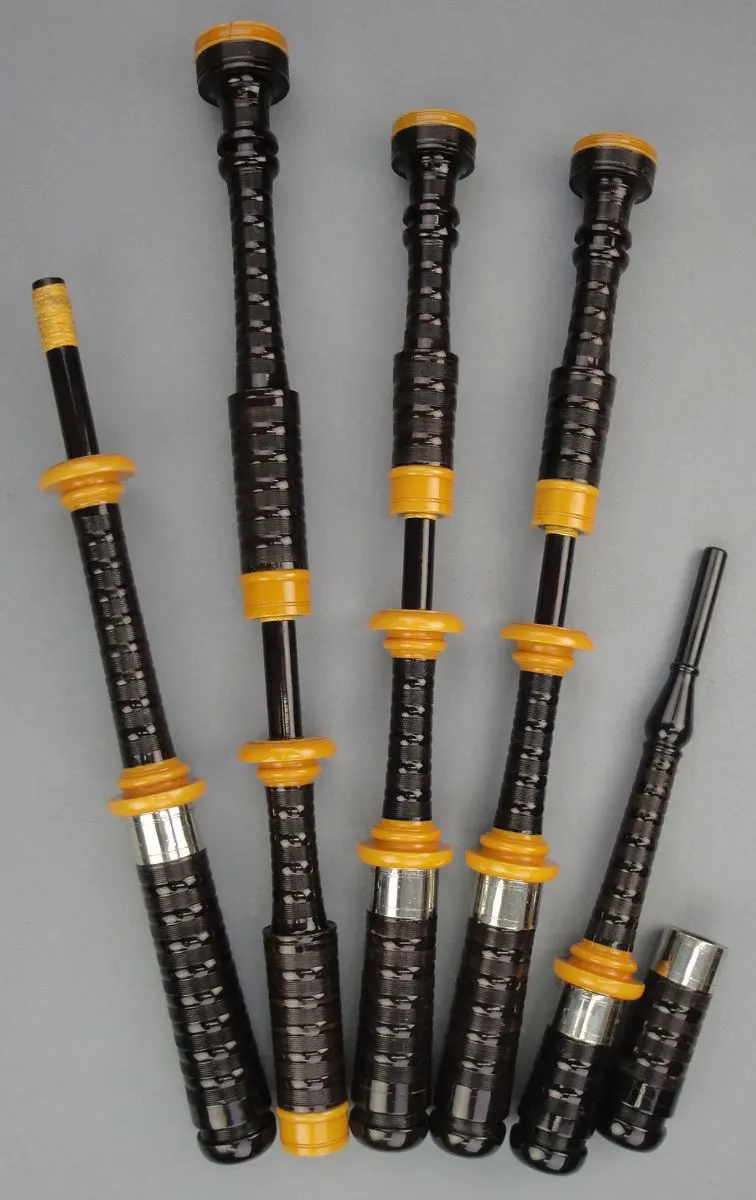
R. G. Hardie, Circa 1960, Blackwood, Full Catalin, Nickel Stock Slides
SOLD – This is not the usual high-end vintage instrument this site is known for, but the set came as an add-on with a high-end set, so here it is, and at a great price.
Made by the R. G. Hardie company, likely around 1960, the set is blackwood, and the drones are mounted in catalin, an artificial ivory material that is resiliant and long-lasting but which turns pumpkin orange as time passes. It is not used any more. The stocks have nickel ferrules
Bob Hardie was one of the most successful bagpipe makers of all time and was renown for the quality of wood he used. I frequently find 70-year-old Hardie sets still crack-free, and with perfectly even tuning chambers. The drones are “mellow,” meaning they are not robust — quiet if you will — but rock steady, air-efficient and easy to reed. As such they are excellent starter sets, or sets for infrequent players who want steadiness and a pleasant hum rather than a booming buzz. The quality of the wood makes them nearly indestructible in any weather.
The finish is original, and as you can see from the photos, it is far from perfect up close. But the idea with this set is to keep the price low, so I have left them as I found them. One repair had to be made: the ring cap on the bass top was broken and had to be glued into place. It wasn’t a perfect fit, but the repair is solid and stable. You can see it in the caps photo.
I’m selling this set as sticks and stocks only, allowing the buyer to install less expensive accessories than I usually stock. However, if you want them set up to play, we can discuss this as well.
-
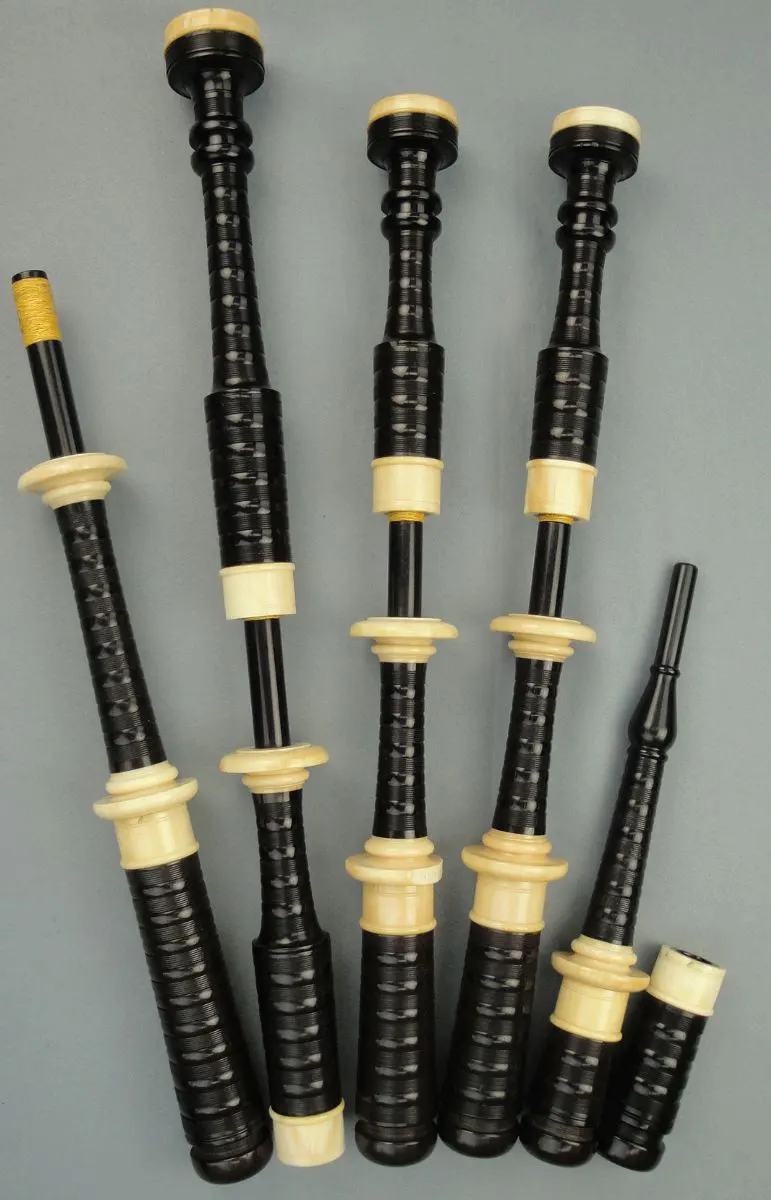
Circa 1920 Hendersons, Ebony, Full Ivory
SOLD – This lovely old Henderson set could be as early as WW1, and plays like a dream — steady, full and seamless in the classic Henderson tradition.
The pipes are in excellent shape with one unfortunate flaw: about 1/4 of the lower projecting mount on one tenor drone has been broken off. This clearly occurred a long time ago as the break is quite clean and worn fairly smooth. That is to say, it is noticeable, but far from obvious.
The wood was in excellent shape for 100-year-old ebony. There was one hairline crack under the ferrule on the chanter stock that has been repaired. A small split in the ivory ferrule on the chanter stock has also been filled. The tone on this set is as good as Hendersons get. The price reflects the flaw described above.
This is an excellent opportunity to get a classic Henderson set at an excellent price.
-
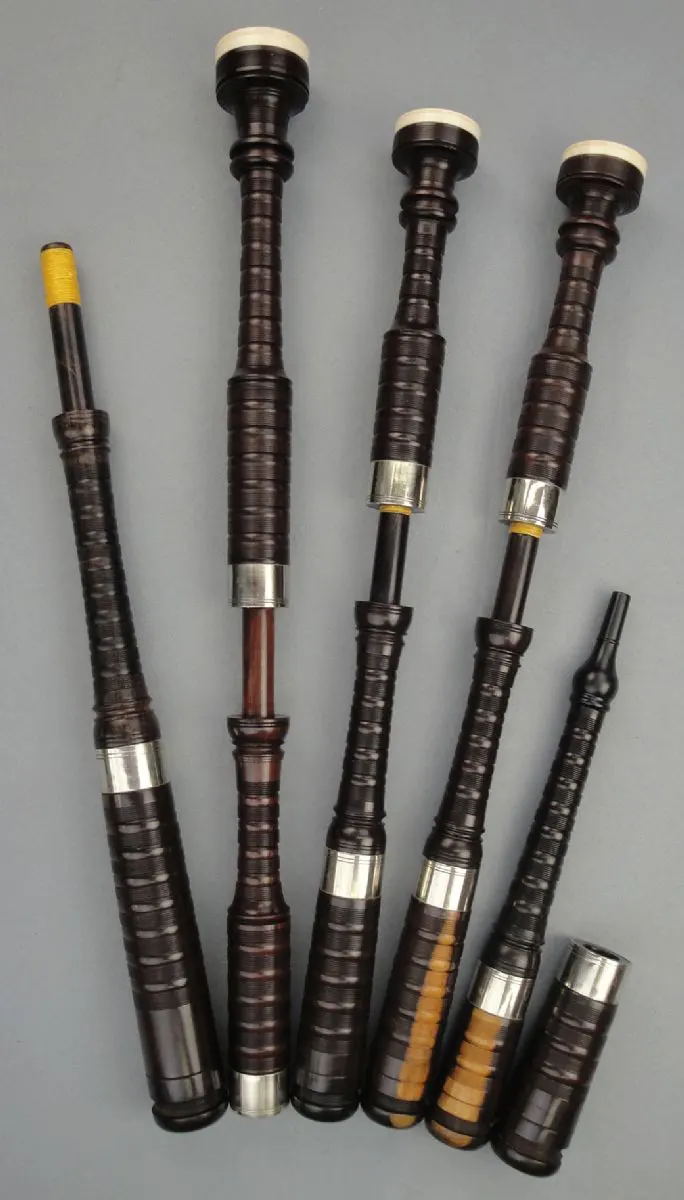
David Glen & Sons, Circa 1910, Cocuswood, Nickel Ferrules, New Imitation Ivory Rings
SOLD – These little button-mount cocuswood David Glen pipes are real gems: great character, rich and rock steady, and very light on the shoulder. This set originally had ivory caps, but they were replaced with artificial ivory with a very realisitc grain.
When I purchased these, it was with all parts original, but the chanter stock is a little ‘stockier’ than the tenor and blowstick stocks, and it is possible that this is an early replacements. Having said that, it appears to be cocuswood.
The pipes are in great shape and were recently stripped and refinished.
The fact that they are free of ivory makes them an idea travel pipe, or, as a good friend of mine calls them, ‘border pipes’!
-
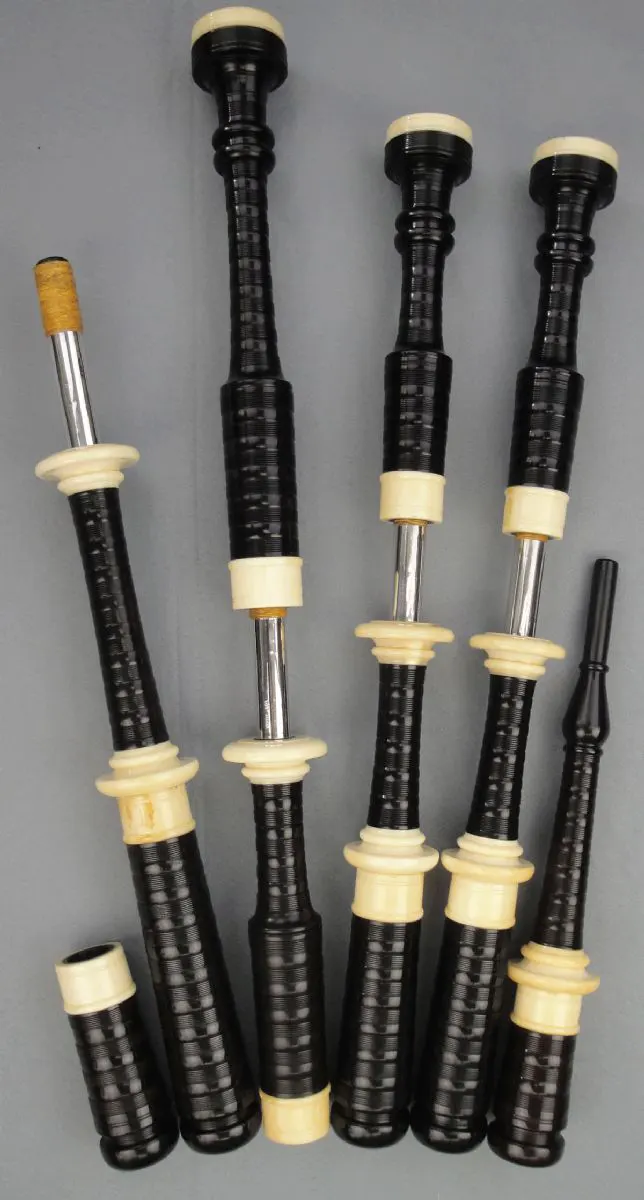
Circa 1900 Ebony Henderson, Ivory with Silver Slides
SOLD – I purchased this gem of a set as having been made in the 1920s, but my trusted refurbishers at Dunbar Bagpipes believe they are much closer to 1900. They are made of ebony, and mounted in ivory. The slides are silver, almost certainly a later addition. They are not hallmarked but but are stamped with two words: STERLING and SAW. If anyone can tell me what this refers to I would be happy to hear from you!
There were a number of hairline cracks here and there, but nothing that was visible until the finish was removed from the pipes. These cracks were easily fixed and should give no trouble again. The blowstick is a blackwood replica with the original mount. The blowstick stock is blackwood, lined with polypenco, made by Dunbar. The pipes have been refinished.
This is the second time I’ve had these pipes. I purchased them back from the previous customer who was downsizing to a less expensive set. The seller from whom I bought them some years ago had originally gotten them from Jim McIntosh in the 1980s.
Tonally, these pipes are top of the line classic Henderson — steady, rich, with a lovely bass and refined harmonics that only ebony can offer.
-
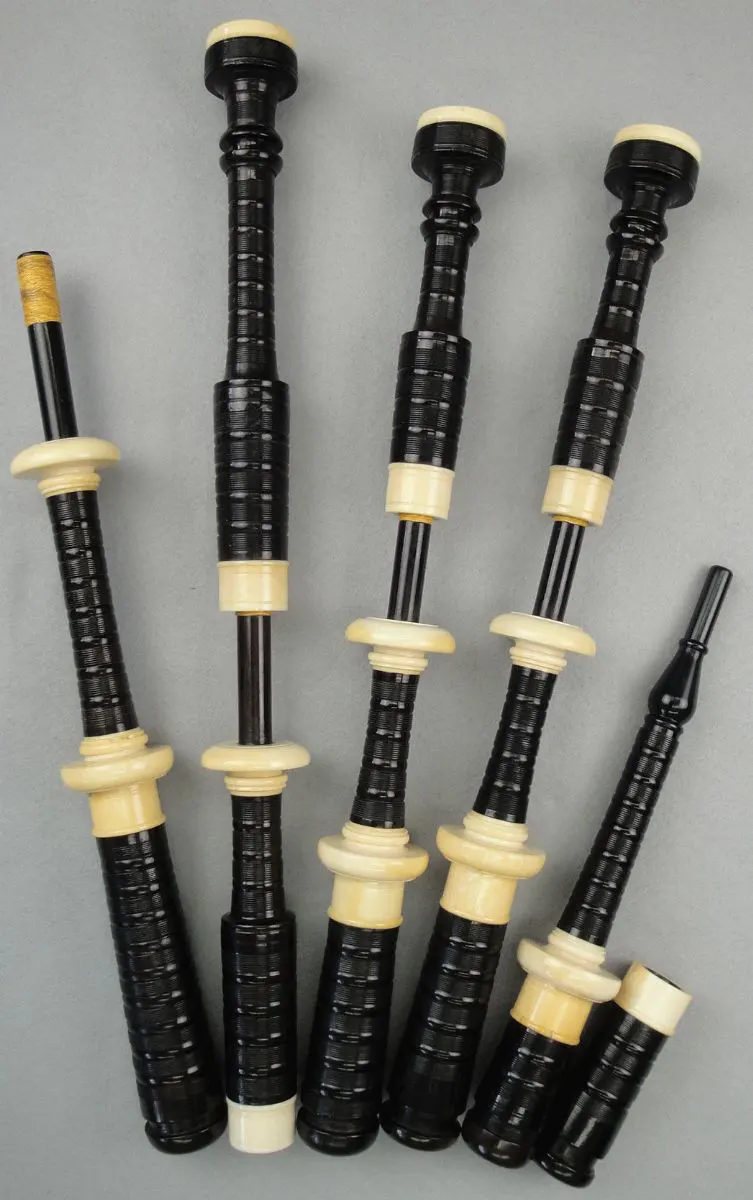
Robertson, Circa 1940, Full Ivory
SOLD – This is a classic James Robertson set made in Edinburgh, most likely in the years around 1940. The set was in excellent shape, needing only the finish polished, the tuning chambers reamed slightly to even them out, and one hairline under the blowstick stock ferrule invisible whipped.
There are some minor anomalies. One tenor drone stock appears not to be original. It is barely noticeable, and only in the combing. I suspect it’s from a different Robertson set. The chanter stock is a perfect match to the rest of the set, except that the ivory ferrule lacks the double scribe-line: again, barely noticeable. The blowstick stock may or may not be a replacement. Again, none of these is visible without very careful examination.
The tone of this set is pure Robertson. He is the most consistent pipemaker I know of tonally. Every single set sounds the same: full, bassy, rich and steady.
-
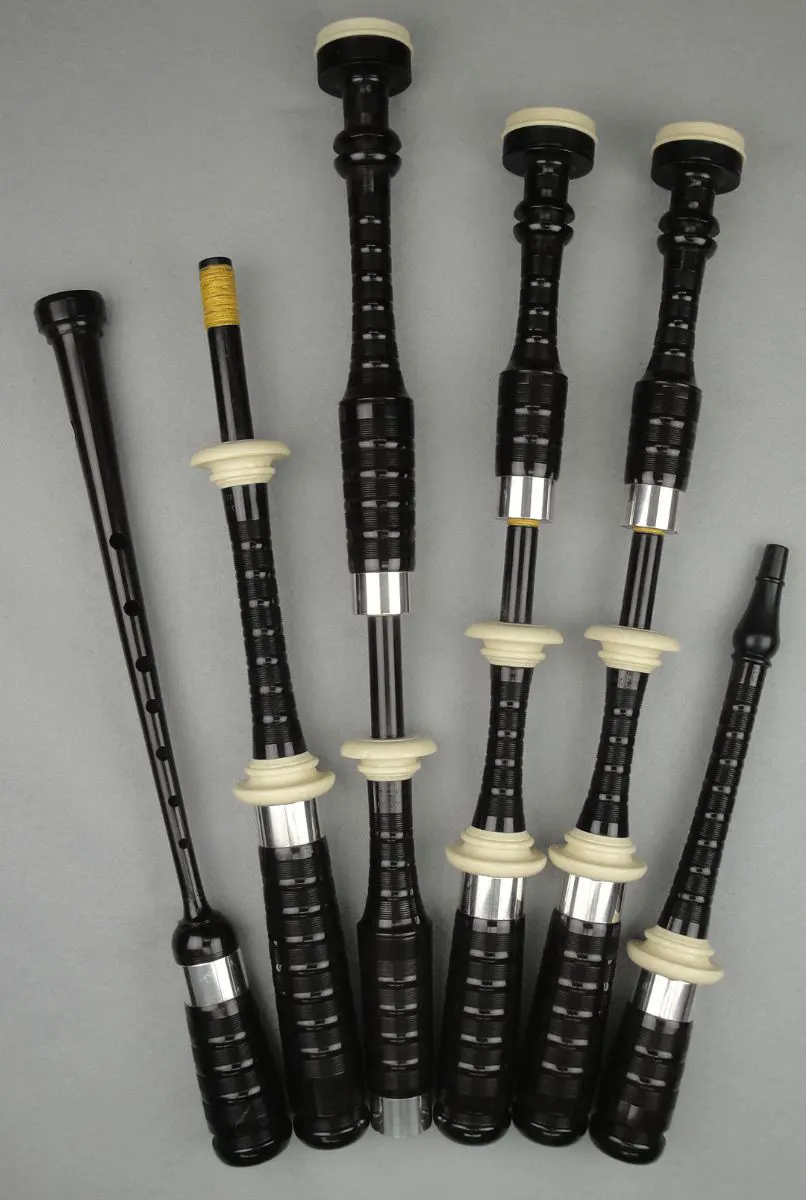
Kron Standard Model, 1998, Blackwood, Plain Sterling Silver, Artificial Ivory
SOLD – This set came to me as a Kron Heritage set made in 2002, but feedback from customer has sent me back to rethink, and I believe now that it is the original Kron model made prior to the Heritage, which was developed in 2001. The chanter, #229, was made in 1998, and I suspect the pipes were made at this time as well.
The pipes were extremely well crafted, and this model was the standard configuration: plain Sterling silver ferrules and artificial ivory projecting mounts and ring caps. The tone is full and steady. This set is in virtually pristine condition, except for one rice-grain sized chip on one projecting mount.
This would be an excellent work-a-day set for a young competitive player, or an attractive, easy-to-reed and trouble-free pipe for a learner of any age. Another of these sets was sold on the site recently, though a later model.
-
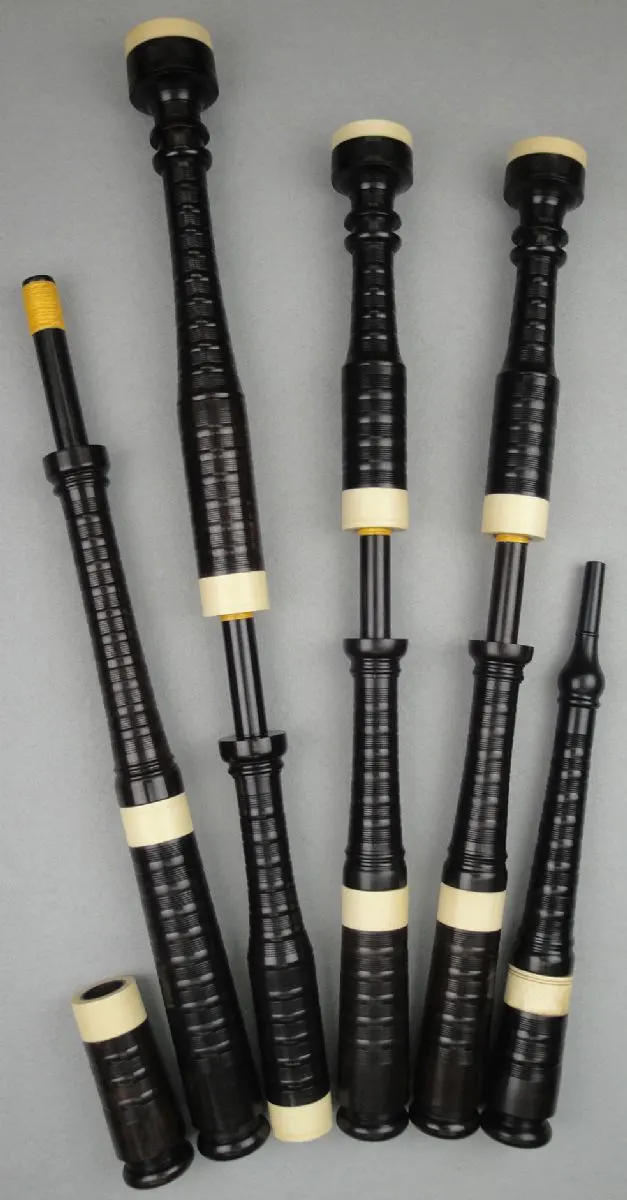
2010 Reproduction Of 1870s J&R Glen, Mcgillivray/Doucet
SOLD – Back around 2008 I acquired a circa 1870s J&R Glen bagpipe in cocuswood with ivory mounts. It was one of the most stunning tonal instruments I’ve owned, and I played it for about three years.
In 2010, I began working with Thomas Doucet in Niagara Falls to create a reproduction. I was thrilled with the result. Most were made out of cocobola, similar in appearance to cocuswood.
We called the instrument, “The Edinburgh,” after the home town of the Glen families.
Only a couple of sets were made out of African blackwood, and this is one of them. The mounts are holly. The pipes were made in 2010 and appearances would suggest they have hardly been played. They look new.
Thomas and I moved on to other projects within a couple of years and production ceased, so only a limited number of The Edinburgh were made.
The robust J&R Glen tone of the 1800s was quite different from the more subdued David Glen pipe. This a bold and vibrant sound more reminiscent of Duncan MacDougall, and very steady. The style also makes them a very lightweight instrument on the shoulder.
I have three of these sets in my high school band and am always pleased with how good they sound and how steady they are. This bagpipe is an affordable little gem.