
Working with vintage bagpipes is as much a hobby as a business for me. I enjoy the process of turning up old pipes and making sure they will be played for years to come. I think it is a good thing for piping. As such, I take great care in purchasing, examining and restoring old pipes.

My refurbisher is J. Dunbar Bagpipe Maker in St. Catharines, Ontario. Not only do they do masterful restorations, they have eagle eyes for examining 150-year-old wood and discovering replacement pieces and flaws that should be addressed before you play the pipes. If a set of pipes has a replacement or repaired piece, you will know about it before you buy.
You should know from the get-go that pretty much every bagpipe made before 1930 has required or will require repairs of some sort, especially if they are ebony. Ebony and cocuswood are superb woods from which to make bagpipes but they are less resilient than African blackwood. I suspect there is hardly an ebony bagpipe in the world made before 1920 that hasn’t experienced at least one crack.
Photos and descriptions of all instruments featured since October 2010
-
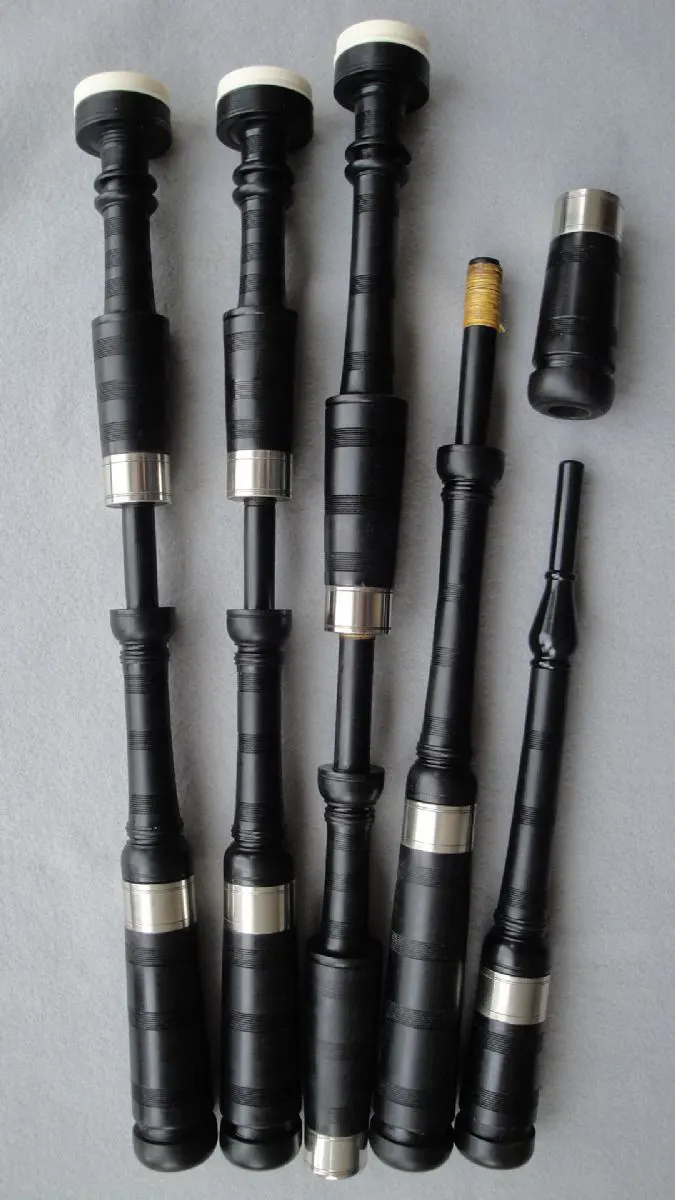
Ebony Roberstons, Nickel, Ivory, Circa 1920s
SOLD – James Robertson’s pipemaking exhibits a quality of wood and craftsmanship almost unequalled from the 1920s to the 1950s. This flat-combed set is made in ebony, allowing his Henderson-like tonal qualities and steadiness to shine through in what was at the time one of his lower-end models.
All wood pieces are original. The drone caps were originally chalky old casein, but these have just been replaced with elephant ivory from an ornamental tusk from the 1950s. Two ferrules which have been replaced with period matches. Tiny cracks under two ferrules have been lightly whipped and covered by the ferrules. Invisible whipping has been performed on one combing section on one tenor top.
Ebony is tonally superior to blackwood and produces a richness and steadiness blackwood cannot equal. These ebony Robertsons are a great choice for someone on a budget looking for a big, classic tone that would fare well at any level of piping.
-

Robertson, Circa 1930s, Blackwood/Ebony Mix, Full Ivory Mounted
SOLD – This stunning set of full-ivory Robertsons is difficult to date precisely because Robertson design standards were very consistent over a long period of time. But the appearance of the ivory combined with the mix of blackwood and ebony parts suggests the 1930s era when the firm was moving away from ebony.
All pieces are original. One possible hairline crack was detected in the bass mid-joint and sealed. It is completely invisible. The ivory has some small chips, and the bottom ferrule on one tenor has a larger chip that has been polished and does not stand out. The entire set has been refinished.
When the pipes were acquired, some of the combing on two of the drone bottoms just above the ferrule was badly torn, suggesting that someone had used a pair of pliers to remove the stuck pieces from the stocks. This has been completely repaired and the repair is not evident.
The stock bottoms on this set are flared, a trait of many earlier Robertsons and 19th century makers. The flaring is thought by many to enhance drone sound.
The set is as stunning tonally as it is visually — a big sound, solid bass, and they lock into tune beautifully.
The ivory-soled chanter appears to be original to the set.
The set came to the Detroit area from Scotland when its then-owner immigrated in 1952 and was played for many years in the Essex Scottish Pipe Band. The same owner used them to pipe John F. Kennedy onto a platform at an outdoor presidential election rally in Detroit in 1960.
-
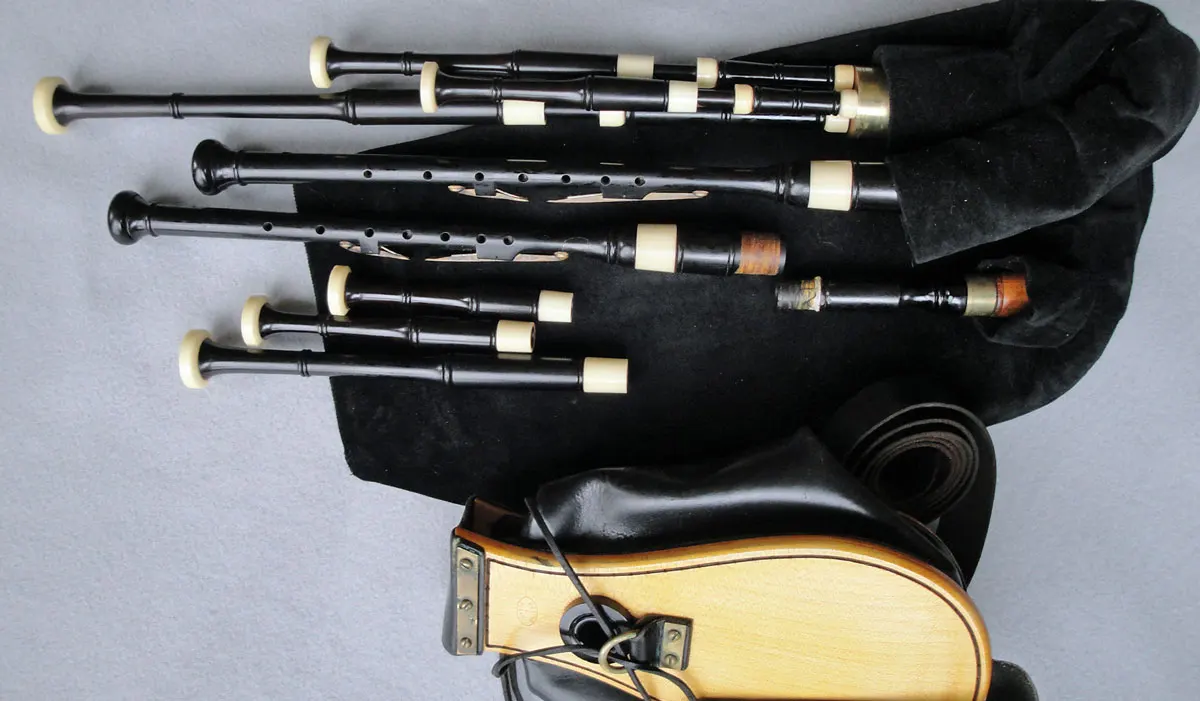
Heriot & Allan Scottish Smallpipes, Combo C/D Set, Blackwood, Imitiation Ivory, Brass
SOLD – Heriot & Allan was the firm name for Robbie Greenstit and his wife Anne Sessoms, who made superb Northumbrian and Scottish smallpipes from the 1970s to just into the turn of this century. This set of Scottish smallpipes was made in 1989, according to a stamp found on the common stock.
The set is designed to play in the keys of C and D. The key of D is excellent for playing with other instruments — fiddles, guitar, keyboards. While D smallpipe chanters can be very small to finger, Robbie used angled holes to produce one of the most comfortable D spacings in the business. The key of C is the loveliest solo pitch, and is also used to play with singers. The chanters are fitted with two keys which open two more holes. In Highland pipe terminology, the two added notes are C-natural (between B and C) and high B (above high A). Each chanter is equipped with its own stock, which plugs into a bag stock, so the chanter reeds need never be exposed. These two chanters will not play with the same set of drones, so the set comes with a second set of drone tops which can easily be switched in when you change chanters.
The pipes are very well made, stylish and attractive, and very sweet sounding. The chanter reeds are made by Colin Ross, the drone reeds a mix of the original Heriot & Allan bass and tenor, and an Evans baritone. The pipes are reeded to be efficient and easy-blowing. Heriot & Allan owners speak highly of their instruments and their sweet, smooth tone.
-

The “Culloden” Bagpipe, Laburnum, Mounted in Bone, Nickel
SOLD – If there has ever been a ‘collector’s item’ offered on this site, this is it.
These bagpipes had initially been attributed to John Ban MacKenzie by a reputable authority; however, Jeannie Campbell at the College of Piping recently indicated that she believes they are much older. Jeannie acknowledges specific similarities between this bagpipe and their own Culloden bagpipe. Authorities believe that the Culloden bagpipe predates the battle by about 50 years, meaning that it was probably made in the late 1600s or very early 1700s. Jeannie believes that this bagpipe probably dates from around the time of the battle, being 1746.
The pipes are made of laburnum, which grows in Scotland and was frequently used to make pipes prior to the 1840s. The mounts are bone and nickel, the latter certainly a later addition. There is a cord guide turned into the bass middle – a common trait in early bagpipes. The pipes have certainly been refinished at some point, and the bone has probably been re-polished. They are in stunning condition.
The history of the pipes is impossible to authenticate. Was this pipe being played before the time of Bonnie Prince Charlie and the historic battle on Culloden Moors? More than one vintage expert has suggested that they may in fact be a pre-Victorian reproduction of a Culloden bagpipe. Even if that is the case, that likely makes them 175-200 years old – and perhaps much, much older.
Being laburnum, the pipes are very light in weight. The tone is smooth, and very mellow – just about the volume of a David Glen set, but not quite as buzzy. They tune fairly low on the pins, as one might expect from an instrument made when bagpipe pitch was much lower than it is today.
Whether you want to buy it or not, it’s a remarkable specimen to see and play, and I’m pleased and proud to have had the opportunity.
-
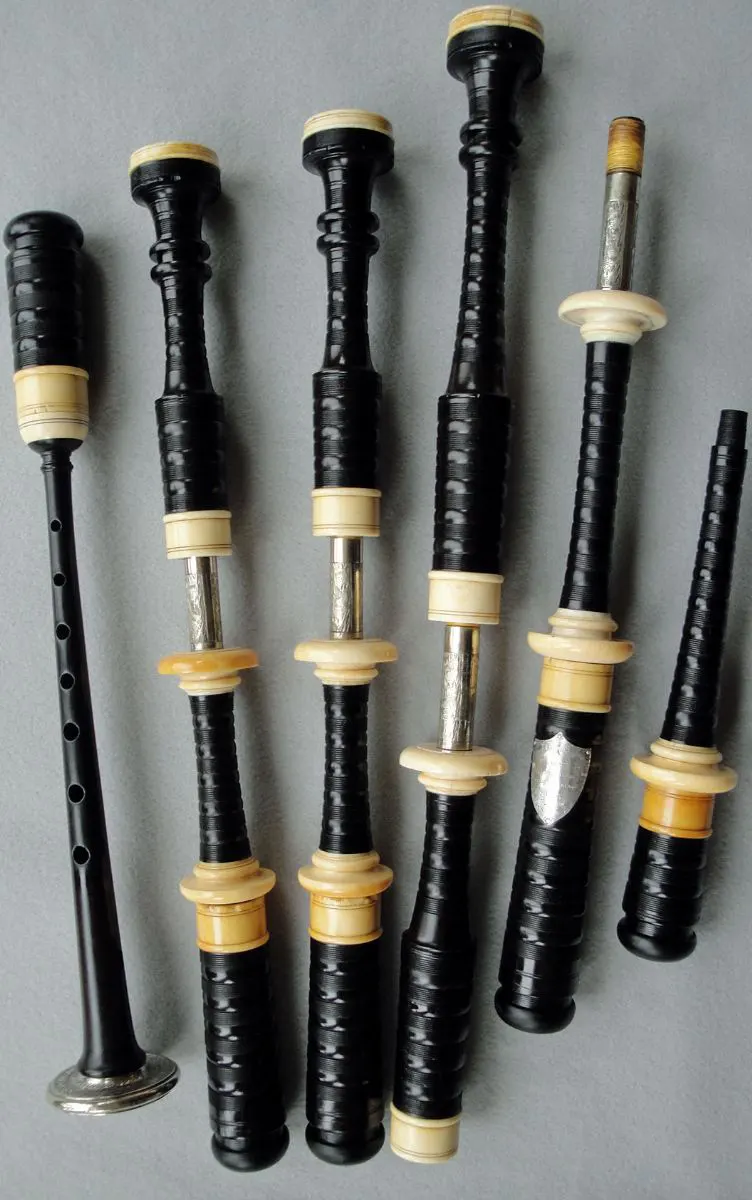
Lawries, Circa 1905, Ebony, Ivory, with Engraved Silver Slides
SOLD – Here is a classic set of ebony Lawries which were tentatively dated by the previous owner as 1905. While there was no firm evidence for this date, the patina of the ivory, the worn silver and the thick, well worn chanter all suggest that 1890s-1910 is almost certainly the correct range.
The pipes were refinished some years ago, at which time some minor cracks in the ivory were filled. All pieces are original. The ivory has normal age-staining and is in good shape, but for a number of chips in the tops of the ferrules on the tenor stocks.
The silver pattern is lovely, but there are no hallmarks. The chanter is almost certainly original to the pipes and features not only an incredible silver sole, but a lovely ivory bulb as well.
The shield on the bass drone stock was designed in an old style, but was in fact added by the previous owner once he determined the age and make of the pipes. It is quite a tasteful addition and could easily pass for original.
There are no cracks or repairs to the wood. The pipes play a huge Lawrie/Henderson sound: very rich and steady, like a wall of sound behind the chanter.
This is really a lovely bagpipe, and the silver slides set the ivory off nicely. Tonally, this is a first-class instrument and would suit competitors right up to Gold Medal level.
-
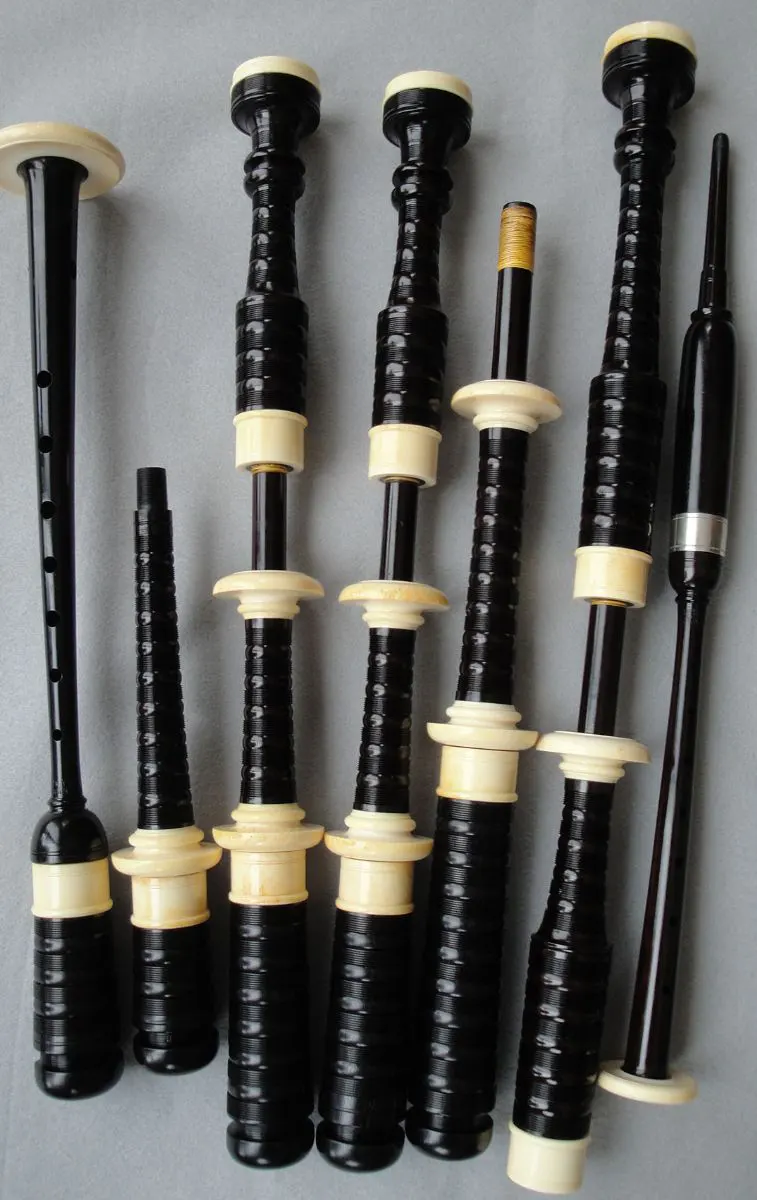
Henderson 1936, Mint, with Original Chanter and Practice Chanter, Shipping Labels
SOLD -This set of blackwood, full-ivory mounted Hendersons comes as close to being authenticated as 1936 as can be without an actual date stamp on the drones. The set came in its original shipping box, addressed to the owner, return addressed Peter Henderson, postmarked 1936. The box was padded with 1936 newspapers. It also contained a brand new Willie Ross-edited Logan’s Tutor printed in 1936. The box was crumbling and the bag was literally rotted, but the parts of the box showing the shipping and postmarking information was kept and will go with the pipes.
The pipes look liked they were used minimally. The stocks were marked with some residue and had to be stripped and refinished, but the finish on the rest of the pipes has not been touched. The original Henderson practice chanter is showing some wear on the mouthpiece. But the pipe chanter is literally brand-spanking new and plays beautifully.
The ivory has some staining, some of which is visible in the pictures. This is the result of the pipes laying unused in the box in one position for decades, perhaps the result of some moisture on the bag. Such staining can be turned down on a lathe without too much difficulty, but I prefer to leave an original gem like this as it is.
The pipes display the big Henderson sound, played steadily with the first set of drone reeds put in them, tuned right where they should, and held nicely for 25 minutes. As a piping friend who was listening said when I was finished, “Yup, those are Hendersons.”
-
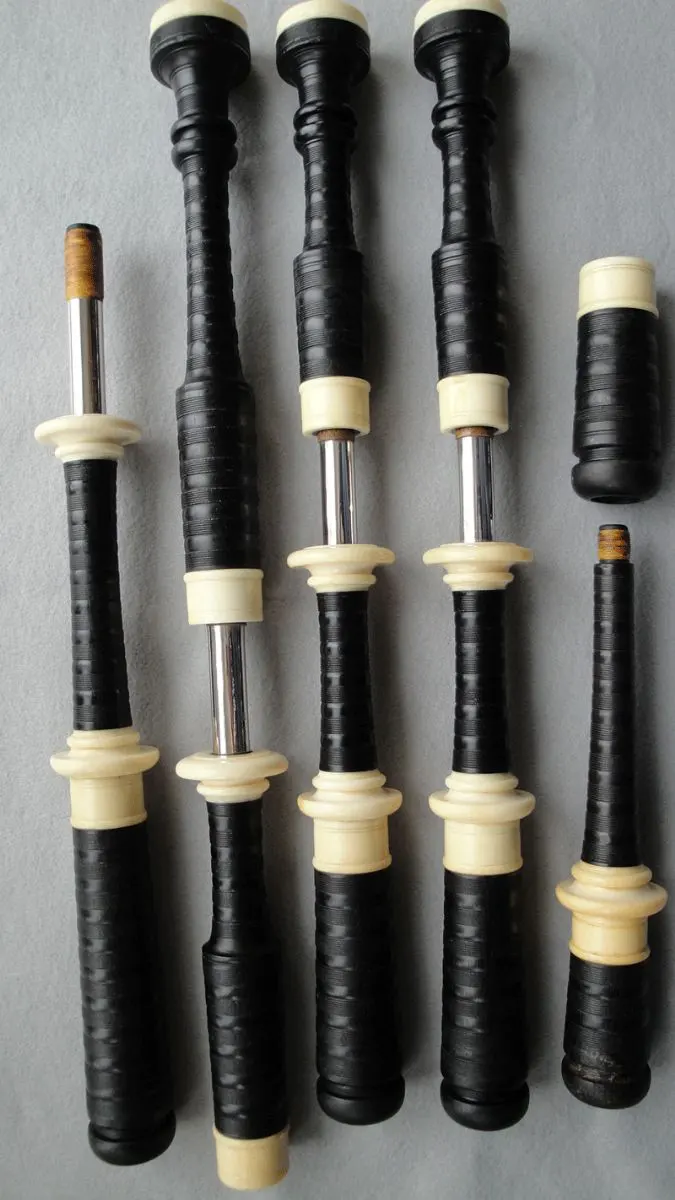
Hendersons, Circa 1900, Ebony, Full Ivory with Plain Sterling Silver Slides
SOLD – This set of Hendersons is thought to date from around the turn of the last century. It is ebony, fully mounted in immaculate ivory, and has plain silver slides that were added at a later date. The pipes play beautifully – a full, rich, steady Henderson sound with great chanter blend. All pieces are original, except for the blowpipe stock which was missing, and has been replaced with a poly-lined blackwood stock and a matching ivory mount.
There are two surface cracks in the drones. One, in a tenor top, appeared 16 years ago, was glued, and has never moved since. The other, barely visible, was in the bass top when the pipes were purchased 25 years ago from Jim McIntosh, and it has never moved. Another crack in the chanter stock, though not right through, appeared a bit threatening and has been invisible-whipped. The pipes have been played regularly in Ontario’s extreme climate for 25 years.
This is really a lovely bagpipe, and the silver slides set the ivory off nicely. Tonally, this is a first-class instrument and would suit competitors right up to Gold Medal level.
-
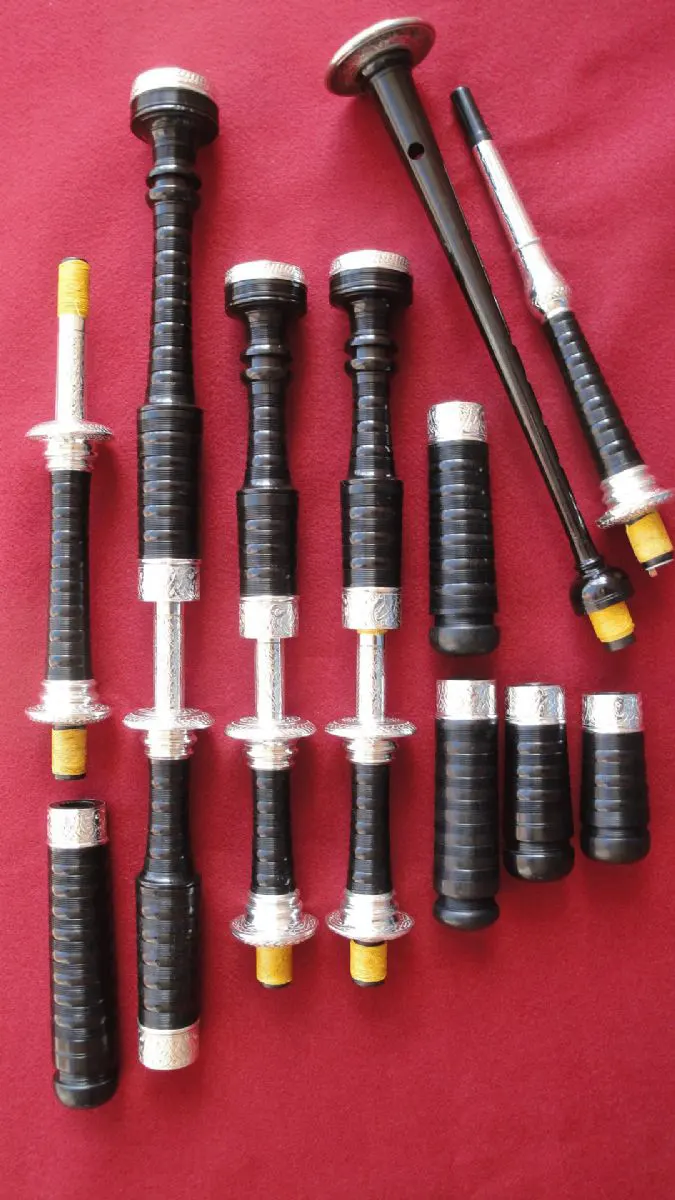
Full Silver Hendersons, Circa 1920
SOLD – This is a spectacular set of full-silver Henderson pipes dating from sometime around 1920. It’s an unusual set in that the hallmark on the chanter sole is dated 1908, on the ferrules 1920, and on the projecting mounts 1923-24. So the 1920 date of the pipes is really a guesstimate based on the varying age of the hallmarks. It’s possible that pipes are earlier and the silver added later.
The silver is almost certainly not factory-installed. The drones are all original, and it appears that the tenor stocks are older replacements. The blowstick stock was cracked and has been replaced with a new, poly-lined blackwood stock. All of the wood has been refinished.
A flaw on the pipes is shown in the last two photos below: the bottom of the lower projecting mount on one tenor bottom has been dented in fairly substantially. However, as the photos show, it is visible only when you turn the drone bottom up to look at it. It is not otherwise apparent, and it was some time after I acquired the pipes that I discovered this blemish. There are a number of other quite minor bumps on the silver typical of a full silver set of this age.
The projecting mounts on this set are hollow, so the pipes are much lighter than most comparable full-silvers. As the photos show, the silver is textured and elaborate: it is very ornate and pristine.
The sticks themselves run true and straight, and the tone of the drones is classic full and steady with the expected rich Henderson bass.
The silver sole is currently installed on a circa 1960s Hardie chanter. The original Henderson chanter without a sole is still with the pipes.
-
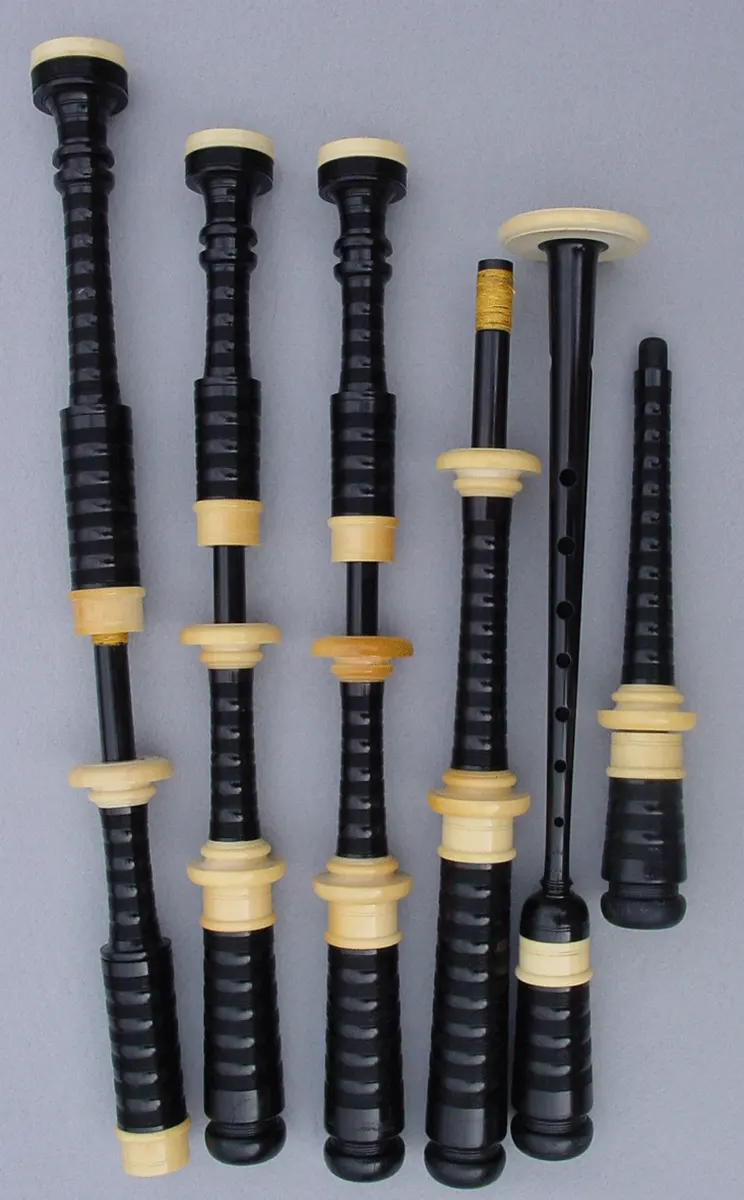
1956 Full Ivory Mounted Hardie, with Original Chanter
SOLD – The great Bob Hardie was one of the most successful pipemakers and pipe majors ever, and this is a set from the prime of his career. They had only one owner who purchased them new in 1956 from Bob’s Glasgow shop.
When I acquired this set I had them shipped from the original owner’s grand daughter directly to my refurbisher. He took one look and sent them straight to me, saying that aside from some staining on several of the ivory pieces like the tenor mounts shown in the photos, the pipes look like they were transported by time machine from 1956 to the present. Mint condition.
Hardie pipes are often described as producing a “mellow” drone sound, not as subdued as the old David Glen pipes, but not robust like Hendersons. They are extremely steady, with a good, solid bass sound. The trueness of the tuning chambers usually found in these older Hardies is a testament to Bob Hardie’s commitment to prime, well seasoned blackwood.
The pipes come with the original Hardie pipe chanter from 1956, one of the most popular, versatile and best loved chanters of all time.
-
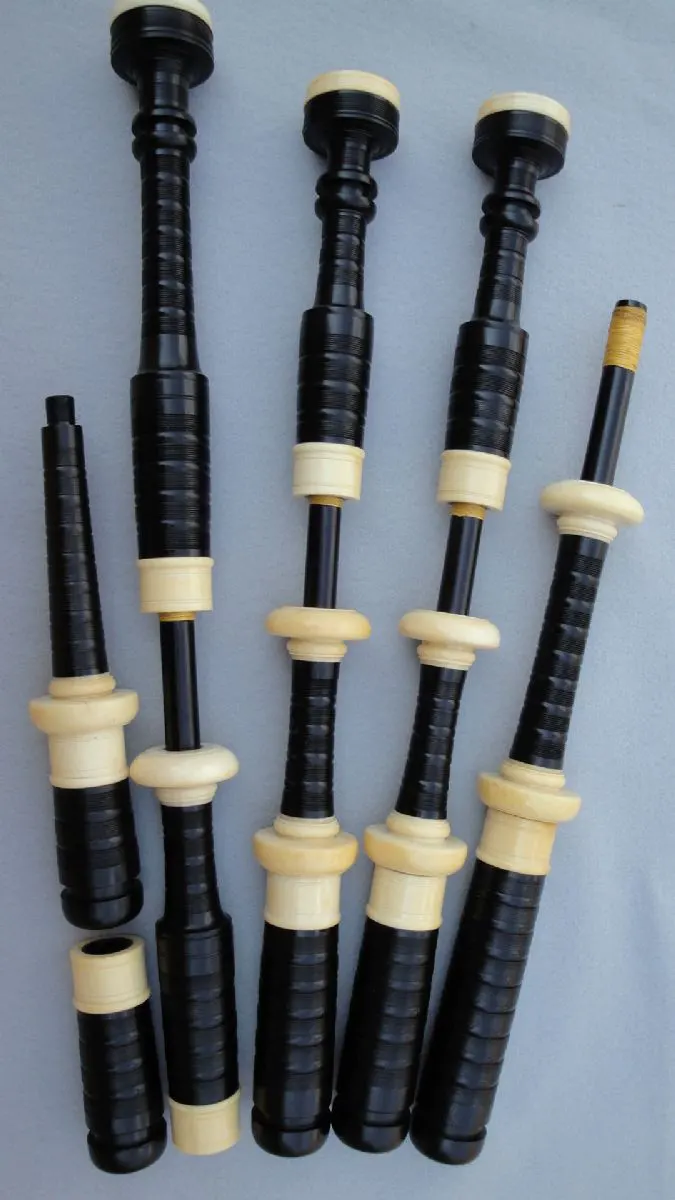
Robertson, Full Ivory, 1941
SOLD – James Robertson set a high standard for pipemaking throughout his long career, and pipemakers without exception speak in reverential terms about his craftsmanship. His design and manufacturing standards were so consistent that it can be difficult to attach dates to his pipes. However, this set at one time had a bill of sale that dated them 1941, though the previous owner (only the second in the life of the instrument) has since lost it.
This set is blackwood, fully mounted in ivory, and shows James Robertson’s unmistakable mushroom-shaped projecting mounts and his characteristic scribe lines and beads on the ferrules. They are in pristine condition after refinishing, though the original blowstick has been replaced with a new delrin-lined blackwood one (original mount). Some of the mounts have some slight staining.
The set is classic Robertson – a full, rich sound and very steady.
-
Circa 1890s David Glen, Cocuswood, Full Ivory, Brass Slides, Stamped
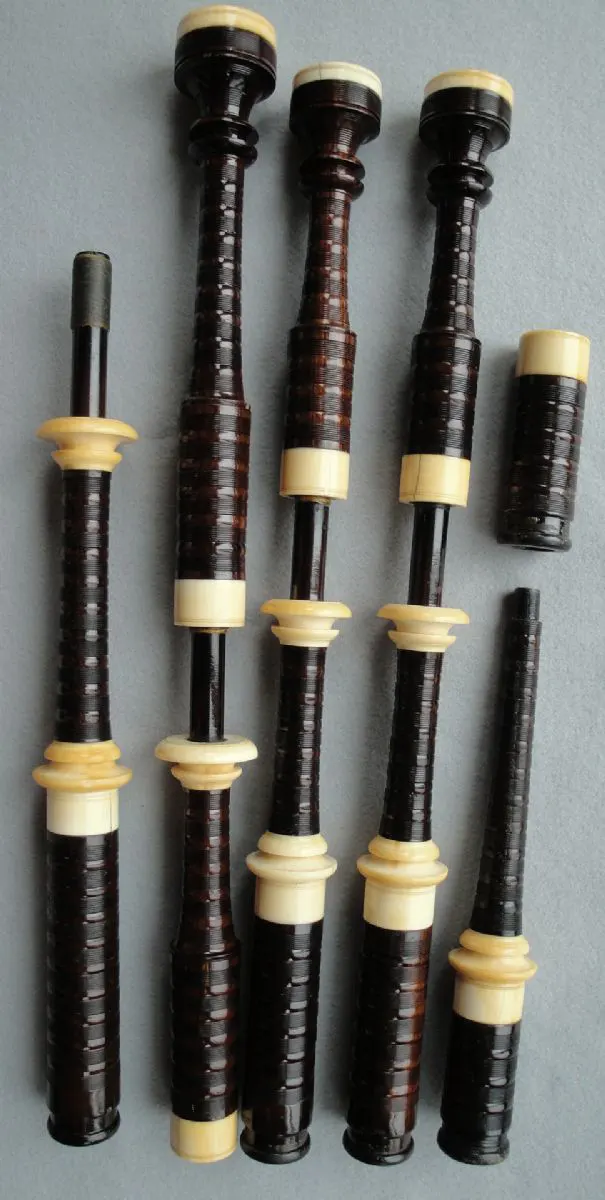
SOLD – Full ivory David Glen pipes are not common. These sticks are cocuswood – David Glen’s favourite wood. The previous owner of this pipe lived in a dry climate in the US, and after he acquired the instrument several of the ivory ferrules cracked. He worked with an ivory conservator and made quite expert repairs that have held firmly now for many years.
The bass drone stock and the blowpipe also cracked. He inserted a marine glue that remains malleable after it dries, and these repairs have never moved. He also inserted a thin brass tube into the blowstick to further reinforce it. The repairs are visible, but not obvious, and since they have remained stable for decades they have not been altered.
The tuning chambers have brass slides, a fairly common practice for David Glen.
The David Glen stamp is barely visible on each of the tuning pins.
Glen was a meticulous craftsman, and his manufacturing standards were very consistent. As a result, it can be difficult to date his pipes. The age of the ivory and the fact that these pipes are cocuswood suggest that they were made prior to 1900.
David Glen drones are really a treat, and if you’re looking for a reliable and remarkably steady set of drones with a rich, buzzy, but not overwhelming tone, you can’t go wrong with them. They are easy to reed and blend superbly with the chanter. It’s a bright, cheerful drone sound.
These pipes required no additional restoration work. They spent several days in an almond oil bath.
-
Thow 3/4 Set in Ebony, 1920s, Nickel Ferrules, Ivory Ring Caps
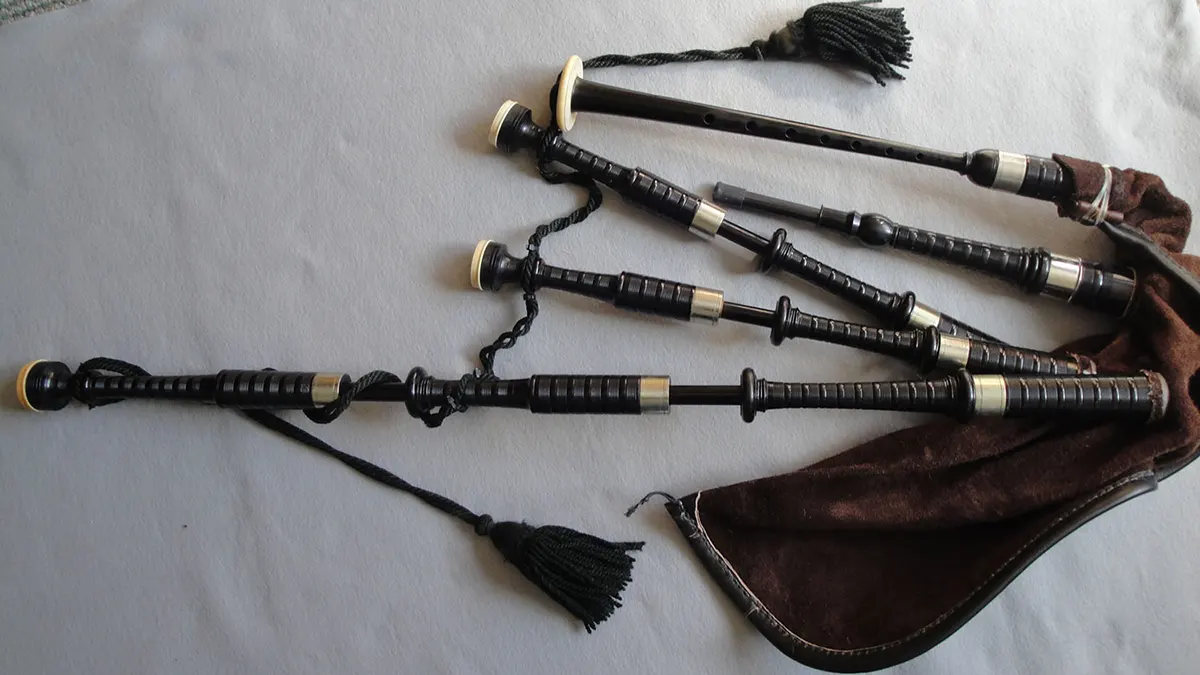
SOLD – Thow made pipes out of Dundee from 1853-1953, and though not common, Thow pipes from the early 1900s are highly respected. The date of this set is unknown, though the patina of the ivory might suggest the 1920s. It is difficult to tell if they are blackwood or ebony, but they appear to be ebony.
The set is almost complete, including a superb, stamped chanter that plays close to Bb. There is no original blowstick or stock. Instead, the set has a regular-sized poly blowstick stock with a nickel mount, and a large-bore poly blowstick.
The ferrules are nickel and the ring caps and chanter sole are ivory.
The set comes with cane reeds that go very nicely, though a set of Ezeedrone 3/4 drone reeds are available for an extra $95. The pipes are equipped with a regular-sized hide bag in excellent shape. It also comes with what is likely its original wooden case.
The set plays beautifully at around Bb with a nice, easy reed. Great set for a child or as a ceilidh or indoor instrument.