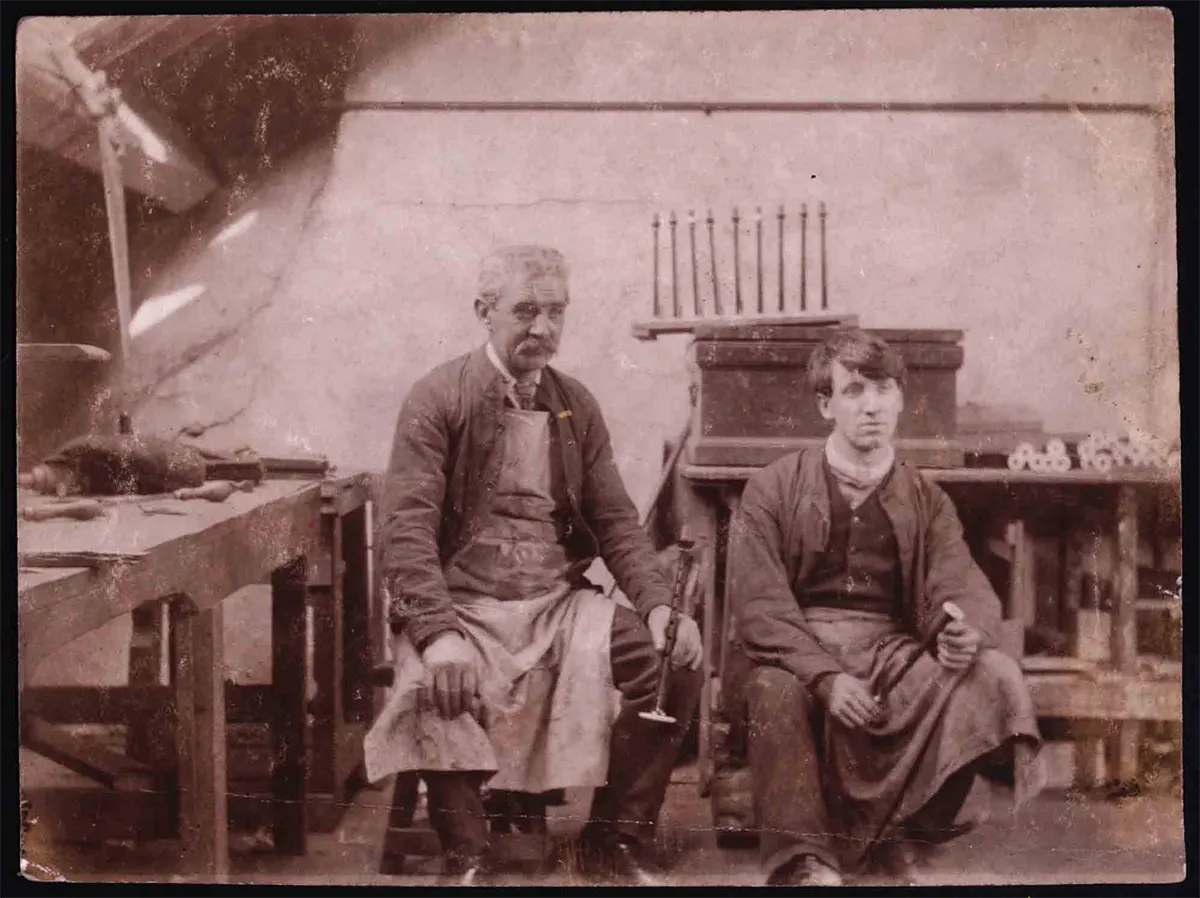
Working with vintage bagpipes is as much a hobby as a business for me. I enjoy the process of turning up old pipes and making sure they will be played for years to come. I think it is a good thing for piping. As such, I take great care in purchasing, examining and restoring old pipes.

My refurbisher is J. Dunbar Bagpipe Maker in St. Catharines, Ontario. Not only do they do masterful restorations, they have eagle eyes for examining 150-year-old wood and discovering replacement pieces and flaws that should be addressed before you play the pipes. If a set of pipes has a replacement or repaired piece, you will know about it before you buy.
You should know from the get-go that pretty much every bagpipe made before 1930 has required or will require repairs of some sort, especially if they are ebony. Ebony and cocuswood are superb woods from which to make bagpipes but they are less resilient than African blackwood. I suspect there is hardly an ebony bagpipe in the world made before 1920 that hasn’t experienced at least one crack.
Photos and descriptions of all instruments featured since October 2010
-
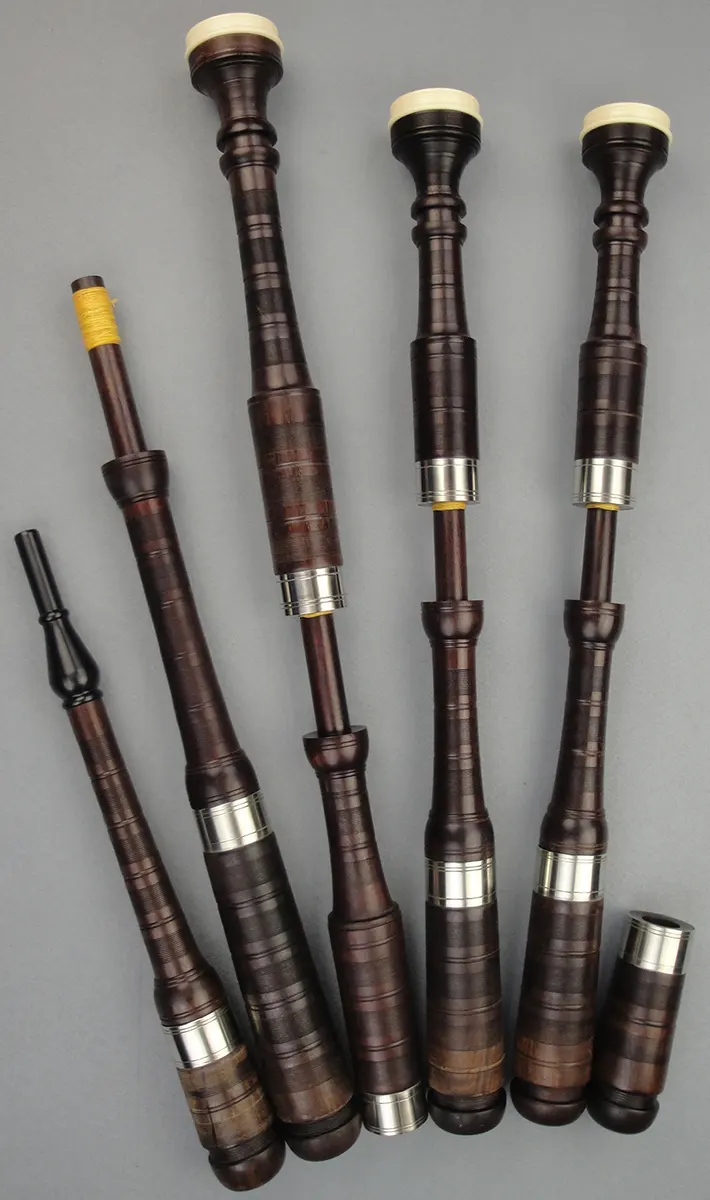
Circa 1950s Lawrie (?), American Rosewood, Nickel and Imitation Ivory Mounts
SOLD – This flat-combed bagpipe is a bit of a puzzle. For all intents and purposes it is a button-mount Lawrie, but the wood may well be Amercian rosewood, and there are no other known Lawries made of this wood. However, it may also be particularly rich-coloured cocobola, which would be more in keeping with pipemaking.
The ferrules are nickel and the ring caps are imitation ivory which replaced orange catalin at some point in the past.
The pipes are in excellent shape, with a full (but not booming) and quite warm tone that locked in nicely with my Kinnaird Edge drone reeds. The pipes are slightly lighter in weight than a blackwood set.
This resilient little number would make an excellent starter pipe, or a work-a-day, foul weather or travel set.
-
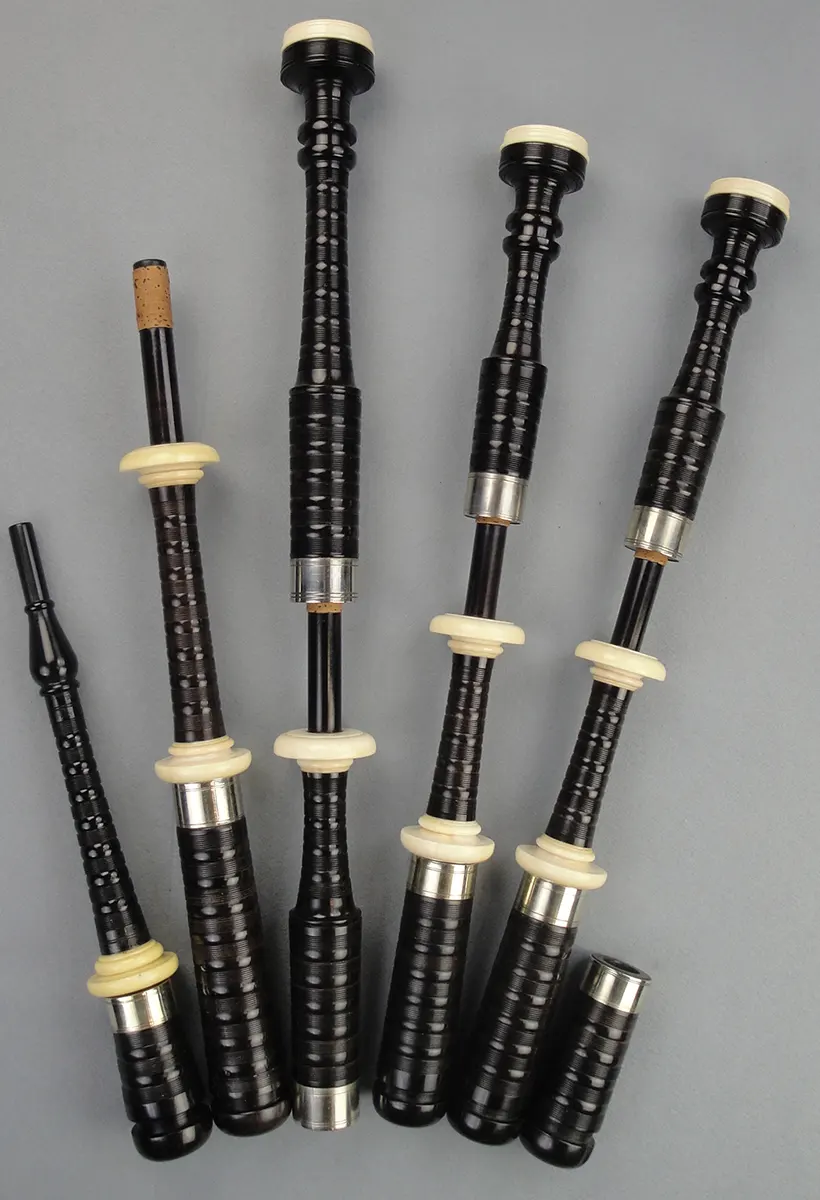
Circa 1930 Henderson, African Blackwood, Nickel and Ivory
SOLD – This old Henderson came to me in spectacular condition. It had been refurbished some years ago and needed no additional work. Profiles suggest a manufacturing date close to either side of 1930, and the exquisite drone tone would confirm that they are from the great Henderson years.
The wood colour suggests cocuswood, and although we can’t be sure without stripping the wood, I believe the pipes are African blackwood.
The tuning pins were recently fitted with cork joints. The fit is absolutely perfect provided a bit of cork grease is applied. Cork grease is provided with the pipes. The sound is robust, seamless, rich and steady as a rock with my Kinnaird Edge drone reeds — what the old Hendersons are renown for.
This set is classic Henderson and would do well on any competition stage in the world, including the major gatherings at Oban or Inverness.
-
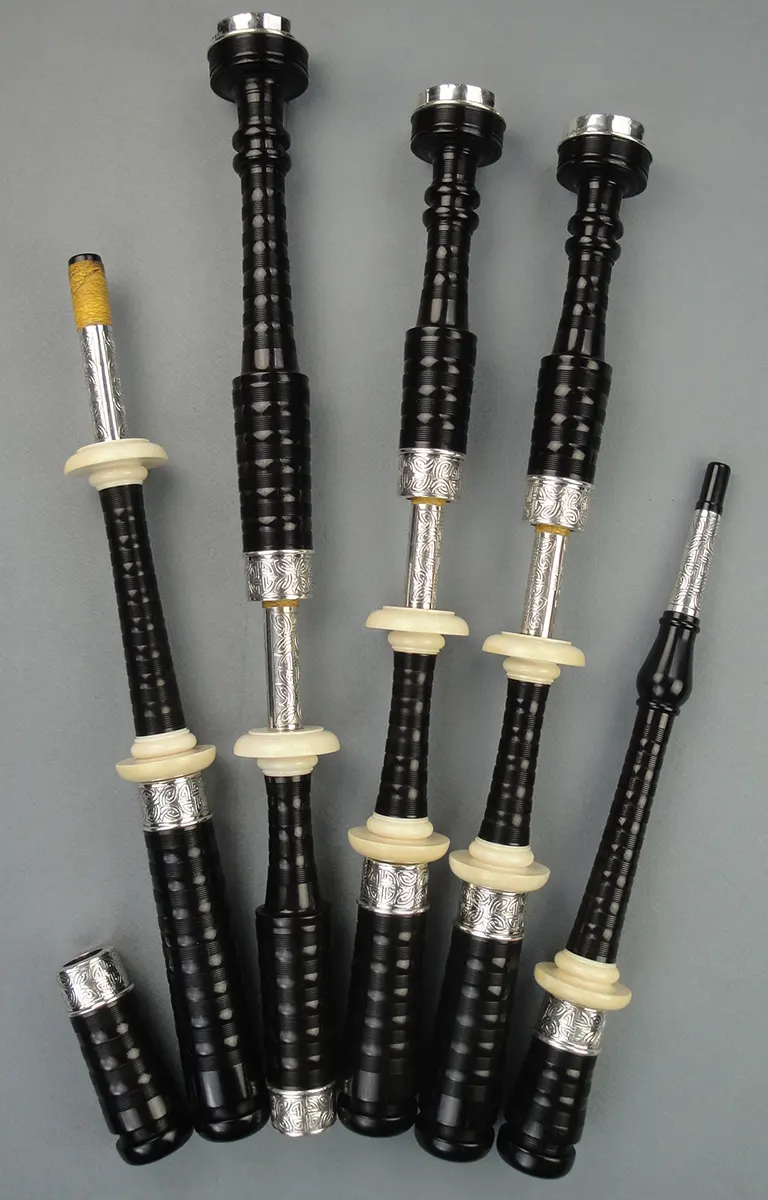
R. G. Lawrie, Silver and Ivory, Hallmarked 1959
SOLD – This lovely silver and ivory Lawrie set is hallmarked with RGL and the 1959 symbol on every piece. Every piece is original except for the mouthpiece bulb. Ivory mouthpiece bulbs rarely service, though the engraved silver sleeve is original.
This set was made at a time when the shapes of the Lawrie bells had departed somewhat from the original design — much more square rather than the rectangular shape on top of a sloping fountain. When I acquired this set from a well known professional player, the drones were fairly flat in pitch and tuned low on the tuning pins. However, this was a fairly simple fix with a couple of bore adjustments by Dunbar Bagpipes and the drones now tune in their proper positions.
It’s a typically robust Lawrie sound: bold, rich and steady. This is a beautiful instrument for someone in the market for a great combination of tone and aesthetics.
-
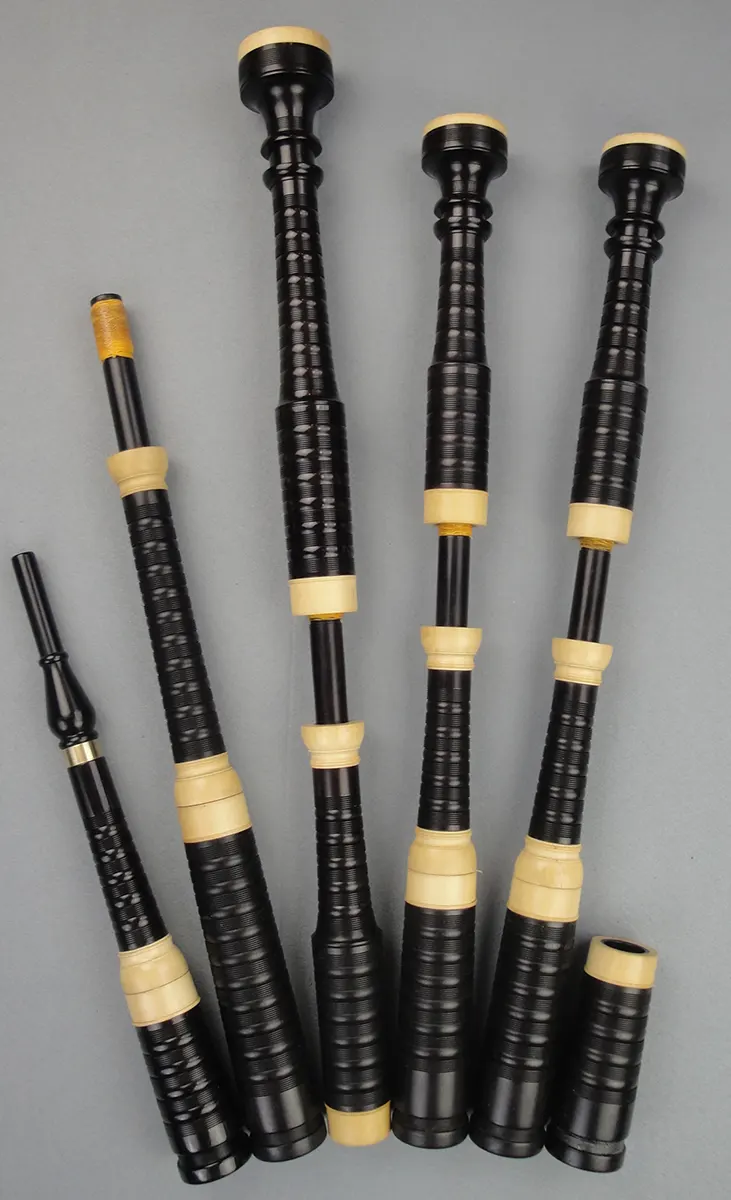
Atherton MD, 2014, Holly Mounts
SOLD – This is a rare, button-mount, Dave Atherton MD (MacDougall bores).
Made in 2014, the profiles and bores of this instrument were modelled after a circa 1870s Duncan MacDougall bagpipe owned by the late Roddy MacDonald of Wilmington Delaware. (Roddy’s bagpipe did not have button mounts.) I was working with Dave when this model of bagpipe was developed and can attest to the incredible quality of craftsmanship and wood that went into his pipes. The tone is a superb reproduction of Duncan MacDougall’s sound: full and rich, with a bass that cradles the entire bagpipe sound. They are remarkably steady, and in recent years Athertons have won prizes at the highest levels, including the Gold Medal at Inverness and the M/S/R at the Glenfiddich Piping Championship.
This instrument came to me with small fissures in two stocks. These have been invisible whipped superbly by Dunbar Bagpipes and will never present another problem. The blowpipe is brass-lined blackwood, and the blowpipe stock is polypenco.
-
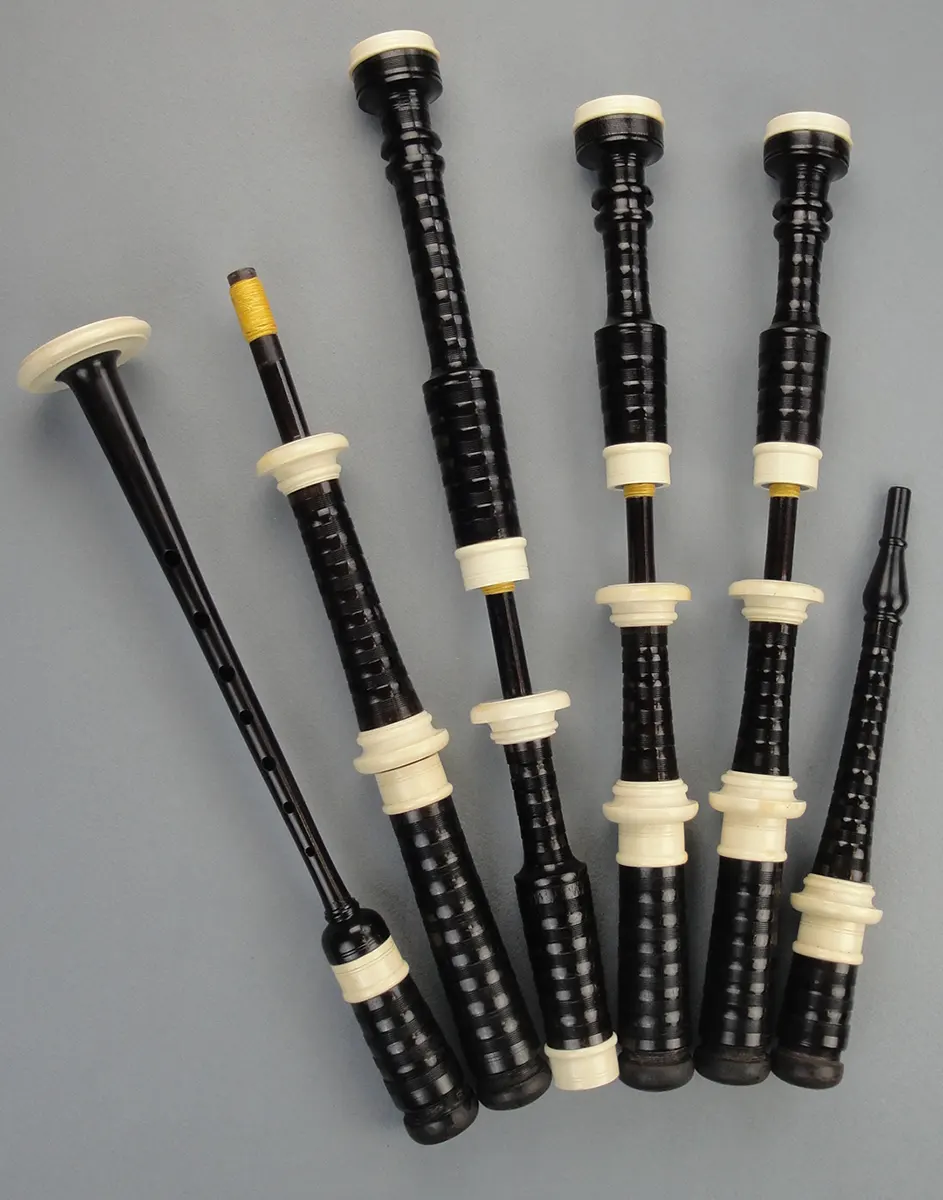
Grainger & Campbell, 1972, African Blackwood, Full Ivory
SOLD – Grainger & Campbell was founded in 1946 in Glasgow, and subsequently moved into Duncan MacRae’s shop on Argyll Street when that firm ceased doing business in 1952. Through the 1960s and early 1970s John MacFadyen and Pipe Major Donald MacLeod were part owners and oversaw all instrument design. G&C made superb pipes during these years and most are still in active duty.
This set was purchased from the shop in 1972 by its only owner and has seen limited playing during its 47-year lifetime. The pipes have their original finish and are in superb condition save for some yellow staining on the ivory. The turner spared no blackwood when making this set and the bottom joints in particular are heavy and ample. The set comes with its original chanter which, under MacFadyen and MacLeod’s direction, was a very good stick in its day. The tuning chambers are still perfectly even, indicating the quality of wood used at the time.
The tone is full and steady and this would be an excellent starter or lifetime set for a hobbyist.
-
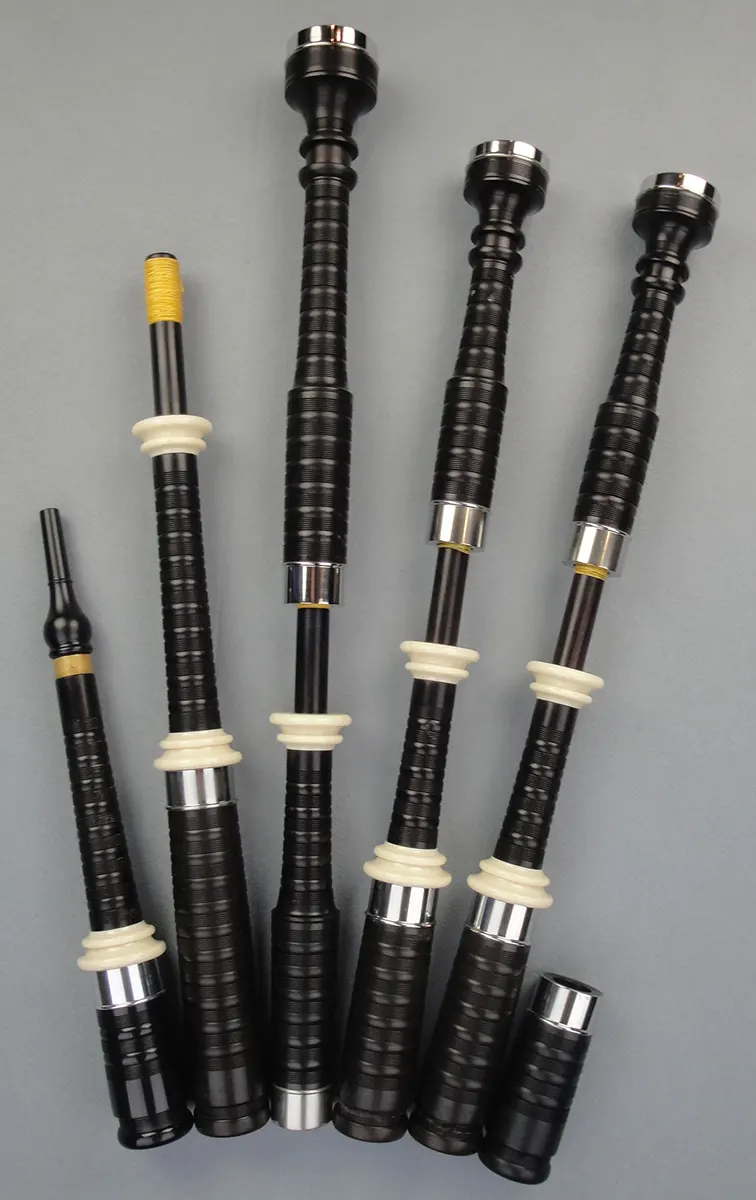
Atherton MD, 2011, Nickel, Imitation Ivory
SOLD – This is a slightly unusual Henderson set. It appears to be a mixture of cocuswood and Brazillian kingwood. This was not an uncommon Henderson configuration in the 1920s and 1930s. The ferrules are nickel, and the mounts and caps are ivory.
This is a tonally superb set, with a sweetness to the Henderson sound that is different from the more robust blackwood.
There are a couple of very slight dings in the projecting mounts, one on the blowstick, and a smaller one on the bass bottom.
The set has no original chanter (the chanter in the photographs was included by mistake). All stocks are replicas with matching ferrules, as there were no stocks with this set. The blowstick stock is a poly split stock, the rest are blackwood.
The pipes were refinished some years ago and the finish is still in excellent shape. The unusual wood configuration and replacement stocks result in a superb price for the classic Henderson sound.
-
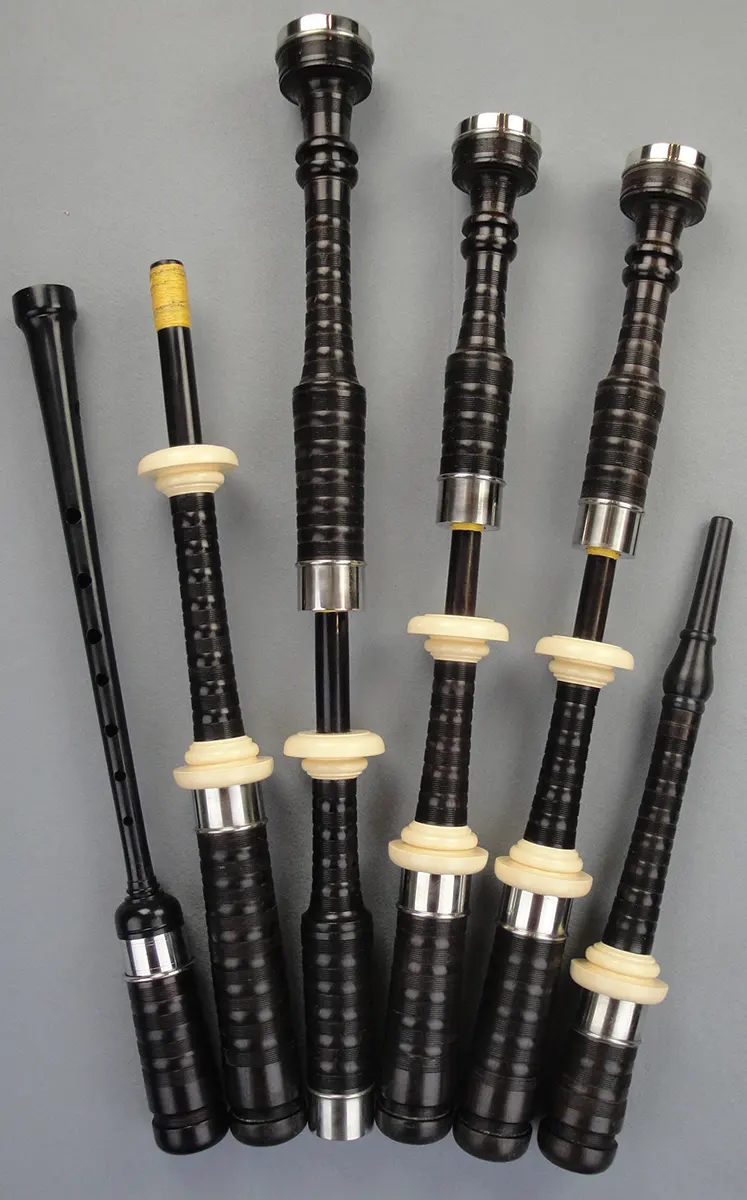
Kintail, 2008, Blackwood, Nickel, Imitation Ivory
SOLD – The Kintail pipemaking firm was founded by Greig Sharp in the early 1970s and still operates today. Sharp learned his trade during the latter years of the Henderson firm before it was sold to R. G. Hardie in 1971. Greig Sharp passed away in 2009.
Though Kintail is rarely ranked in the top tier of pipemakers, Sharp’s pipemaking pedigree produced a solid and reliable set of pipes with a bold, steady sound. This set is a substantial set to hold in your hands: no skimping on wood. It locked in nicely with my current set of Kinnaird Edge drone reeds. The set has been well taken care of and is in superb shape, with nickel and imitation ivory mounts in pristine condition. The original Kintail poly pipe chanter plays very well.
This would be an excellent set for a new piper or an adult hobbyist looking for a reliable instrument at an accessible price. I played a set of Kintails in the early years during my first couple of years as a professional competitor.
-
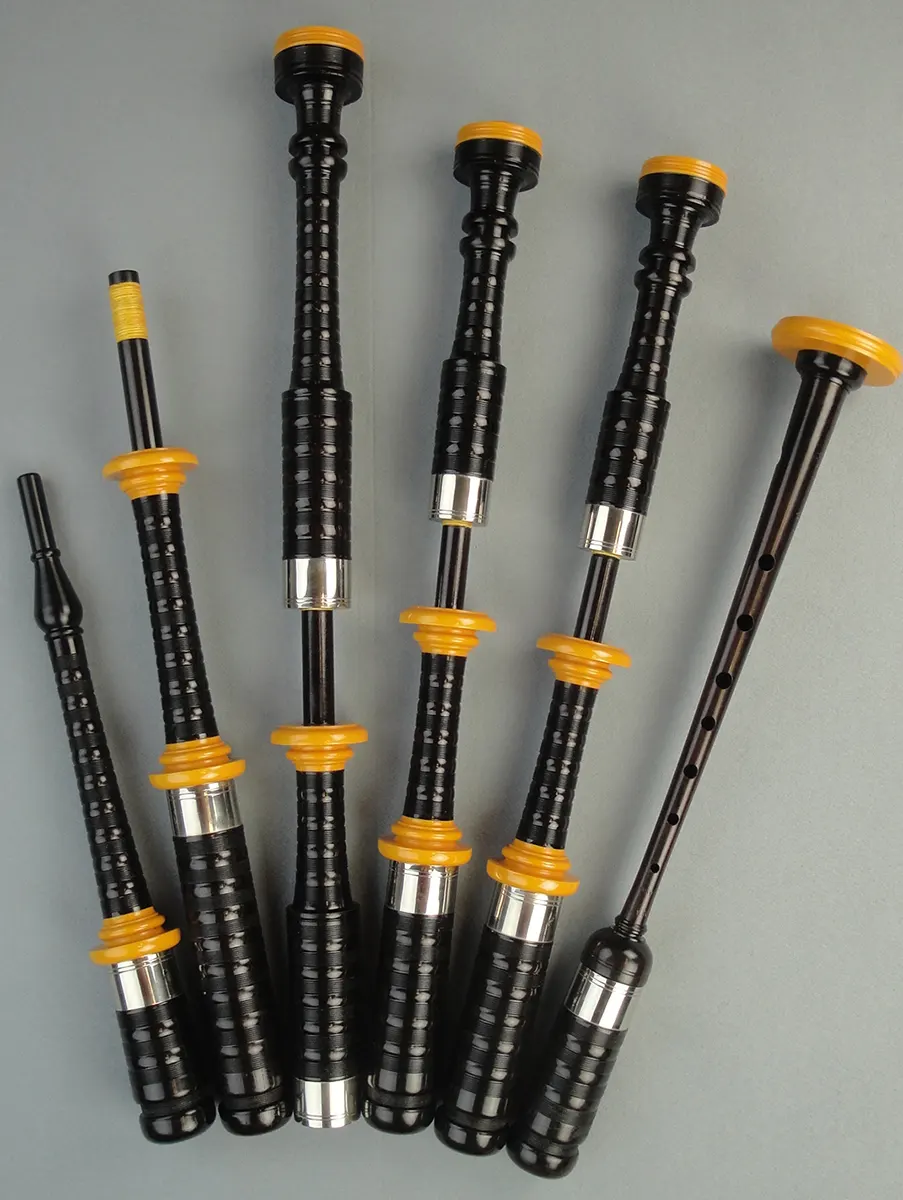
R. G. Hardie, Circa 1970, Blackwood, Mounted in Nickel, Imitation Ivory
SOLD – This Hardie bagpipe came to me in superb condition, well taken care of, and as far as I know with the original finish. I’ve become a big fan of the old Hardies. Bob Hardie and John Weatherston used superb, well-aged wood, and made consistently good pipes that are steady and easy to reed. Smaller-bored drones, they are more mellow in tone and are an excellent choice for young beginners or adult hobbyists.
The reedseats in these drones have been opened out slightly and threaded to better latch on to the drone reeds.
Hardie pipes of this vintage and older have frequently appeared on these pages and are always well received. Bob Hardie was a gem of a man, a superb player and pipe major of Muirhead & Son’s Ltd. Pipe Band when they won five straight World Pipe Band Championships in the mid-1960s. The company was dissolved after its two principals passed in the 1990s, though the name has been revived again in recent years.
The pipes come with their original Hardie chanter. When it was made this was the premier chanter of the day. It will still play well with the right reed, though the lower pitch would be out of place on today’s competition boards.
-
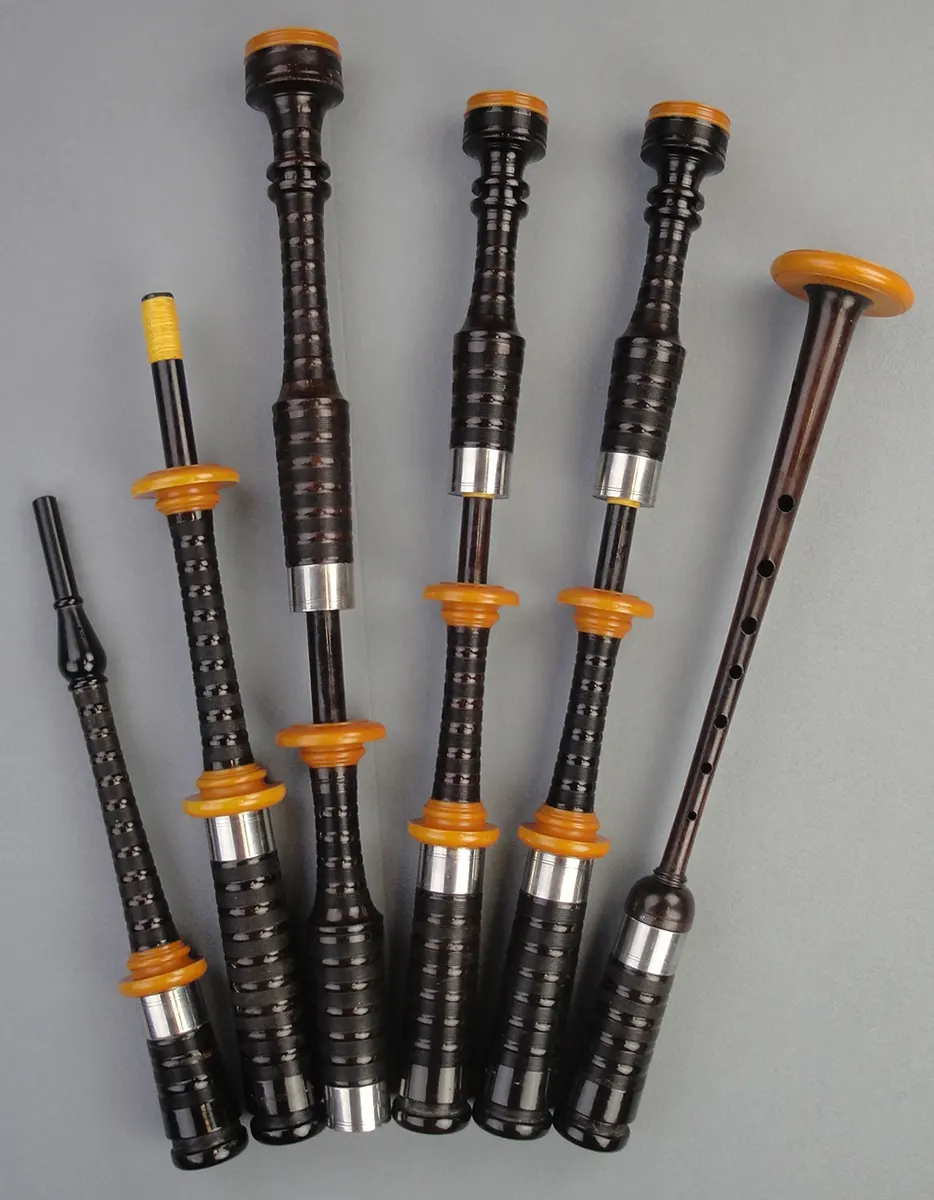
R. Gillanders & Son, Circa 1970, Blackwood, Mounted in Nickel, Imitation Ivory
SOLD – Robert Gillanders began making pipes in Dundee in 1930, having amassed an impressive pedigree by apprenticing with John Center, the Thows and Gavin MacDougall. This set was made by Robert Jr. in Forfar around 1970, just before Pipe Major Iain McLeod bought into the company in 1972 and it became Gillanders & McLeod. Each cord guide in this set is stamped “R. Gillanders.”
This set is completely original and blemish-free, the finish original. Pipes made by the original Gillanders company have a loyal underground following, and after hearing this set played and recorded for an upcoming pipesdrums.com article on the Gillanders firm I understand why. The tone startled me: bold and rich, with a sound-surround bass and superb steadiness. It would hold its own at any level: a sleeper if I ever heard one.
The chanter pictured with the set is a Grainger and Campbell that came with the pipes: quite a superb chanter in its day, from a time with Donald MacLeod and John MacFadyen were kingpins in the Grainger shop on Argyle Street in Glasgow. It will still play well with the right reed, though the lower pitch would be out of place on today’s competition boards.
-
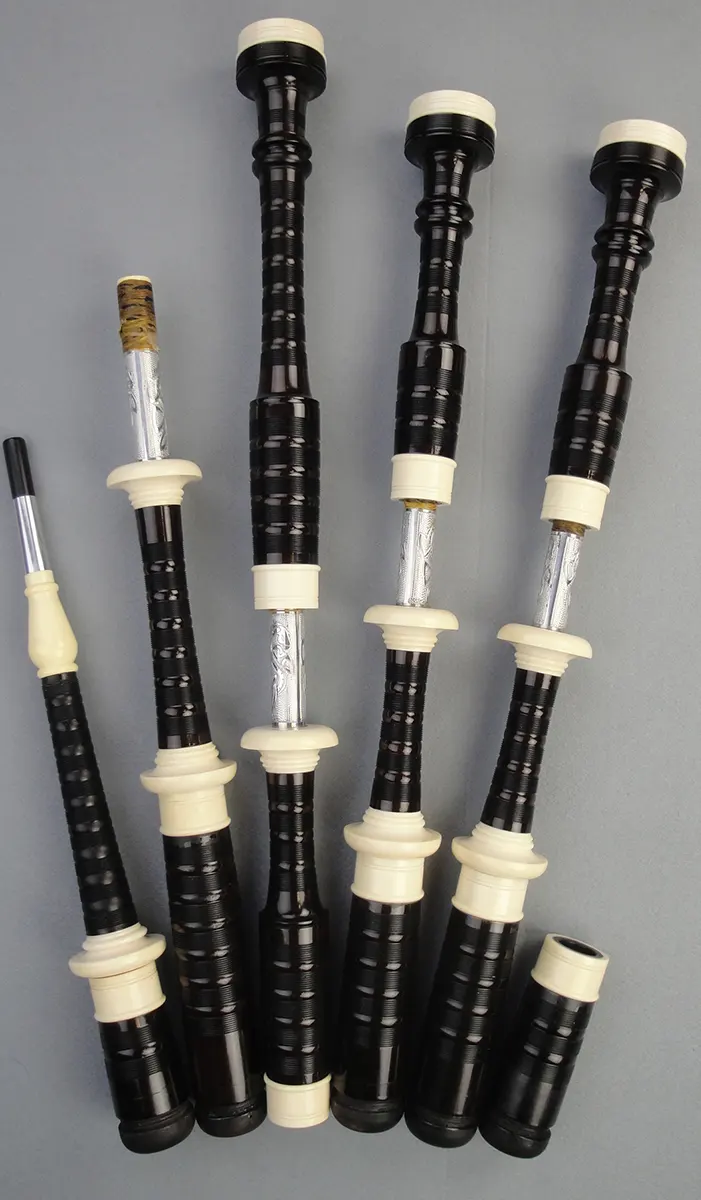
Wm Sinclair & Son, Circa 1980, Blackwood, Natural Mounts, Hand-engraved Nickel
SOLD – William Sinclair Sr. began making pipes in Edinburgh in 1931 and the company is still in business today under his grandson Alistair. The company has maintained an extremely high standard of manufacturing and tonal excellence throughout its long history.
The exact manufacturing date of this instrument is unclear as makers continued to use previously purchased legal ivory for some years after the CITES ban came into effect in 1974. However, it was presumably purchased new in 1983 by a member of the Canadian armed forces, who purchased them from the Sinclair shop while he was stationed in Germany. The hand-engraved nickel slides were added in 2011, as was the poly blowpipe bulb.
This instrument has never been refurbished or refinished: it remains as it was made, with absolutely pristine mounts and unblemished wood.
Tonally it is full and steady, with a brightness of sound typical of William Sinclair pipes at their best.
-
Alexander Glen, Circa 1860, Ebony, Marine Ivory
SOLD – Alexander Glen began making pipes in Edinburgh around 1835 and continued until his death in 1873. His son David was perhaps the most famous Glen in this pipemaking dynasty that spanned more than 120 years, but Alex set the original standard for craftsmanship.
This remarkable set came to me almost complete, lacking only its blowpipe. The wood is ebony and the mounts are marine ivory — walrus — which was used widely in pipemaking during the 19th century. The pipes display the narrow profiles and mounts typical of Edinburgh pipemakers during this period.
Unfortunately, the blowpipe stock and one tenor stock were cracked badly enough that it was best to make blackwood replicas. The blowpipe and blowpipe stock are poly-lined, with the projecting mount on the blowstick coming from an orphan tenor bottom in my collection that matched very well. A number of hairline cracks in the drone pieces were invisible whipped and will not recur. It would appear that one of the tenor bushings may have been replaced at some point in the distant past. The pipes have been completely refinished.
The tone is rich and refined: the more ‘mellow’ sound which David would continue. The drones were rock steady with my set of Kinnaird Edge reeds.
This is a lovely piece of antique history as well as a superb musical instrument.
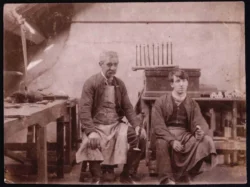
Alexander Glen with son David in their Edinburgh shop around 1870. -
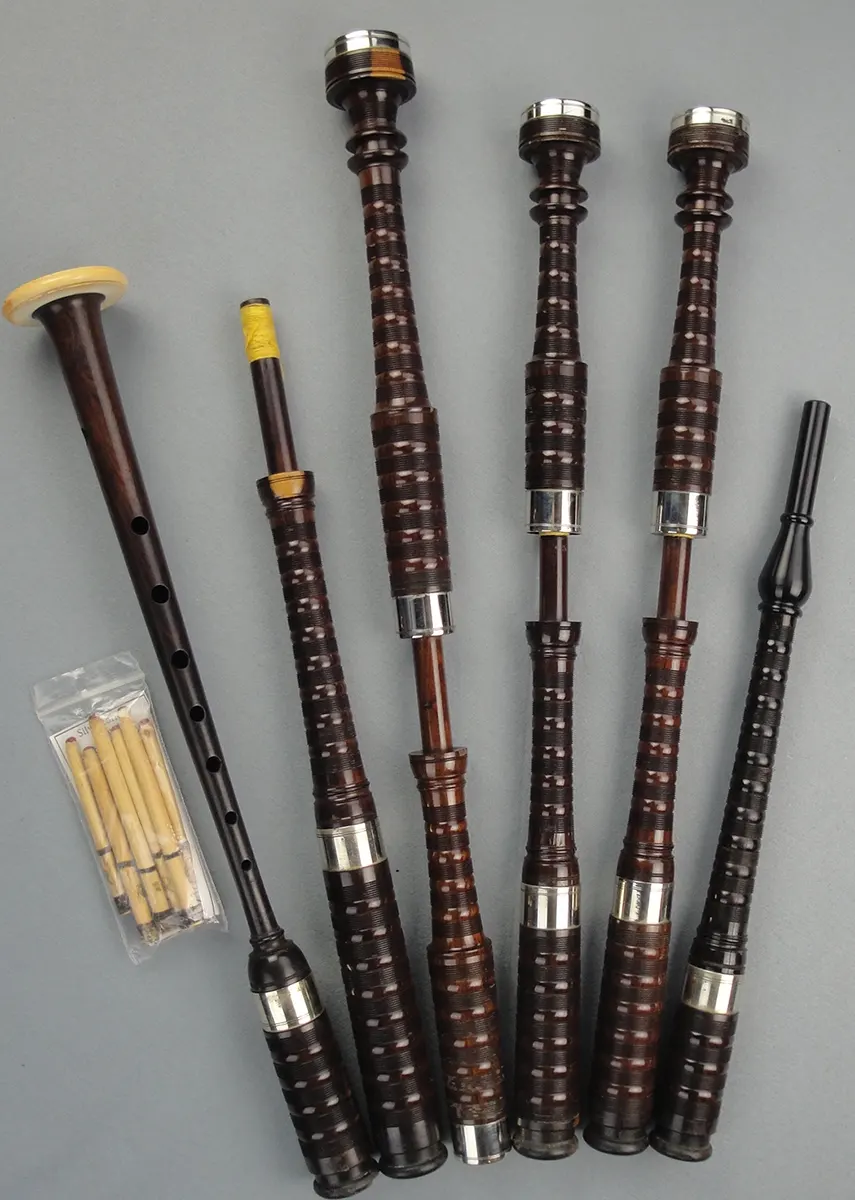
Circa 1920 3/4-size Cocuswood David Glen & Sons
SOLD – This is an interesting little number: a classic “3/4 set,” often called in the old days a “lady’s set” or a “child’s set.” They are cocuswood with nickel ferrules and rings, and are stamped “David Glen & Sons, Edinburgh” on the chanter and bass drone stock. They almost certainly date within 10 years either way of 1920.
The 3/4-sized chanter is pitched pretty close to Bb (466). The pipes are in good shape, though the combing has been scraped in several places. There are no cracks and all pieces are original. A plastic bag containing two sets of cane 3/4-size drone reeds came with the pipes, though the Ezeedrone folk also make drone reeds to suit pipes like these.
I have done no work on this set except to rehemp them (after the pics were taken). They are priced to sell and are being sold as-is: sticks, stocks, chanter and drone reeds only. Some people play these as “session pipes” in Bb, though perhaps they are more suited these days to getting a tiny, young piper started. Bruce Gandy told me he started his son Alex on a 3/4 set.