
Working with vintage bagpipes is as much a hobby as a business for me. I enjoy the process of turning up old pipes and making sure they will be played for years to come. I think it is a good thing for piping. As such, I take great care in purchasing, examining and restoring old pipes.

My refurbisher is J. Dunbar Bagpipe Maker in St. Catharines, Ontario. Not only do they do masterful restorations, they have eagle eyes for examining 150-year-old wood and discovering replacement pieces and flaws that should be addressed before you play the pipes. If a set of pipes has a replacement or repaired piece, you will know about it before you buy.
You should know from the get-go that pretty much every bagpipe made before 1930 has required or will require repairs of some sort, especially if they are ebony. Ebony and cocuswood are superb woods from which to make bagpipes but they are less resilient than African blackwood. I suspect there is hardly an ebony bagpipe in the world made before 1920 that hasn’t experienced at least one crack.
Photos and descriptions of all instruments featured since October 2010
-
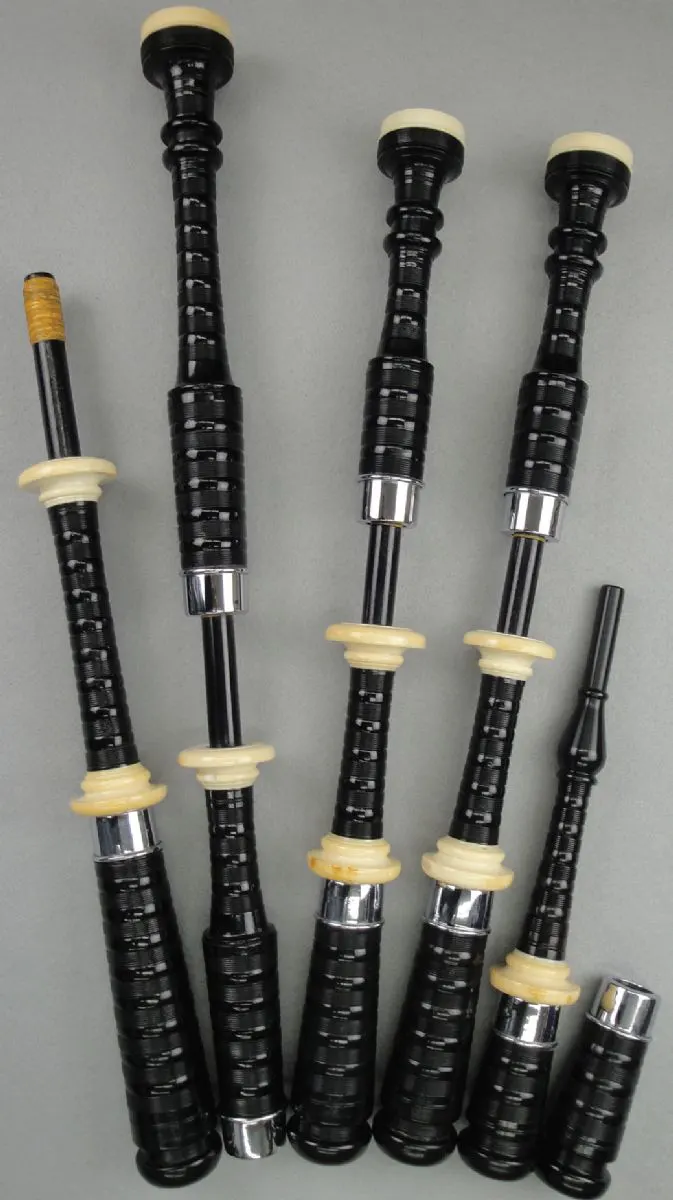
Lawrie, Circa 1905, Ebony, Ivory, Nickel
SOLD – This is one of the oldest Lawries to appear on this site, thought to have been made within a few years of 1900-1905. They are ebony, with ivory projecting mounts and ring caps, and high quality nickel ferrules, Required repairs were relatively few given the age and the wood.
One tenor stock and the tuning pin of the bass middle joint required some invisible whipping to seal hairlines. The blowstick was invisible whipped its entire length. None of these repairs will ever again reopen, such is the effectiveness of invisible whipping. The bead on one projecting mount has a small chip. The finish that was on the set was in fine shape, so the entire set was simply put on the lathe and polished. The nickel in particular came out beautifully.
The set is typical vintage, ebony Lawrie: the drones locked in immeidately with my Ezeedrone set. The bass tuned quite low, as most Lawrie and Henderson of this vintage do. (Some folk think this is problematic; it is not. You want your tenors to tune high. Low-tuning bass is common, perfectly fine, and free of roaring strike-ins.) The tone was full, rich and seamless.
For someone looking for classic, vintage tone at an affordable price, you would do well to consider this set. These old mid-range Lawries in ebony are every bit as good as their expensive silver and ivory cousins!
-
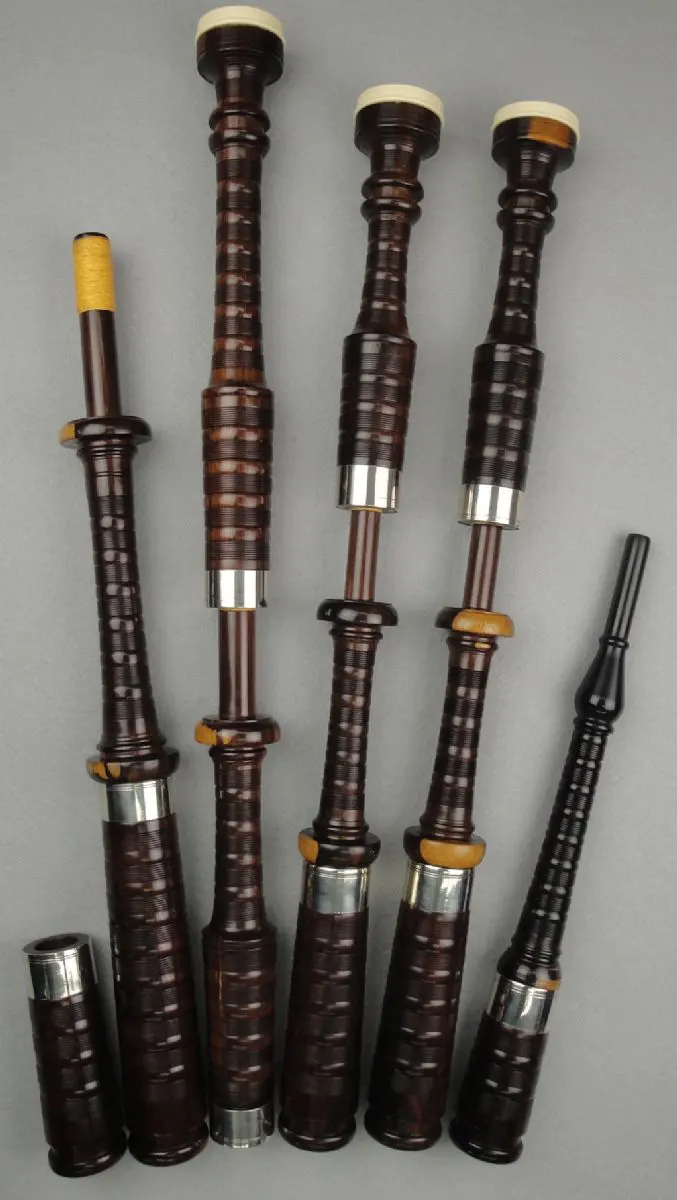
Cocuswood, Possible Glen, Circa 1920s, Nickel, Artificial Ivory
SOLD – The make of this stunning cocuswood set is a bit of a puzzle, but the caps, tone, wood and workmanship suggest David Glen, sometime after 1920. The wide beads between the combing sections are unlike Glen, and other thoughts range from Henderson to MacRae. The tone is first class cocuswood: rich, buzzy and steady.
The set came with catalin rings on the drone tops, thought to be a later addition. These had turned the usual pumpkin orange, and I had Dunbar Bagpipes replace them with non-chip artificial ivory.
The set also had came with no stocks. Replica stocks have been made from cocobola, and I found superbly matching nickel ferrules from my collection of parts. The cocobola is an excellent match to the original cocuswood, almost undetecatable as replacements.
The bass mid-joint had a hairline crack running an inch or two up from the ferrule, but this has been invisible whipped and you would never guess it was there.
Tonally speaking, this bagpipe is exceptional, and the work is clearly that of a high-end maker. The appearance in person is stunning.
The price is reflective of the unknown make and replacement parts, but not of the tone!
-
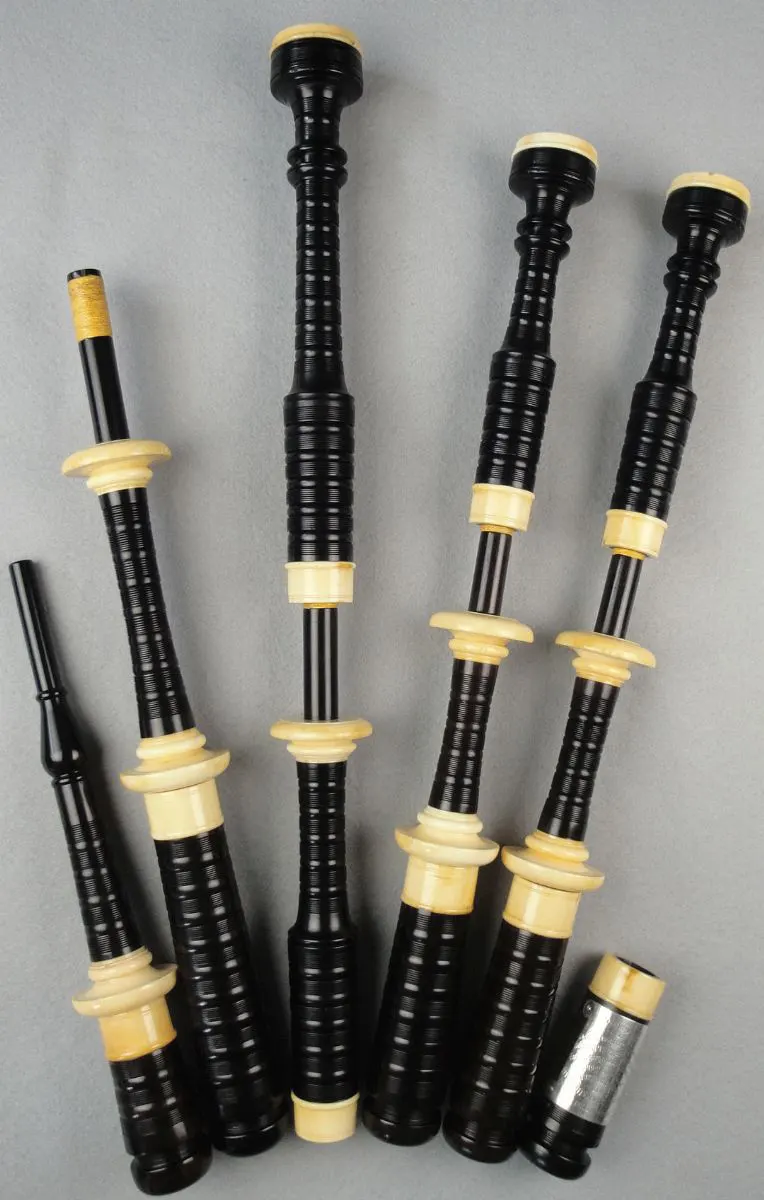
Thow, 1893, Cocuswood and Ebony, Full Ivory, Presentation Set
SOLD – “Presented to Piper Charles Dunbar by Major Campbell, 1st Seaforth High’rs, in remembrance of good piping, good conduct and good fellowship, during the years of 91, 92, 93, at Fort George.”
Thus reads the silver shield that was affixed to the chanter stock of this presentation set of Thows. Charles Dunbar (1870-1939) was a prize-winning Halkirk native, Seaforth Highlander and Gordon Highlander, a Boer war and WW1 veteran, who emigrated to Canada and served for many years as Pipe Major of the Argyll and Sutherland Highlanders in Hamilton, Ontario.
The pipes are certainly Thow, showing the scribe line on each cord guide distinctive to that company. One would expect the pipes were made the year they were presented, though it is also possible that they were Dunbar’s regimental set and he was simply allowed to keep them along with the shield when he left the Seaforths for the Gordons in 1893.
The pipes have obviously seen long usage. Both tenor drone stocks are new blackwood replicas with the original ivory ferrules affixed. The blowstick stock is a new poly-lined blackwood stock with the original mount. The chanter stock appears to be an earlier replacement, though pin marks indicated clearly that the shield had been affixed there. The blowpipe is a new, poly-lined, blackwood replacment as well.
The tone of the pipes can best be described as “mellow,” in the Glen tradition: steady and rich, benefiting from the mix of early woods: all three drone bottoms are cocuswood, the rest of the pieces are ebony, but for the replacement stocks.
-
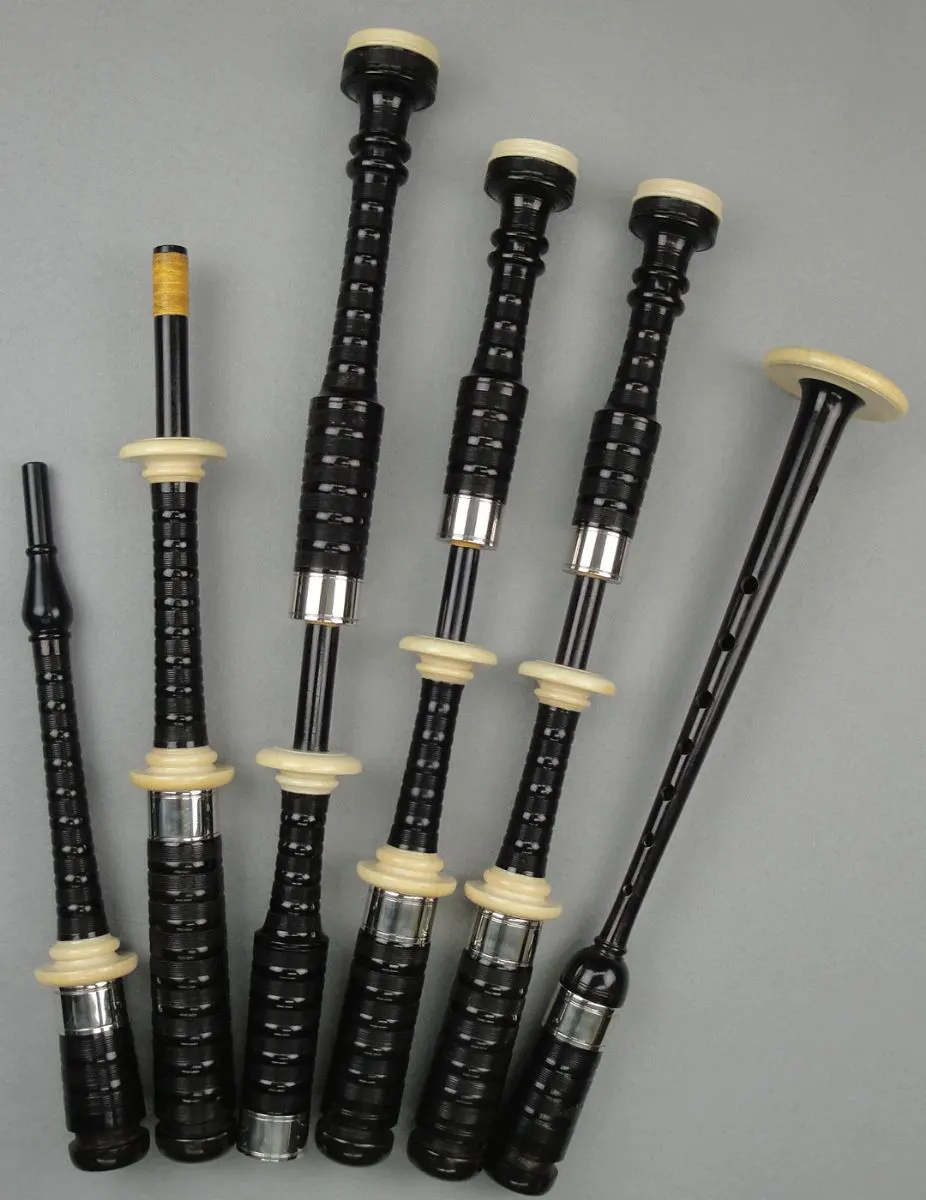
Henderson, Circa 1920, Blackwood, Nickel, Ivory
SOLD – This set adds to the plethora of lovely old Henderson pipes that have appeared here in the last couple of months. The set is blackwood, and while it was purchased as a 1930s set, the seamed ferrules and dinner-plate style chanter sole suggest 1920 or even earlier.
The pipes are in fantastic condition. No cracks were found in the wood, and the finish was in fine shape, so the pipes were just put on the lathe and polished.
There is spider cracking on some of the projecting mounts — another sign of advanced age. The cracking is fairly pronounced on one tenor projecting mount (visible in photos) but the mount is solid and stable and should remain so without a serious knock. There are a couple of inconspicuous chips in the ivory rings that are normal for a set of this age.
The tone on the set is top-drawer vintage Henderson. The drones all tune in the proper positions, the tuning chambers are smooth and even, and the pipes are full, rich and seamless, with a superb chanter blend.
While it’s nice to have the original chanter with the pipes, an early 20th century Henderson chanter would probably not fare well at the Glenfiddich Piping Championship — but the pipes would!
-
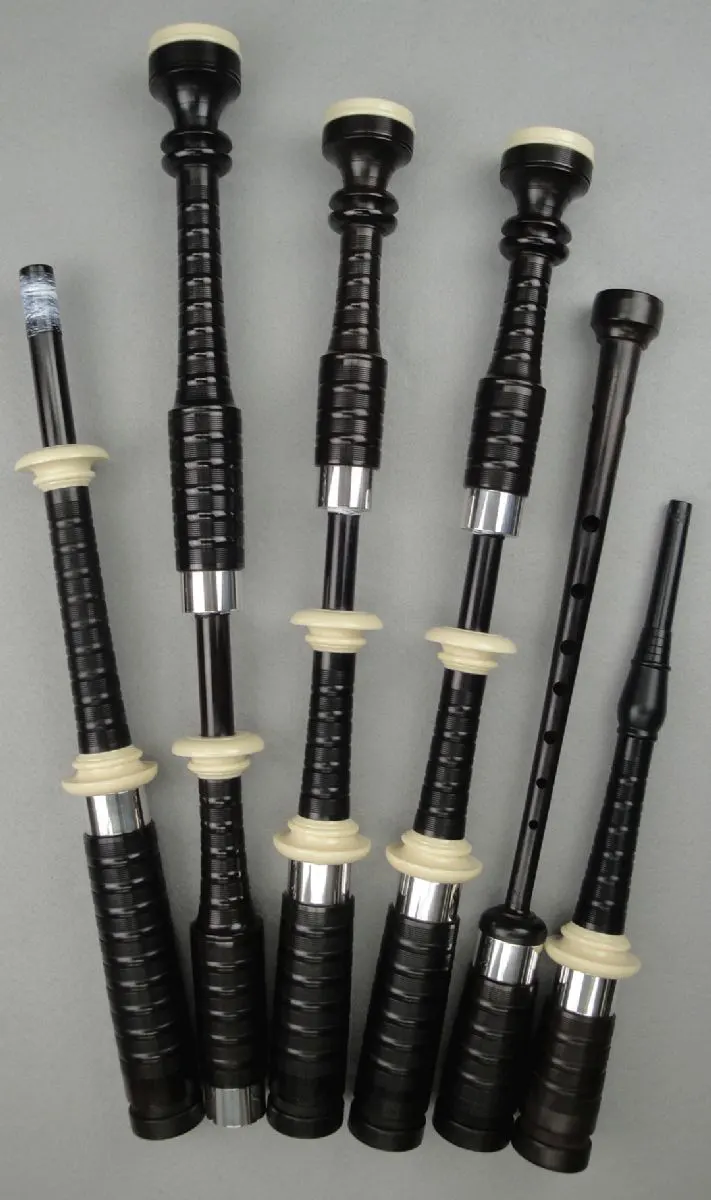
Kron Heritage, 2004, Artificial Ivory, Plain Silver
SOLD – The Kron Heritage was created in around 2001 using my own 1912 silver and ivory Hendersons as a model. C. E. Kron in Dobbs Ferry, New York, developed the model, which was made by then Kron employee Dave Atherton. Charley Kron ceased producing this model a few years later after Dave left the company.
The pipes were extremely well crafted, and this model was the standard configuration: plain silver ferrules and artificial ivory projecting mounts and ring caps. The tone is full and steady in the Henderson tradition. This set is in virtually pristine condition. There are a couple of slight scratches on the chanter stock, but aside from that they look like they have hardly been used. The chanter is the original chanter that came with the set, a Kron Medallist, #776.
This would be an excellent work-a-day set for a young competitive player, or an attractive, easy-to-reed and trouble-free pipe for a learner of any age.
-
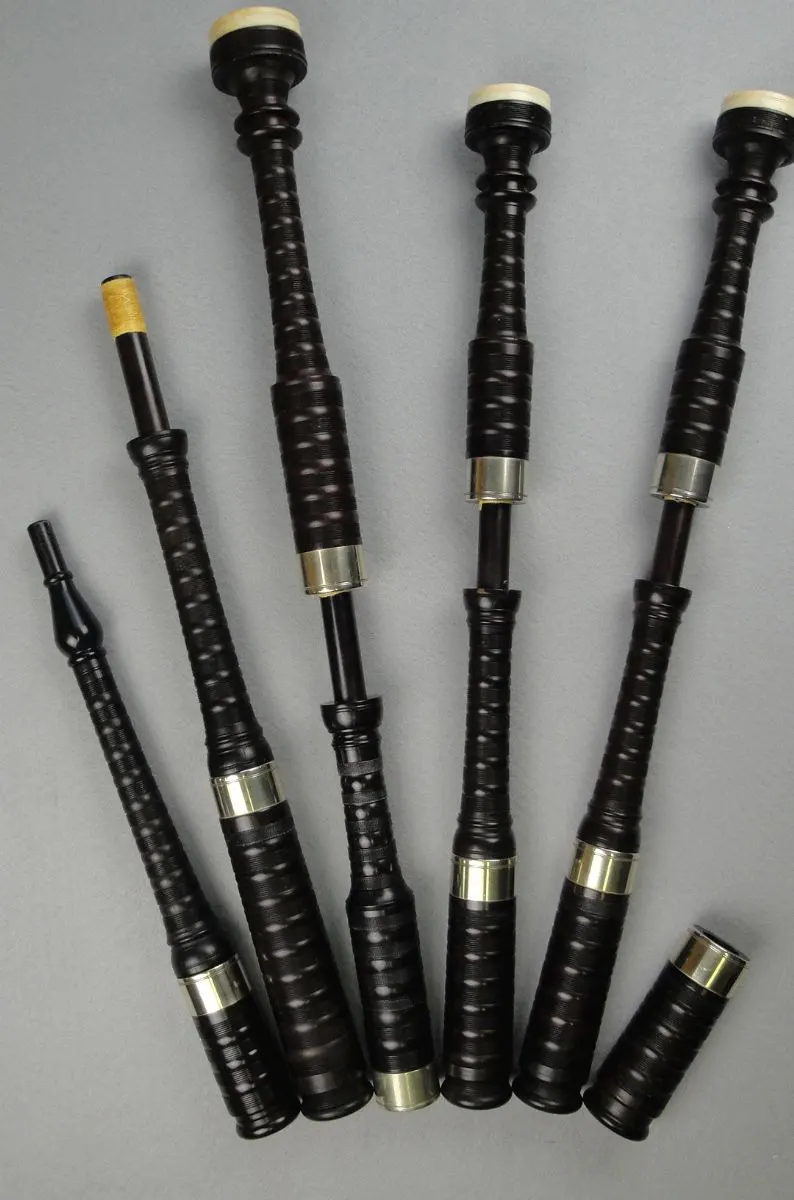
David Glen, Circa 1900, Cocuswood, Nickel, Ivory
SOLD – This is a great old Glen set is well priced because it are visibly whipped in several places. It was purchased from this site several years ago and has now been repurchased after several years of playing by the owner.
They are cocuswood, with button mounts, nickel ferrules and ivory rings. The bass middle joint is not original to the set, but it is a Glen of the same era in ebony and matches the set perfectly. The tone of this set is classic Glen cocuswood — not booming, but ample, very rich, and really, really steady. The set has been owned and played by several good competition players over the past few years who have since moved onto higher-end sets.
The whipping is external, and locations can be seen in the photos. This work was done several years ago before the refurbisher developed the invisible whipping technique. The whipping is quite apparent up close. As a result, I was able to acquire the pipes for a very good price and am selling them for a price that might work for someone who can’t afford some of the other sets here.
The set plays really well and, in typical Glen fashion, is easy to reed.
There are two blowsticks — they match, and one is longer than the other. One may be a blackwood reproduction.
-
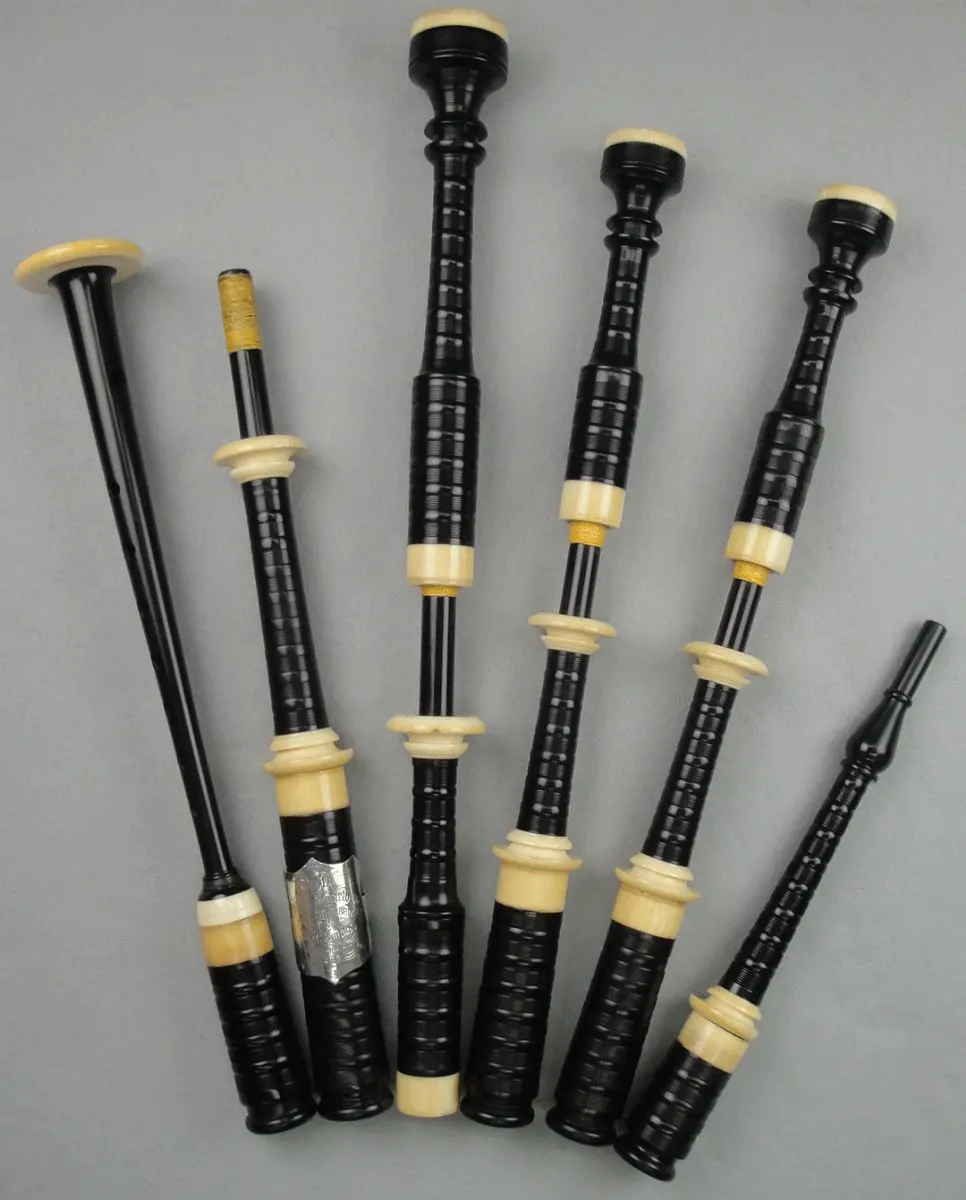
Alexander Glen, 1865 Presentation Set, Ebony, Ivory
SOLD – This presentation set of Alexander Glen pipes, was presented to Archibald Forbes as winner of the piobaireachd at Perth Highland Games in 1865. Alex Glen judged the contest. Duncan MacDougall was another judge on the day — both leading pipemakers of the time. The set was acquired by an Ontario piper in 1984 and played in leading Grade 1 bands trom then until 2014. They were played in the 78th Fraser Highlanders for many years in the late 1980s and 1990s. Research on the set includes the newspaper report of the contest from the Perthshire Courier.
Alexander Glen made pipes in Edinburgh from 1833 until his death in 1873. His son David continued to run the business, which thrived for another century. Alex and David were foremost pipemakers of the time, and modern makers still marvel at the quality of their work. The set has been well used, but the integrity and history of the instrument have survived.
The shield reads, “Perth Hi. Society; 1st Prize for Pibroch to Arch Forbes, Aug 26 1865.”
Made in ebony, with marine ivory mounts, the pipes had numerous cracks when they were acquired, though they continued to play well. In 2002 the previous owner undertook a partial restoration by having brass sleeves inserted into all of the tuning chambers and several other bores as well. This work was done beautifully in a traditional style. I had Dunbar Bagpipes strip the pipes, fill all visible cracks, refinish all of the wood and rehemp the joints. Only the blowpipe is a replacement piece with the original projecting mount, about a quarter of which has at some point been broken off and worn smooth. A small piece is broken off the upper bass projecting mount as well.
The chanter, though not playable, is original and shows the A. Glen Edinburgh stamp.
The pipes are steady, rich, and mellow in the Glen tradition, quite the antithesis of full-volume Hendersons. This is a lovely historic relic and a proven top-level instrument.
-
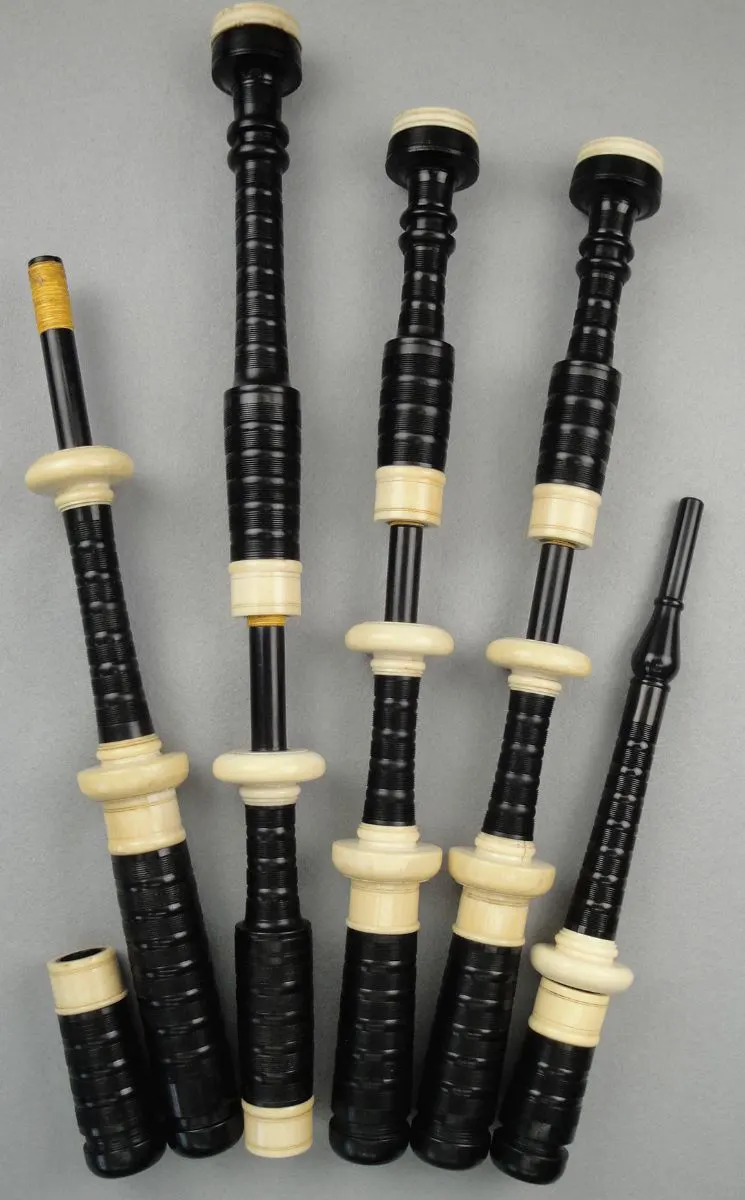
Circa 1950s Robertson, Full Ivory
SOLD – James Robertson’s Edinburgh pipemaking company is the most consistently superb pipemaker I know of. From the firm’s founding in 1908, through Robertson’s death in 1948, right to the company’s dissolution in 1967, the quality of the instruments remained consistently high, especially tonally. While I test every set of pipes I offer, I’ve often thought that Robertson is the one make I could actually send out without testing and be fully confident of what my customer receives.
As expected, the tone of this set was full, rich and steady. I removed a set of Ezeedrone reeds from my vintage Henderson set, plugged these drones into the stocks with the same reeds and they locked into tune after 10 seconds of tuning. Typically lovely.
While all drone pieces are original, the set has several compromises. Two tenor stocks and the chanter stock are not original, but the visual match aside from the scribe lines and bead size is excellent. The blowpipe is also not original, but the poly-lined replica and imitation ivory mount made by Dunbar Bagpipes is superb.
The ivory shows signs of a well used set, with some minor chipping and staining here and there. Overall, though, this is a solid and toneful Robertson bagpipe, priced to reflect the slight deficiencies.
-
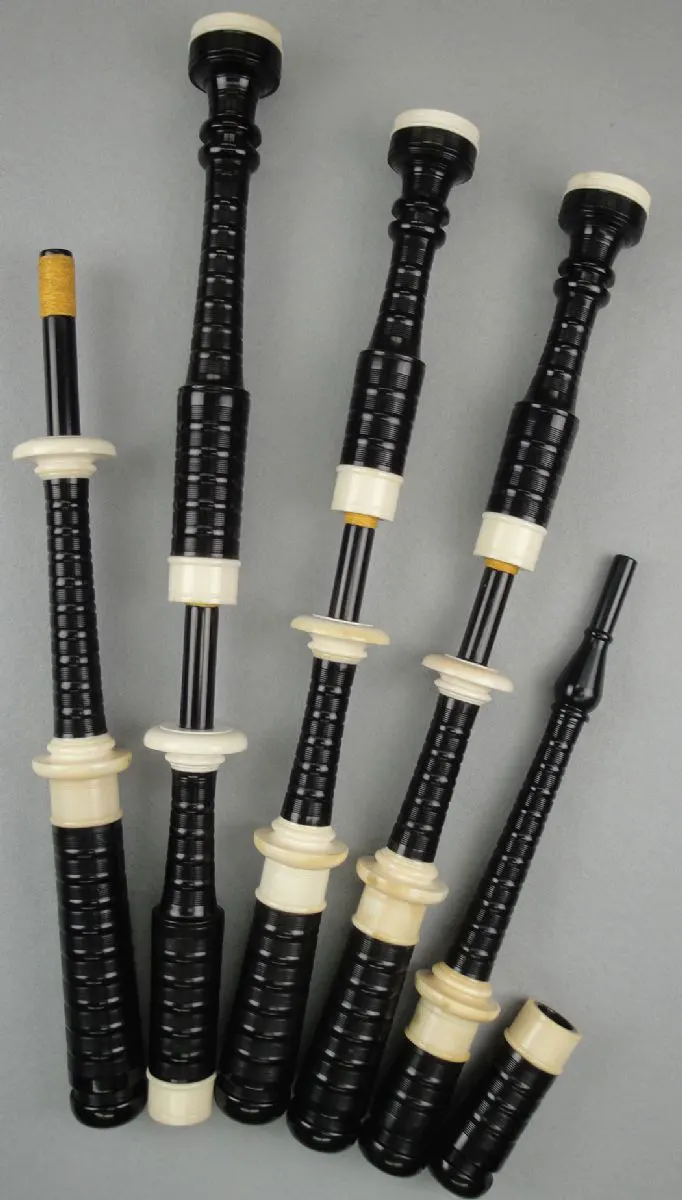
Henderson, Circa 1905, Cocuswod, Full Ivory
SOLD – This remarkable turn-of-the-century Henderson set is in superb shape for its age. It is made in very dark cocuswood — only apparent when the pipes were stripped for refinishing — and mounted in full ivory. The ivory is remarkably white for a set of pipes 110 years old, almost as though the pipes were in dark storage for decades.
The only flaw is a few greenish stains in the ivory, likely from long contact with a bag cover. Some of these are apparent in the photos.
The only refurb the set required was stripping and refinishing. They have been played off and on by the previous owner over the last 15 years. The tone is really high-end vintage Henderson of the quality that could win any piping competition on the planet: full, seamless, rich, and with a bass sound that cradles the whole bagpipe.
-
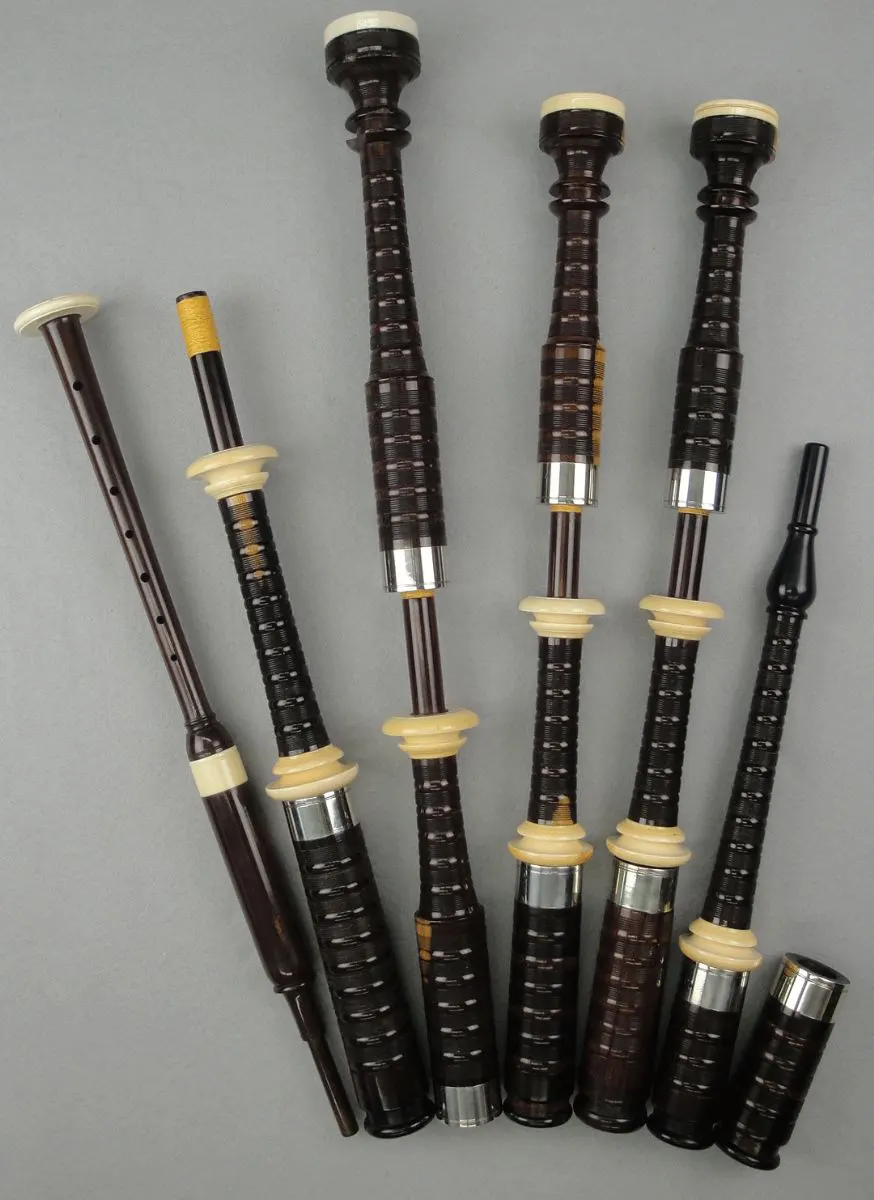
David Glen, Circa 1890s, Cocuswood, Nickel, Ivory, with Original Practice Chanter
SOLD – David Glen pipes can be visual gems. This set is made in lovely, striped cocuswood, with ivory projecting mounts and rings, and nickel ferrules.
When the bagpipe was acquired, the bass ring and one tenor ring were missing. Fortunately, in my stock of parts I had almost identical rings from cocuswood Glens of the same era, so these have been added. Photos show that the patina is slightly different on the bass.
The chanter stock and one tenor stock each had a hairline crack, so these were invisible whipped and will not trouble anyone again. There is a small chunk of wood broken off of the bass cord guide. I believe it is visible in one of the photos.
The tone of these pipes is extremely rich and surprisingly full for Glens — almost as fully as an ebony Henderson set. The chanter blend was magnificent.
This set also came with a mint condition David Glen practice chanter that plays beautifully. Hard to say if it was purchased with the set, but it certainly is a perfect match.
This is quite a stunning and distinctive set of pipes, both tonally and visually.
-
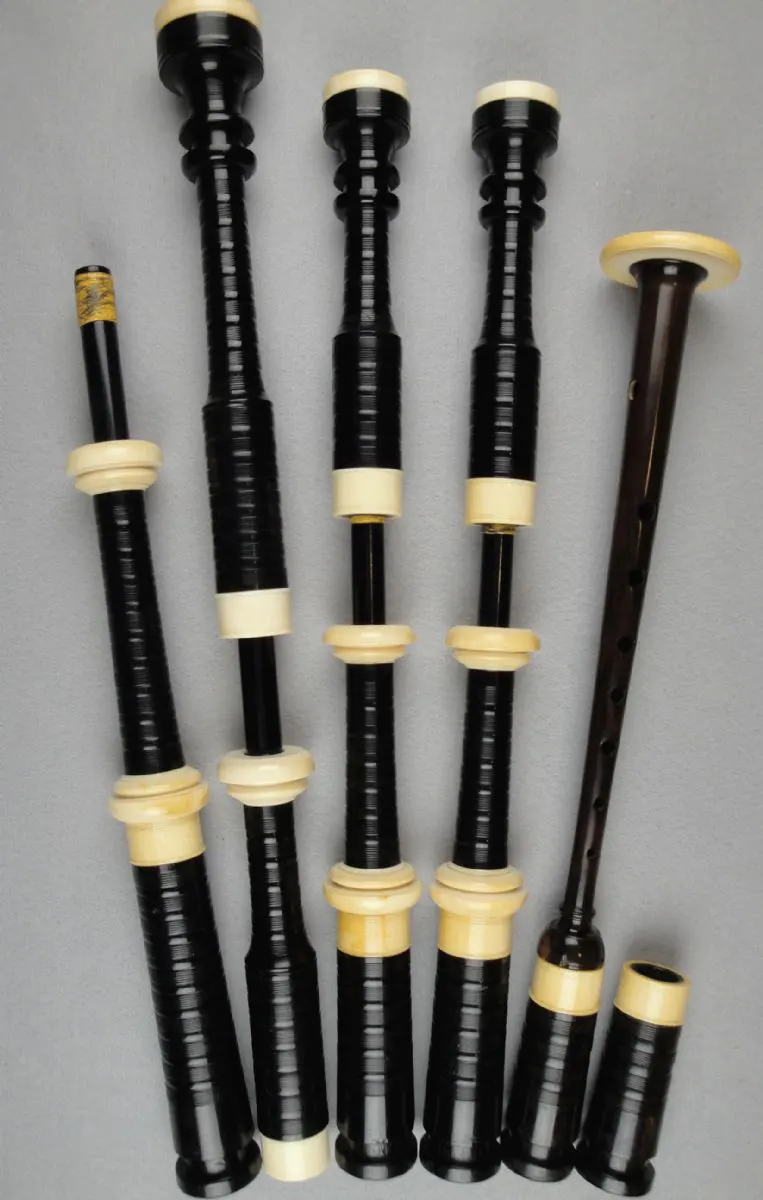
Stamped William Ross (Queen’s Piper), in Ebony, Full Ivory, Brass Inserts
SOLD – This is another rare and remarkable set sold on this site some years ago to an owner who for personal reasons is downsizing his collection.
William Ross was a monumental piping figure during the latter half of the 19th-century. He was born in 1823, and died in 1891, having held the position of Queen’s Piper to Queen Victoria since Angus Mackay’s death in 1854. His 1869 publication of piobaireachd and light music, called “Pipe Music” is one of the most significant collections of the century.
The exact history of his pipemaking business is not clear. He was a very clever businessman and well-to-do. Jeannie Campbell tells us he made the prize pipe at Inverness from 1873 to 1886. Whether he was a turner himself or not we aren’t sure, but later on he hired turners to make his pipes for him. From about 1880 onwards, he used Henry Starck, whose family had immigrated to London from Germany many years earlier. This would mark the beginning of the Starck pipemaking business, and the pipes made by the company for the next 30 years would be their best.
After Ross’s death, Starck would stamp his pipes “H. Starck/late W. Ross.” It is thought that sets stamped only “W. Ross” were the earliest, perhaps even turned while Ross was actively involved in the business.
Starck and Ross were meticulous about stamping instruments, often in several places, and this set is stamped “W. Ross” on each stock. The distinctive projecting mounts are typical of Starck’s later wide shapes, though shallower and using a softer, rounded bead rather than the straight cut bead he would use later on. This styling may well have originated with Ross. The tuning chambers have brass slides installed. One drone ferrule has a narrow split that was filled during the orignal restoration some years ago.
All pieces appear to be original, though the blowstick was missing. A new poly-lined blackwood blowstick has been made using an old, matching Starck mount. The chanter with this set a Brian Donaldson chanter with an original W. Ross ivory sole. The original chanter stick was damaged beyond repair. (Note that these photos are the original photoset, and the chanter is not the same, though the sole is.)
The set had several cracks, only two of which required whipping. Kudos to Dunbar Bagpipe Maker for a remarkable restoration of this instrument, which now should have another 100 years of life left in it.
The tone of this set is typical of the earliest Starcks: big, robust and buzzy: very much a MacDougall sound. They are as steady as a rock and a joy to play and behold.
-
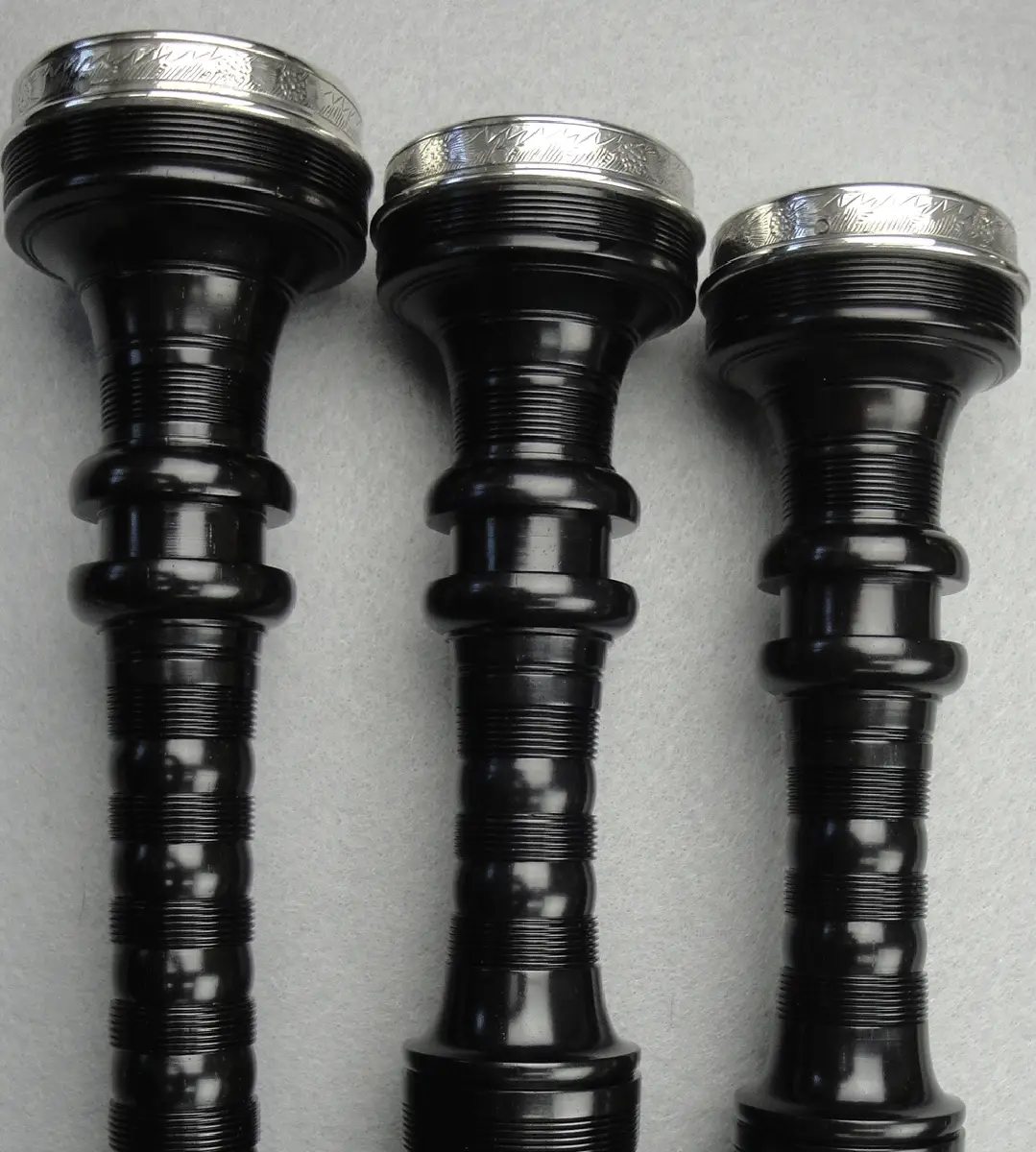
Lawries, Circa 1950, Silver and Ivory
SOLD – This set of Lawries is in prime condition and was likely made around 1950.
These pipes came to me in excellent shape. They have been stripped and refinished. A tiny hairline crack was found just around the ferrule on one tenor drone stock and this has been sealed. The blowpipe was bored out to provide a restriction-free modern bore. The original ivory bulb was not present — these crack with moisture and rarely survive — but the engraved metal sleeve was, so the sleeve was fitted to an imitation ivory bulb.
This Lawrie set displays a classic, seamless, steady Lawrie sound that ranks with the best of this make. The set comes with the original chanter and sole. In truth, Lawrie chanters were never among the best made, but it is good to know that the set was cared for well enough that the original chanter is still present along with the sole.