
Working with vintage bagpipes is as much a hobby as a business for me. I enjoy the process of turning up old pipes and making sure they will be played for years to come. I think it is a good thing for piping. As such, I take great care in purchasing, examining and restoring old pipes.

My refurbisher is J. Dunbar Bagpipe Maker in St. Catharines, Ontario. Not only do they do masterful restorations, they have eagle eyes for examining 150-year-old wood and discovering replacement pieces and flaws that should be addressed before you play the pipes. If a set of pipes has a replacement or repaired piece, you will know about it before you buy.
You should know from the get-go that pretty much every bagpipe made before 1930 has required or will require repairs of some sort, especially if they are ebony. Ebony and cocuswood are superb woods from which to make bagpipes but they are less resilient than African blackwood. I suspect there is hardly an ebony bagpipe in the world made before 1920 that hasn’t experienced at least one crack.
Photos and descriptions of all instruments featured since October 2010
-
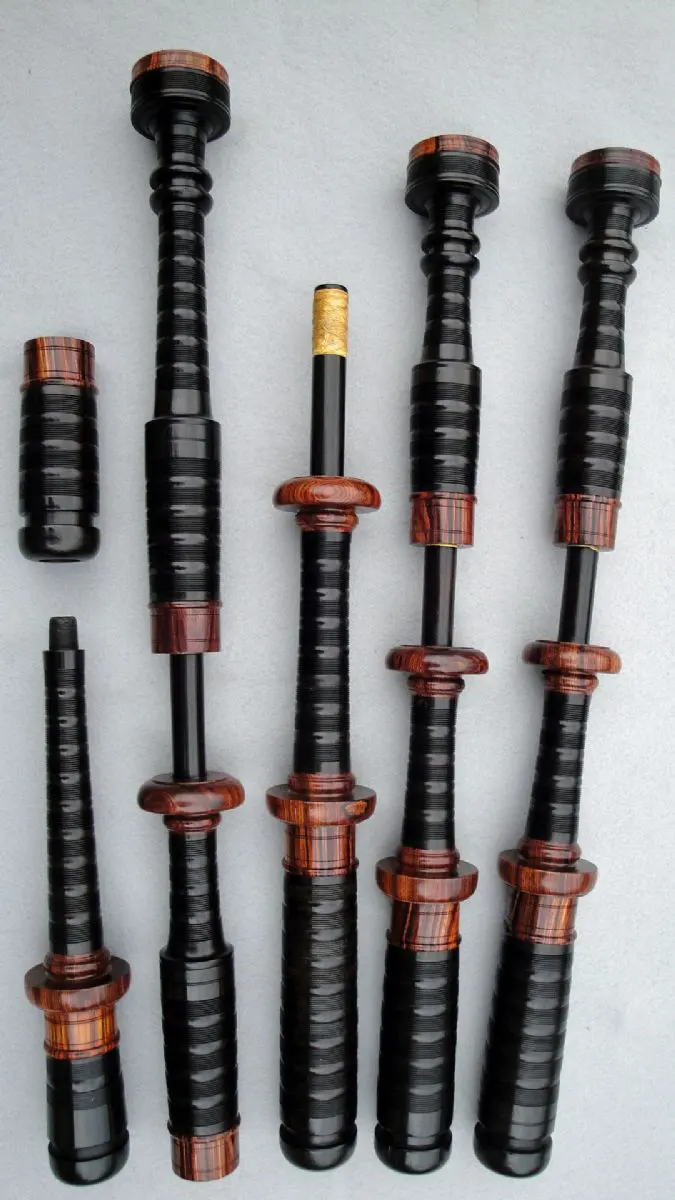
Robertsons, Circa 1940, Fully Mounted in Cocobola
SOLD – This set of Robertsons was originally mounted in casein, an imitation ivory material used in the early and mid-1900s. Casein unfortunately breaks down over time to acquire an unattractive chalky appearance. The casein on this set had deteriorated quite a bit, which would date them from the 1930s or 1940. The pipes themselves were in superb condition, so the casein mounts were removed and replaced with cocobola wood.
The pipes were stripped and refinished when they were remounted.
James Robertson made pipes from just before the Great War until he died in 1948. His company continued into the 1960s. His reputation for tonal and manufacturing consistency over this long period of time is almost unequaled. His drones are full, rich and steady, and this set is no exception.
-
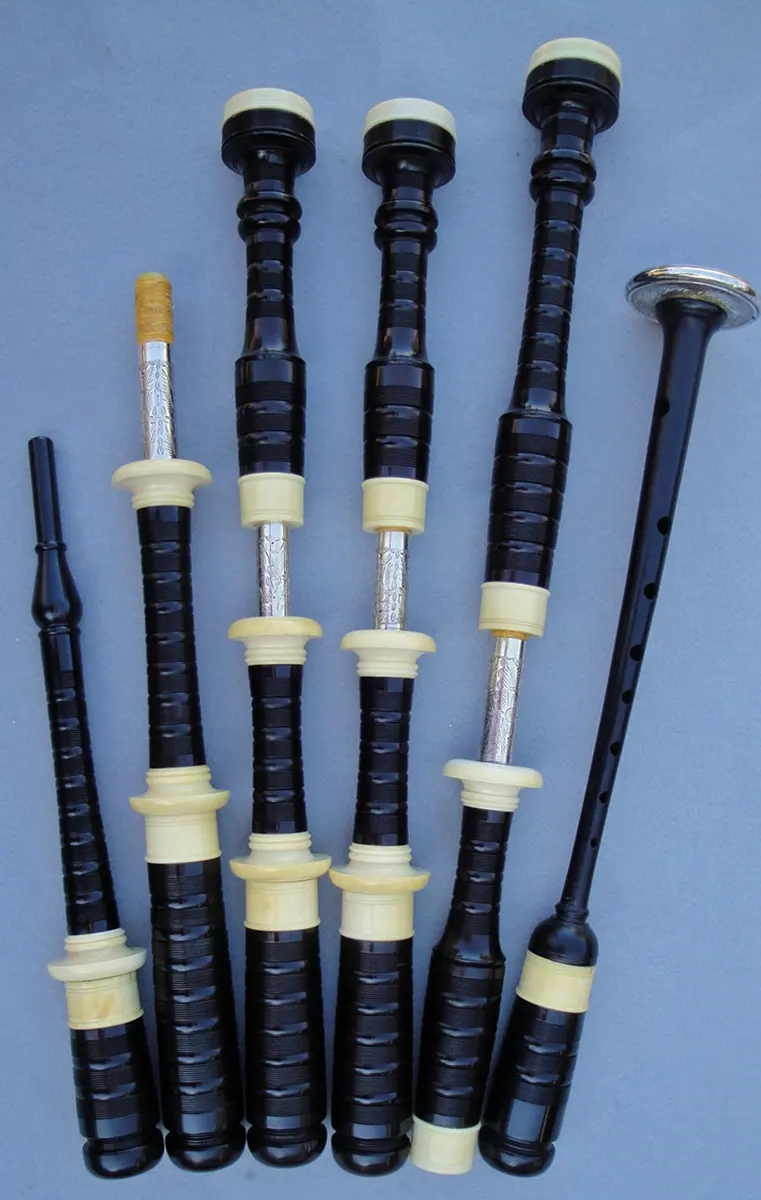
Wm. Sinclair and Son, 1945, Blackwood, Ivory, Engraved Silver Slides
SOLD – William Sinclair & Son has been a premier pipemaker since it was founded in 1931 in Edinburgh. Though the Sinclair chanter has been an iconic band chanter since the 1950s, Sinclair drones have gained an equal reputation for craftsmanship, steadiness and tonal brilliance. I won the Gold Medals at Oban and Inverness and the Clasp at Inverness on a set of silver and ivory 1948 Sinclair drones.
This is an absolutely lovely set, in superb shape, with great lines and a lovely, bright sound like my set. The slides are engraved sterling silver, hallmarked 1945. The Sinclair practice of putting serial numbers on chanters has been followed here as well. Barely visible on the top of the slide on the bass bottom is “432201-945” — the last three numbers matching the hallmark date on the silver.
A new blowpipe and stock were made with original mounts to replace the cracked originals. Both are lined with polypenco to prevent cracking.
The wood and ivory on this set are gorgeous, and they sport the distinctive one-piece-full ivory caps typical of the Sinclair brand. The pipes play beautifully — steady, rich and bright. The chanter is original and looks like it has been broken and expertly put back together again. It plays beautifully.
-
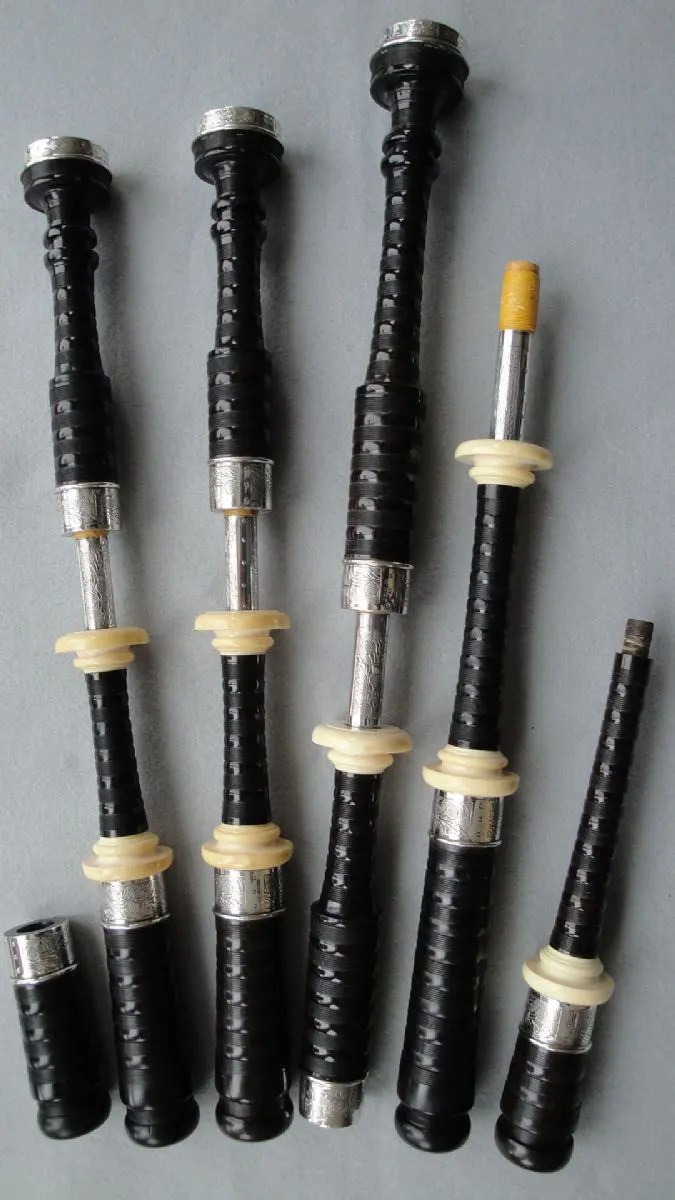
R. G. Hardie, 1961, Engraved Silver and Ivory
SOLD – Bob Hardie made pipes from the late 1940s until the 1980s. He was a careful craftsman and used excellent blackwood.
His pipes are extremely steady, though they do not produce a big sound like the old Henderson or Lawrie sets. They are a very reliable and effective choice for a hobby piper wanting a stable, trouble-free silver and ivory set.
This set is in superb condition, with no flaws on the wood or ivory. It appears that one tenor stock and the blowstick stock are newer than the rest of the set (original mounts), and were probably replaced at the Hardie shop at some point.
The pipes were recently refinished.
-
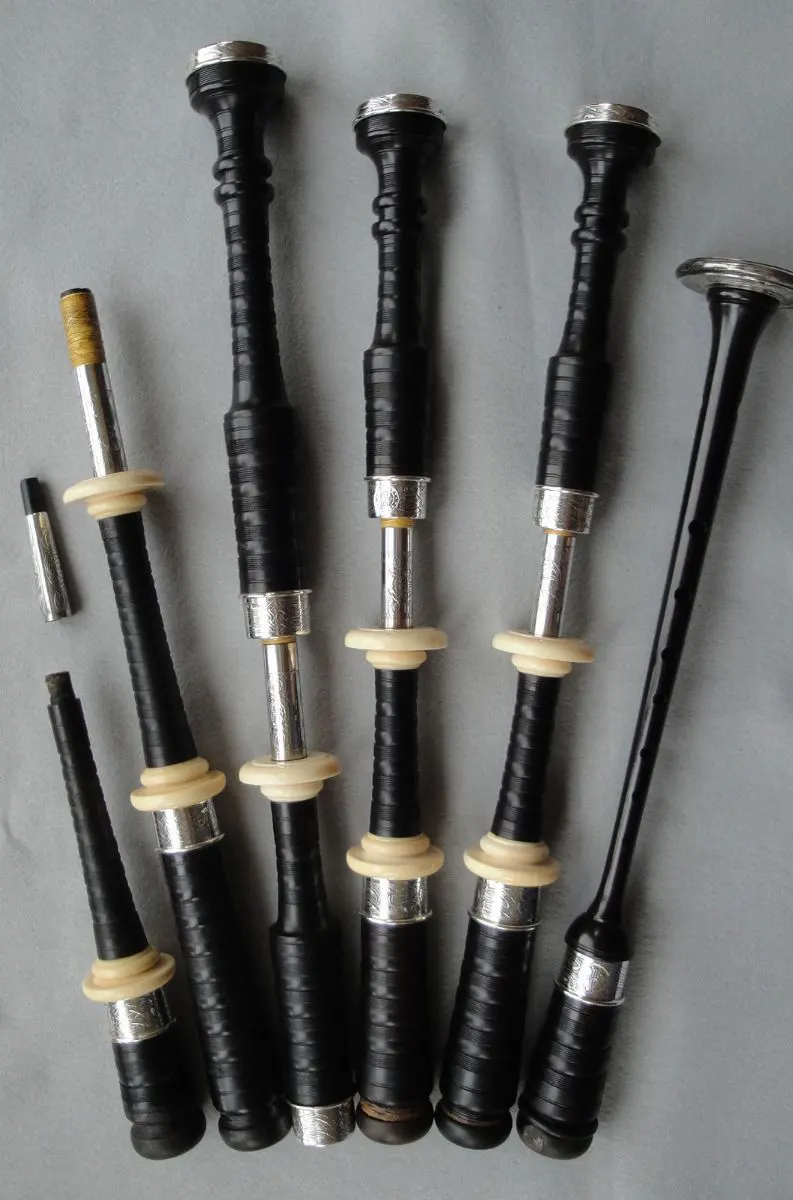
Engraved Silver and Ivory Lawries in Blackwood and Ebony, 1951-52
SOLD – This Lawrie set is hallmarked 1951-52. Two of the pieces (including the chanter sole) are hallmarked 10 years later, but are perfect matches. The pipes were apparently bought new in 1952. The wood appears to be a mix of blackwood and ebony.
All pieces are original and there are no cracks. The ivory blowtick bulb has been lost, though the original engraved mouthpiece sleeve remains. One of the ivory ferrules on the bass has some age cracks on the bottom, but the ferrule is still solid.
The hand-engraved silver is outstanding, as evidenced by the photos of the chanter sole and the three ferrules.
The pipes play with great power and steadiness — typical Lawrie attributes.
The chanter doesn’t appear to be original to the pipes. Where the bulb meets the stock is not a perfect match in diameter, which it would be if it were the original Lawrie chanter. This may not be a bad thing. While Lawrie drones are top-of-the-heap, the chanters… not so much. This chanter has no maker’s name. It is quite good, though I can’t say for sure who made it. If I were guessing I would say Sinclair.
-
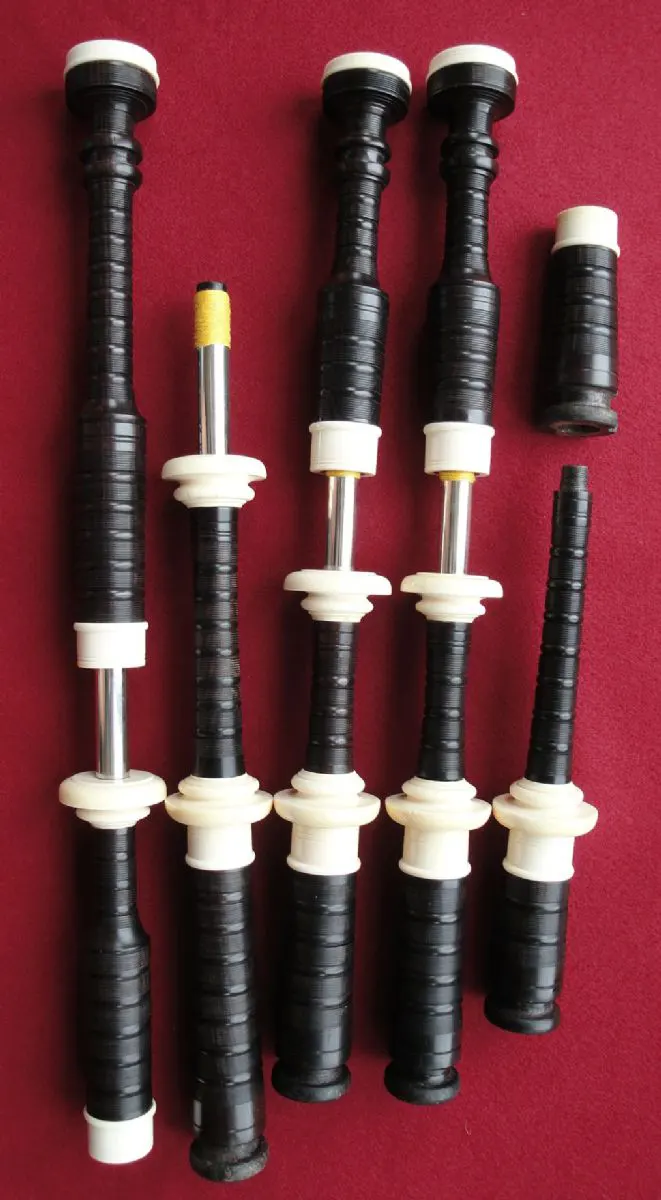
Circa 1940s Starck in Blackwood, Full Ivory, Nickel Slides
SOLD – This set of 1940s Henry Starck pipes comes from the estate of Captain John MacLellan, who purchased them in Edinburgh in the 1970s. Henry Starck came from a German woodwind making family that immigrated to London in the early 1800s. Henry began making pipes in 1889 and the company continued into the mid-1900s. The company was renown for its meticulous craftsmanship and instruments that can stand up against the best pipes in the business.
This set is blackwood, and all of the mounts are ivory. The tuning slides are nickel. It is very likely that the pipes underwent a cosmetic refurb just before Captain MacLellan purchased them, and it’s possible that the ivory ferrules were added at that time as the ferrules do not look as old as the projecting mounts and ring caps. The pipes were probably refinished then as well.
All pieces are original. One projecting mount broke in transit, but the break was perfectly clean and it has been glued back into place with just a light line visible at the join.
The tone is full and steady and similar to a set of modern Naills. This may be no coincidence, as Naill founder Les Cowell trained at Starck’s in the 1950s. The pipes are in virtually new condition.
-
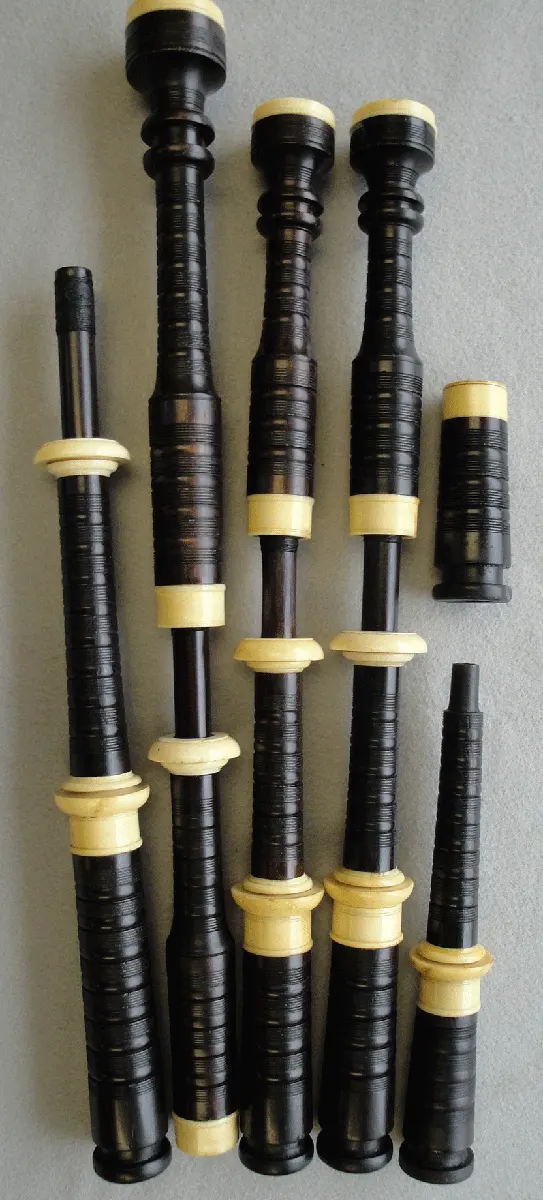
Circa 1890s Henry Starck, Cocuswood, Full Ivory
SOLD – Henry Starck was part of a woodwind-making family that came to London from Germany in the early 1800s. Henry Senior began making pipes in 1889 after William Ross, the Queen’s piper, convinced him there was a good market. His pipes would eventually became renowned and sought after for their tone and for a level of craftsmanship at which modern makers still marvel.
Starck stamped many of his sets. This cocuswood set is not stamped, but the projecting mounts are turned in Starck’s very distinctive style, and these drone bottoms are identical in every respect (including the combing) to two drone pieces I have that are stamped “H. Starck” just below the upper projecting mount. These pipes are not as meticulously crafted as later Starck sets and are thought to be a very early example of Henry’s work.
The pipes are all original, except for one replaced tenor drone bush, and they are in immaculate shape but for some slight staining on the ivory.
The tone is superb cocuswood: steady, buzzy and full, though not as robust as a Henderson set. The tuning chambers are perfectly even and the tenor drones tune in a perfect position above the hemp line.
The cocuswood gives the pipes a deep, reddish-brown hue with great old-school character.
-
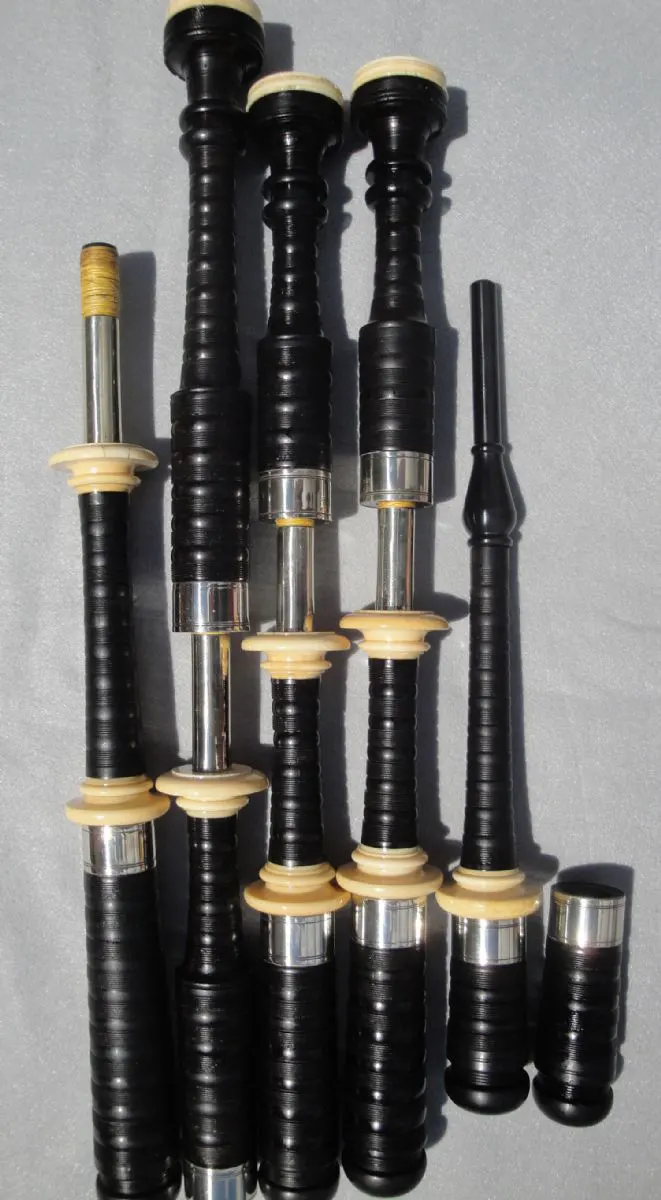
Henderson, Circa 1910, Ivory, Nickel
SOLD – This very old Henderson set is in superb shape for its age.
Dating is difficult with a set like this, but the shape and patina of the ivory suggest pre-Great War.
The nickel ferrules are original. The slides were added by the previous owner and are a perfect match.
All pieces are original and un-repaired, except for the chanter stock that had a slight crack that has been invisible whipped. The ivory drone caps have some normal age chipping. One projecting mount has had a piece of ivory about a quarter-inch square surgically inserted into what was undoubtedly a chip. The seams are visible but the ivory is a perfect match. The tuning chambers are perfectly even.
The tone is lovely: robust, but not overpowering; rich, with the deep, luxuriant Henderson bass and locked-in steadiness.
This is a prime, vintage Henderson set that would hold its own against any bagpipe in the world.The slight shine in the photos is the not-quite-dry remnants of a 4-day almond oil bath.
-
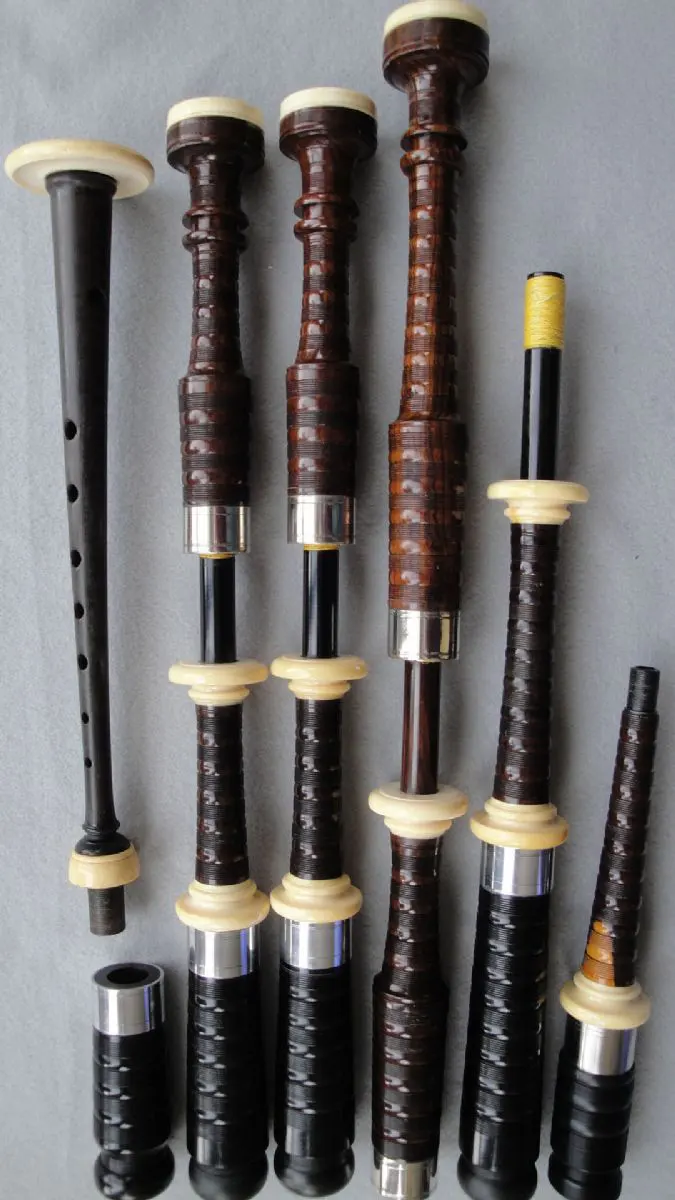
Henderson, Circa 1930, Cocuswood or Brazillian Kingwood, Nickel, Ivory
SOLD – Several of these Henderson sets have come up on the site in the last few years. They are either cocuswood or the lighter and more variegated Brazillian kingwood, or a mix of both. It seems to have been a fairly common Henderson configuration in the 1920s and 1930s: cocuswood or kingwood with ivory projecting mounts and ring caps, and nickel ferrules.
They are tonally superb sets, with a sweetness to the Henderson sound that is different from the more robust blackwood sound.
The set has no original chanter (the chanter in the photographs was included by mistake). All five stocks are replacements with matching ferrules, as there were no stocks with this set. The blowstick stock is poly, the rest are blackwood.
The pipes have been refinished.
-
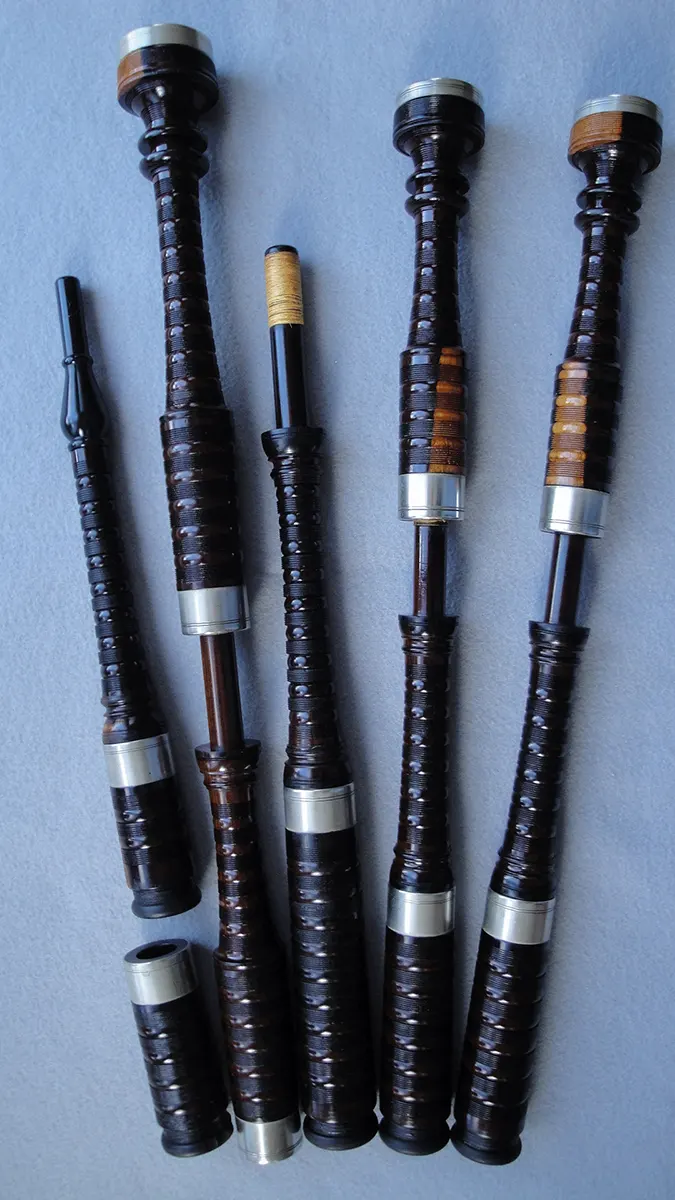
Circa Late 1800s Stamped David Glen in Cocuswood
SOLD -David Glen was a giant of piping. He was a prolific and significant compiler and publisher of pipe music, and the leading Edinburgh maker of bagpipes. His pipes are prized for their rich, steady tone, and stamped sets are historical icons. His meticulous craftsmanship is the envy of pipemakers even today.
This set is cocuswood with button mounts and nickel ferrules and rings. The David Glen stamp appears at the top of the bass drone stock.
The tone is vintage Glen: rich and remarkably steady. This set is more reserved than the Henderson or MacDougall sound, but is fuller than most Glens, perhaps due to the cocuswood.
This set is flawless but for one very effective repair in one tenor top. A crack that begins under the ferrule and extends above it has been ‘whipped’ under the ferrule with the addition of a brass ferrule under the nickel ferrule. The crack has been sealed with glue. This repair existed when the previous owner acquired the pipes in 1986, and the pipes have been played ever since with no change in the status of the repair. The seam of nickel ferrule opened at some point, but it too has never budged.
The finish in light varnish is also the pre-1986 finish and is in immaculate condition. No refurbishment was required on this bagpipe. This set was recently removed from an almond oil bath, resulting in some reflection in the photographs.
This is a lovely David Glen set with a sweet sound, and with no concerns for travelers or buyers worried about ivory mounts.
-
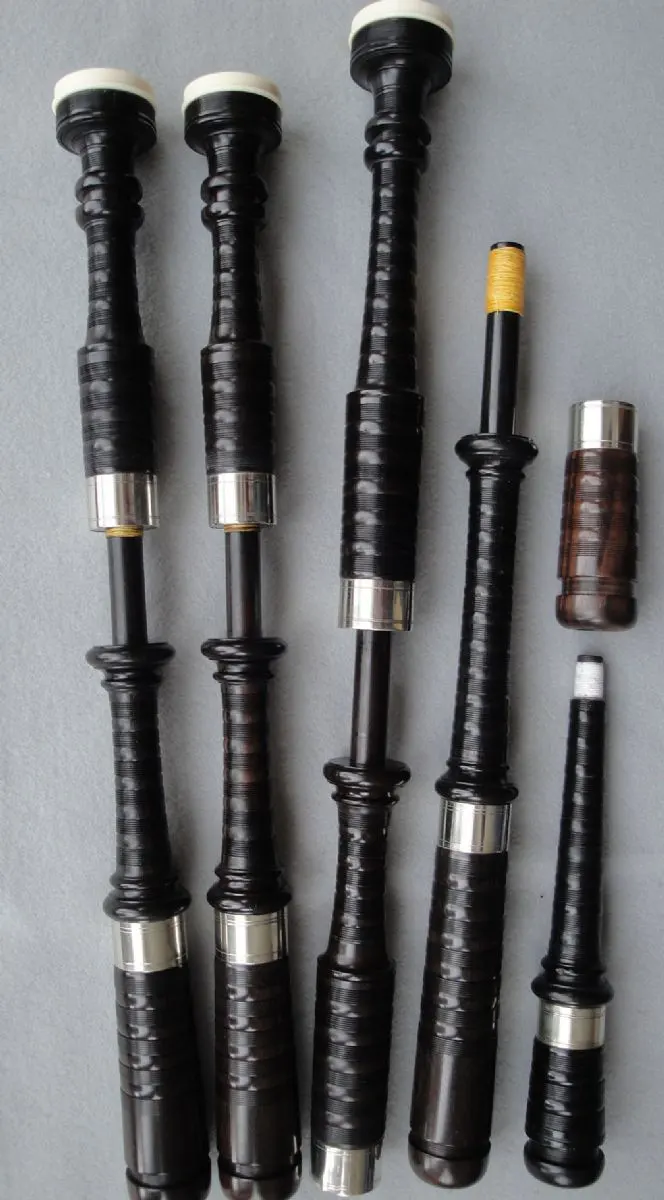
WWI-era Ebony Henderson, Ivory Caps, Nickel Ferrules
SOLD – If you’re looking classic ebony-Hendersons without all the expensive bling, this may be your set.
This Henderson set is ebony, likely made between 1910 and 1925, with nickel ferrules and and new ivory caps. The caps were originally worn and chalky casein, but it was just been replaced with elephant ivory from a 1950s ornamental tusk.
The pipes play a robust, rich and very steady Henderson tone.
All drone pieces are original and in perfect shape. The stocks are all replacements, made with ebony and with matching nickel ferrules. Though the stocks may look brown in the photos, they will darken up to match the wood in the drones.
The pipes have been refinished. This is a very sweet set of early Hendersons.
-
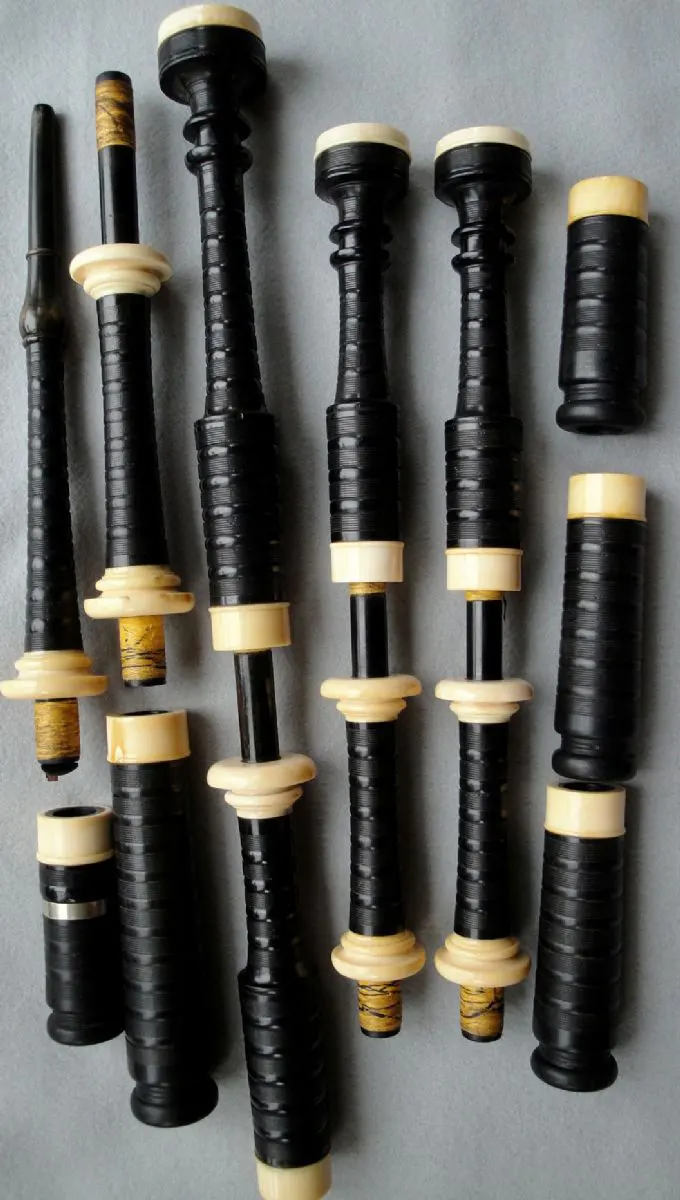
Duncan Macdougall, Circa 1890, Ebony, Full Ivory
SOLD – Many pipers believe that of all pipemakers, Duncan MacDougall, in his prime, displayed the greatest combination of tonal excellence, craftsmanship and style. He began making pipes around 1858 and died in 1898, leaving the firm to his son Gavin. Duncan MacDougall’s pipes are prized above almost all others.
This set likely dates from about 1890, later in Duncan’s career. They are likely ebony, though a hint of red through parts of the finish might suggest cocuswood. All mounts are elephant ivory.
The pipes came from an estate disbursement and had not been played since 1929. I acquired them from pipemaker Blue MacMurchie, who buffed the ivory and the wood, but did no other work on them. There was a barely visible crack in the top of the blowpipe stock near the ferrule, which I had invisibly whipped. You cannot tell this work was done.
I have played the pipes since last fall, and they are spectacular: steady, rich and full. There are no cracks or major blemishes. The tenor caps are slightly different, suggesting work may have been done sometime in the past, but the two tenor tops are certainly original.
One curiosity is the two-piece blowpipe stock equipped with a built-in brass watertrap, which I found quite useful used in combination with my McGillivray Piping tube trap. I’ve seen this on only two other sets, including a silver and ivory MacDougall set I now own that is replacing this set as my #1 pipe. -
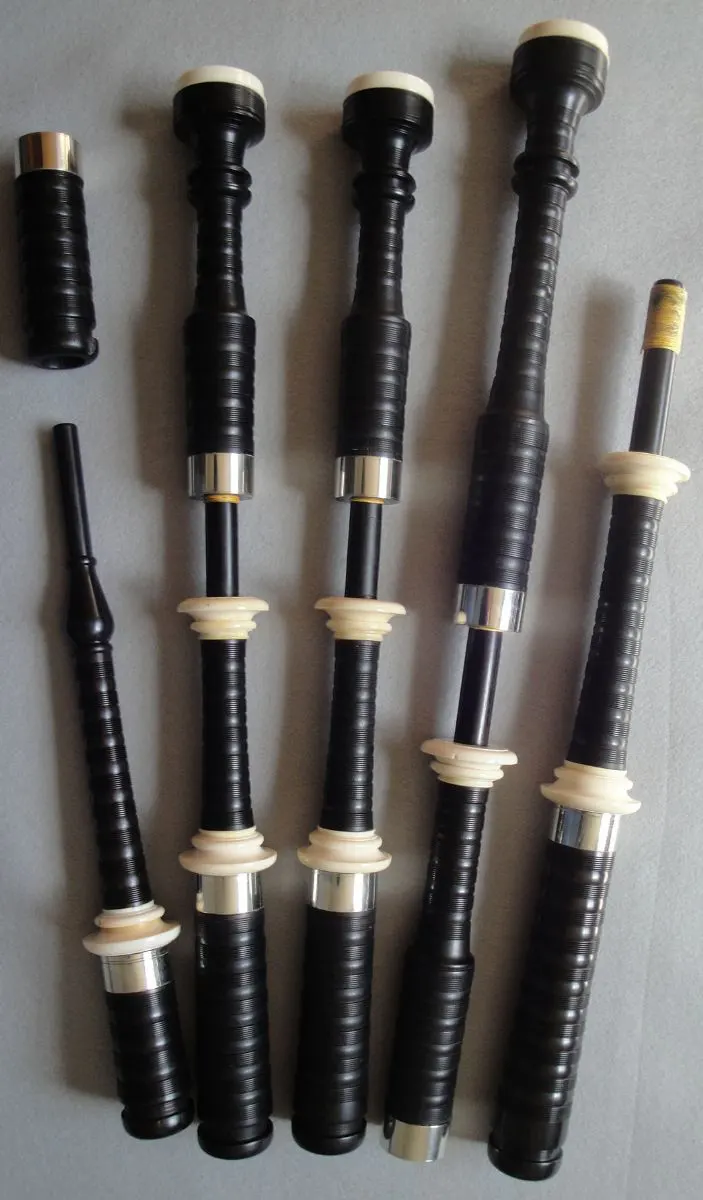
Duncan Macdougall, Circa 1890, Restored, Full Ivory
SOLD – This is a classic MacDougall from Duncan’s later career, but it has undergone a substantial restoration at some point. A number of pieces are replacements, some with original ivory, some without.
First, a warning: the set was acquired from a frequent ebay seller. Though promoted on ebay as ‘all original,’ stamped, and with some restoration, the set proved to be beautifully made and with a great sound, but not ‘all original’ at all. Further research into the seller’s website revealed that almost none of the sets being offered are what they appear to be: makers are unauthenticated and guesses at best. The seller refused to compromise on the sale or provide a refund, so products offered on the ‘Vintage Bagpipes’ site or by this seller on ebay are best avoided.
The good news is that only one replacement piece (the bass middle) is modern and blackwood. The rest are ebony and quite old, so the bagpipe is by no means a modern reproduction. All stocks and the complete bass drone are replacement pieces. Most of the ivory is original, though some pieces appear more pristine than others and may be replacements, albeit very good ones. In the bottom-right photo below, you will see a ‘D. MacDougall Aberfeldy’ stamp right below the ivory mount. The letters are clearly askew, indicating that the stamp is a forgery produced with individual letter stamps, rather than with a true maker’s stamp.
Good news part 2, is that they fooled me. I was initially very impressed with the tone and look of the pipes. It was only through Dave Atherton’s generous offer to examine them that I learned of the discrepancies. So, while not original, the bagpipe is still of a very high quality, both tonally and aesthetically, and is a first-class instrument. The same bottom-right photo shows the bass top (old replacement) and tenor top (original) side by side, and clearly the match is excellent. This same cohesive appearance marks the entire instrument, as shown in the photos.
The tone is full, rich, and extremely steady. They went beautifully with the first set of reeds I put in them. Despite the questionable pedigree, the sound of this bagpipe still says Duncan MacDougall.
If you’re looking for a great 100% original, stamped Duncan MacDougall set, save up about $7,500 and continue your search. If you’re looking for a superb set of ebony/ivory pipes in the Duncan MacDougall tradition with a mix of original and old replacement pieces at an affordable price, this one will fit the bill quite nicely.