
Working with vintage bagpipes is as much a hobby as a business for me. I enjoy the process of turning up old pipes and making sure they will be played for years to come. I think it is a good thing for piping. As such, I take great care in purchasing, examining and restoring old pipes.

My refurbisher is J. Dunbar Bagpipe Maker in St. Catharines, Ontario. Not only do they do masterful restorations, they have eagle eyes for examining 150-year-old wood and discovering replacement pieces and flaws that should be addressed before you play the pipes. If a set of pipes has a replacement or repaired piece, you will know about it before you buy.
You should know from the get-go that pretty much every bagpipe made before 1930 has required or will require repairs of some sort, especially if they are ebony. Ebony and cocuswood are superb woods from which to make bagpipes but they are less resilient than African blackwood. I suspect there is hardly an ebony bagpipe in the world made before 1920 that hasn’t experienced at least one crack.
Photos and descriptions of all instruments featured since October 2010
-
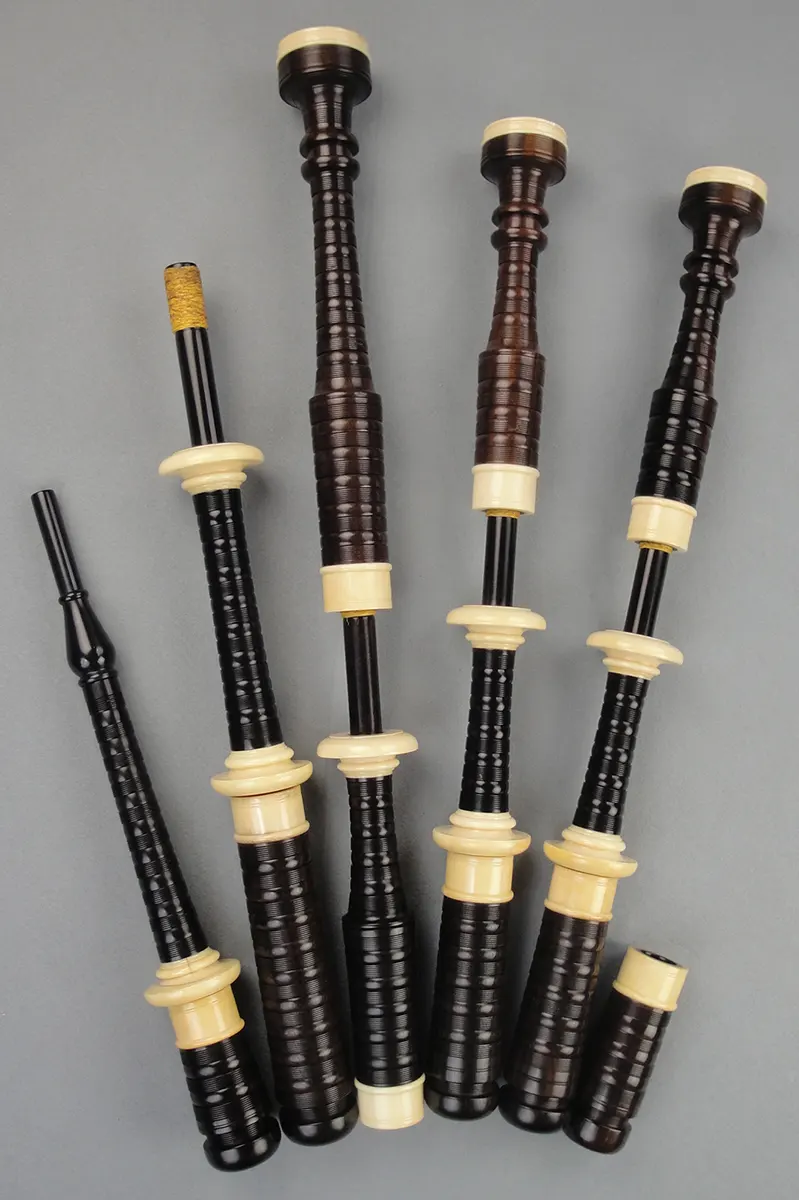
Henderson, Circa 1915, Ebony & Blackwood, Full Ivory
SOLD – This gorgeous set of Hendersons came to me covered with a thick coat of inky material and varnish. I had no idea what kind of wood they were. Once stripped though, they were revealed to be a gorgeous Henderson bagpipe with African blackwood stocks and ebony drones. The profiles and mix of woods suggest a manufacturing period between 1910 and 1920. During the transition to blackwood, makers commonly mixed woods. This particular one is a clever mix, since blackwood is a more resilient wood and better suited to stocks than is ebony.
Hairline cracks were repaired in the blowpipe stock and chanter stock as well as one tenor stock. The bagpipe was refinished. There are a few spider lines in the ivory, and some yellowing on two of the stock ferrules.
The drones played as I expected they would, with the classic, bold and seamless Henderson sound becoming apparent as I pulled the middle tenor into tune and the pipes locked.
Play these on any stage in the world, or enjoy them in your own piping room.
-
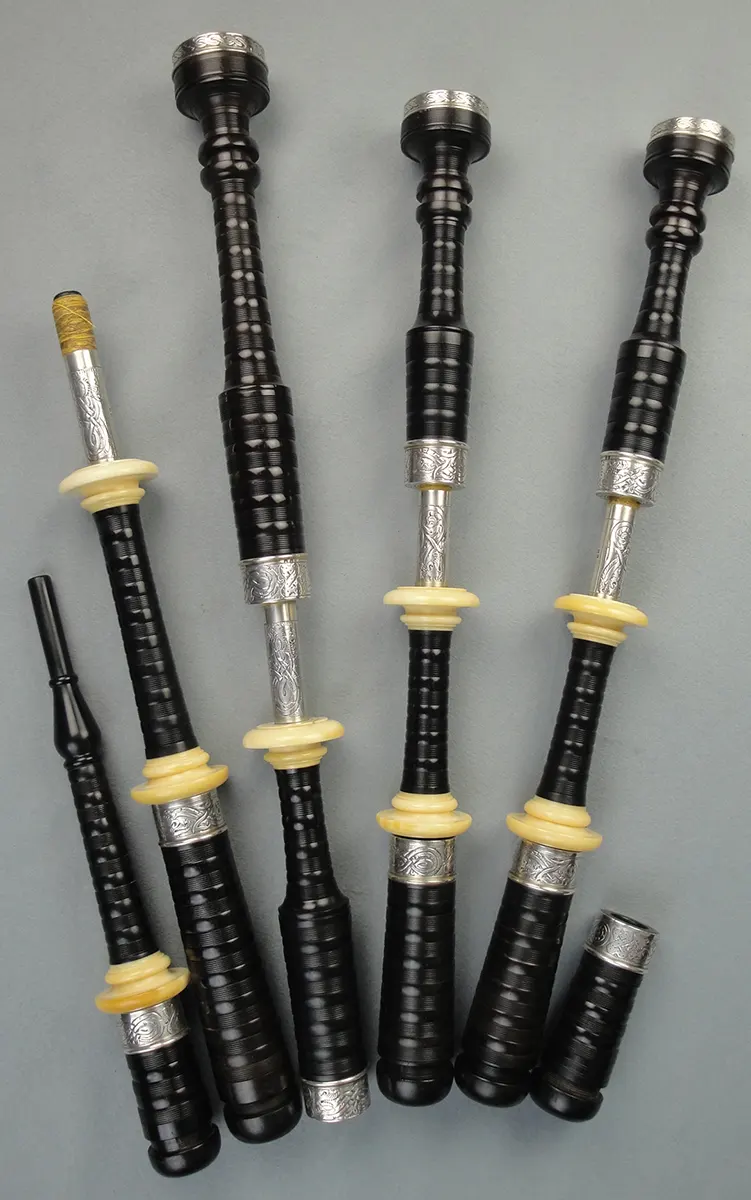
Henderson, Silver and Ivory, Hallmarked 1915-16
SOLD – These don’t come around very often.
This great old set of Hendersons came to me as is. I knew the previous owner, what he thought of these pipes and how well he took care of them. They are a gem.
I recall that he had the pipes refurbished at some point in the not-too-distant past, so after a polish on the lathe they looked pristine. I think the blowstick stock and chanter stock have had some excellent invisible whipping done on them, but it’s hard to be certain.
A few spider lines on the ivory projecting mounts and the 1915-16 hallmark attest to the age of these pipes.
Unlike some Hendersons from this era, the cord guides aren’t stamped with the maker’s name, nor does the silver show the PH (Peter Henderson) maker’s name. But between myself and Ron Bowen — who is the foremost Henderson expert I know — we are confident that these are Hendersons.
The pipes played beautifully when tried by myself and another professional piper, each using our own reeds.
-
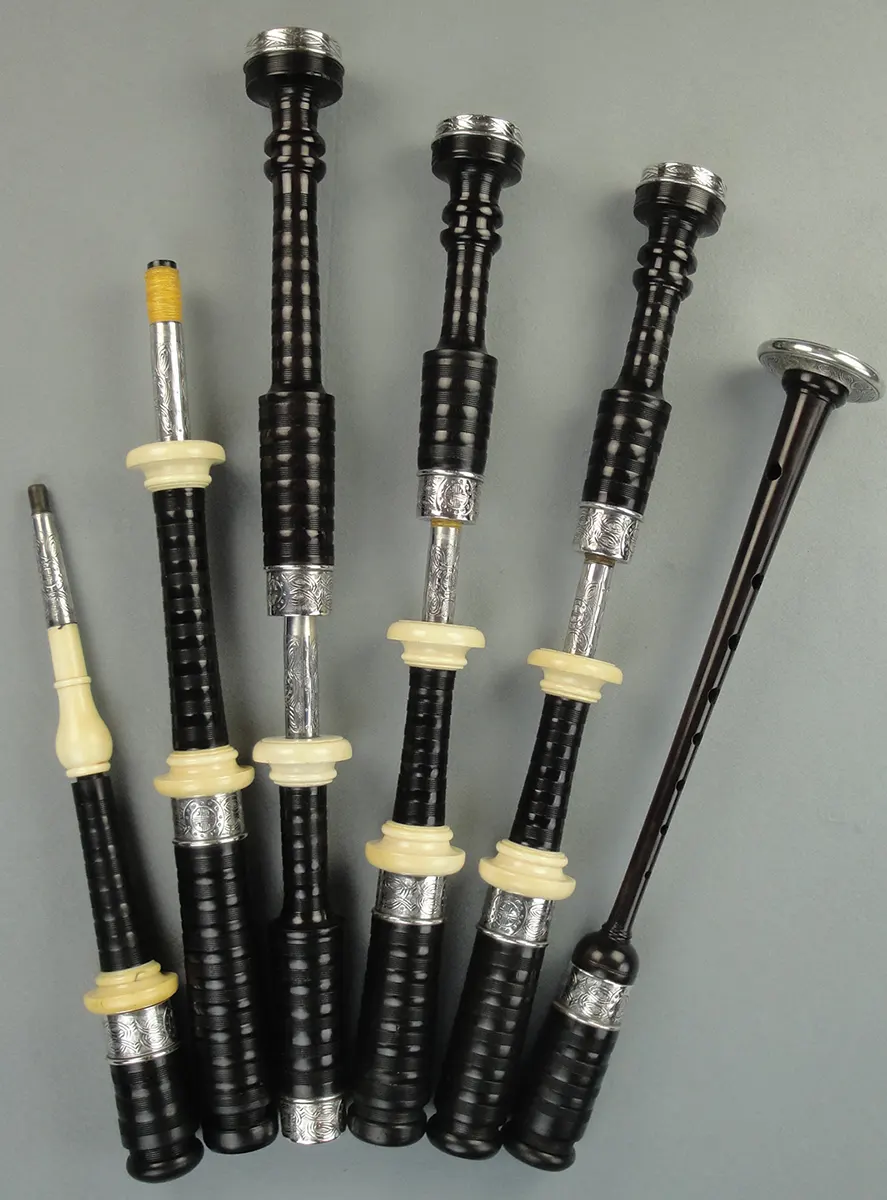
Grainger and Campbell, Silver and Ivory, Hallmarked 1969-70
SOLD – The Grainger and Campbell pipemaking company operated in Glasgow beginning in 1946. In 1952 they took over the premises and machinery from the defunct Duncan MacRae firm. They made bagpipes of excellent quality until the company closed in 1989.
This silver and ivory Grainger and Campbell set is hallmarked 1969-70 on every piece. The pipes were originally selected by Donald MacLeod — part owner of the Grainger firm along with John MacFadyen — for the late Geoff Neigh, brother of the more famous Ed, and a good friend of mine. I well remember Geoff playing this set in the old Guelph Pipe Band in the 1970s.
The set is in superb condition, requiring a good polishing on the lathe, and the reaffixing of a couple of the mounts. The blowstick stock had a hairline crack near the mount that has been invisible whipped. The original Grainger chanter is still with the pipes. These chanters played very well in their day, though they would be low-pitched in today’s piping world. The set also has its original silver and ivory mouthpiece.
Interestingly, the set has had modifications made to it by the late John Kidd. John believed that square edges in the bores created turbulence that affected the steadiness of pipes detrimentally. He rounded off the tops of the tuning pins and tapered the bottoms of the stocks to ease the flow of air. A surprising number of sets of pipes are around that show John’s work. Geoff Neigh swore by the modifications, saying that the pipes had never been steadier than after the Kidd treatment.
As expected, the drones on this set were full and very steady, locking into tune nicely with my Canning drone reeds.
-
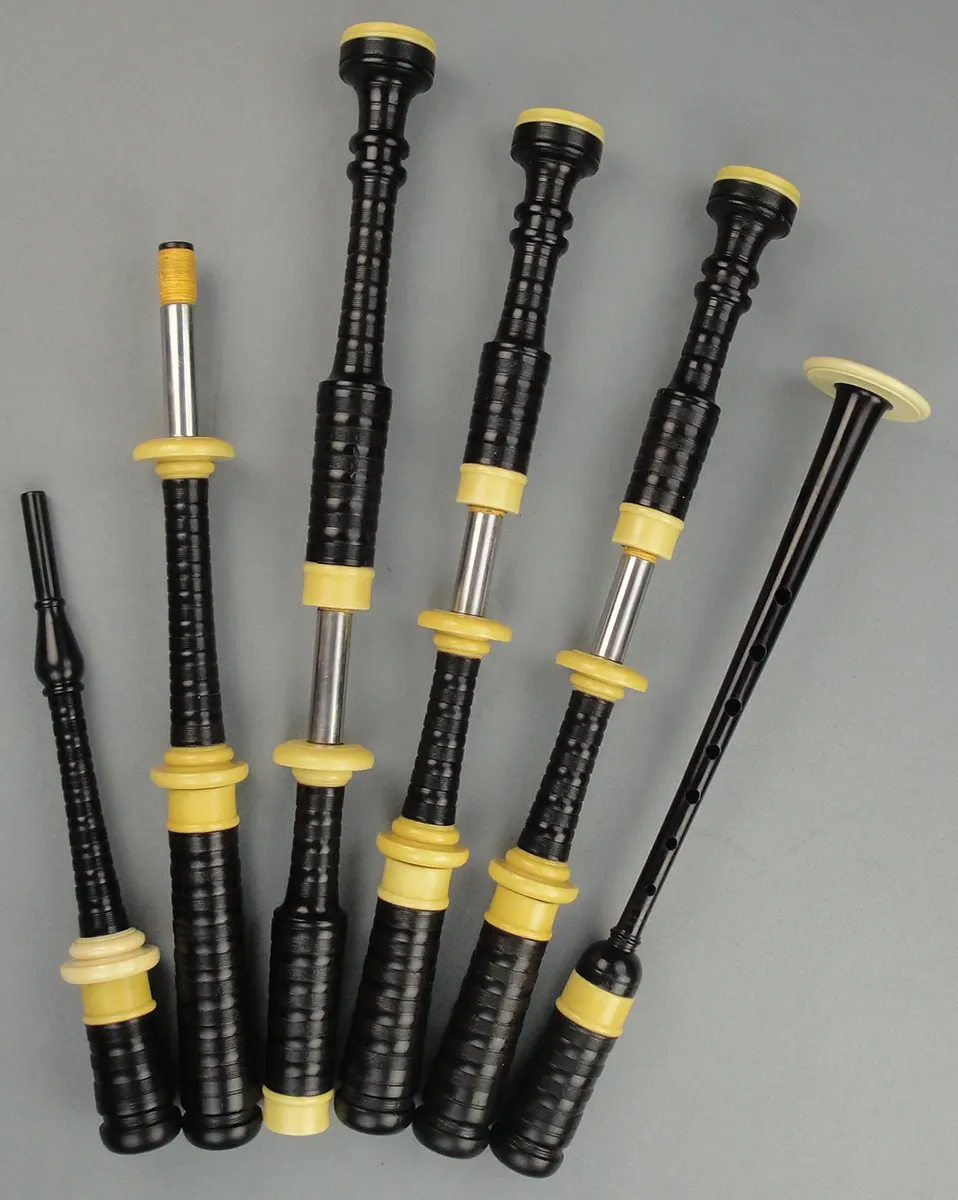
R. G. Lawrie, Circa 1930s, Imitation Ivory, Nickel Slides
SOLD – This set of blackwood Lawries was likely made in the 1930s. It is blackwood, with imitation ivory mounts and nickel slides. The pipes underwent a refurbishment that included and strip-and-refinish not too many years ago, so it was in great shape when I acquired it.
The drones have a typically robust Lawrie sound and immediately locked into tune with my Canning drone reeds. It was a lovely sound. The chanter appears to be original, but these old Lawrie chanters weren’t particularly tuneful, and it should likely not be played.
This is a well-priced, classic Lawrie set with a tone that would stand up beautifully on any stage.
-
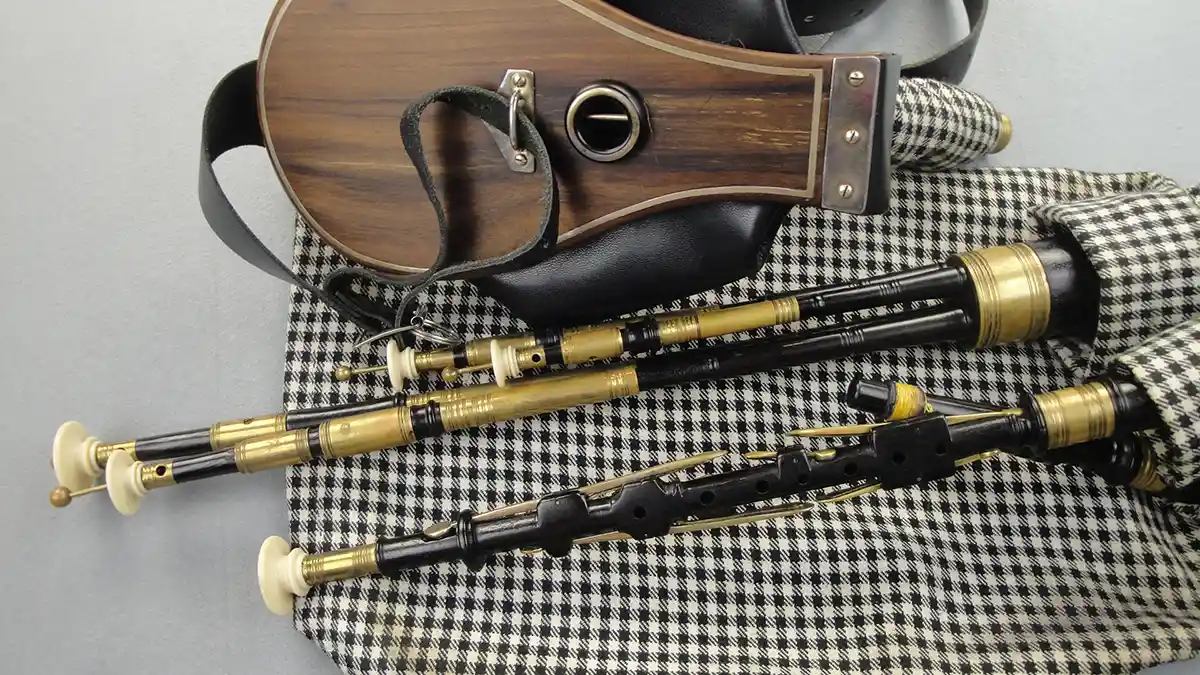
Northumbrian Smallpipes in F by David Burleigh
SOLD – Many a budding Northumbrian smallpipe player got their start on a reconditioned David Burleigh set just like this.
Burleigh numbered all of his sets, and this one is numbered 2,999. This F set was put into playing condition two years ago, still plays very well. The bellows was acquired from Colin Ross in 2001 (they aren’t original to the set). The pipes are African blackwood with brass keys and metalwork. The mounts are imitation ivory.
-
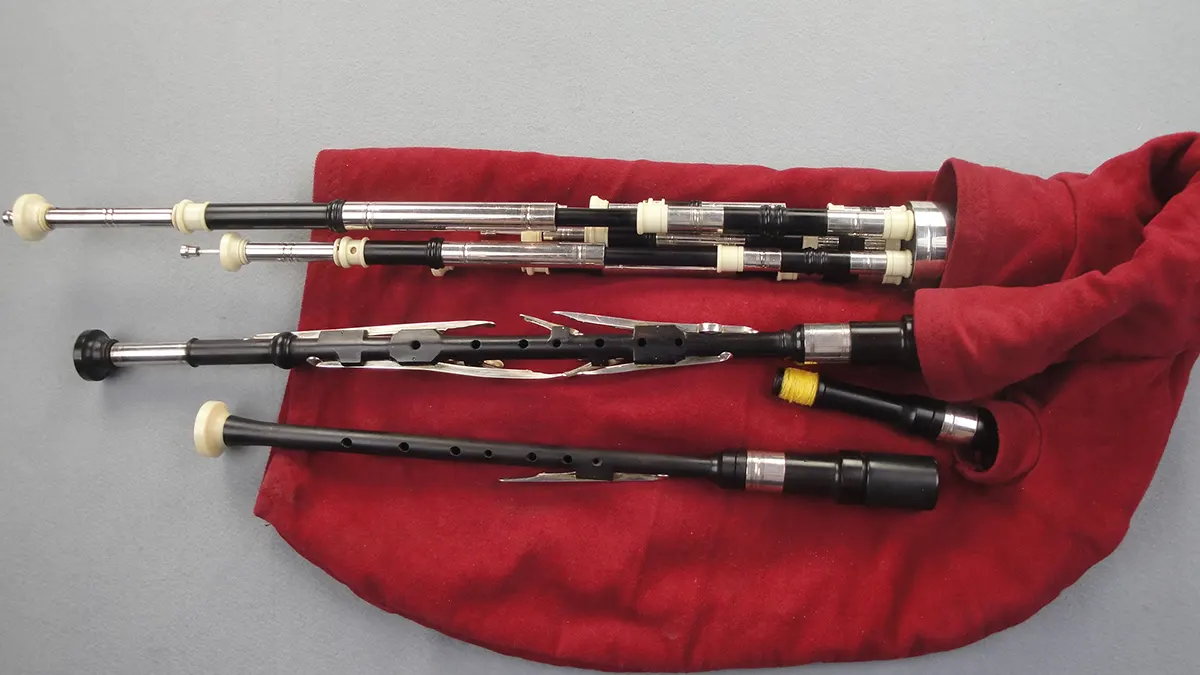
Northumbrian Smallpipes in D by Richard and Anita Evans
SOLD – This isn’t the usual offering one expects on a GHB site, but it IS a bagpipe, and a very nice one.
This set of Northumbrian smallpipes in the key of D was made by the firm of Richard and Anita Evans, who recently retired from making pipes. The set has an 11-key chanter and five drones, each with a tuning bead. The set also comes with an Evans Scottish Smallpipe chanter in D, with a high B key. The drones will play with either chanter. The pipes are in great condition, with excellent Evans drone reeds. Each chanter has a reed, but they are past their lifespan and should be replaced. Though retired, the Evans will still make reeds for their pipes.
The pipes are African blackwood with imitation ivory mounts. Keys and other metalwork are silver-plated brass.
The set does not come with a bellows.
-
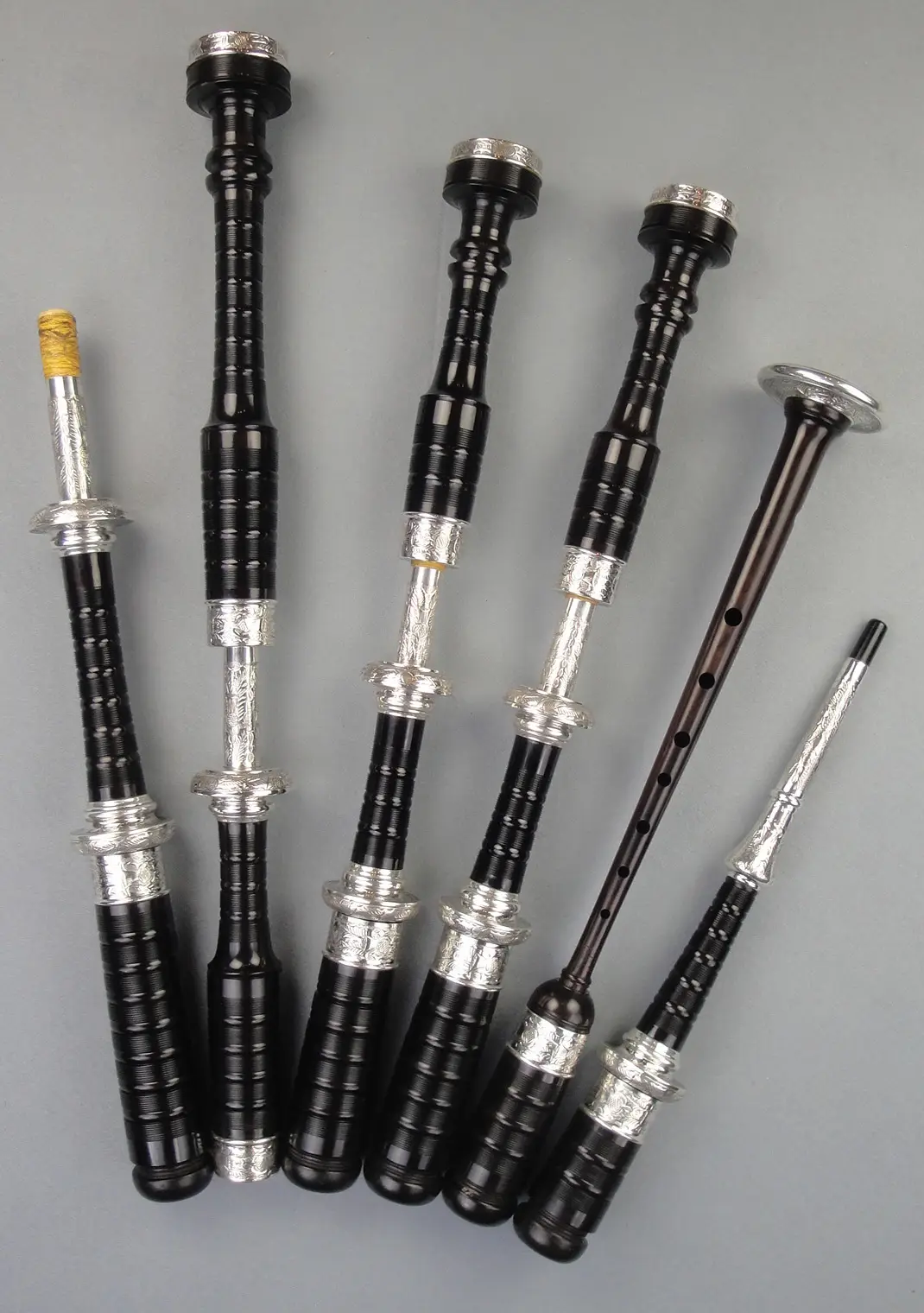
Full-silver William Sinclair & Son, Hallmarked 1966
SOLD – This stunning set came from an estate sale where it had never been played. It was originally purchased by a gentlemen who had never had a lesson and who, it would appear, never played them either. The pipes came to me without a mark on the wood or silver. The finish you see in the photos is the original, unblemished finish. This is essentially a brand new, 1966 full-silver Sinclair bagpipe.
This brief history comes from a letter to the Sinclair company from the owner and the return letter from Alistair Sinclair, both included with the pipes. The owner makes it clear that he always wanted a bagpipe but knows nothing about how to play. He asks for instructions. The reply offers basic blowing instruction, a tutor book, a practice chanter and a tin of seasoning. There is no further correspondence.
The pipes come with the original Sinclair chanter and matching silver sole as well as the original, good-as-new case with the Sinclair stamp on the inside of the lid.
The pipes required the re-affixing of many of the mounts, a polish, a shortening of the blowstick, rehemping and oiling.
They played like a dream. I played Sinclair pipes for 10 years at the height of my competitive career and loved the full, bright sound of the drones.
-
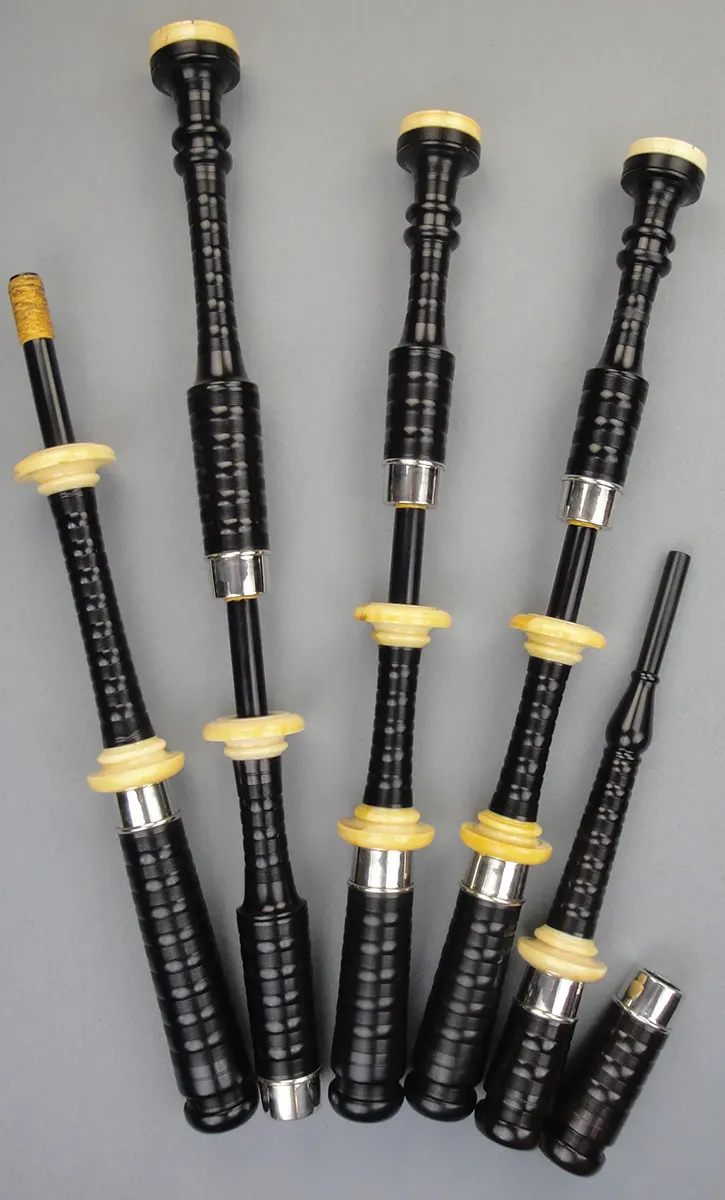
Lawries, Circa 1920, Nickel, Ivory Mounts
SOLD – This set had only one owner, who brought the pipes with him when he emigrated from Aberdeen, Scotland to the Canadian midwest in 1920 when he was 20.
The pipes are R. G. Lawrie, and the appearance, plus the above evidence, date the set from the years around 1920. The pipes are mounted in ivory and nickel — tapered ferrules, as Lawrie was wont to do.
The blowstick and blowstick stock were beyond repair and have been replaced with poly-lined, blackwood replicas. One tenor top had a small crack. Unfortunately, due to thin wood at that point in the drone, it had to be externally rather than internally whipped, and this is visible in the photos. The pipes have been stripped and refinished and since they haven’t been played since the 1980s, extra care has been taken in oiling.
Tonally, these pipes are typical Lawrie from this era: extremely robust and very steady, locking in nicely with my current set of Canning drone reeds.
-
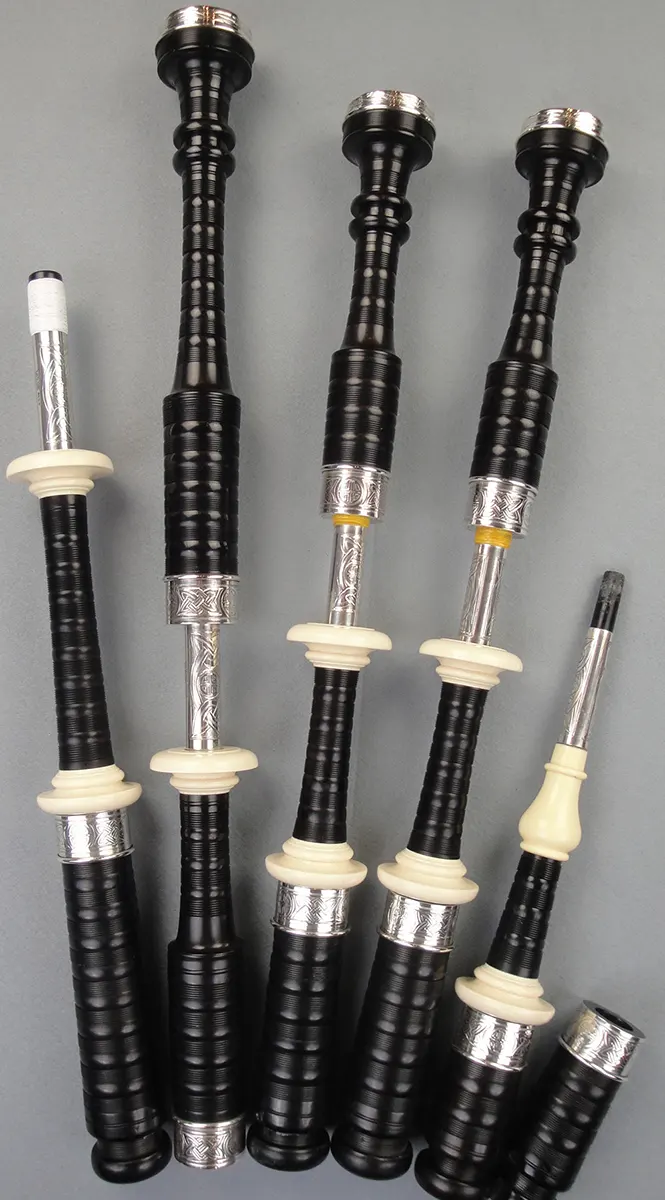
Circa 1920s Lawrie, Silver, Imitation Ivory
SOLD – This set came to me about a year and a half ago and has been my personal set for the past few months. They came to me as hallmarked 1926 Hendersons; however, this is not what they were at all. They were clearly Lawries, and while the pipes certainly had every indication of being from the 1920s — including the superb tone — the silver was neither PH hallmarked nor 1926. Only the slides are hallmarked, and as far as I can tell from the date stamp in the hallmark, the silver slides are from 1983. The rest of the silver may have been installed at the same time, but this is not certain.
The pipes are blackwood and the projecting mounts are new imitation ivory installed some months ago to replace ivory which was aging badly. Why did I play these pipes as my own set for some months? Because the tone was brilliant: a big drone sound that blended beautifully with the chanter. I couldn’t resist making them mine for a while.
The set was stripped and refinished during its initial refurbishment. All evidence points to this being a brilliant early Lawrie set, with silver added later.
-
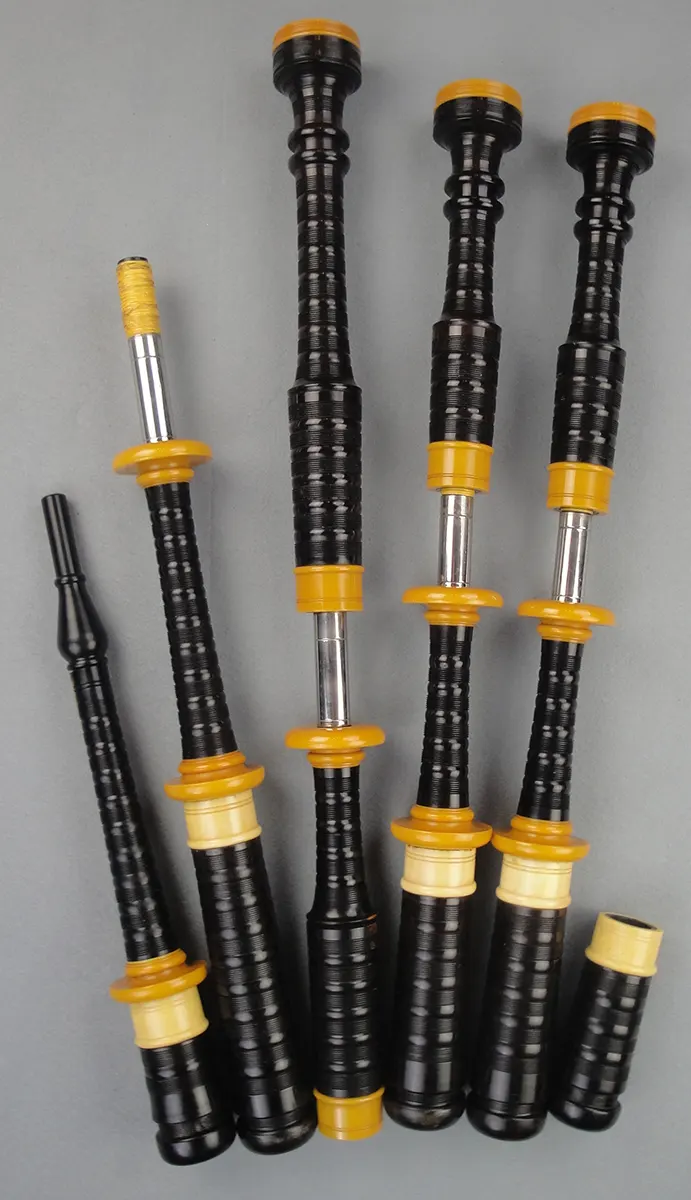
Boosey & Hawkes, Circa 1960, Nickel, Imitation Ivory
SOLD – Boosey & Hawkes was a woodwind instrument maker in London who took over the Starck shop when it closed in the mid-1950s. The firm made pipes but they also had other makers make their pipes, mostly Lawrie and Starck.
This set is in excellent condition, although the original stocks were lost and have now been replaced by stocks from a different set. The blowpipe has been lined with brass. These pipes played very well with my reeds: steady, full, and very much in the Naill tradition.
This set provides good tonal quality for an affordable price.
-
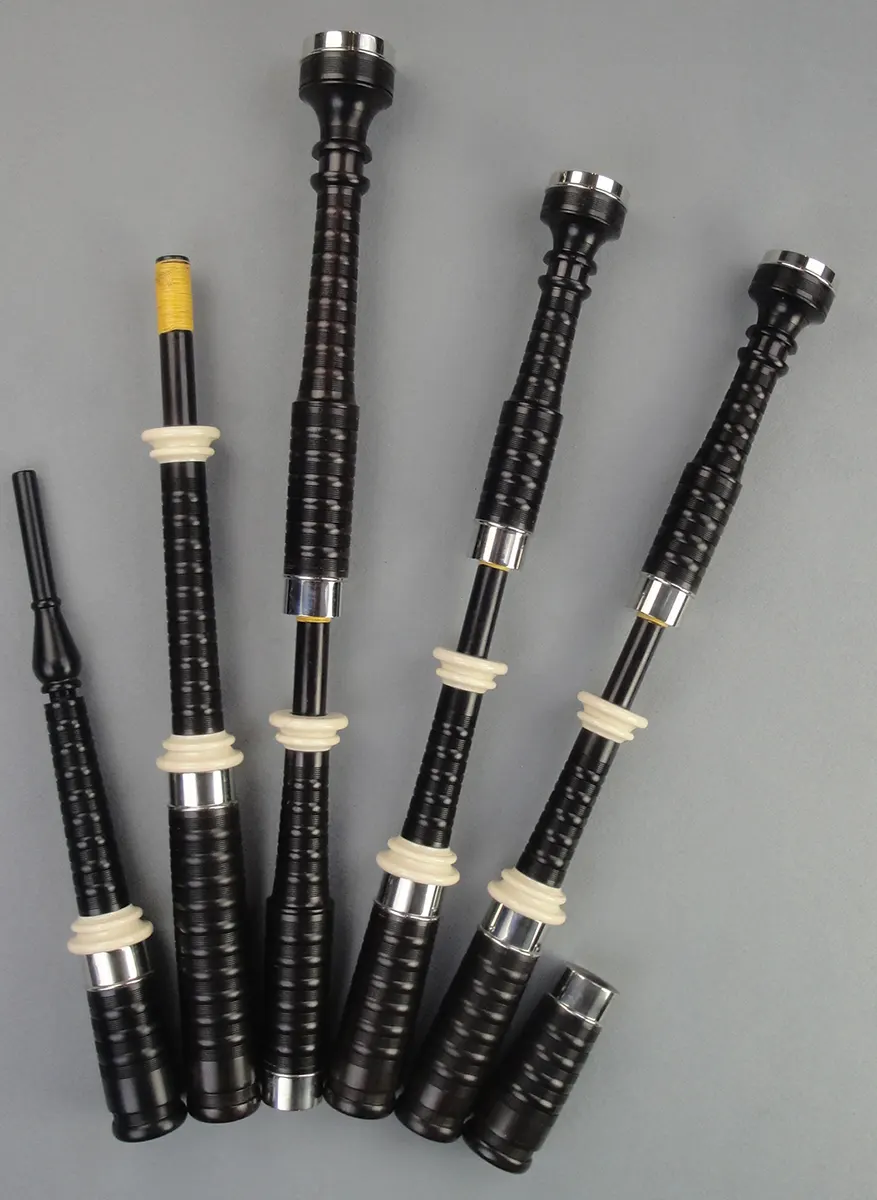
Atherton MD, Macdougall Bores, 2009, Nickel, Imitation Ivory
SOLD – This Dave Atherton MD was made in 2009 or a little before. Dave Atherton models his MacDougall reproduction after a set of brilliant 1870s cocuswood Duncan MacDougall pipes that had been owned by Roddy MacDonald from Wilmington, Delaware. The craftsmanship and tone of these pipes as a modern-made instrument are beyond compare.
This set is in mint condition but for one chip on one projecting mount. The chip has been glued nicely back in place and the repair is almost invisible. The blowstick and blowstick stock are polypenco. The drone and chanter stock bores are all tapered, a technique Atherton has used periodically in keeping with the theory that the tapering reduces turbulence for steadier air flow.
As an aside, this set was played in seven winning bands across four grades at the North American Championship in Maxville and was played in an army pipe band in recent years during tours of Vimy, Dieppe, Juno Beach, and the battlefields of the Italian campaign.
-
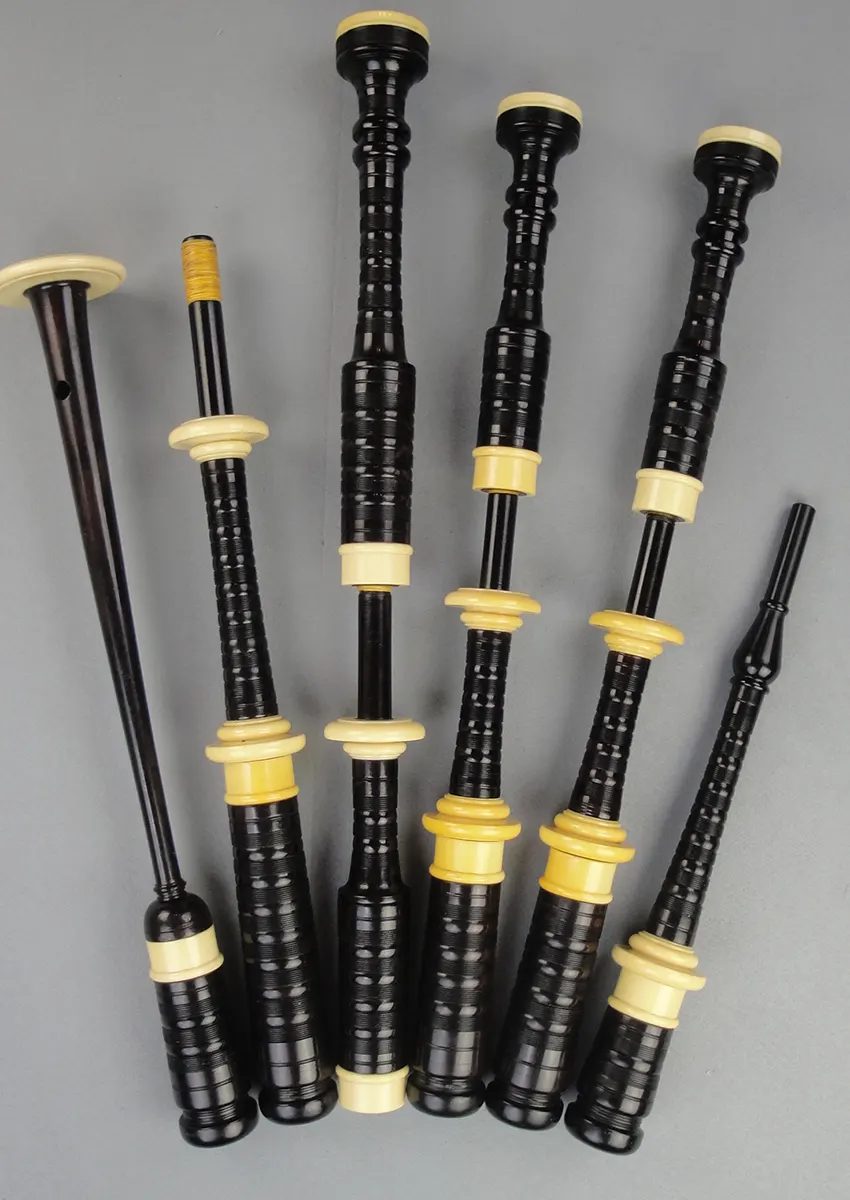
R. G. Lawrie, Circa 1920s, African Blackwood, Imitation Ivory
SOLD – This Lawrie set is in excellent condition for its age. All pieces are original, and needed no work was needed other than to polish them up on the lathe.
The set comes with its original chanter, though old Lawrie chanters were not particularly good and this is not a chanter you would wish to play. However, it supports the historical integrity of the instrument.
Tonally the drones are steady and rich, though slightly flatter than some Lawries, tuning slightly lower than usual on the tuning pins. The set is ivory-free.