
Working with vintage bagpipes is as much a hobby as a business for me. I enjoy the process of turning up old pipes and making sure they will be played for years to come. I think it is a good thing for piping. As such, I take great care in purchasing, examining and restoring old pipes.

My refurbisher is J. Dunbar Bagpipe Maker in St. Catharines, Ontario. Not only do they do masterful restorations, they have eagle eyes for examining 150-year-old wood and discovering replacement pieces and flaws that should be addressed before you play the pipes. If a set of pipes has a replacement or repaired piece, you will know about it before you buy.
You should know from the get-go that pretty much every bagpipe made before 1930 has required or will require repairs of some sort, especially if they are ebony. Ebony and cocuswood are superb woods from which to make bagpipes but they are less resilient than African blackwood. I suspect there is hardly an ebony bagpipe in the world made before 1920 that hasn’t experienced at least one crack.
Photos and descriptions of all instruments featured since October 2010
-

Henderson, Ebony, Circa WWI, Full Ivory, Plain Sterling Silver Slides
SOLD – This lovely Henderson set has been reacquired from a customer who purchased it from this site in March, 2016. At that time the pipes were stripped, a hairline crack was invisible-whipped in the bass top, a small opening in the bottom projecting mount of one tenor bottom was filled, and the set was refinished. All pieces are original, and the plain Sterling silver slides were added at the previous customer’s request.
The set saw limited use since it was refurbished and purchased three years ago, so it is in superb condition. The ivory shows age staining common to 100-year-old pipes, I would say adding character of age more than detracting from appearance.
Tonally, the set is absolutely superb, locking beautifully with both my Kinnaird Edge and my Ezeedrone drone reeds. The drones are bold, vibrant and steady in the classic, vintage Henderson tradition. You would be hard-pressed to do better tonally.
-
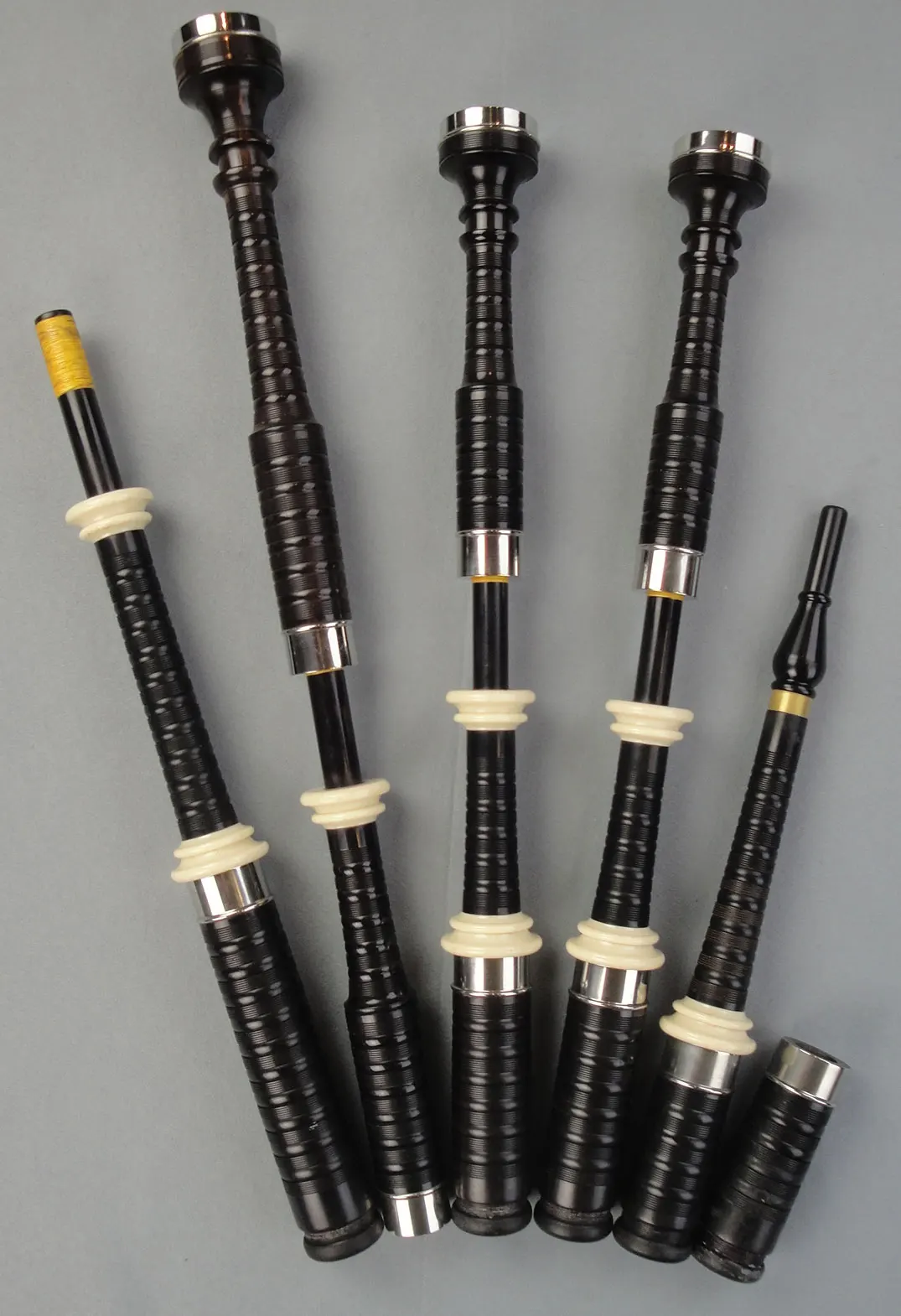
Atherton MD, 2007, Nickel, Imitation Ivory
SOLD – This set of Atherton MDs won the World Pipe Band Championship in 2008 when Pipe Major Terry Lee played them in the Simon Fraser University Pipe Band. Terry went on to order a higher-end Atherton and passed this set on. It was made in 2007.
Dave Atherton learned his craft with Charley Kron in Dobbs Ferry, New York in the late 1990s and early 2000s and went on to open his own firm. His signature pipe was this reproduction model of a set of circa 1880 Duncan MacDougalls played by the late Roddy MacDonald of Wilmington, Delaware. A remarkable craftsman, Dave made an immaculate instrument with meticulous craftsmanship and incredible tone and steadiness. I would unhesitatingly call him the best pipemaker of the modern generation. He still makes a small number of instruments out of his shop near Chicago.
This bagpipe is in excellent shape, showing only some very slight tarnish marks on the nickel and some wear on the stocks. This imitation ivory is in perfect shape and the tuning chambers are as true as the day the pipes were made. Dave was always careful to make pipes out of exceptional pieces of African blackwood.
The tone is full and rich on this superb rendering of Duncan MacDougall’s original work.
-
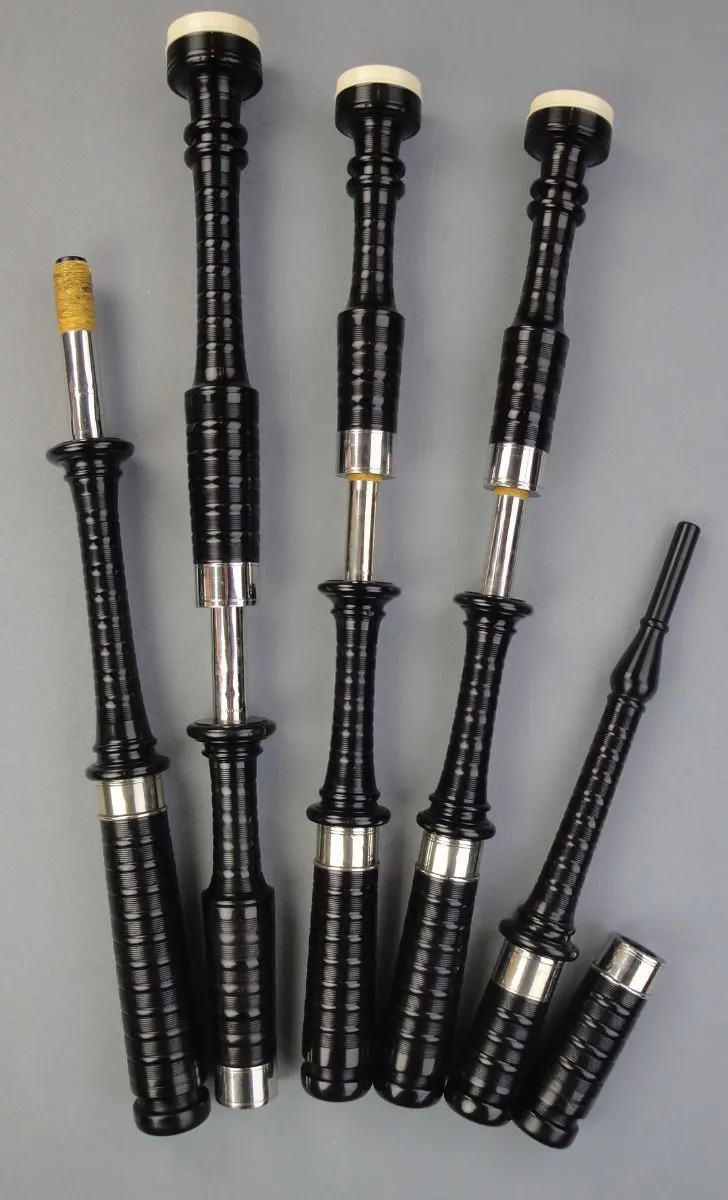
Duncan MacRae, Circa WWI, Ebony Nickel, Imitation Ivory
SOLD – This set of Duncan MacRae pipes came to me with the original MacRae “hempless slides” on the tenors. Unfortunately, as is usually the case, the sprung nickel slats had lost their spring and their seal, so the ends of the nickel slides had to be removed and the tuning pin ends combed to take hemp. The original hempless slide was a patented feature of many of Duncan MacRae’s pipes, and the patent number is still clearly visible on the bottoms of all of the nickel slides.
The pipes had some damage so several pieces have been replaced: the bass top, one tenor top, both tenor stocks and the blowpipe stock. Dunbar Bagpipes made replica pieces using the original pieces for exact measurements. However, the original robust and rich MacRae tone has been preserved. MacRae pipes display the fullest drone sound I know of, and this set is no exception. They were extremely steady with my set of standard Ezeedrone reeds.
All ferrules are original.
The ivory ring was missing to the original tenor top, so it was decided to replace the remaining ivory on all rings and bushes with imitation ivory. So this in a ivory-free vintage bagpipe of very high tonal calibre.
One tenor stock ferrule is inscribed: GLASGOW HIGHLANDERS, 9th BN HLI. The 9th Battalion was a volunteer force, part of the Lowland Division of the Highland Light Infantry, with its HQ in Glasgow. It saw a great deal of action in the Great War. Whether this set of pipes saw battle is not known.
Although MacRae pipes flew under the radar for many years, they have enjoyed a rebirth due to the playing of solo and band phenom Stuart Liddell. MacCallum bagpipes makes a reproduction that you can see offered lower down on this page.
-
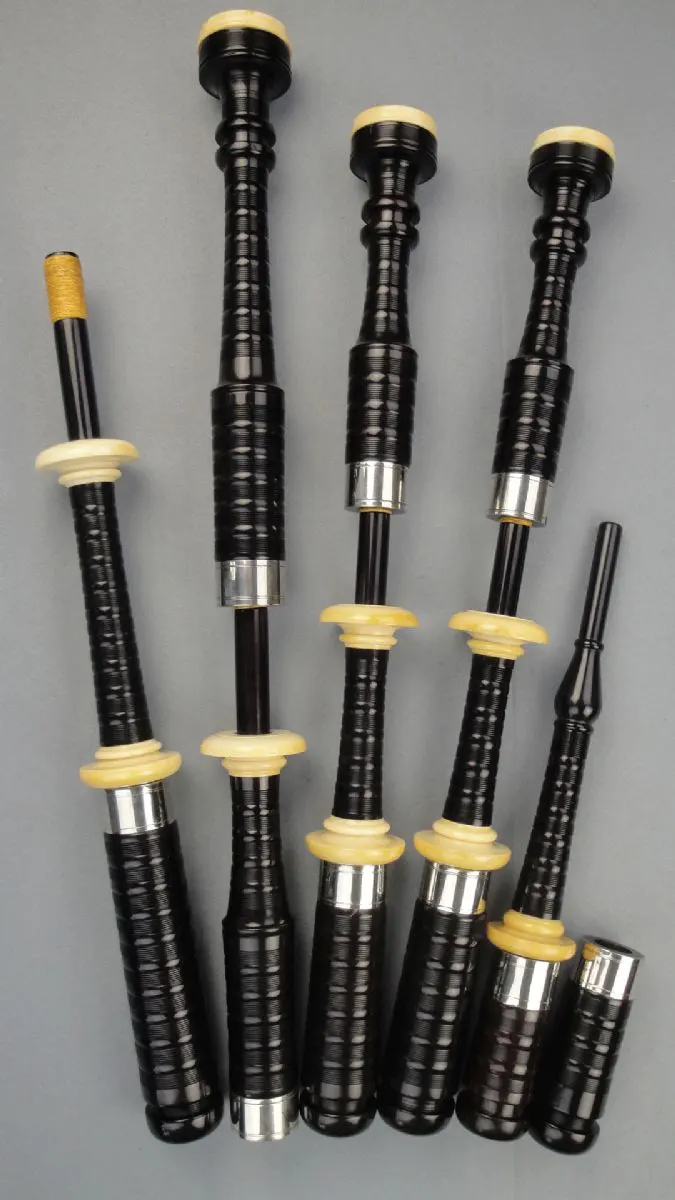
Duncan MacRae, Circa 1912, Natural and Nickel Mounts
SOLD – This set of pipes was identified as a Duncan MacRae set some years ago by my friend Ron Bowen. The voluminous drone sound would bear this out.
They look to be quite an early set, Ron suggesting they might have come from the early years of Duncan MacRae’s shop, which began around 1909. They are made of ebony, an early wood that would also suggest an early date of manufacture. So they may have been made within a few years either side of 1912.
As is typical of an ebony set well over 100 years old, some hairline cracks became apparent once the finish was stripped off the pipes. The bass stock, one tenor stock, the blowpipe, and the blowpipe stock all had small fissures that have been invisible whipped and will cause no more trouble. One tenor top had a small chunk of wood missing on the shoulder and this has been filled. The pipes were refinished and all of the natural mounts and nickel were polished. It’s possible that the ring on the bass drone was replaced at some point, and it’s possible that the chanter stock is not original. The nickel ferrules on the stocks don’t have the scribe lines that the drone ferrules have, so they are probably replacements.
I asked my friend Matt MacIsaac to play the pipes for me for a recording to be used in an article on Duncan MacRae on the pipedrums website. This article should appear around the first week of September, so the pipes can be heard there. The sound was rich, steady and extremely full.
Although MacRae pipes flew under the radar for many years, they have enjoyed a rebirth due to the playing of solo and band phenom Stuart Liddell. MacCallum bagpipes makes a reproduction that you can see offered lower down on this page.
-
Circa 1930 Hendersons, Blackwood, Ivory, Nickel
SOLD – This blackwood Henderson is thought to have been made in the 1930s and is mounted in ivory with nickel ferrules.
All drone pieces are original. It appears that the blowstick stock and one tenor stock might be replica replacements with the original mounts. The original blowstick had a pencil-thin bore and the stick cracked when it was being bored out, so a replica, poly-lined blackwood blowstick has replaced it.
There are a few tiny nicks on the caps and bells, but nothing out of the ordinary for an old set. The pipes were stripped and refinished and the tuning chambers gently reamed to even up the tuning action.
Blackwood tends to be more robust than ebony or cocuswood, and this set bears this out. The tone is extremely full and rich, and they locked into tune perfectly with my Ezeedrone reeds. This would be an impressive an reliable vintage bagpipe on any stage.
-
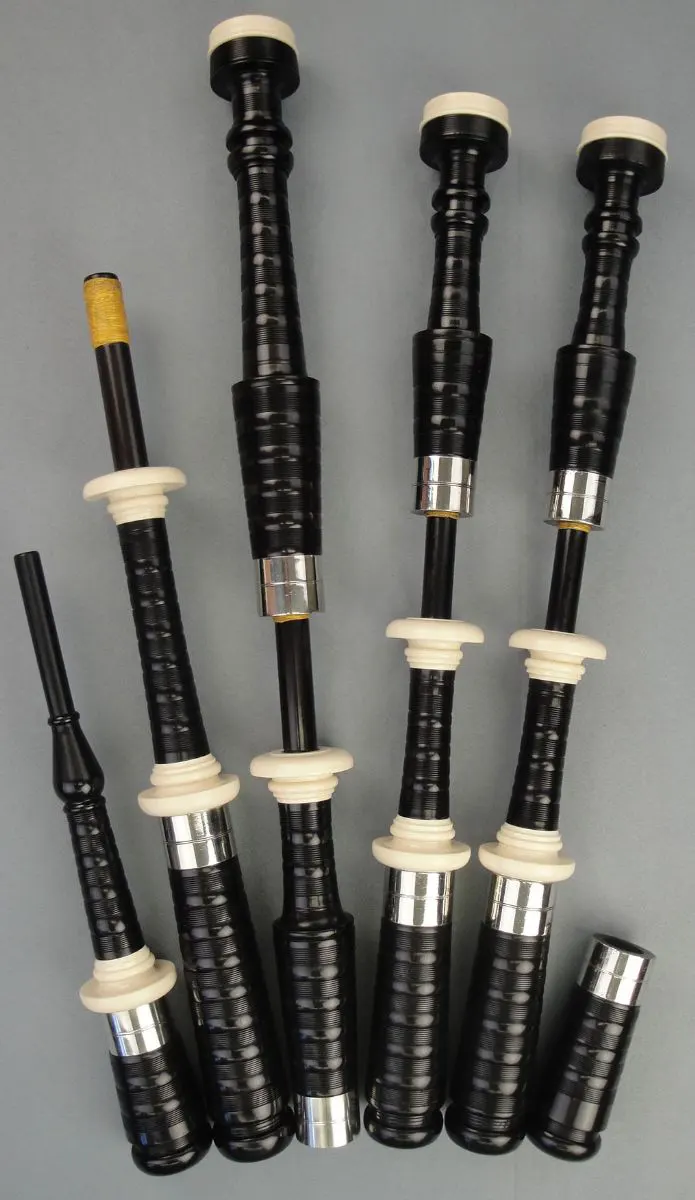
Robertson, Circa 1920s, Ebony, Nickel, New Imitation Ivory
SOLD – The scribe lines in the middle of the nickel ferrules on this Robertson set suggest a manufacturing date sometime in the 1920s. The bagpipe is made of ebony. The original ivory was removed and has been replaced with convincingly accurate replica imitation ivory projecting mounts and ring caps.
The blowpipe stock is new, poly-lined blackwood, and it’s possible that the chanter stock is not original either. Unfortunately, the bass drone top piece split apart on the lathe during repairs and has been replaced with a blackwood replica The tuning pin on the bass bottom was also replaced. Several cracks were invisible whipped, and the entire bagpipe has been stripped and refinished. Repairs of this extent are not unusual in a 100-year-old ebony instrument
James Robertson took over the John Center shop in 1908 when the Centers moved to Melbourne, Australia. Though Robertson himself died in 1948, his company continued until the mid-1960s. I know of no other bagpipe making company that maintained such a high standard of tone and manufacturing during its entire run, even after the passing of its founder.
Robertson pipes are robust and full in the Henderson tradition, easy to reed and extremely steady. And the “mushroom” style mounts make them one of the most recognizable bagpipes in the industry. Why we don’t see more Robertson pipes played at elite levels has long been a mystery to me. They are superb, and this instrument follows in that tradition.
In addition, the fact that this bagpipe contains no ivory means it can travel freely the world over. It is, as my good friend Donald Lindsay calls it, a “border pipe.”
-
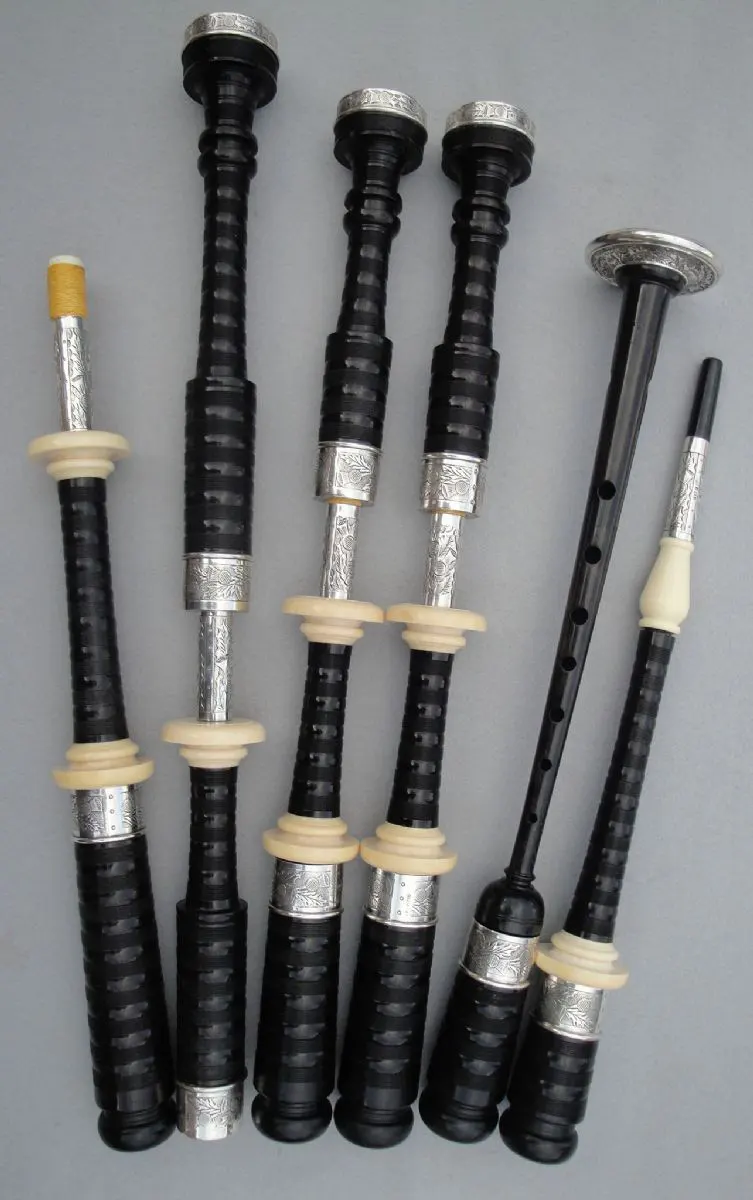
R. G. Hardie, Hand-Engraved Silver and Ivory, Hallmarked 1956
SOLD – This set was sold on this site some years ago and has returned as the owner wished to upgrade to another set. The photos were taken at the time of the first sale. Unfortunately, the mouthpiece in the photographs was lost, so the set will be sold with a plain, plastic mouthpiece. The set also had its original lacquer finish stripped and replaced with a natural oil/wax finish.
Bob Hardie was a lovely, quiet, modest man and an icon of 20th-century piping. He was a leading soloist in the 1940s and 1950s, and his band, Muirhead and Sons Ltd., won five straight World Pipe Band Championships in the 1960s. In 1950 he and John Weatherston founded one of the most successful bagpipe making companies of the time. The company continued until 2005, though Bob died in 1990.
This Hardie bagpipe was made in 1956. It is mounted in hand-engraved Sterling silver and ivory. All parts including the chanter are original except the mouthpiece bulb, as mentioned above
Hardies were renown for using well seasoned, high quality wood. Even after more than 60 years, all pieces in this set are straight and true. The set has been refinished.
The drones are mellow, steady and easy to reed. The chanter is flatter pitched and a little more difficult to reed because of its age, but the Hardie chanter was the chanter for both top bands and soloists during the 1950s and ’60s.
This is the one of the loveliest early Hardies I have seen.
-
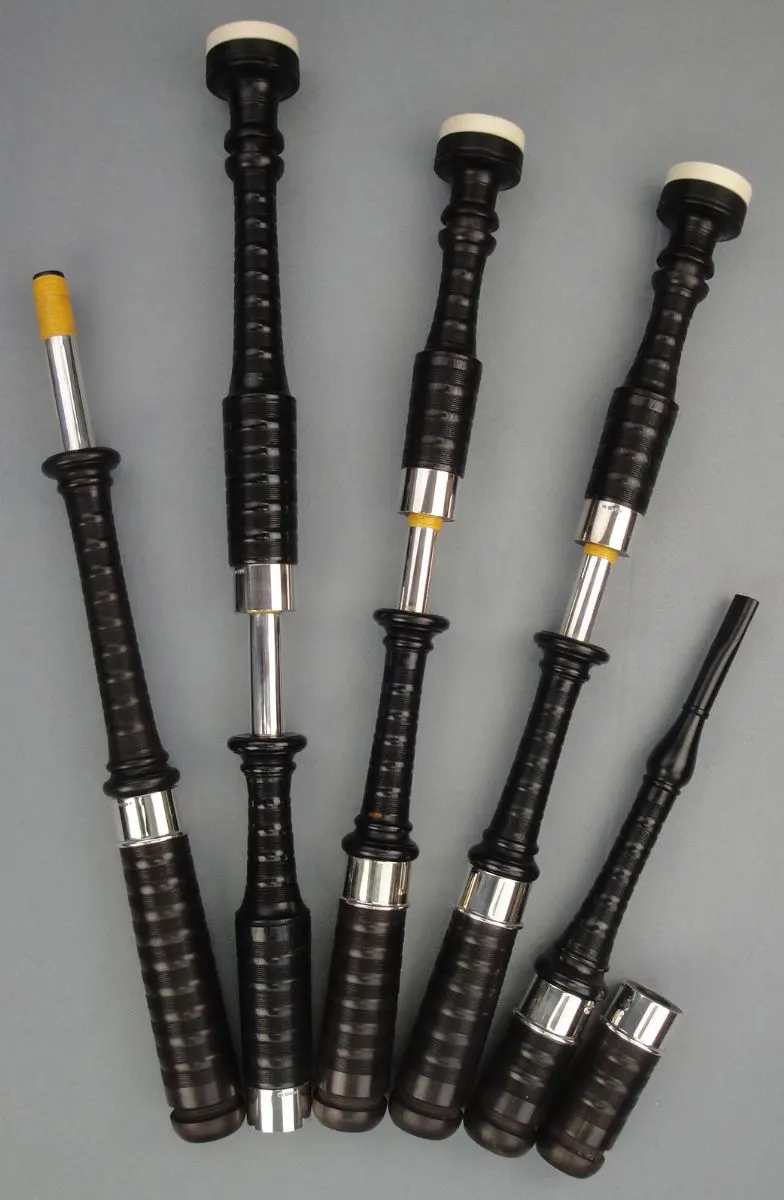
Henderson, Circa 1920s, Ebony, Blackwood, Sterling Silver, Artificial Ivory
SOLD – This unusual set of Hendersons dates from the 10 years around 1920. They are made from very open-grained ebony, though the stocks came with blackwood replica replacements.
The plain Sterling silver is not original. It is hallmarked 2016. One unusual feature of the silver is that the stock ferrules are beaded, while the drone ferrules aren’t. Hallmarks are the same on all.
The caps may originally have been casein, but came to me with artificial ivory replacements. The bushes, however, are casein, and likely original.
The pipes have a beautiful, rich, vibrant, old Henderson tone, quite classic. So while it does not display a “nornal” vintage Henderson appearance, the set certainly plays a classic, vintage Henderson sound.
-
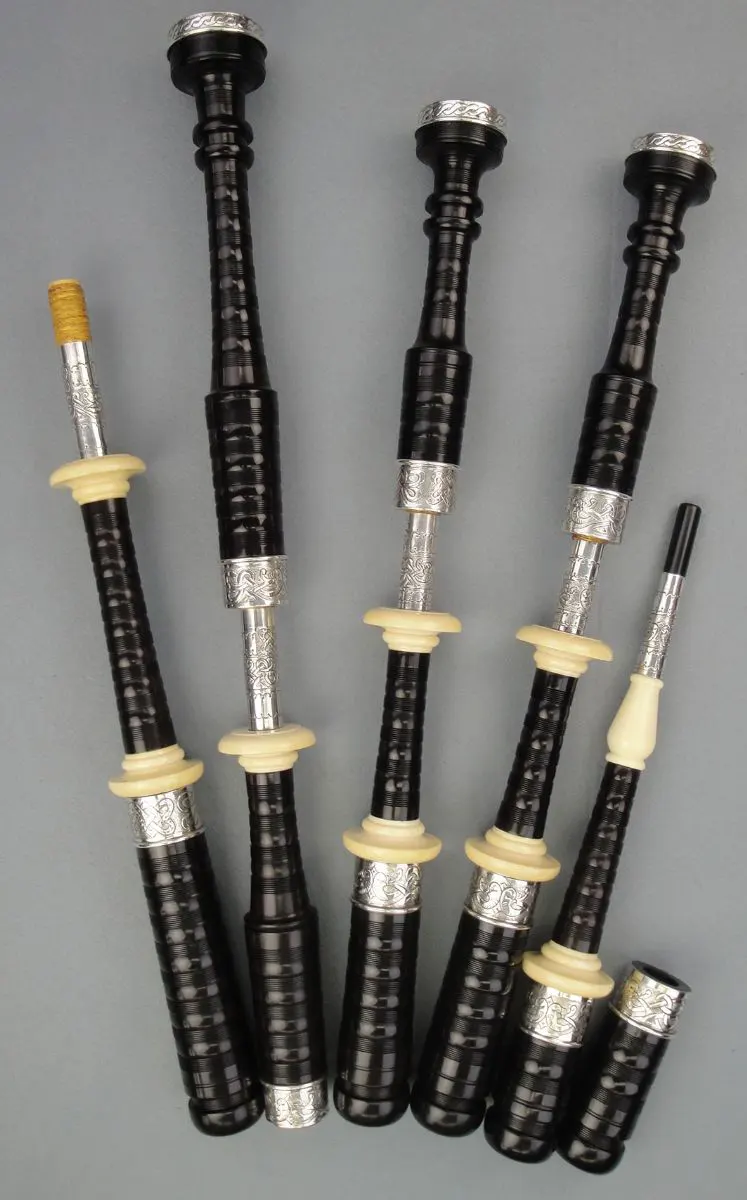
Henderson, Silver and Ivory, Hallmarked 1963
SOLD – This gorgeous set of Hendersons is hallmarked 1962-63 and displays a stunning Zoomorphic hand-engraved silver pattern.
The pipes have been stripped, checked for flaws, and refinished. The original ivory mouthpiece bulb was cracked, as most older bulbs are, so a replacement was made in artificial ivory. The rest of the pipes are entirely original. The ivory has aged with lovely character, save for one very minor stain on one tenor projecting mount.
The pipes played beautifully and locked into tune immediately with the Ezeedrone reeds I play in my own Hendersons. They are robust and vibrant and formed a fantastic blend with the chanter.
Not much more to say about this set — the photos say it better than I can, and the sound matches the shots!
-
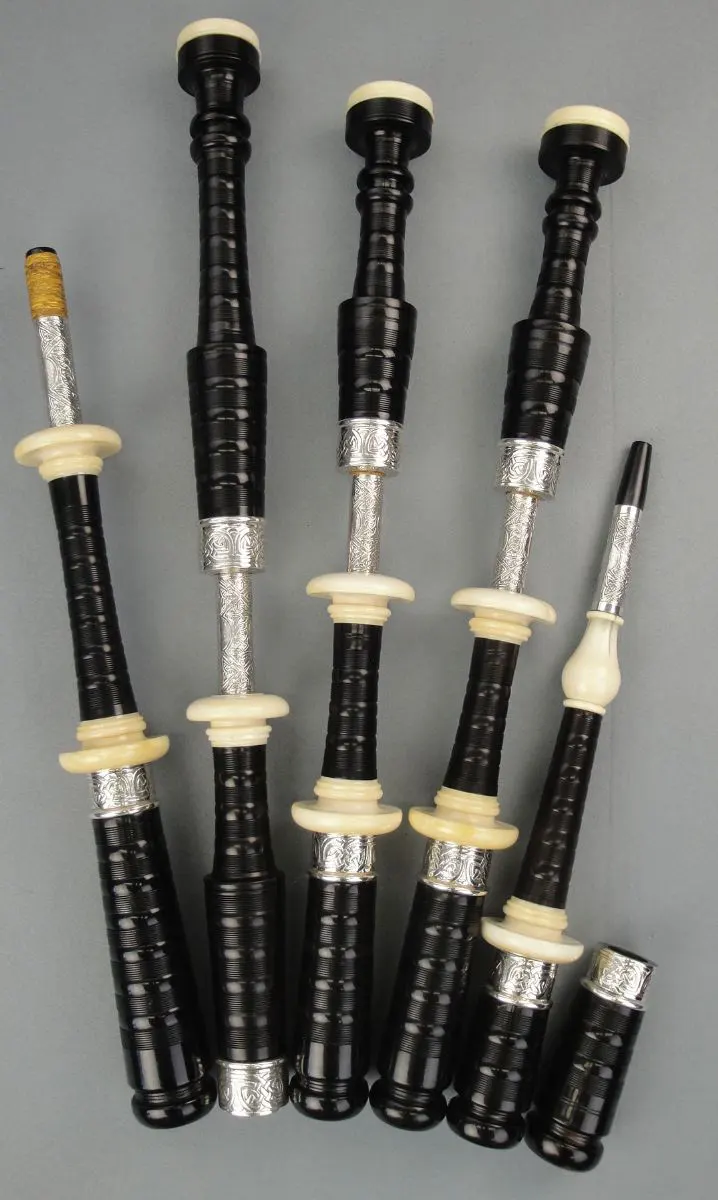
Robertson, Circa 1920s, Engraved, Hallmarked Silver 2006, Ivory
SOLD – This Robertson set was manufactured sometime in the 1920s, probably as a full ivory bagpipe. In 2006 a previous owner had the hallmarked Sterling silver installed onto the ferrules, slides and mouthpiece sleeve. As you can see in the photos, the silver is spectacular.
The tone is equally spectacular. James Robertson is, I think, the most consistent bagpipe maker I know of, both tonally and in his commitment to manufacturing excellence.
There were cracks in both tenor tops that have been invisible whipped and will give no more trouble. The age of the ivory resulted in some open cracks that have been filled beautifully by my refurbisher, Dunbar Bagpipes.
The ivory mouthpiece bulb is original, with a couple of slight cracks repaired. As with all Robertsons, the tone of this set is full, steady and full of blend with the chanter.
-
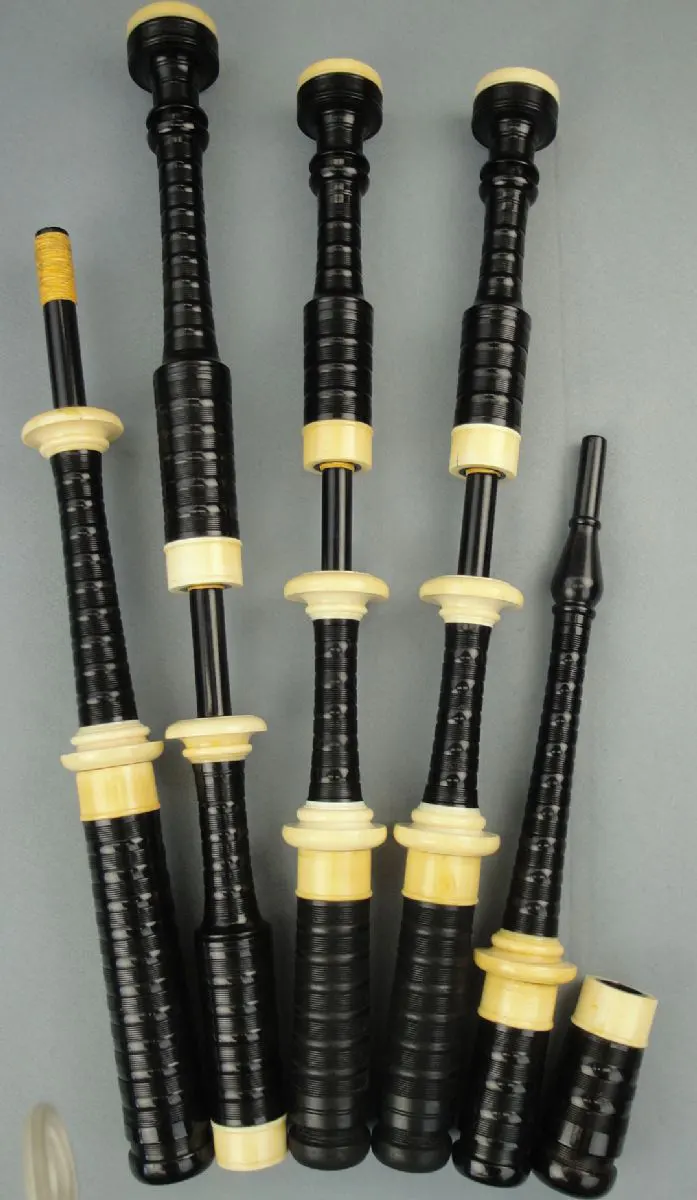
Henderson, Circa 1890s, Ebony, Full Ivory
SOLD – This is one of the older sets of Henderson pipes we’ve had on the site for a while. They likely date to around the 1890s or earlier as suggested by the narrow beading and the much finer bead on the ferrule. The pipes are ebony, with ivory mounts that are in excellent shape except for a couple of rice sized chips.
There are a couple of anomalies with these pipes. The two tenor bottoms appear on closer inspection to be Lawrie pieces rather than Henderson, though the vintage of the pieces looks quite similar to the Henderson. I double-checked my own knowledge of Henderson and Lawrie pipes of that era with Rick Pettigrew, who runs Dunbar Bagpipes and is my refurbisher. He confirmed that back in these days Henderson and Lawrie were making pretty much exactly the same instrument except for cosmetic differences. They were known even to job out to one another.
Rick measured up the two tenor bottoms and they match up perfectly with Henderson tenor bottoms from that era. The bass drone stock and blowpipe look like they may be Lawrie as well through the mounts appear original.
As is usual with ebony that is more than 100 years old there were a couple of cracks that have been invisible whipped and will give no trouble again.
The slight differences in pieces have no detrimental effects on the tone of this instrument, which is classic, refined, bold, seamless Henderson.This is a lovely set for any level of serious piper who would like a vintage bagpipe with character and tone.
-
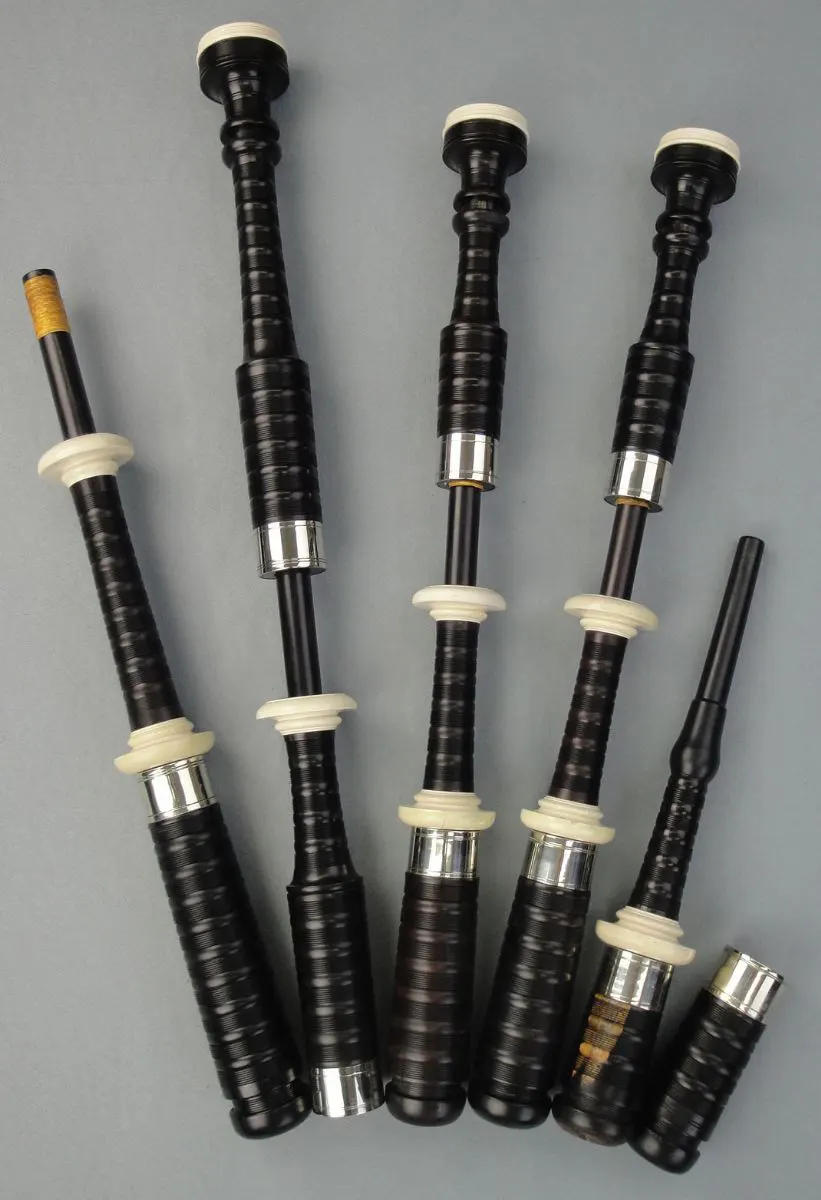
Henderson, WWI, Cocuswood, Nickel and Casein
SOLD – This set of cocuswood Hendersons is tonally exceptional, to the point where I have enjoyed it myself for the past several months, giving my number one bagpipe a rest.
It was likely made in the years around WWI, perhaps a bit earlier. It has nickel ferrules and casein projecting mounts, ring caps and bushes. Unlike the chalky and discoloured casein we often see on old Robertson pipes, this material is white enough to be mistaken for modern imitation ivory. So the pipes are ivory-free and can be transported across borders without a certificate.
One piece of casein has a small brown discolouration on it, and the bead on one projecting mount has a tiny split that has been filled.
The blowstick was too badly cracked to repair so the projecting mount was installed onto a replica polypenco blowpipe.
The cord guides on both tenor drones are stamped “P Henderson.” Although there is no stamp on the bass drone, there is no doubt it is original to the pipes.
I was extremely impressed with the seamless, robust sound of these pipes and their exceptional steadiness.