
Working with vintage bagpipes is as much a hobby as a business for me. I enjoy the process of turning up old pipes and making sure they will be played for years to come. I think it is a good thing for piping. As such, I take great care in purchasing, examining and restoring old pipes.

My refurbisher is J. Dunbar Bagpipe Maker in St. Catharines, Ontario. Not only do they do masterful restorations, they have eagle eyes for examining 150-year-old wood and discovering replacement pieces and flaws that should be addressed before you play the pipes. If a set of pipes has a replacement or repaired piece, you will know about it before you buy.
You should know from the get-go that pretty much every bagpipe made before 1930 has required or will require repairs of some sort, especially if they are ebony. Ebony and cocuswood are superb woods from which to make bagpipes but they are less resilient than African blackwood. I suspect there is hardly an ebony bagpipe in the world made before 1920 that hasn’t experienced at least one crack.
Photos and descriptions of all instruments featured since October 2010
-
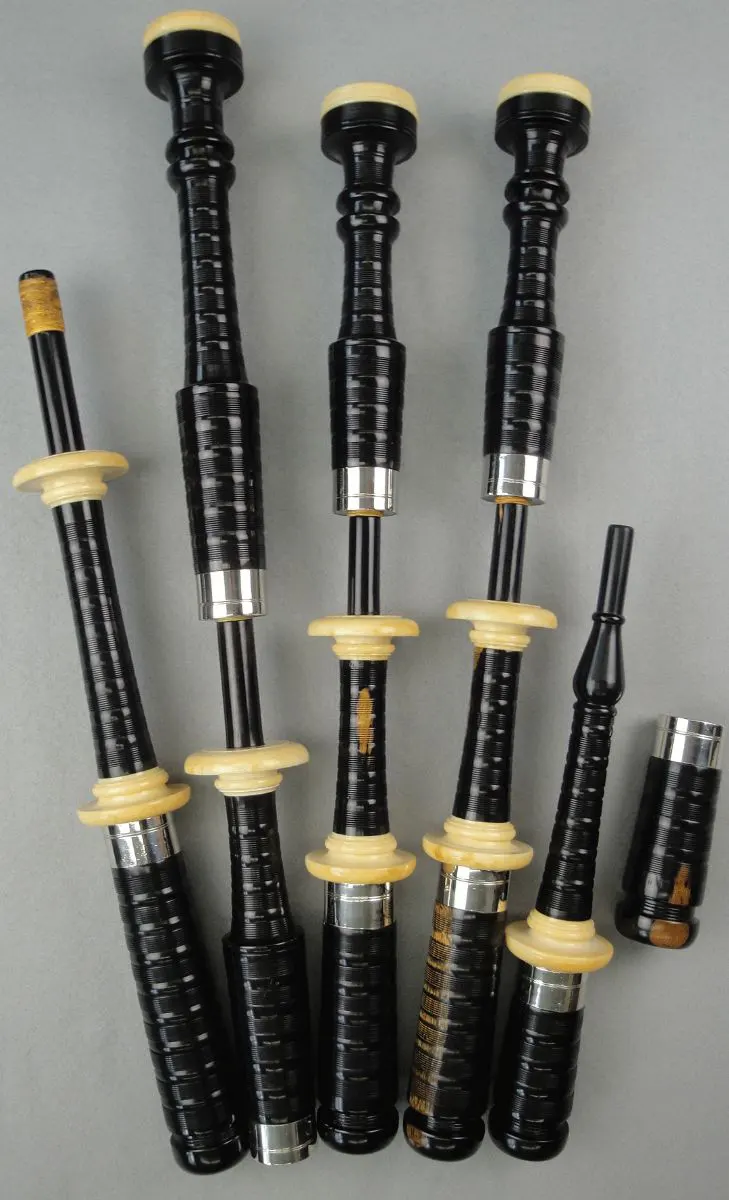
Unknown Ebony, Circa Pre-1890, Ivory, Nickel Ferrules
SOLD – This is a really neat bagpipe. Tonally, it is one of the best instruments I’ve had in my hands in some time. The sound is huge and room-filling. When I put my own Ezeedrones into them and plugged the drones into my own stocks and with my own chanter, I tuned them and immediately played 4 minutes of 4/4 marches without the slightest wobble. They locked like they were digital — but with life and boldness.
They came to me as unknown, though educated guesses range, in order, from Henderson to early Lawrie to Donald MacPhee, the latter being Ron Bowen’s considered assessment. Certainly in the Glasgow tradition. The sticks are ebony and quite massive. The pipes are noticeably heavier than other such mounted pipes, confirming the amount of wood used, especially in the drone tops.
The ferrules are quite distincive — a bit in the old Robertson tradition — and may well be later additions. The lovely old ebony shows sapwood here and there, adding to the visual character. As with any 125-year-old ebony, there were a couple of hairline cracks. I take no chances and have all of these filled or whipped, whether they look threatening or not. This set needed no whipping. The two tenor stocks are quite noticeably different lengths. This is not uncommon among pre-1900 pipes of various makes (especially Glen), though no one is quite sure why. The bass bottom joint is worn almost smooth.
The set was stripped (which is how we find the wee hairlines) and refinished. The tuning chambers were reamed perfectly even.
A first-class set of pipes which may live out their lives unnamed.
-
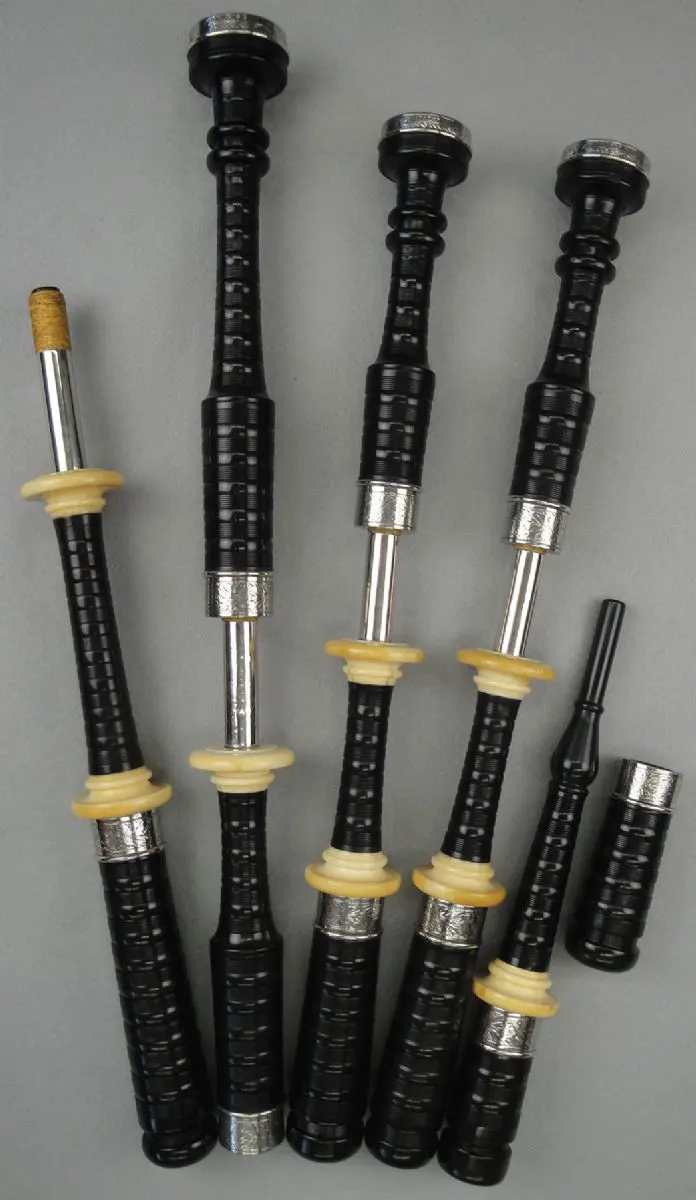
Henderson, Circa 1900, Ebony, German Silver and Ivory
SOLD – This old Henderson set could pass for silver and ivory, but is in fact German silver, a high quality precursor to what we now call nickel.
The wood is ebony. The pipes are beautifully made and the ivory is in excellent shape for its age, showing only a few spider lines here and there.
The set underwent a major refurbishment with hairline cracks, particularly under ferrules, in several pieces. All were invisible whipped.
Very few are visible except in one or two places where the browner shade of ebony couldn’t be perfectly matched on the bead. Invisible whipping is foolproof. Those cracks will not reopen.
Two of the five stocks are not originals. The drone stocks are all original, the chanter and blowstick stocks are replicas with the original mounts affixed. The ivory projecting mount on the blowstick was replaced with a matching Henderson mount. You would not know it isn’t original. The set was refinished.
The pipes display a fabulous, ebony Henderson tone, full but refined in a way only ebony can offer. The drones are steady, vibrant, full of blend, and tune in the right places.
This pipe could be played at any level.
-
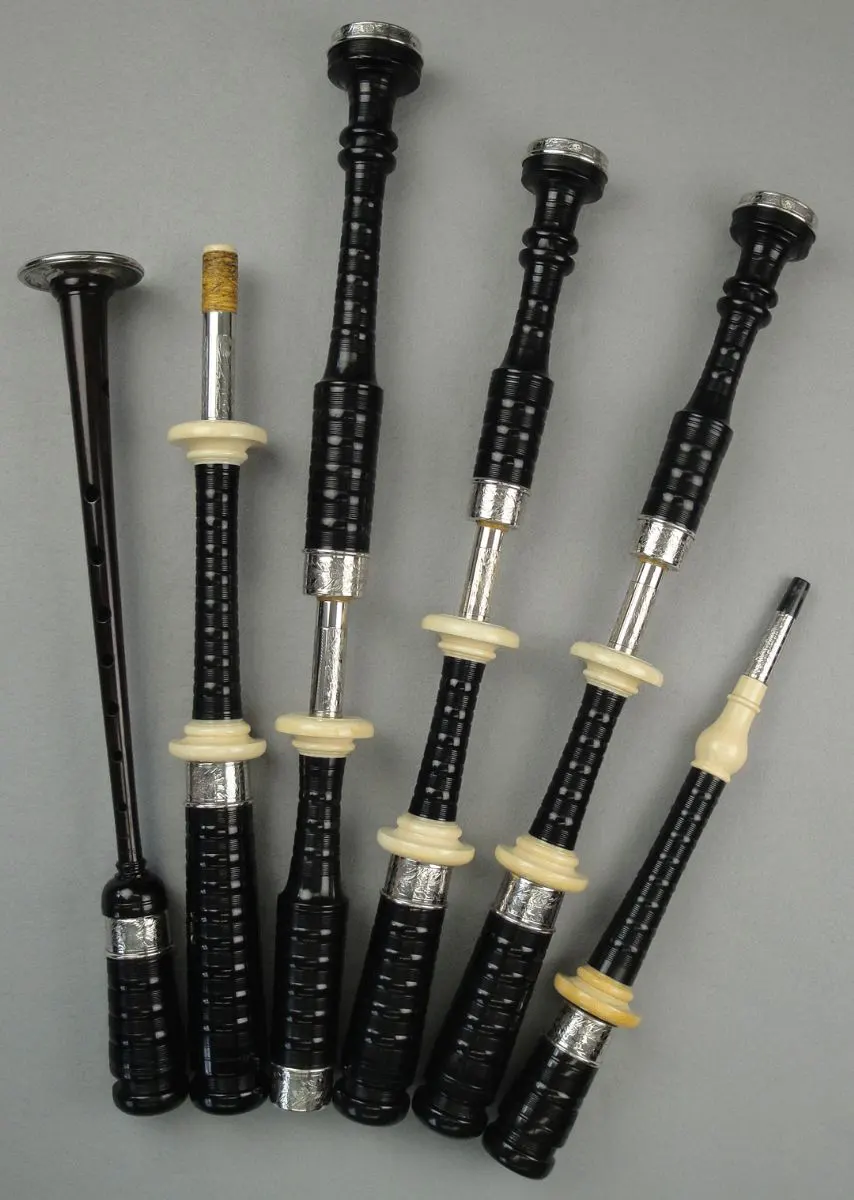
Lawrie, Circa 1905, Ebony, Silver and Ivory
SOLD – This is one of the earliest silver and ivory Lawries we’ve had on the site in a long time. All of the pieces are original except for the blowpipe, which is a poly replica with internal valve and the original mount. The chanter is an old Hardie fitted with the original engraved silver sole. The blowpipe bulb is modern polypenco, and the sleeve is engraved nickel. The blowpipe mount has aged more than the rest of the ivory, but does appear to be original. I suspect an owner at some point used a different blowpipe and stored the original in a damp place. One lower projecting mount has a rice-grain-sized chip.
The set was dated by the previous owner, and external evidence and profiles support a date that could indeed be as early as 1905.
As with any 100+ year old ebony, there were three or four hairline crack on the outside of the wood. None threatened any of the pieces, but I prefer to have all of these sealed or invisible whipped as required. No whipping was needed on this set.
It should be noted that this style of Lawrie bagpipe with engraved, tapered, metal ferrules, are usually called “silver and ivory.” In fact, the silver is plating only. But Lawrie executed the best plating I’ve ever seen. Even after years of terrible tarnishing on the mountes of an unplayed pipes, these buff up to a gorgeous sheen.
The drones are a tonal masterpiece — big, bold and steady. This is a prize set.
-
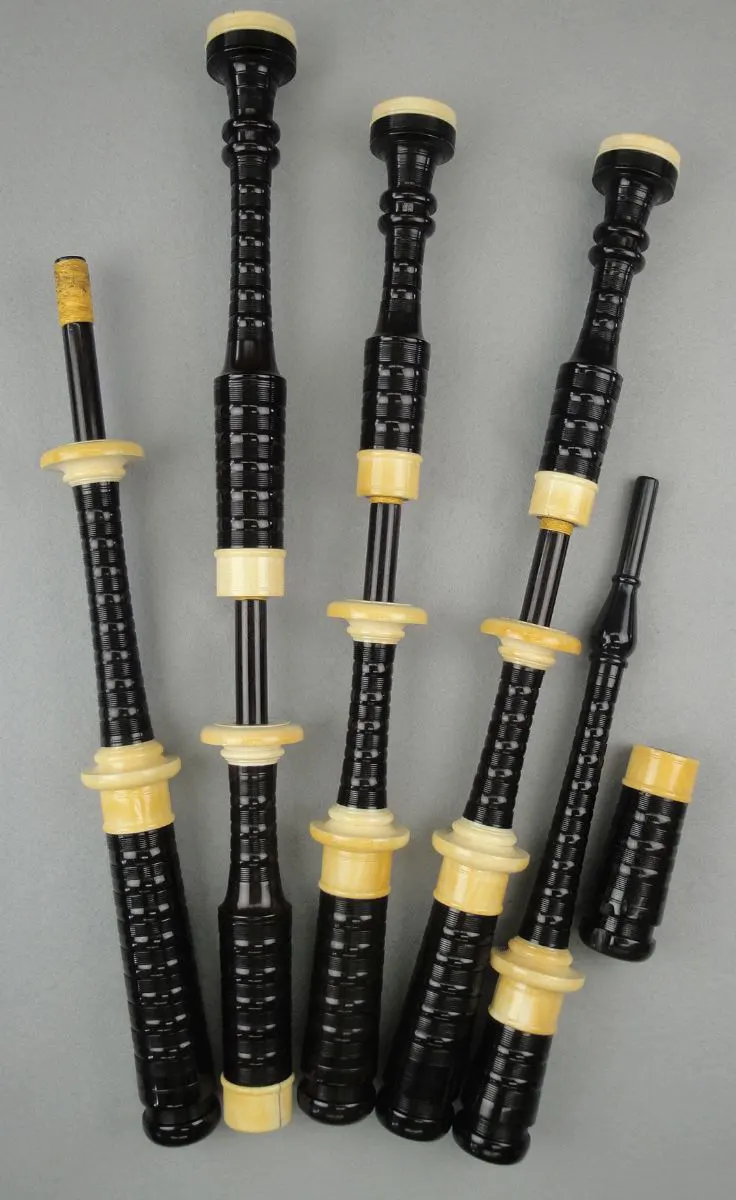
Lawrie, Circa 1915, Full Ivory
SOLD – This beautiful set of Lawries were sold to me as Hendersons. It comes from the Great War era when Lawries and Hendersons were quite similar in appearance, but especially in tone. Vintage Lawries and Hendersons have always had very similar tonal characteristics, but it is no surprise to me that the previous owner pegged these as Henderson.
It is one of the loveliest ivory sets we’ve had here in a while, both visually and tonally. The pipes are seamless and rich in quality, with a bass that cradles the whole bagpipe. The ivory patina is quite stunning and the pipes are a visual treat.
There were hairline surface cracks in one tenor top, the bass mid-joint and two of the stocks, but these have been sealed and are undetectable. Two of the ivory ferrules had open cracks. These have been sealed, though the difficulty of matching ivory patina means they are visible.
The ivory bushing from one one of the tenors was missing, but I had a perfect match in my box if miscellaneous bits, and you would be hard-pressed to detect the difference. One tenor ring has a small chip out of it: pretty standard with a set of this age.
This Lawrie set is really a classic from the golden age of pipemaking in Glasgow.
-
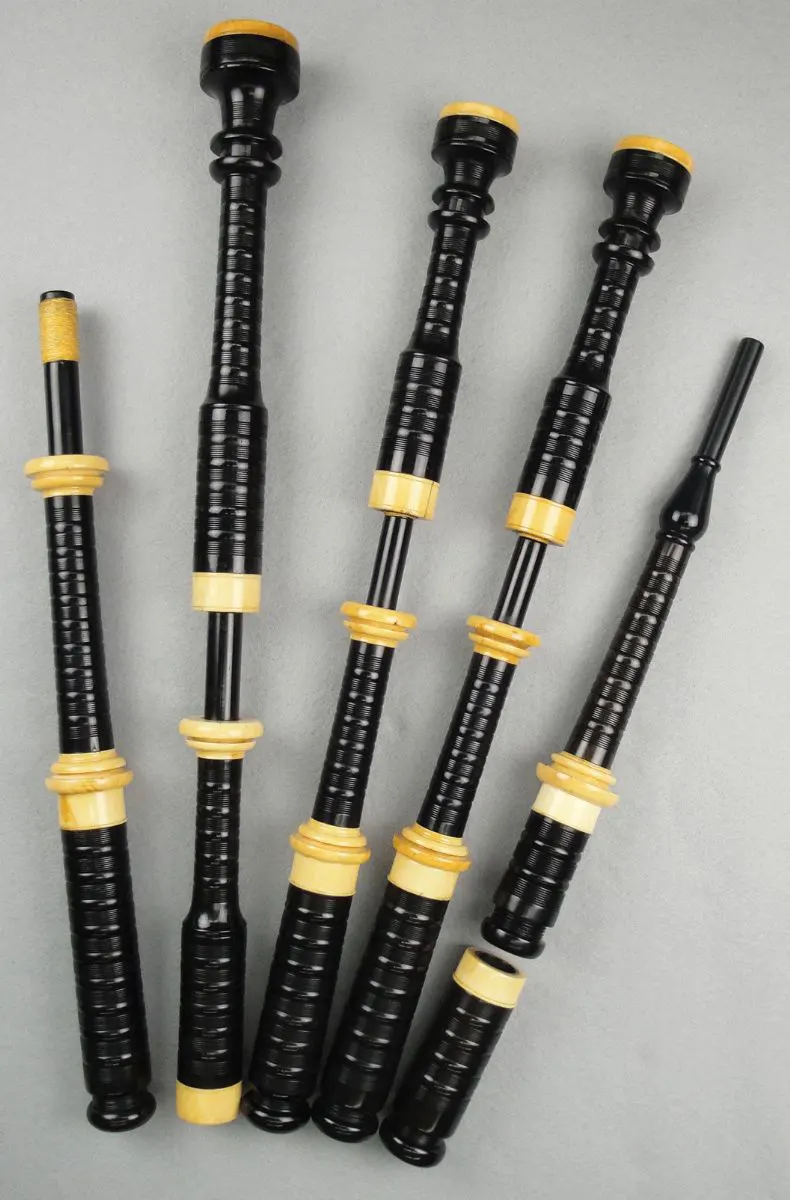
Suspected Macdougall, Circa 1850s, Ebony, Full Ivory, Brass Lined
SOLD – I love this set. It is one of the oldest and most distinctive we’ve had on the site.

I acquired them as MacDougall, and other opinions support this. Having said that, they are not exactly like any other MacDougall set I’ve ever seen. They may be too early for Duncan, and may be his father John’s, though the possibility of them being made by Thomas MacBean Glen — easily an equal maker — has also been raised.
The set is brass lined and very MacDougall-like in tonal character. I’ve played them for the last three months, and am taken with every aspect of them.
As is usually the case with brass-lined ebony, there were some cracks adjacent to the brass. These have been invisible whipped and will never be trouble again. The set came without stocks. By pure coincidence, several days after I purchased this set a friend approached me about a box of parts that contained one complete set of stocks — ebony and from likely the same period. They were a near perfect match for the pipes.
The blowstick is a poly-lined blackwood replica. The set has been stripped and refinished.
Though the identity of this set may not be positive, there is no doubt they are the exquisite product of a high-end mid-19th century maker.
-
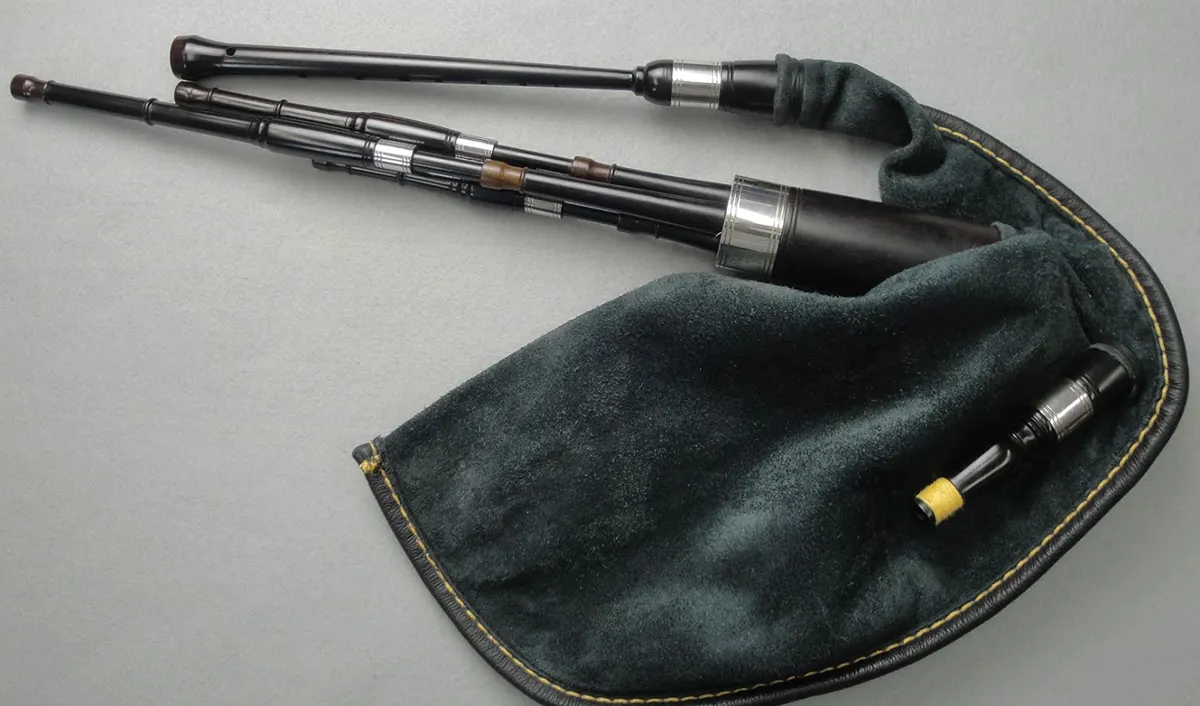
Henderson, Circa 1912, Blackwood, Ivory, Nickel
SOLD – This is one of several Henderson sets of this vintage to appear on the site in recent months, though the seamed ferrules on this set suggested they might be earlier than the 1920s. Additional information provided recently by a reader who has seen an identical set with the same bass stock engravings suggest they were made prior to the Great War and spent time overseas during the war with the 236th Battallion in New Brunswick.
The pipes were in fantastic shape, requiring only a polish on the lathe. The blowstick was missing completely, so a poly-lined blackwood replica was made and a perfectly matching Henderson ivory blowpie mount was found in my stock of “otherwise useless” parts.
The tuning chambers were a bit uneven, so they have been gently reamed to perfection, and of course the set was rehemped.
An inscription on the ferrule of the bass drone stock reads, “Donated by Miss Louisa F. Murray, Douglas Avenue, St. John.” There is a number “16” inscribed on the chanter stock ferrule.
There is nothing more to be said about this set. It is a top-drawer, vintage Henderson bagpipe: steady, rich and full, easy to reed, with a big, solid sounding bass.
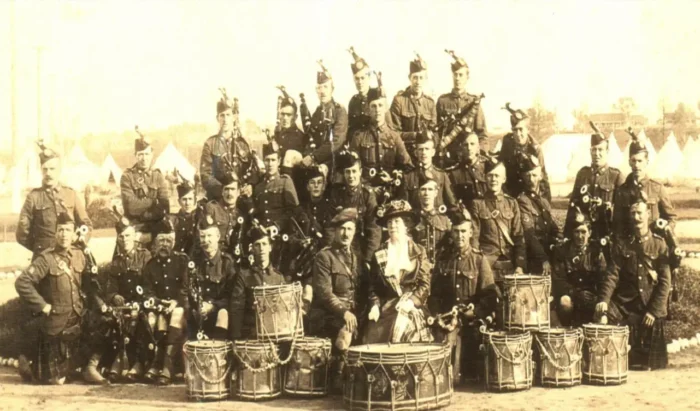
236 Battalion, New Brunwick, prior to departing for the Great War. It almost certain that this Henderson is in this picture and that Miss Louisa F. Murray is front and centre. -
Hamish Moore Scottish Smallpipe in Key Of D, Circa 2004
SOLD – Hamish Moore is well known as one of the great makers and revivalists of the Scottish smallpipe. His pipes are played around the world by perhaps the majority of top smallpipe players.
This bellowsblown set is in the key of D. It was made around 2004. It is made in blackwood with cocobola ferrules. The common stock is hallmarked Sterling silver, so I suspect the ferrules are silver as well, though too small and troublesome to hallmark.
I’ve owned this set for a number of years and had great pleasure out of it. Because of the extreme winters in Ontario I’ve sometimes found Hamish’s cane reeds finicky. Recently I sent this bagpipe to John Walsh in Antogonish, Nova Scotia, a great smallpipe maker in his own right, and had John reed it with his plastic reeds. This has made the smallpipe totally steady and reliable, even when my Ontario relative humidity is at 15%. The chanter reed is slightly higher pressure than most smallpipe reeds, so has great volume.
The set does not come with a bellows. You’ll need to provide that yourself! This would be a great set for someone who may already own a bellowsblown set in A and wants to expand their horizons!
-
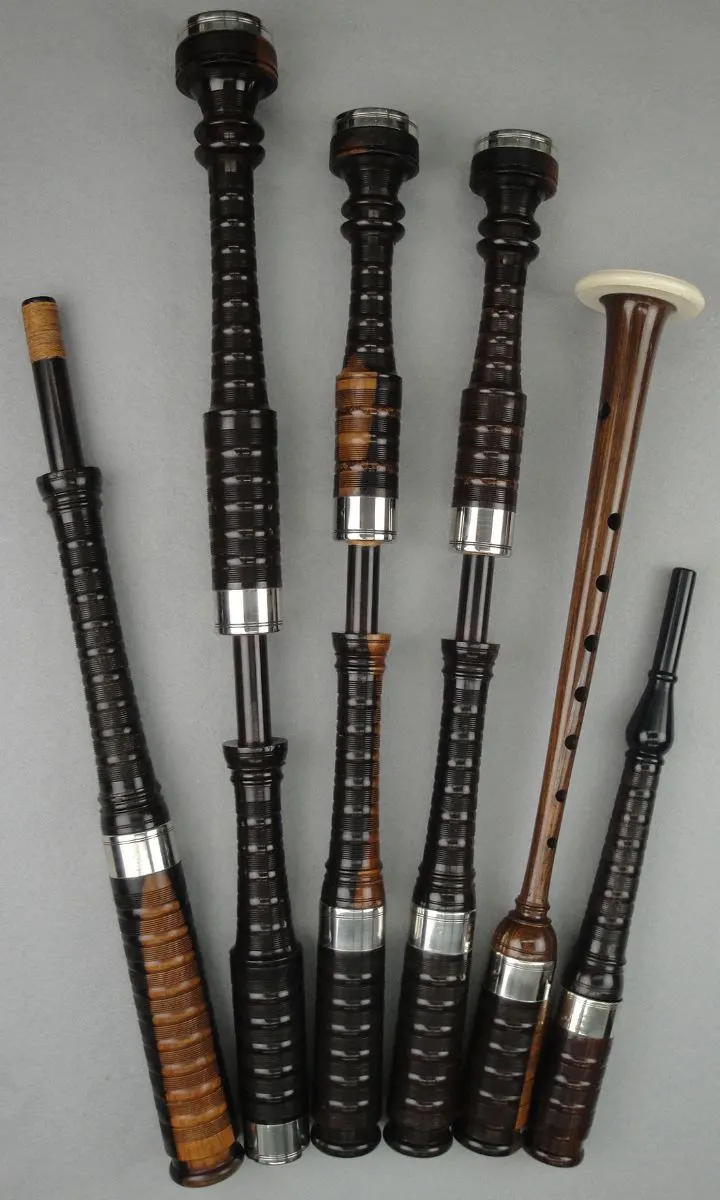
David Glen, Circa 1900, Cocuswood, Nickel
SOLD – David Glen cocuswood pipes like this circa 1900 set can be a visual delight. The tone is extremely rich, with great locking ability and chanter blend. Glen pipes do not generally give a booming drone sound but are steady and subtle. This set has great character both tonally and visually.
These pipes were on the site a few years ago with visible external whipping on the tenor tops. This has now been augmented to invisible whipping. While it’s impossible to hide the whipped combings completely given the variations in cocuswood colouring, the overall effect is excellent, as seen in the photos of the tenor tops.
The blowpipe stock was badly cracked, so a poly-lined cocobolo replica was made. In all other respects the set is in great shape.
The chanter actually plays quite nicely, albeit at a very low pitch. The ivory sole suggests it is not original to the pipes, though it is a more than suitable match. The pipes themselves are free of ivory.
-
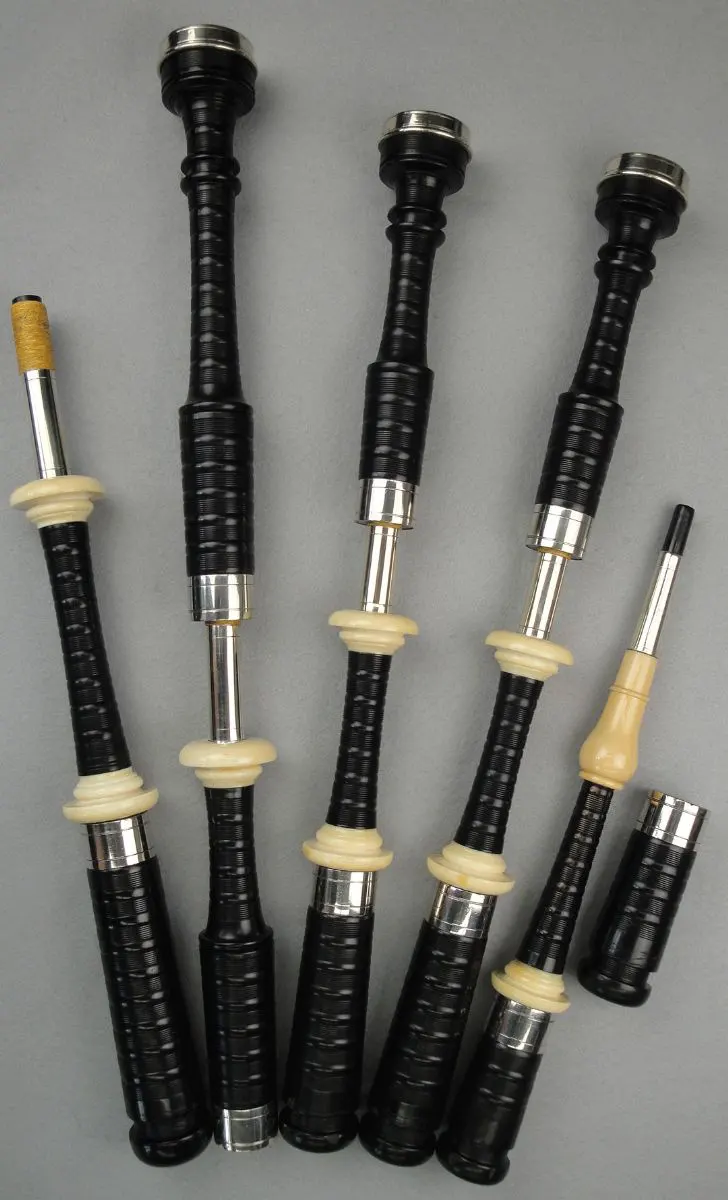
Thow, Circa 1910, Ebony, Ivory, German Silver
SOLD – Kudos to my friend Ron Bowen for identifying this set as Thow of Dundee. Once he gave me the lead I was able to match up the style of projecting mount with a documented 1909 silver and ivory Thow set I sold a few years ago. This set lacks the iconic Thow scribe line on the cord guide, but, as Ron reminded me, Thow “was all over the map” stylistically.
This is a beautifully made bagpipe with lovely overall aesthetics. The pipes were purchased from an estate dealer. Other items in the estate were a hat badge and sash belonging to a warrant officer in the Highland Cyclist Battalion 1908-1918, as well as some literature with connections to the Clan MacRae Pipe Band.
The only notable fault is that the ring caps appear not to be original, though the German silver matches that on the rest of the pipes. The ivory bush inside one of the tenor caps is set slightly askew. The cap could not be removed to fix this without risking damage. Given that this would have no effect on the sound, it was decided to leave it as is.
As is often the case with old ebony pipes, there were slight hairline cracks under a number of the metal ferrules. Though no immediate threat, these can spread years down the road, so the ferrules were removed, the tenons whipped, and the ferrules reaffixed. The mouthpiece bulb doesn’t appear to be ivory, and the mouthpiece is almost certainly not original to the pipes. The set will be shipped with this mouthpiece as well as a standard plastic mouthpiece.
The pipes were stripped and refinished and the tuning chambers were reamed slightly to even out the tuning action.
Tonally, this set is much like the 1909 silver and ivory set previously mentioned: full, steady, and with a great blend with the chanter, unlike some Thows I’ve had that can be quite mellow. The sound reminded me a great deal of a Sinclair set I played during my competitive years in the 1980s, though the set is certainly not Sinclair. I like this bagpipe a lot.
-
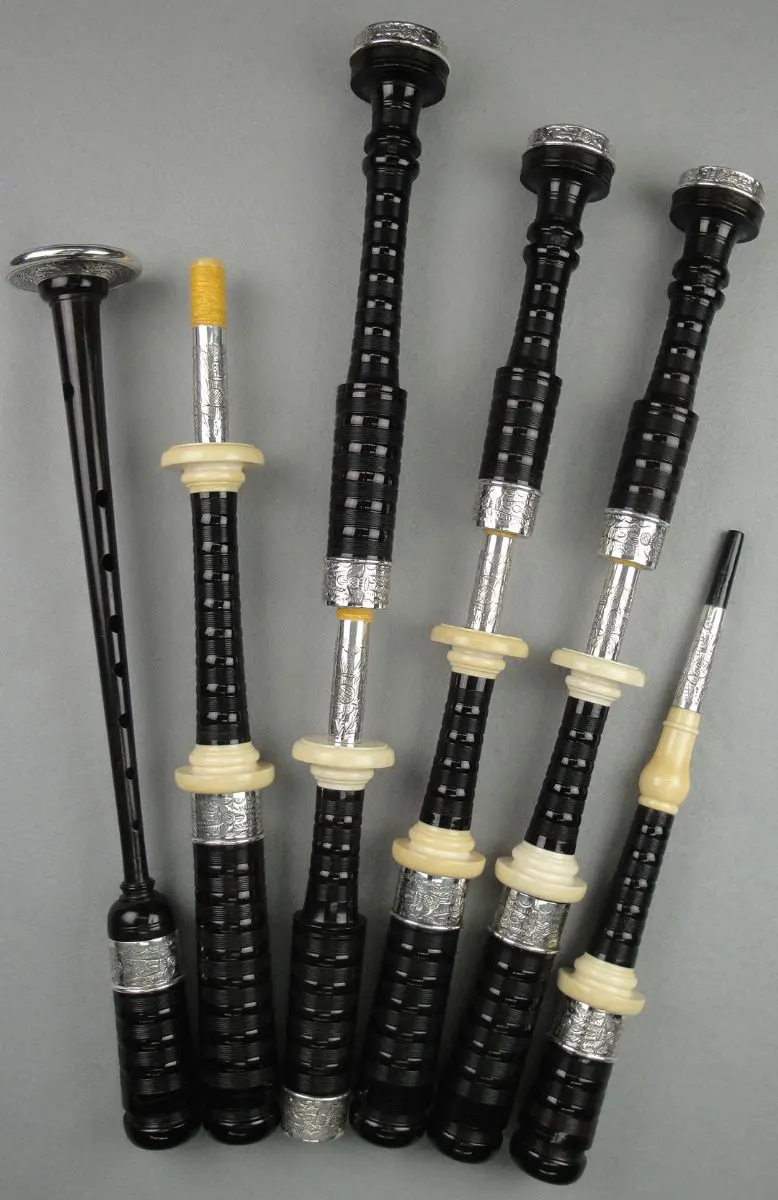
R. G. Hardie, 1970-71, Hallmarked Engraved Sterling Silver, Ivory
SOLD – The original R. G. Hardie firm in Glasgow was the most successful pipemaking company during the 1960s and early 1970s. A great player and pipe major, Bob Hardie’s standards were high. The company used superb, well-seasoned wood, and the pipes were steady and easy to reed.
This set came to me in excellent condition. It is common to see hairline cracks begin to form beneath ferrules due to the pressures of swelling hemp. They can be found in most pipes. I prefer to have these fixed to circumvent future trouble, and two such pests were whipped under the ferrules on this set. Aside from that, the pipes were simply cleaned and polished on the lathe and rehemped.
Hardie pipes are sought in many circles for their mellower tone. They are not bold like Hendersons, but they are just as steady. This set fits that pattern and comes with all original pieces, including the chanter, engraved sole, and ivory mouthpiece bulb and silver sleeve. In truth, while it’s nice to have, a 1970 Hardie chanter can be difficult to reed. But it can be done if you’re a fan of the 1960s pitch.
This is a beautiful set in great condition, perfect for a hobbyist who has always longed for a sparkling and steady high-end bagpipe.
-
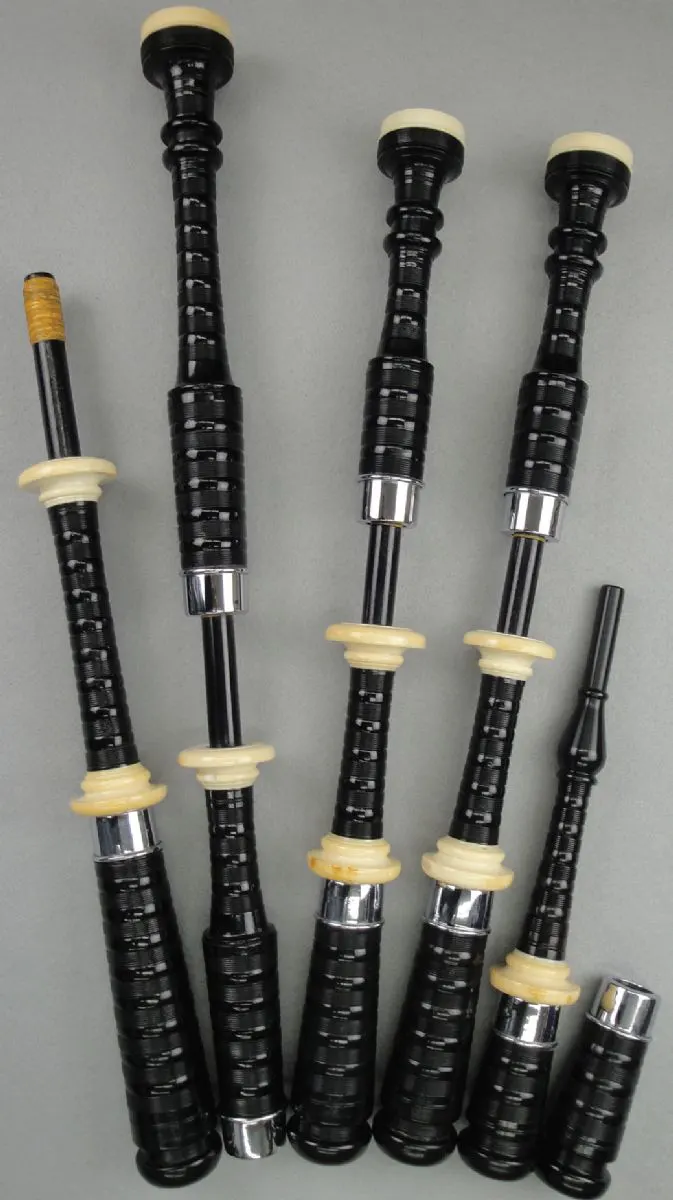
Lawrie, Circa 1905, Ebony, Ivory, Nickel
SOLD – This is one of the oldest Lawries to appear on this site, thought to have been made within a few years of 1900-1905. They are ebony, with ivory projecting mounts and ring caps, and high quality nickel ferrules, Required repairs were relatively few given the age and the wood.
One tenor stock and the tuning pin of the bass middle joint required some invisible whipping to seal hairlines. The blowstick was invisible whipped its entire length. None of these repairs will ever again reopen, such is the effectiveness of invisible whipping. The bead on one projecting mount has a small chip. The finish that was on the set was in fine shape, so the entire set was simply put on the lathe and polished. The nickel in particular came out beautifully.
The set is typical vintage, ebony Lawrie: the drones locked in immeidately with my Ezeedrone set. The bass tuned quite low, as most Lawrie and Henderson of this vintage do. (Some folk think this is problematic; it is not. You want your tenors to tune high. Low-tuning bass is common, perfectly fine, and free of roaring strike-ins.) The tone was full, rich and seamless.
For someone looking for classic, vintage tone at an affordable price, you would do well to consider this set. These old mid-range Lawries in ebony are every bit as good as their expensive silver and ivory cousins!
-
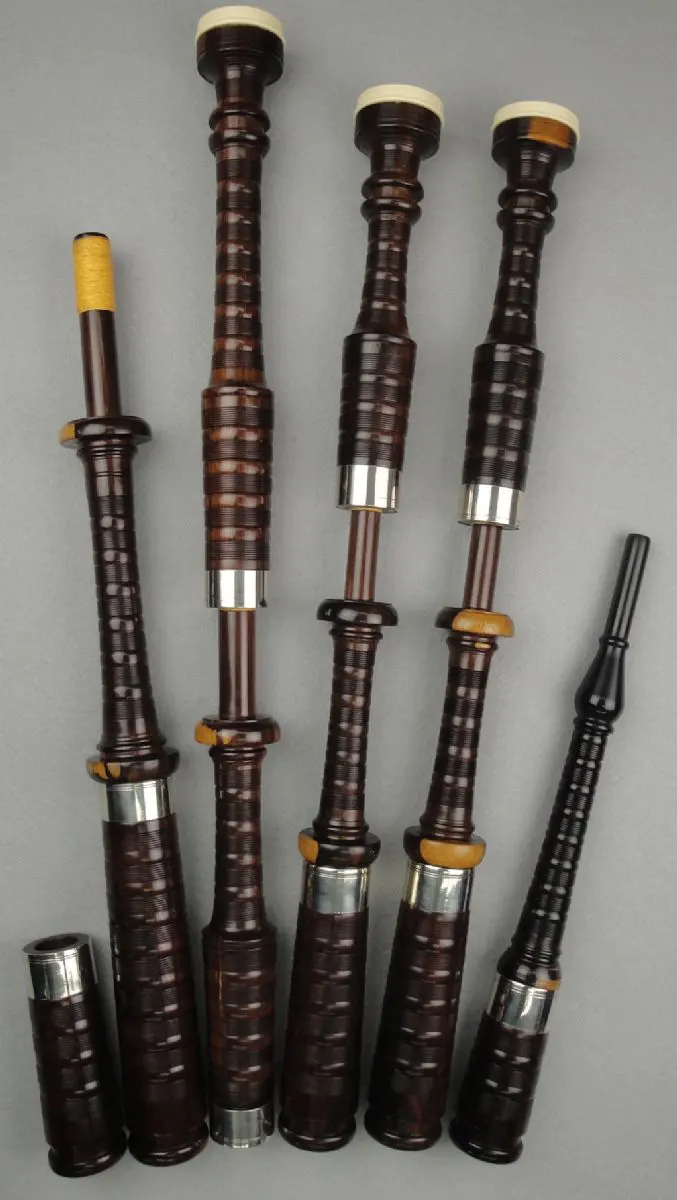
Cocuswood, Possible Glen, Circa 1920s, Nickel, Artificial Ivory
SOLD – The make of this stunning cocuswood set is a bit of a puzzle, but the caps, tone, wood and workmanship suggest David Glen, sometime after 1920. The wide beads between the combing sections are unlike Glen, and other thoughts range from Henderson to MacRae. The tone is first class cocuswood: rich, buzzy and steady.
The set came with catalin rings on the drone tops, thought to be a later addition. These had turned the usual pumpkin orange, and I had Dunbar Bagpipes replace them with non-chip artificial ivory.
The set also had came with no stocks. Replica stocks have been made from cocobola, and I found superbly matching nickel ferrules from my collection of parts. The cocobola is an excellent match to the original cocuswood, almost undetecatable as replacements.
The bass mid-joint had a hairline crack running an inch or two up from the ferrule, but this has been invisible whipped and you would never guess it was there.
Tonally speaking, this bagpipe is exceptional, and the work is clearly that of a high-end maker. The appearance in person is stunning.
The price is reflective of the unknown make and replacement parts, but not of the tone!