
Working with vintage bagpipes is as much a hobby as a business for me. I enjoy the process of turning up old pipes and making sure they will be played for years to come. I think it is a good thing for piping. As such, I take great care in purchasing, examining and restoring old pipes.

My refurbisher is J. Dunbar Bagpipe Maker in St. Catharines, Ontario. Not only do they do masterful restorations, they have eagle eyes for examining 150-year-old wood and discovering replacement pieces and flaws that should be addressed before you play the pipes. If a set of pipes has a replacement or repaired piece, you will know about it before you buy.
You should know from the get-go that pretty much every bagpipe made before 1930 has required or will require repairs of some sort, especially if they are ebony. Ebony and cocuswood are superb woods from which to make bagpipes but they are less resilient than African blackwood. I suspect there is hardly an ebony bagpipe in the world made before 1920 that hasn’t experienced at least one crack.
Photos and descriptions of all instruments featured since October 2010
-
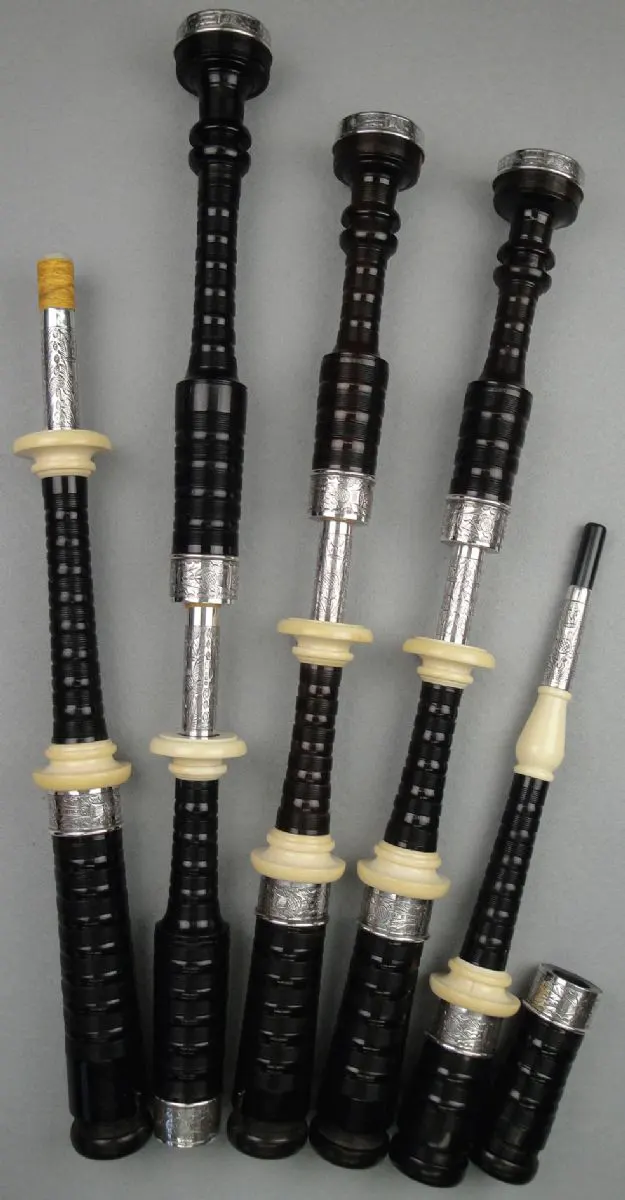
R. G. Hardie, Hallmarked 1950 Silver and Ivory
SOLD – This rare set of R. G. Hardie pipes was made the year the company was founded in 1950, and the engraved silver is hallmarked accordingly. The pipes had one owner who bought them new, though they have been in possession of the his son, unplayed since the original owner’s passing.
The set was well used during its playing career in both Scotland and Canada, but is still in superb shape. The wood and finish are in excellent condition and required only polishing on the lathe.
The blowstick and blowstick stock were missing and had been replaced with poly pieces and the original mounts. These have now been replaced with a brand new poly-lined blowstick and stock with the original mounts retained. The blowpipe bulb is new artificial ivory with the original engraved silver sleeve. The bottom projecting mount on one tenor bottom has a rice-grain sized nick.
Bob Hardie (who would have turned this set) was renown for using well-aged, high quality blackwood. His pipes are best described as “mellow,” not as full as a Henderson or Lawrie, but steady and easy to reed and tune.
While there is no original chanter with this set, I’m quite confident I could provide at added cost an engraved silver sole from my stock that would match the silver pattern, minus the hallmark.
-
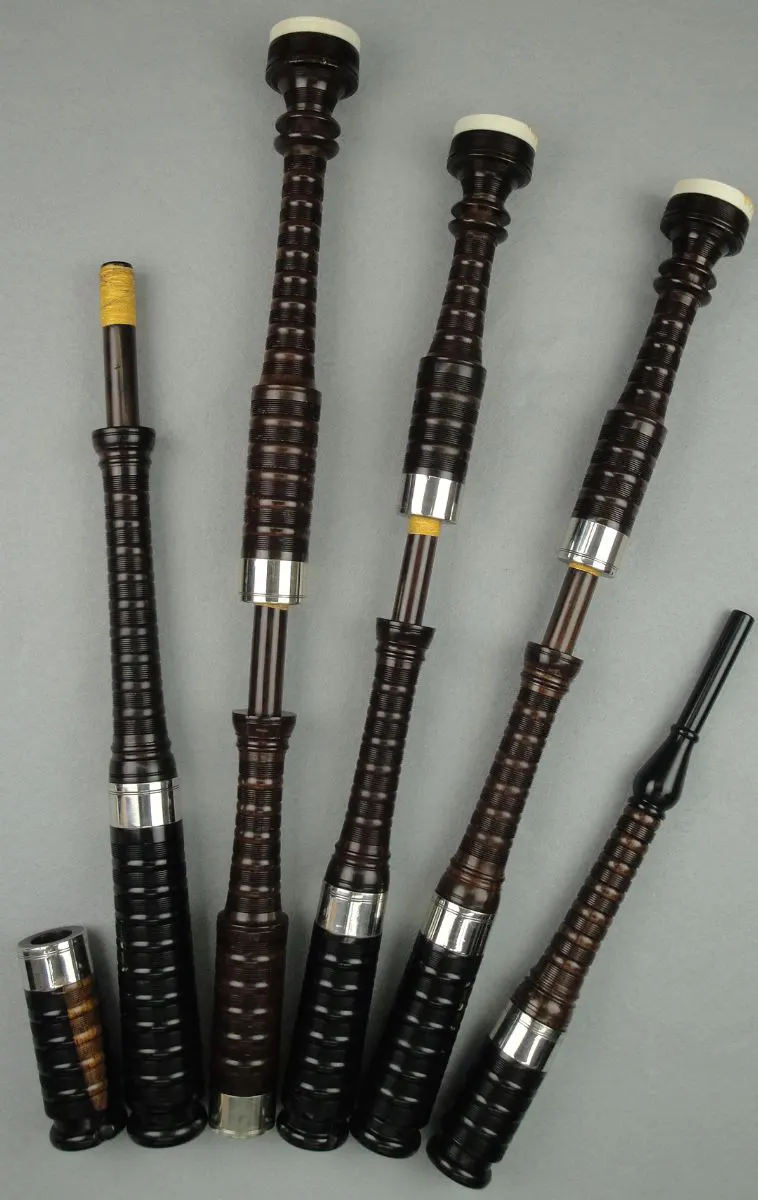
David Glen, Circa 1900, Cocuswood, Ivory Caps, Nickel Ferrules
SOLD – This is a classic button-mount turn-of-the-century David Glen set in cocuswood. The stocks look distinctly unlike cocuswood. The sapwood showing on the chanter stock suggests they might be ebony. Back in the early 1900s it wasn’t unsual for makers to mix woods like this, but I’ve never seen a cocuswood Glen set with stocks that weren’t cocuswood. They might be replacements, but certainly made in the Glen style, if not by the company itself.
The pipes are in superb shape, the only visible flaw being some orange staining on the ivory rings of the tenor drones, partly visible in the photos.
In typical Glen fashion, the tone is subdued but rich with the vibrant nature of cocuswood. They are rock steady and easy to reed and tune. The pipes appear to have been refinished at some point fairly recently.
-
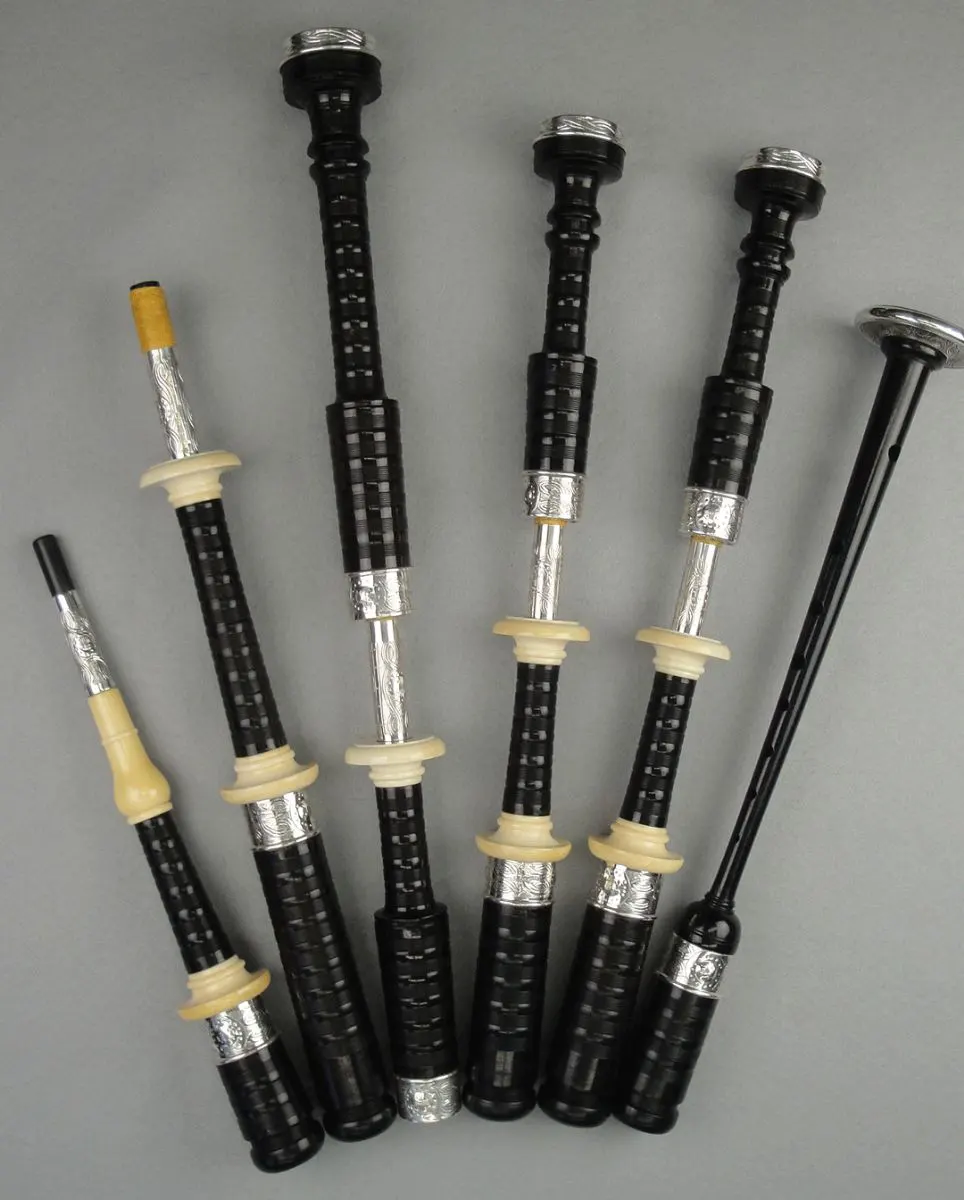
Grainger and Campbell, Hallmarked 1962-63 Silver and Ivory
SOLD – The Grainger & Campbell shop opened in Glasgow in 1946 and later took over the Duncan MacRae shop on Argyll Street when that firm closed in 1952. The great piper John MacFadyen became a partner in the 1950s, and Donald MacLeod joined the shop in 1962. As a result, the company was making some of the finest pipes available through the 1960s and 1970s.
This set is hallmarked 1962-63, made during the company’s tonal prime, and is in superb condition with all original pieces, including the original chanter and sole, and ivory mouthpiece bulb and silver sleeve. The pipes required no major refurbishment. They were cleaned and polished on the lathe, the blowstick was shortened and bored larger, and the tuning chambers were slightly reamed to even-up the tuning action. The silver pattern is gorgeous, and typical of the company.
The drones are full and very steady. I know a number of professional-level players who purchased sets like this new in the 1960s and never found reason to change.
The chanter is quite low-pitched, as one might expect, but still plays well. The set spent most of its life with one owner, a former 48th Highlander. The last owner had them for four years and decided to pass them along after having rarely played them.
-
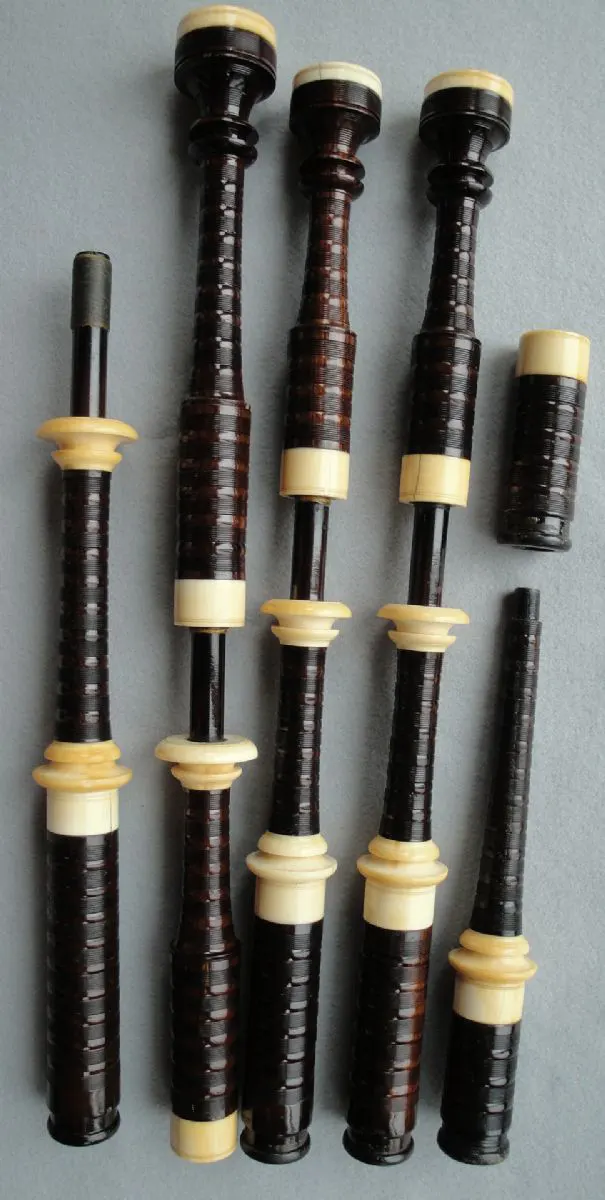
Circa 1890s David Glen, Cocuswood, Full Ivory, Brass Slides, Stamped
SOLD – Full ivory David Glen pipes are not common. These sticks are cocuswood – David Glen’s favourite wood. The previous owner of this pipe lived in a dry climate in the US, and after he acquired the instrument several of the ivory ferrules cracked. He worked with an ivory conservator and made quite expert repairs that have held firmly now for many years.
The bass drone stock and the blowpipe also cracked. He inserted a marine glue that remains malleable after it dries, and these repairs have never moved. He also inserted a thin brass tube into the blowstick to further reinforce it. The repairs are visible, but not obvious, and since they have remained stable for decades they have not been altered.
The tuning chambers have brass slides, a fairly common practice for David Glen.
The David Glen stamp is barely visible on each of the tuning pins.
Glen was a meticulous craftsman, and his manufacturing standards were very consistent. As a result, it can be difficult to date his pipes. The age of the ivory and the fact that these pipes are cocuswood suggest that they were made prior to 1900.
David Glen drones are really a treat, and if you’re looking for a reliable and remarkably steady set of drones with a rich, buzzy, but not overwhelming tone, you can’t go wrong with them. They are easy to reed and blend superbly with the chanter. It’s a bright, cheerful drone sound.
These pipes required no additional restoration work.
This set was purchased from this site a few years ago and have come back from a player who has decided to downsize his collection. This is the original listing, but the pipes are exactly the same. I don’t believe they were played much.
-
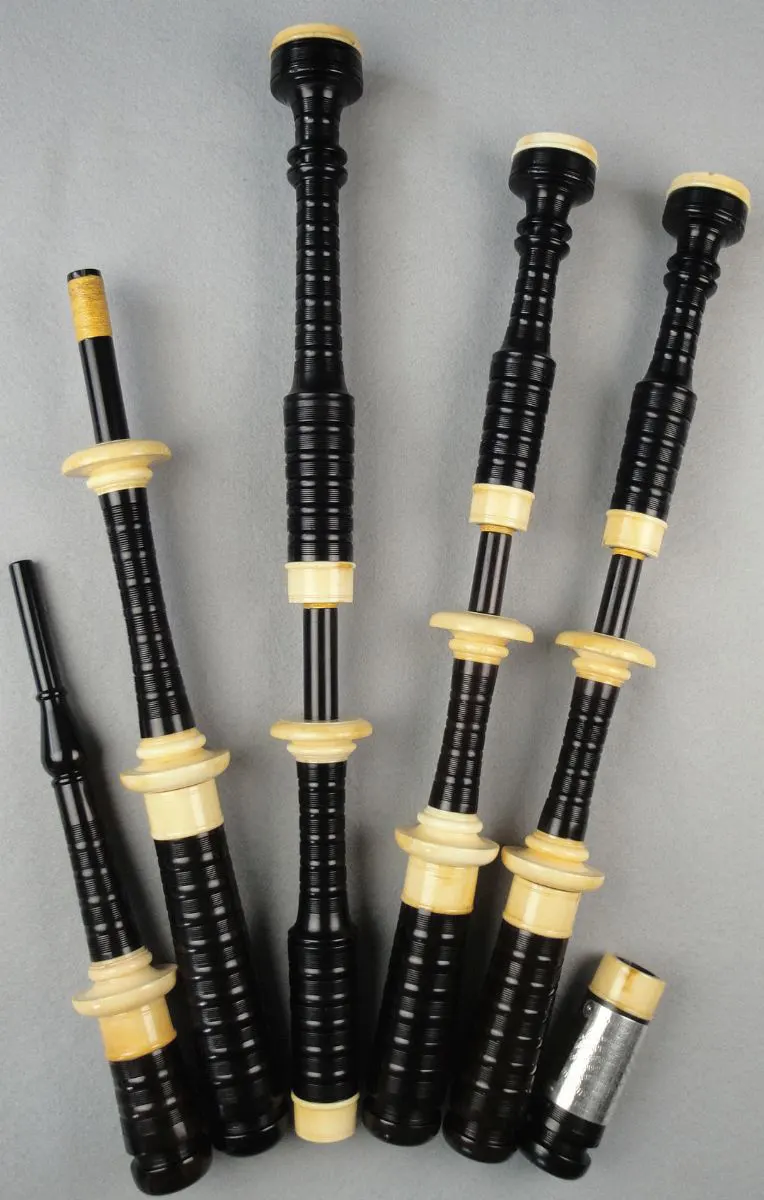
Thow, 1893, Cocuswood and Ebony, Full Ivory, Presentation Set
SOLD – “Presented to Piper Charles Dunbar by Major Campbell, 1st Seaforth High’rs, in remembrance of good piping, good conduct and good fellowship, during the years of 91, 92, 93, at Fort George.”
Thus reads the silver shield that was affixed to the chanter stock of this presentation set of Thows. Charles Dunbar (1870-1939) was a prize-winning Halkirk native, Seaforth Highlander and Gordon Highlander, a Boer war and WWI veteran, who emigrated to Canada and served for many years as Pipe Major of the Argyll and Sutherland Highlanders in Hamilton, Ontario.
The pipes are certainly Thow, showing the scribe line on each cord guide distinctive to that company. One would expect the pipes were made the year they were presented, though it is also possible that they were Dunbar’s regimental set and he was simply allowed to keep them along with the shield when he left the Seaforths for the Gordons in 1893.
The pipes have obviously seen long usage. Both tenor drone stocks are new blackwood replicas with the original ivory ferrules affixed. The blowstick stock is a new poly-lined blackwood stock with the original mount. The chanter stock appears to be an earlier replacement, though pin marks indicated clearly that the shield had been affixed there. The blowpipe is a new, poly-lined, blackwood replacment as well.
The tone of the pipes can best be described as “mellow,” in the Glen tradition: steady and rich, benefiting from the mix of early woods: all three drone bottoms are cocuswood, the rest of the pieces are ebony, but for the replacement stocks.
-
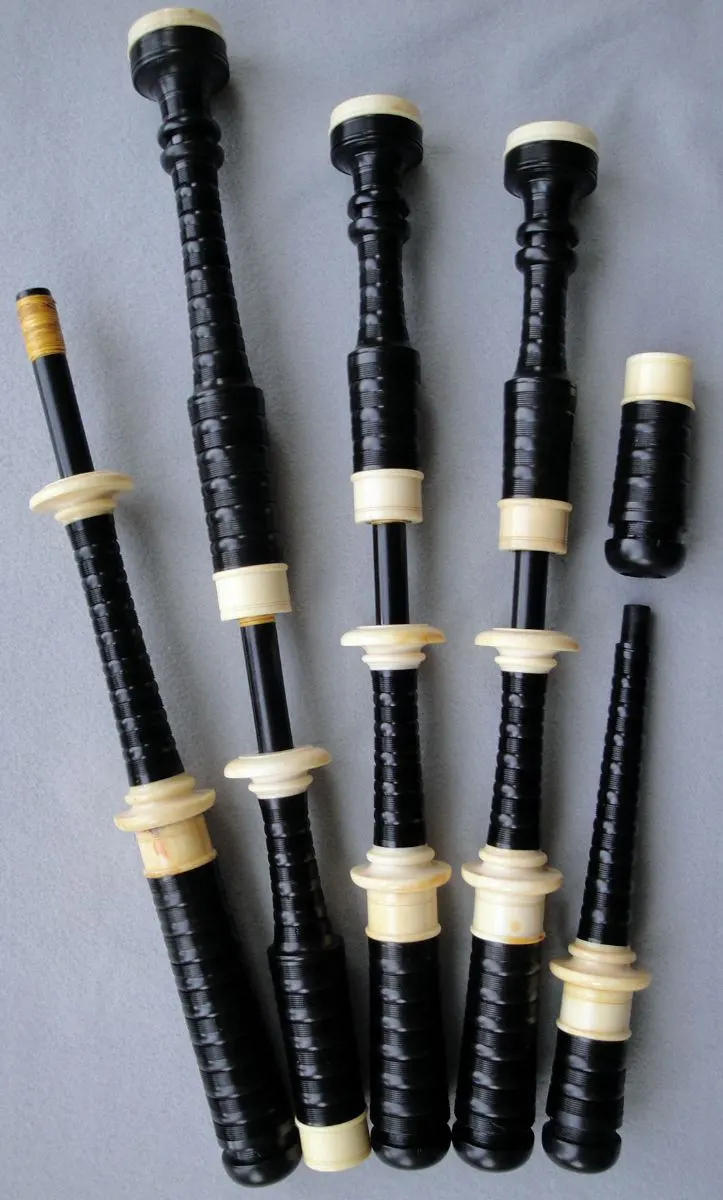
Henderson, Circa 1920-1930, Ebony, Full Ivory
SOLD – This old Henderson set is in prime shape. All pieces are original, with no cracks or repairs. It looks like one tenor bushing has been replaced with celluloid. The ivory shows some minor staining here and there, but is undamaged but for one small nick in the chanter stock ferrule.
The set is ebony, the tuning slides are perfectly even and the set is really primo vintage Henderson.
The pipes were purchased from Jim McIntosh in the early 1980s as a circa 1920-1930 set. They were purchased from this site a few years ago and have come back from a player who has decided to downsize his collection. This is the original listing, but the pipes are exactly the same. I don’t believe they were played much.
The wood was refinished when the pipes were first offered here.
-
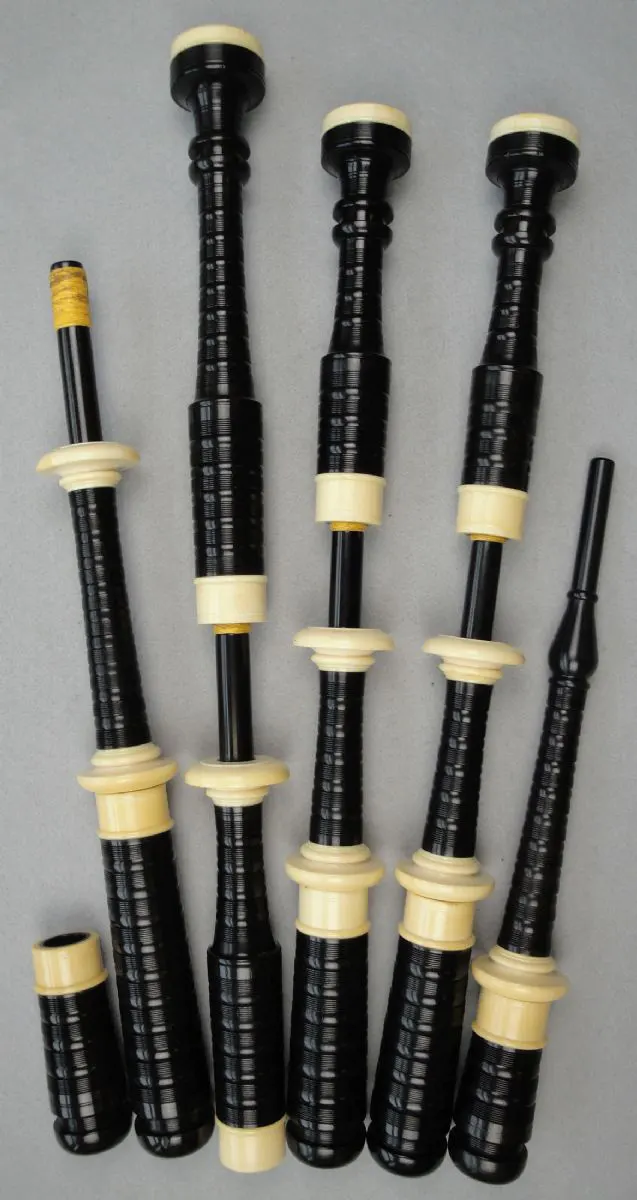
Henderson, Circa 1930, Ebony, Full Ivory
SOLD – This old Henderson set was sold here a number of years ago and has been repurchased from the buyer, who is selling for personal reasons.
It is in lovely shape, both visually and tonally. The set is ebony, with ivory mounts, and the drones are rock steady, robust and seamless in the Henderson tradition.
All pieces are original, and the only visual flaws are some very tiny chips in the ivory that are quite normal in a set of this age.
There was a tiny hairline crack in one tenor top, and another in one tenor stock — pretty typical of old ebony. I don’t like to take any chances with ebony, so these have been invisible whipped and you’d be hard-pressed to tell from the photos where the work was done.
The age of the set has been estimated to be around 1930 by the shapes of the projecting mounts, the use of ebony, and the appearance of a “PH” stamp below the cord guide rather than a “P. Henderson” stamp inside the cord guides. The pipes have aged well. These photos were taken when the pipes were refinished several years ago. The finish is still in excellent shape, though not as pristine as it appears here.
One added feature of this set not pictured: Henderson bass drones tend to tune quite low on the tuning pin. This is not something that has ever bothered me. However, the previous owner had a matching bass piece made with holly mounts and a narrower bore that allows the mid-joint to tune higher on the pin. Both the original and the new piece come with the set, so you can decide which one you wish to play! The previous owner also provided with the pipes a McCallum MCC2 chanter with a matching antique ivory sole.
These are classic ivory Hendersons that will perform well at any level.
-
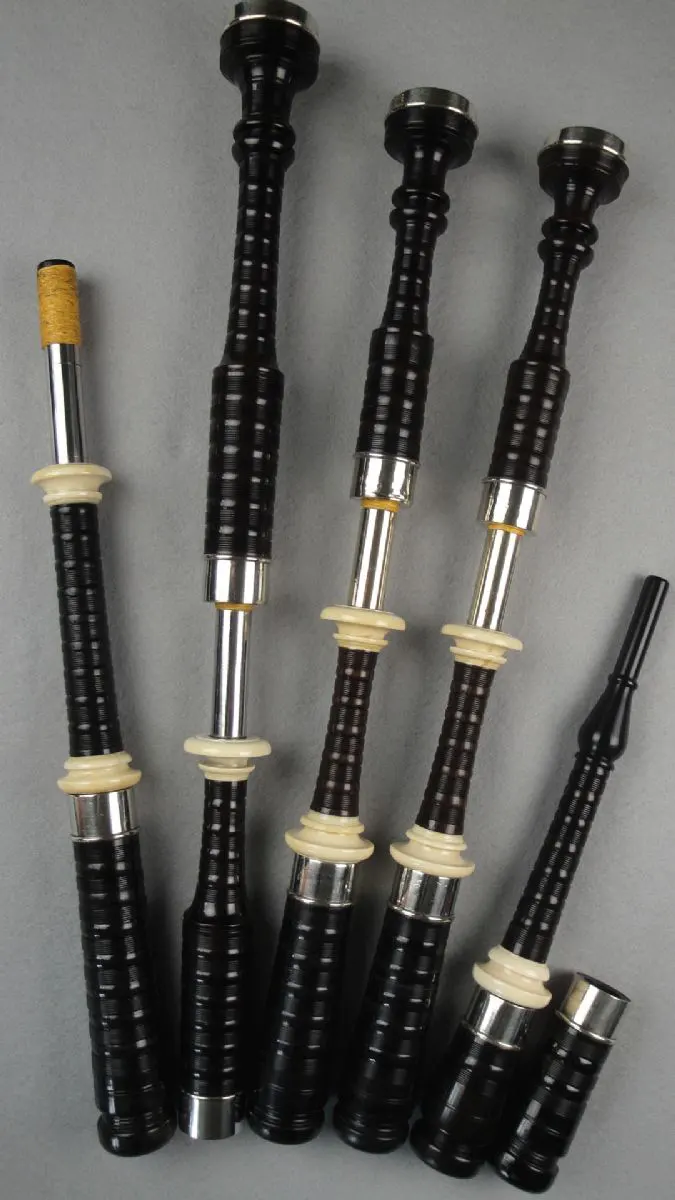
Duncan MacRae, Circa 1930, Cocuswood and Ebony, Nickel and Ivory
SOLD – Duncan MacRae sets don’t come up very often. The company made pipes in Glasgow from 1897 until 1952. The great piper Willie Gray worked closely with the firm for many years, helping them introduce numerous innovations, including hempless metal tuning slides. Many such sets were subsequently converted to hemp but, as with this set, the patent marks and dates (1929) remain on the slides.
This set appears to be a mix of ebony and cocuswood. The ivory projecting mounts are narrow and beautifully styled. Some of the nickel shows dents, including one tenor drone ferrule. Hairline cracks were sealed in the bass stock and two drone tenons — preventative measures only.
The blowstick stock appears to be a blackwood replacement. It is possible that the bass top is a replacement as well. The two tenor tops are visibly different in external diameter, but such inconsistencies were not uncommon with MacRae pipes. McCallum Bagpipes recently decided to maintain a similar inconsistency in their reproduction of Stuart McCallum’s silver and ivory MacRae set.
This is the first MacRae set I have ever played, and I was quite struck by the remarkable tone — very full, engaging and stready. This set is a rare and distinctive find. both visually and tonally.
-
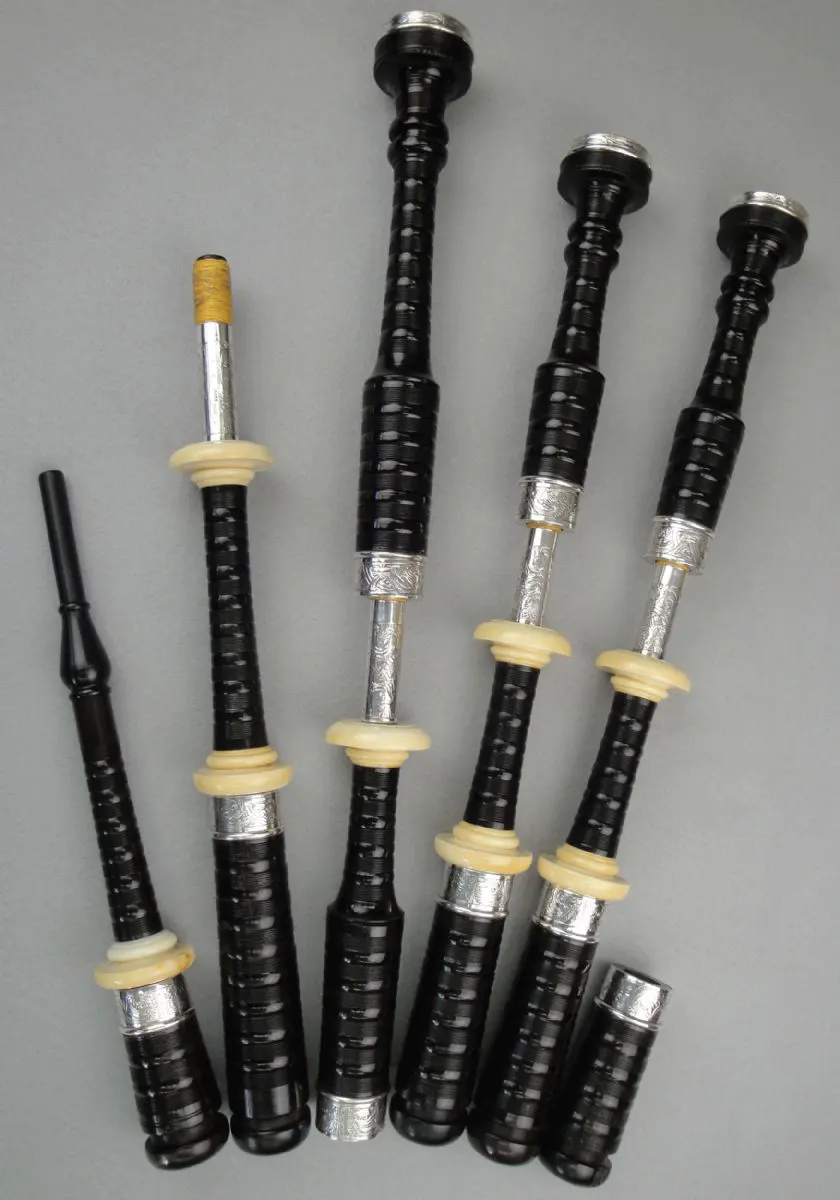
Henderson, Hallmarked 1950-51, Silver and Ivory
SOLD – Here is a lovely set of silver and ivory Hendersons with a gorgeous silver pattern hallmarked PH 1950-51.
All pieces are original except for the blowpipe, which was missing. The new blowpipe is poly-lined to prevent cracking and the mount is an old ivory Henderson mount taken from some old drone pieces, nearly a perfect match for the set.
The set required no major repairs. Two small hairlines under the ferrule of the bass drone stock have been sealed and are quite invisible. The original finish has been left as is. The set was professionally cleaned and polished on a lathe.
The tone is full, rich and steady. In typical Henderson fashion, the drones are very easy to reed. This great old set would suit any piper at any level, from street-band player to top competitor.
-
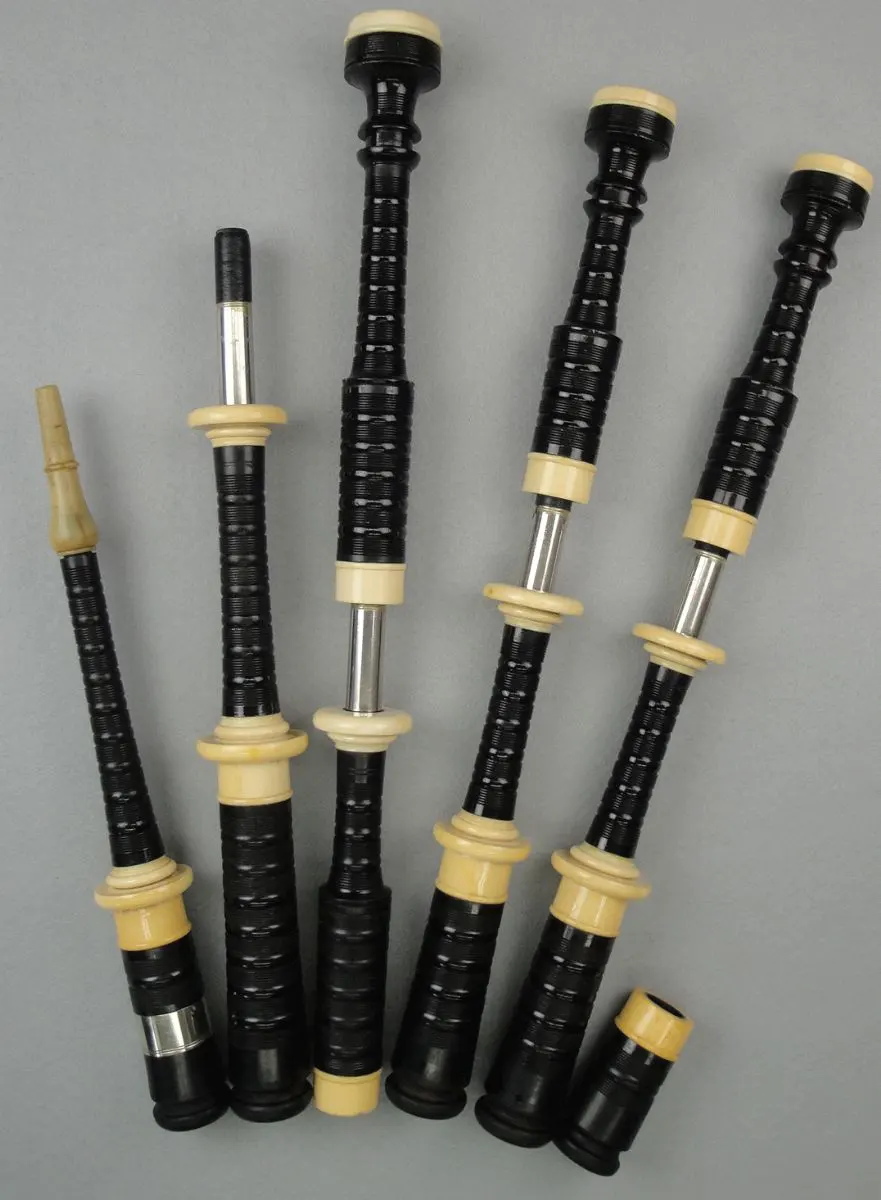
Macdougall, Suspected Gavin, Circa 1905, Full Ivory, Plated Brass Slides
SOLD – This set is certainly MacDougall, but estimates of its exact age have ranged from early Duncan, circa 1860s, to late Gavin, circa 1910. Several experienced pipers think that it is a Gavin MacDougall set from around 1905, and I tend to concur. Nonetheless, what appear to be two-piece projecting mounts, and the stubby tuning pins do suggest an earlier date.
Whatever their exact origins, the pipes are superb tonally, beautifully made, and display great character.
The mounts are elephant ivory and the metal slides appear to be silver-plated brass. The blowstick stock is two-piece brass lined, though the original watertrap it was made to house is no longer present. The bone mouthpiece may or may not be original to the pipes.
There is no visible stamp anywhere, and all pieces appear to be original.
The pipes were not stripped or refinished as the current finish is in excellent shape. There are no visible repairs. The pipes appear to have lived most recently in Perthshire, Scotland.
The tone is vibrant, rich and full, with a solid bass. The set reeded quickly and was steady from the get-go.
-
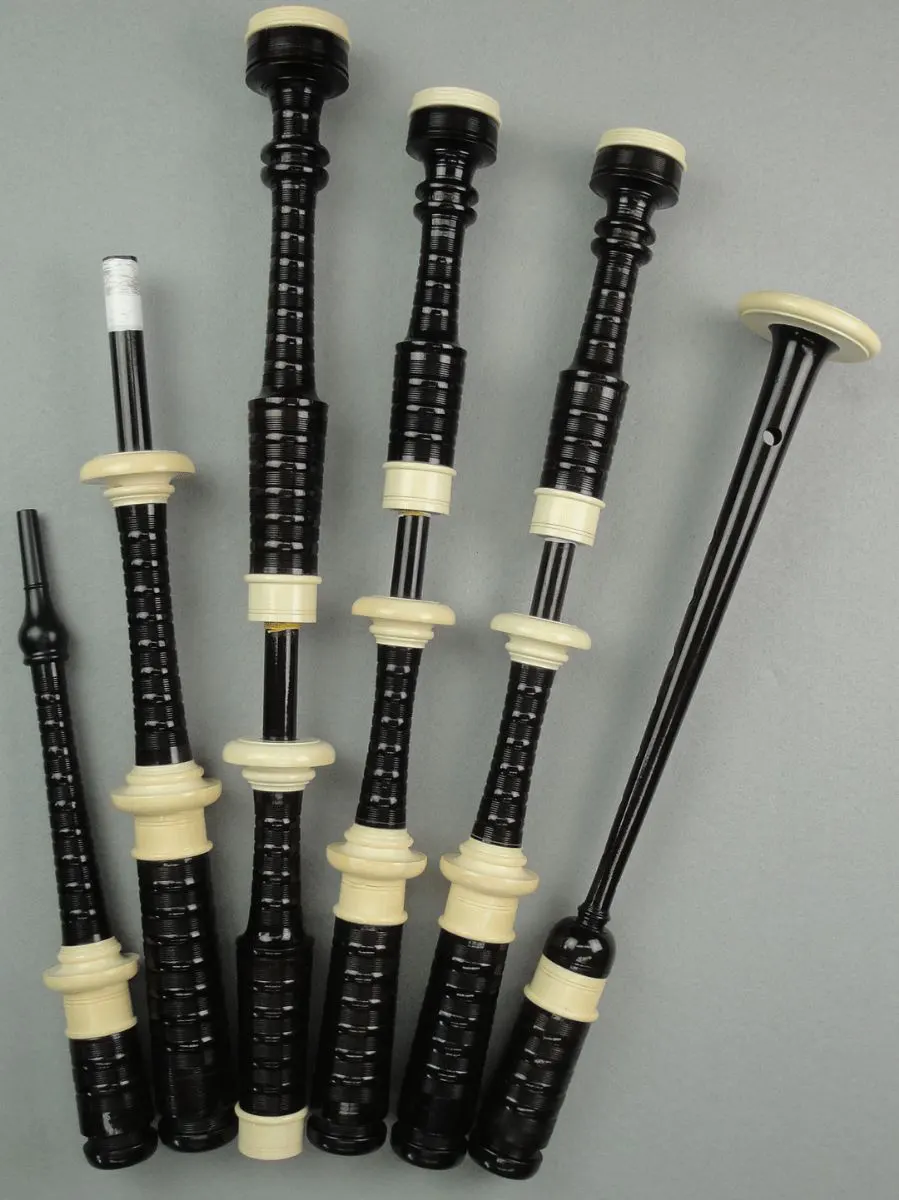
R. Gillanders and Son, Circa 1956, Full Natural
SOLD – This set came to me as having been made/purchased in 1956. The ivory patina supports that vintage.
The pipes are in great shape and required no repairs or refinishing. The original chanter is a testament to the integrity of the instrument and the care with which it was treated. The pipes have the Gillanders stamp in the cord guides.
The tone is smooth and seamless, not as “mellow” as the Hardie sound, but not as full as the Henderson. The set locked into tune for me very quickly.
Bert Gillanders learned his pipemaking with John Center, the MacDougalls and the Thows around the turn of the century. He set up his own business in Dundee in the late 1920s. His son Robert learned the business in the 1930s, and would have made this set. The company continues to operate today as Gillanders and McLeod.
This is a modestly priced vintage set in great shape, with great style and a sweet tone.
-
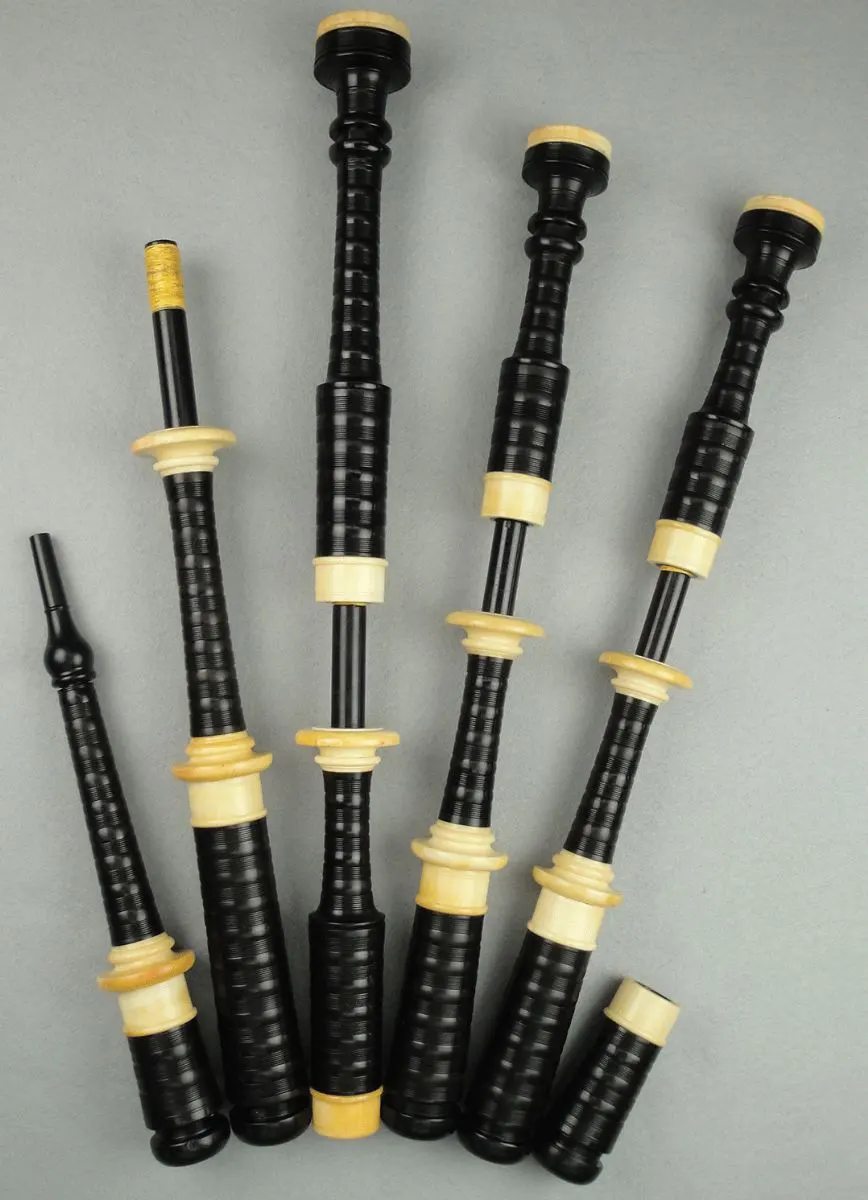
Henderson, Circa 1920s, Ebony, Full Ivory Mounted
SOLD – This old Henderson set was sold to me as circa 1930s, but I think it might be a little earlier than that. The wood is ebony, the mounts are full ivory.
They have been stripped and refinished. A very small hairline crack was invisible whipped on the bass top and a crack in a projecting mount on one of the tenor bottoms has been filled. Aside from that the pipes are in great shape and are all original.
The ivory shows some staining due to age, as well as a slight bit of red staining, perhaps caused by a bag cover while the pipes were in storage.
I put the drones in my own stocks with my normal reeds and chanter as I usually do, and they locked together with the first tuning. I didn’t need to play them for more than two minutes to realize how good they were. The sound is bold, vibrant and steady. The drones tune exactly where they should.
I love old sets like this — in great condition, yet full of character from years of use, with a tone that demonstrates exactly why we like vintage instruments.