
Working with vintage bagpipes is as much a hobby as a business for me. I enjoy the process of turning up old pipes and making sure they will be played for years to come. I think it is a good thing for piping. As such, I take great care in purchasing, examining and restoring old pipes.

My refurbisher is J. Dunbar Bagpipe Maker in St. Catharines, Ontario. Not only do they do masterful restorations, they have eagle eyes for examining 150-year-old wood and discovering replacement pieces and flaws that should be addressed before you play the pipes. If a set of pipes has a replacement or repaired piece, you will know about it before you buy.
You should know from the get-go that pretty much every bagpipe made before 1930 has required or will require repairs of some sort, especially if they are ebony. Ebony and cocuswood are superb woods from which to make bagpipes but they are less resilient than African blackwood. I suspect there is hardly an ebony bagpipe in the world made before 1920 that hasn’t experienced at least one crack.
Photos and descriptions of all instruments featured since October 2010
-
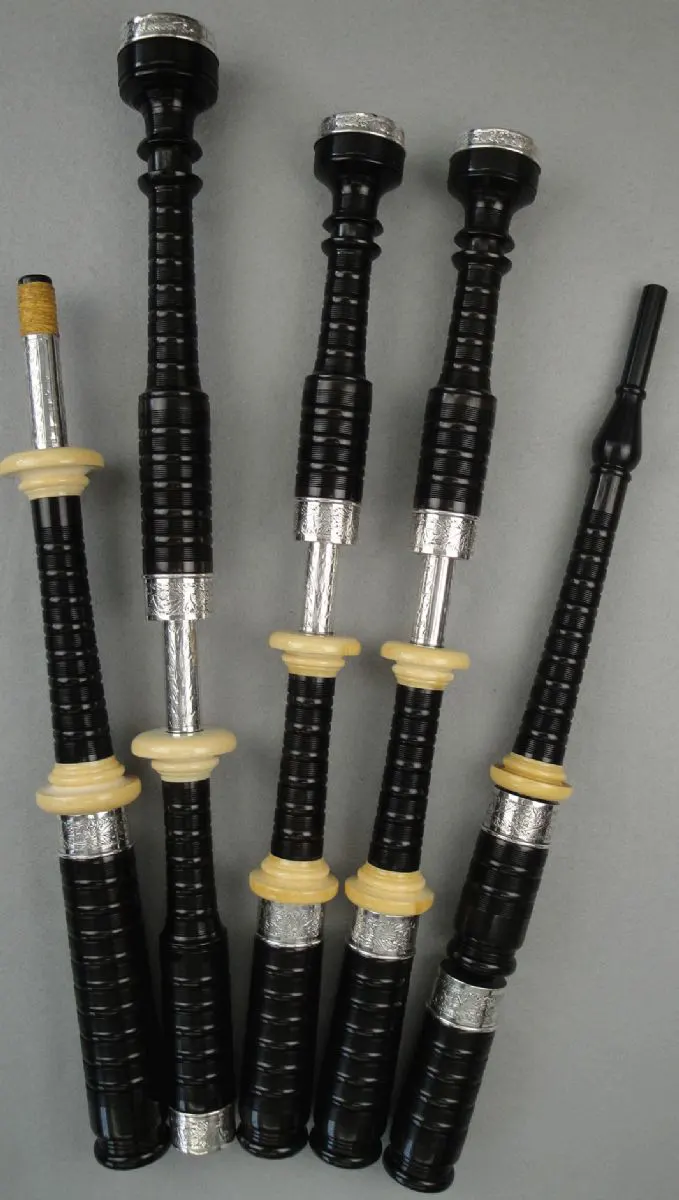
Original Macdougall Silver and Ivory Mounts on Breadalbane Reproduction
SOLD – This striking set is absolutely unique. Some months ago I purchased a very old bagpipe that was badly cracked and contained several replacement pieces. It was clear that a number of the pieces were Duncan MacDougall’s, made during his Breadalbane period in the 1870s, and that all of the original silver and ivory mounts were present and in mint condition. There was no sense in restoring the original mix of drone parts. So instead I asked Dunbar Bagpipes, my sole and superb refurbisher, to carefully remove all the original mounts and use them on one of the Breadalbane MacDougall reproductions they have been making for me for some years now.
It was a match made in heaven. The Dunbar reproduction is exemplary, both visually and tonally, and it would not be hard to pass this set off as a MacDougall original that had been restored and refinished. To prevent this, the bottom bass drone joint and all stocks have been stamped to identify the pipes as a modern reproduction. (Note that the stamps were added after these photos were taken.)
The deep-cut silver is gorgeous and the ivory is blemish-free but for a couple of age stains. As stated elsewhere in this site, the reproduction drones are an exact copy of a Breadalbane MacDougall set that I acquired from the late Skye piper Allan Beaton. I’m thrilled with the way these pipes turned out tonally — a very steady sound, with a large, cradling bass — and I will be playing my set during my summer foray to Scotland to play with the Inveraray and District Pipe Band. The set pictured here was made from wood that was purchased in 2006 and has been aging ever since.
-
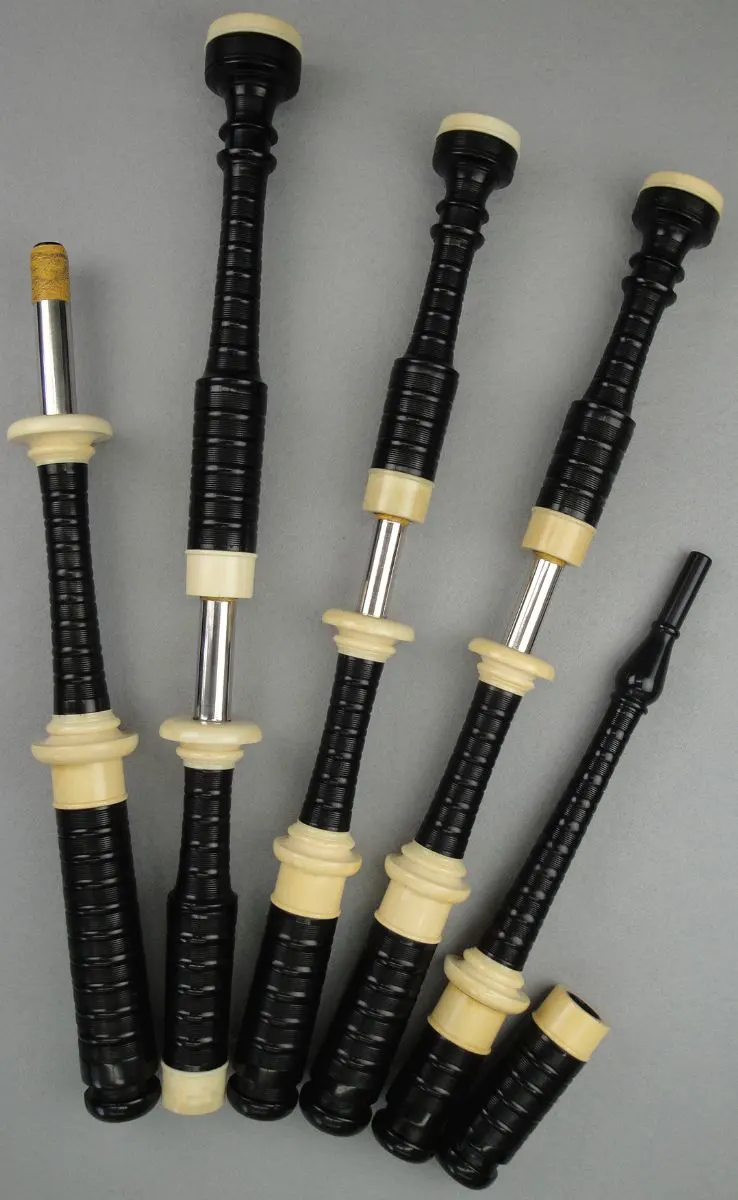
Duncan Macdougall, Plain German Silver Slides, Circa 1880s
SOLD – It’s hard to say if the plain German silver slides on this set are original, but they add a distinct touch of elegance to an already elegant MacDougall bagpipe. It can be difficult to guesstimate the age of a Duncan McDougall set, but this one and appears to be at least partially mounted in marine ivory — almost certainly walrus — although the projecting mounts could be elephant. This would suggest a pre-1890 date of manufacture. The wood is of course ebony.
The pipes were in good shape upon receipt and played well. After the finish was removed some hairline cracks were found on one tenor top and on the middle joint of the bass drone. These have been invisible whipped and are not detectable. The blowpipe stock was badly cracked and has been replaced with a poly-lined blackwood replica that uses the original mount.
The pipes are tonally brilliant — a very exceptional set, even by Duncan MacDougall standards. The bass is bold and cradles the perfectly matched and steady tenors. The tuning chambers are smooth and even for ease of tuning. The pipes have been refinished, though the ivory is perfect, and it is clear that the set has been well cared for for more than 120 years.
-
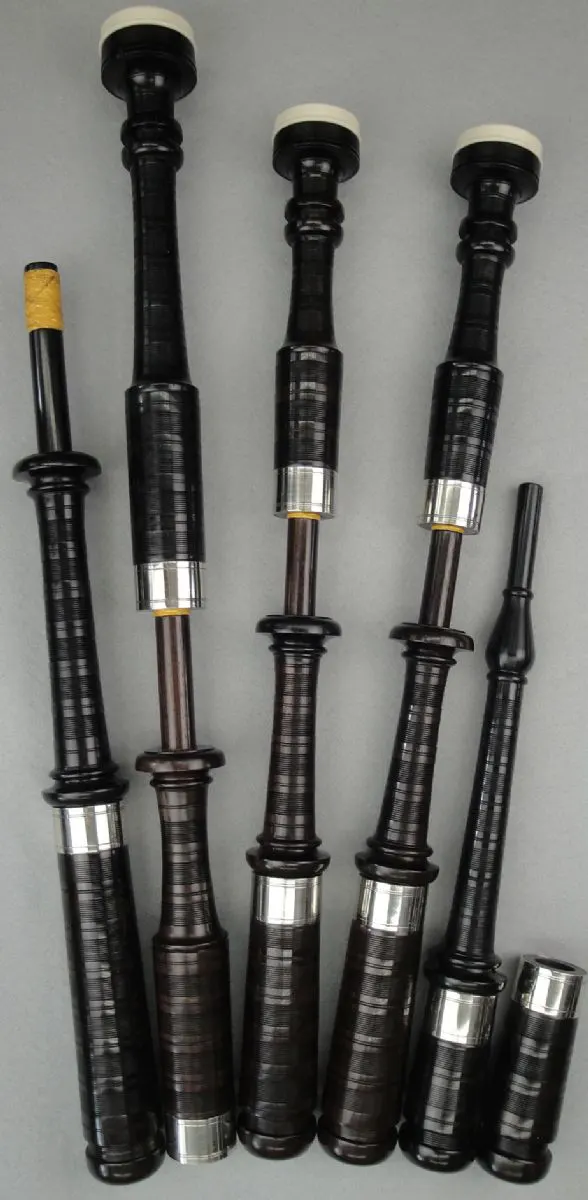
Henderson, Circa 1905, Cocuswood and Ebony, Nickel Ferrules, New Artificial Ivory Caps
SOLD – Mixing ebony and cocuswood in a single set of pipes was common around the turn of the century. With this Henderson set, the bass top and bottom, one tenor top and the blowpipe are all ebony. The rest of the pieces are Caribbean cocus. The tuning pin on the bass middle joint was cracked beyond repair and has been replaced with a perfectly matching cocobola pin.
The set came with well-worn and chalky looking casein drone caps. These have been replaced with high-quality artificial ivory. The nickel ferrules and all other pieces are original and the set is thought to date from the first 10 years of the 1900s. The Henderson name is stamped in the cord guides and the pipes were accompanied by what appears to be the original shipping label from the Henderson shop on Renfrew Street in Glasgow.
The set required a number of repairs, including invisible whipping to the bass top and one tenor top. The blowpipe and stock were also invisible whipped. Hairline cracks were found under a number of the ferrules. These may never have created problems, but we take no chances with old wood on classic pipes and these were whipped under the ferrules as well.
For someone looking for a top-drawer Henderson sound free of ivory, this is your bagpipe. The tone is classic, robust Henderson: steady, with a big, surround-sound bass. The pipes are also very light-weight on the shoulder.
The set was stripped and refinished with our usual natural buffed finish that shows the wood grain nicely.
-
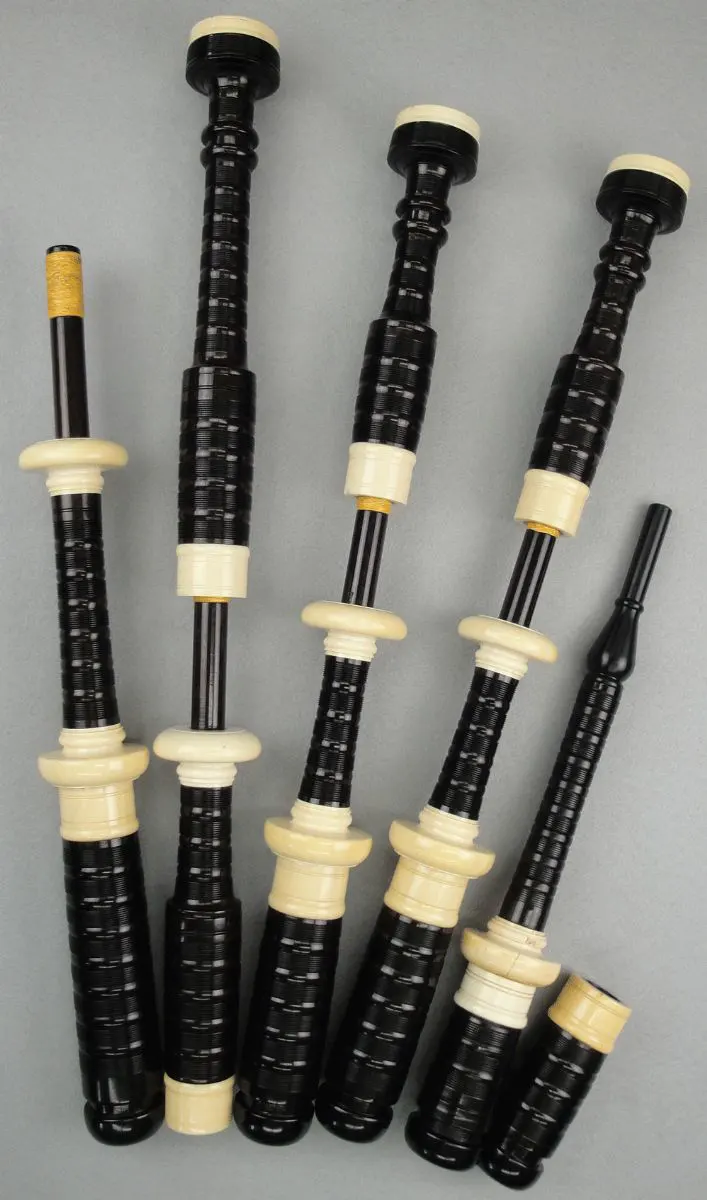
Robertson, Circa 1930s, Full Ivory
SOLD – This classic full ivory Robertson set likely dates from the late 1930s, as demonstrated by the pattern of scribe lines on the ferrules. The distinctive Robertson mushroom-style projecting mounts are in their full glory here as are the conical shaped drone and chanter stocks.
The set was stripped and refinished and found to be completely free of cracks. The pipes sport the usual nicks and knocks that one might expect from a well used 80-year-old set of pipes as well as some normal spider cracking in the ivory projecting mounts. The blowstick stock appears to have been lightly skimmed at some point, perhaps to remove staining, so it is whiter than the rest of the ivory mounts.
The consistency of Robertson manufacturing and tonal quality has been mentioned many times on this page and will be mentioned many more. The set is beautifully made and displays the usual bold, steady, vibrant Robertson drone sound. They are easy to reed and easy to tune.
-
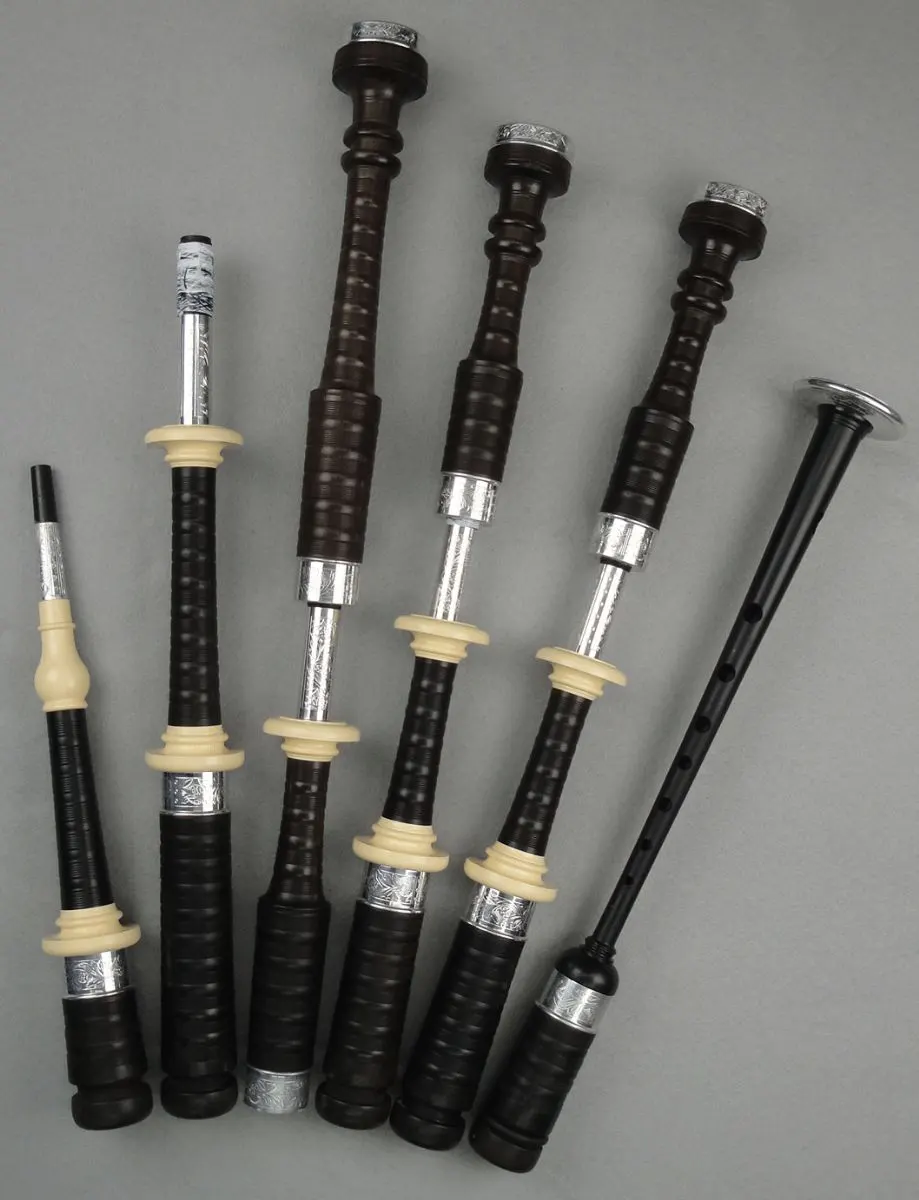
Henderson, Circa 1930, Remounted in Engraved Nickel and Artificial Ivory
SOLD – This set came to me just as it is. It was acquired by the previous owner as having been purchased in the late 1920s. Profiles and the shape of the ivory projecting mounts support this.
The ivory mounts were in terrible shape so the owner had the set refurbished — stripped and refinished and remounted with artificial ivory and engraved nickel. The refurbishment was undertaken by McCallum and the set comes with a McCallum poly chanter with a matching engraved sole. The rest of the set is blackwood except for the blowpipe which is polypenco.
The odd nick and chip in the wood again suggest a set that has seen long usage. There are no visible cracks or repairs and all pieces appear to be original.
The tone is typically big Henderson — full, vibrant, steady and easy to reed. For someone looking for a great old set free of ivory fears but with classic old-time tone, this could be the set for you.
-
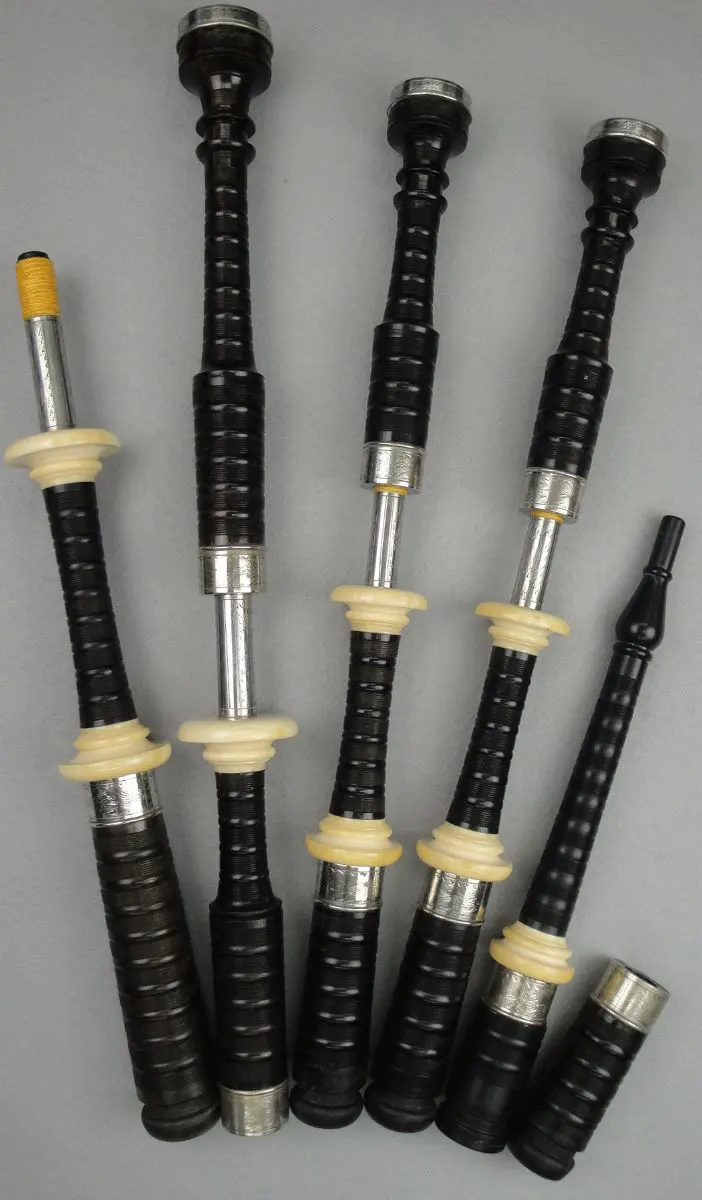
Duncan Macdougall, Circa 1890s, German Silver and Ivory
SOLD – This lovely Duncan MacDougall set appears to date from the 1890s. The pipes are ebony, the mounts engraved German silver and ivory.
The drones are free of cracks. One small crack appeared on the bass drone stock under the ferrule and extended a half-inch below that. It has been invisible whipped. The finish that was on the pipes when they were acquired is in reasonable shape and it was elected to leave it is. The blowstick and blowstick stock are replacements made of polypenco, but with the original mounts affixed.
This set was played extensively in competition during the 1980s and 1990s, and was played to win, among other prizes, the Silver Medal at Inverness.
The tone of this set is classic Duncan: rich, steady, and with a room-filling bass.
There are some minor nicks in the wood as one would expect from a set of this age, but overall it is a magnificent tonal and historic set, made by one of the great bagpipe makers of all time.
Though not pictured, the original chanter sole does come with this set.
Update: this set was sold almost immediately after it was put up on this page. The buyer has opted to have the set stripped and refinished and to have the blowstick stock replaced with a poly-lined blackwood replacement.
-
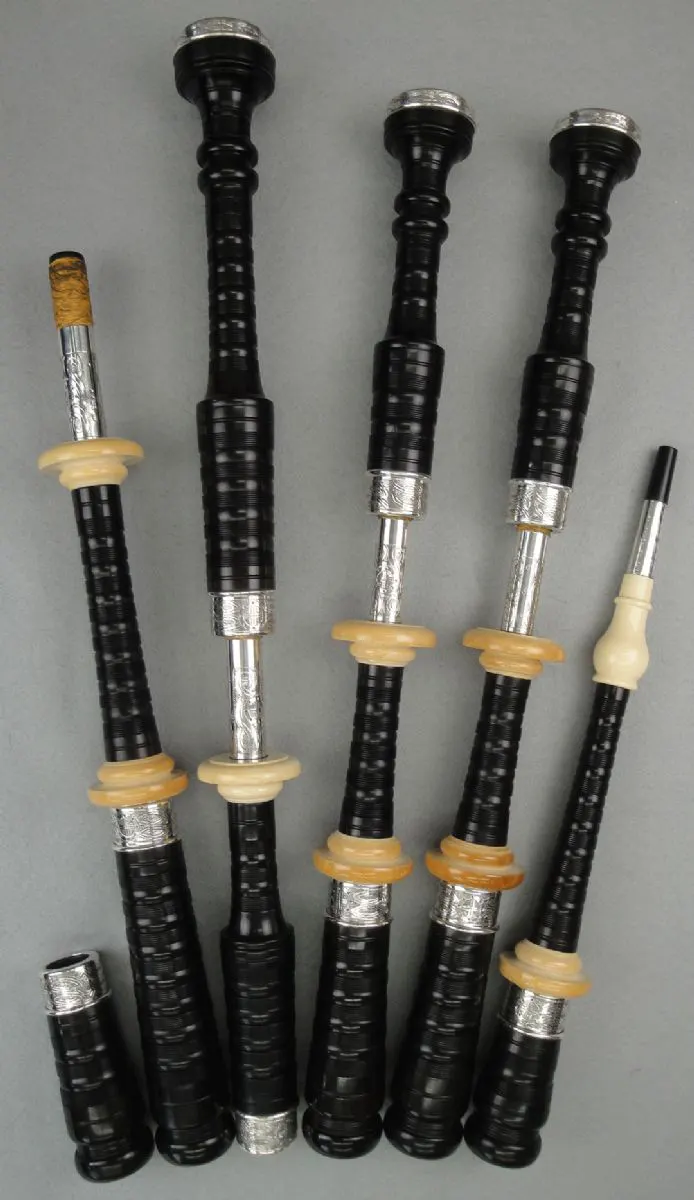
Lawries, Silver and Ivory, 1952
SOLD – This silver and ivory mounted Lawrie set is in superb shape, with the silver hallmarked 1951-52.
There were no cracks in the wood when they were acquired. They have been stripped and refinished, and there were no cracks under the original finish either. The tuning chambers have been gently reamed to even out the tuning action.
Some of the ivory has turned a cream colour, a little darker than the off-white of the rest, but the overall effect is still quite appealing. The ivory bushing of one tenor drone has some staining that couldn’t be removed and is visible in the photo of the drone caps.
The mouthpiece is not original. It is recent imitation ivory and engraved nickel.
The pipes play very nicely, displaying the usual robust and steady sound that Lawrie pipes maintained well into the 1950s. It’s a vibrant sound with lots of chanter blend.
-
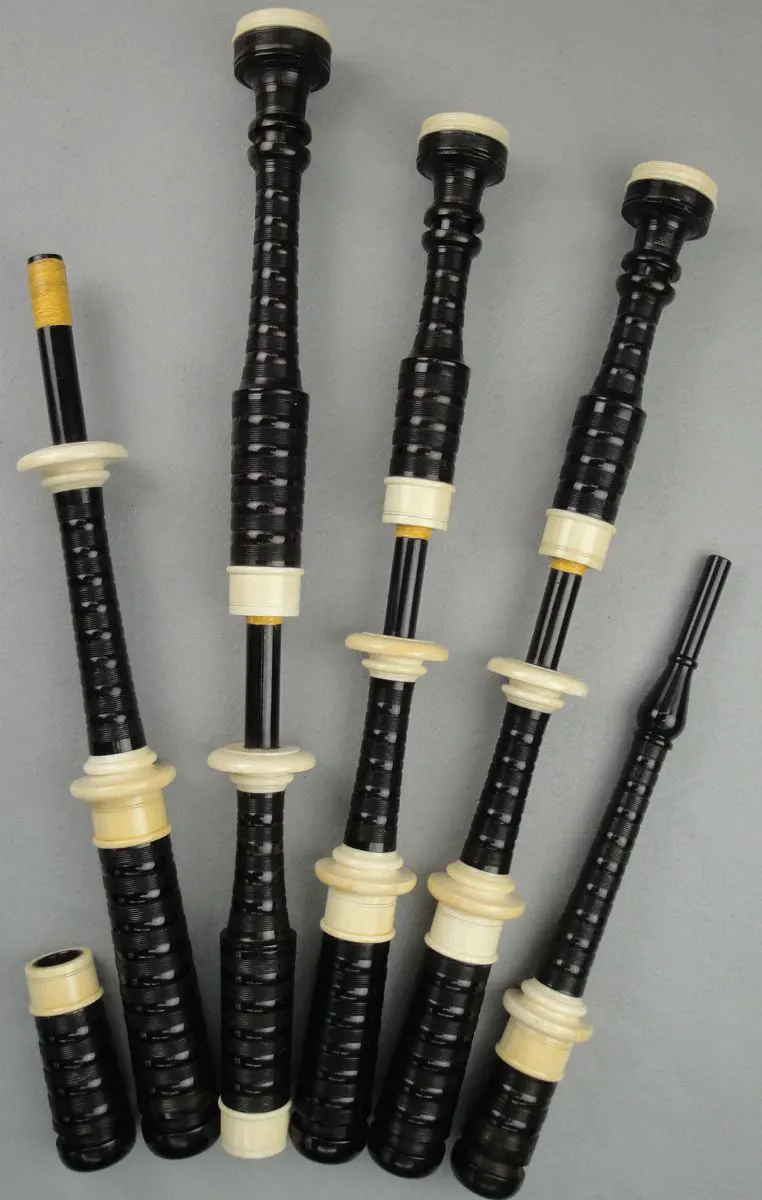
Full Ivory Henderson, Circa 1905
SOLD – This Henderson set was purchased as circa 1900-1910. The profiles, and particularly the wide projecting mounts suggest that this is a fairly accurate dating. They are blackwood, and were they any earlier than this they would likely be ebony or cocuswood.
The tone and steadiness are superb, with the deep and cradling bass sound is what one would alway hope for in a classic Henderson set. The pipes locked into tune quickly and solidly.
The finish appears to be original. One tenor stock had a hairline crack running much of its length and this was invisible whipped. A couple of the ferrules had hairlines underneath them and these were whipped as well. These repairs are permanent and you would be hard-pressed to see where any of this work was done. The ivory ferrule on the blowstick stock was a mess. A matching period replacement was found in much better shape, despite a small crack that has been sealed.
There are some minor nicks in the wood, but overall the pipes are in excellent shape for 110 years old.
Though not pictured, the original chanter does come with this set. It’s nice to have, but it is not really playable.
-
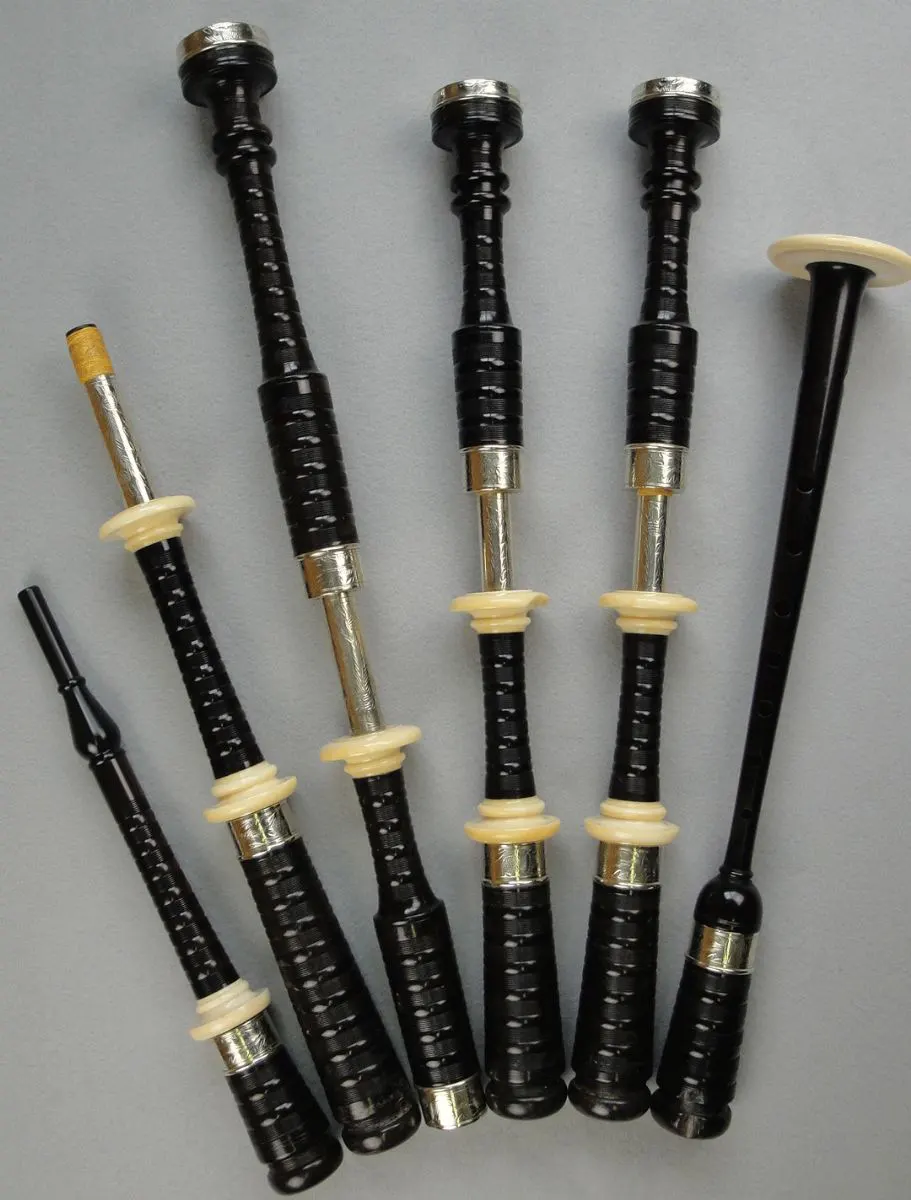
Silver and Ivory Henderson, Circa 1920
SOLD – This set is a real beauty: silver and ivory Hendersons thought to date from the early 1920s. They appear to be blackwood and are free of cracks. The only flaw, as you’ll see in the photos, is that one tenor drone projecting mount has a piece broken off the side. Someone with good sense had the break sanded straight and polished, so, while visible, it is not unsightly.
The blowstick is a poly-lined blackwood replica by Dunbar Bagpipes, with an ivory mount that is not original to the set but was taken from the previous cracked blowpipe. The mount matches the rest of the set fairly well; it just doesn’t look quite as old. The finish has been left on the set as is, though the wood, silver and ivory were all polished on a lathe. A hairline crack under the ferrule on one tenor stock and the bass stock have been whipped.
The chanter is a Henderson, and the fact that it has an ivory sole would suggest it is not original to the pipes, though it may be.
Like the pipes directly below, this is a first-class old Henderson set. The tone is full and steady, and the pipes went brilliantly with both sets of reeds I tried.
-

Henderson, Cocuswood, 1932, Ivory, Nickel Ferrules
SOLD – This set was listed a couple of months ago and snapped up very quickly. Unfortunately, the customer could not get the pipes to go steadily. I apologetically took the pipes back for a full refund. Turns out there were some undetected cracks in both tenor turning pins. These were sealed and invisible whipped. I just had 45 minutes on the pipes and they are now as steady as any MacDougall set I’ve ever played.
The set came to me from my friend Ron Bowen and has been identified as MacDougall, from the years around 1860. It could be Duncan’s work, or that of his father John, but the pipe is distinctly MacDougall. It is ebony, except for the bass drone, which is blackwood.
The original bass drone could not be salvaged, and a reproduction was made using the internal specifications of the MacDougalls owned by John Wilson, Edinburgh/Toronto, that were sold on this site some years ago. All mounts are original, with the exception of the bass ivory ring and bushing.
The bass drone stock appears to be cocuswood and may not be original to the pipes, though, again, the mount is. The upper projecting mount on the bass bottom joint has a small chunk out of it. When the pipes were in transit to the customer described above, a piece of the same mount broke away cleanly. This was professionally repaired when the tenor tuning pins were addressed. The blowstick stock may not be original. Both tenor stocks required invisible whipping.
The tone is superb, and while the pipe has some compromises, the tone is clearly MacDougall — full, rich and seamless, with a powerful bass.
The pipes are priced with its hybrid nature taken into account, and is a great opportunity for a piper to experience the MacDougall tone and style at a very affordable price.
-
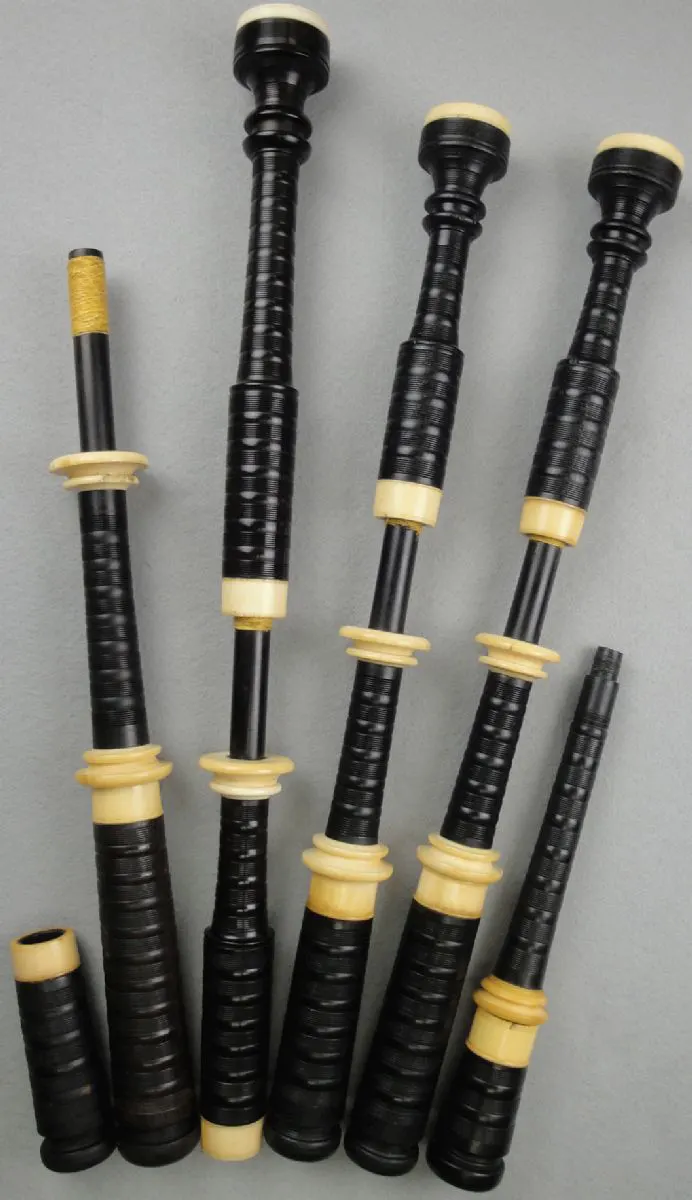
Macdougall, Circa 1860, Full Natural, with Reproduction Bass Drone
SOLD – This set was listed a couple of months ago and snapped up very quickly. Unfortunately, the customer could not get the pipes to go steadily. I apologetically took the pipes back for a full refund. Turns out there were some undetected cracks in both tenor turning pins. These were sealed and invisible whipped. I just had 45 minutes on the pipes and they are now as steady as any MacDougall set I’ve ever played.
The set came to me from my friend Ron Bowen and has been identified as MacDougall, from the years around 1860. It could be Duncan’s work, or that of his father John, but the pipe is distinctly MacDougall. It is ebony, except for the bass drone, which is blackwood.
The original bass drone could not be salvaged, and a reproduction was made using the internal specifications of the MacDougalls owned by John Wilson, Edinburgh/Toronto, that were sold on this site some years ago. All mounts are original, with the exception of the bass ivory ring and bushing.
The bass drone stock appears to be cocuswood and may not be original to the pipes, though, again, the mount is. The upper projecting mount on the bass bottom joint has a small chunk out of it. When the pipes were in transit to the customer described above, a piece of the same mount broke away cleanly. This was professionally repaired when the tenor tuning pins were addressed. The blowstick stock may not be original. Both tenor stocks required invisible whipping.
The tone is superb, and while the pipe has some compromises, the tone is clearly MacDougall — full, rich and seamless, with a powerful bass.
The pipes are priced with its hybrid nature taken into account, and is a great opportunity for a piper to experience the MacDougall tone and style at a very affordable price.
-
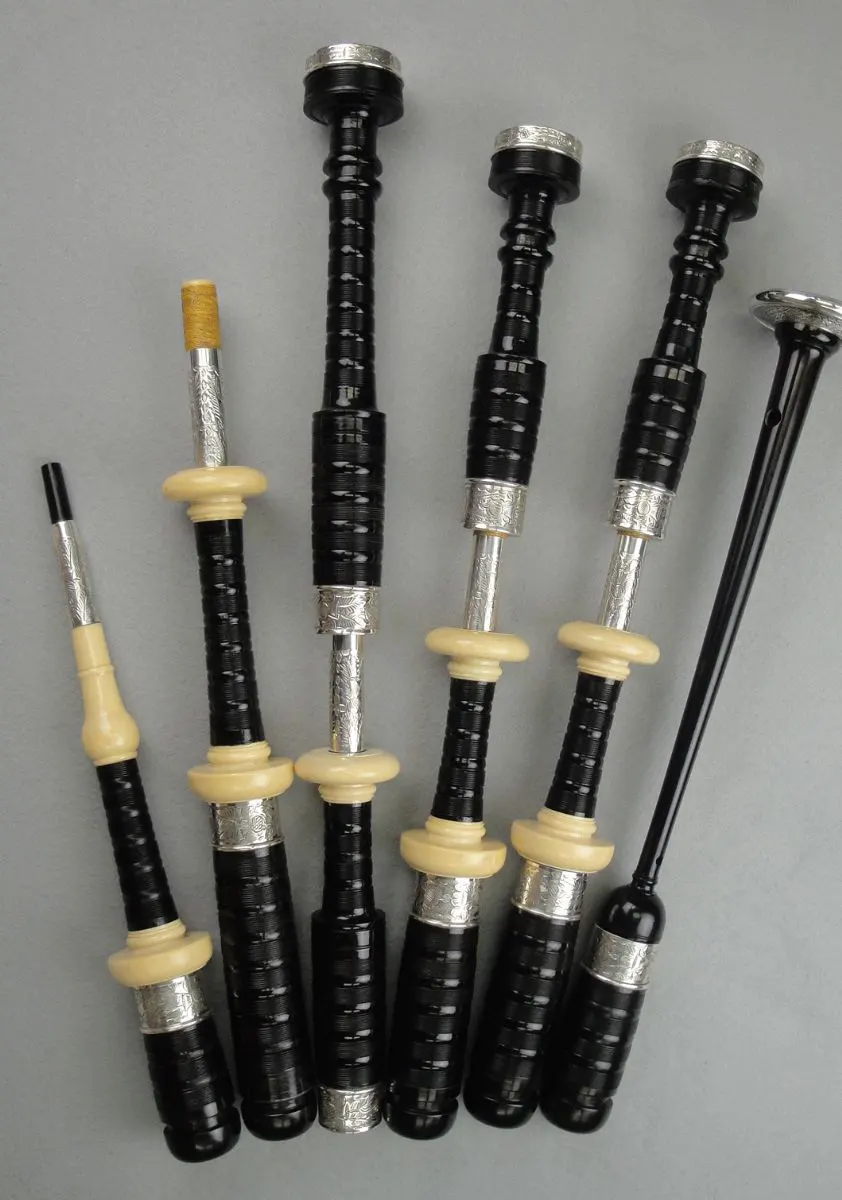
Robertson, 1962, Silver and Ivory
SOLD – This set is a real beauty: silver and ivory Hendersons thought to date from the early 1920s. They appear to be blackwood and are free of cracks. The only flaw, as you’ll see in the photos, is that one tenor drone projecting mount has a piece broken off the side. Someone with good sense had the break sanded straight and polished, so, while visible, it is not unsightly.
The blowstick is a poly-lined blackwood replica by Dunbar Bagpipes, with an ivory mount that is not original to the set but was taken from the previous cracked blowpipe. The mount matches the rest of the set fairly well; it just doesn’t look quite as old. The finish has been left on the set as is, though the wood, silver and ivory were all polished on a lathe.
The chanter is a Henderson, and the fact that it has an ivory sole would suggest it is not original to the pipes, though it may be.
Like the pipes directly below, this is a first-class old Henderson set. The tone is full and steady, and the pipes went brilliantly with both sets of reeds I tried.