
Working with vintage bagpipes is as much a hobby as a business for me. I enjoy the process of turning up old pipes and making sure they will be played for years to come. I think it is a good thing for piping. As such, I take great care in purchasing, examining and restoring old pipes.

My refurbisher is J. Dunbar Bagpipe Maker in St. Catharines, Ontario. Not only do they do masterful restorations, they have eagle eyes for examining 150-year-old wood and discovering replacement pieces and flaws that should be addressed before you play the pipes. If a set of pipes has a replacement or repaired piece, you will know about it before you buy.
You should know from the get-go that pretty much every bagpipe made before 1930 has required or will require repairs of some sort, especially if they are ebony. Ebony and cocuswood are superb woods from which to make bagpipes but they are less resilient than African blackwood. I suspect there is hardly an ebony bagpipe in the world made before 1920 that hasn’t experienced at least one crack.
Photos and descriptions of all instruments featured since October 2010
-
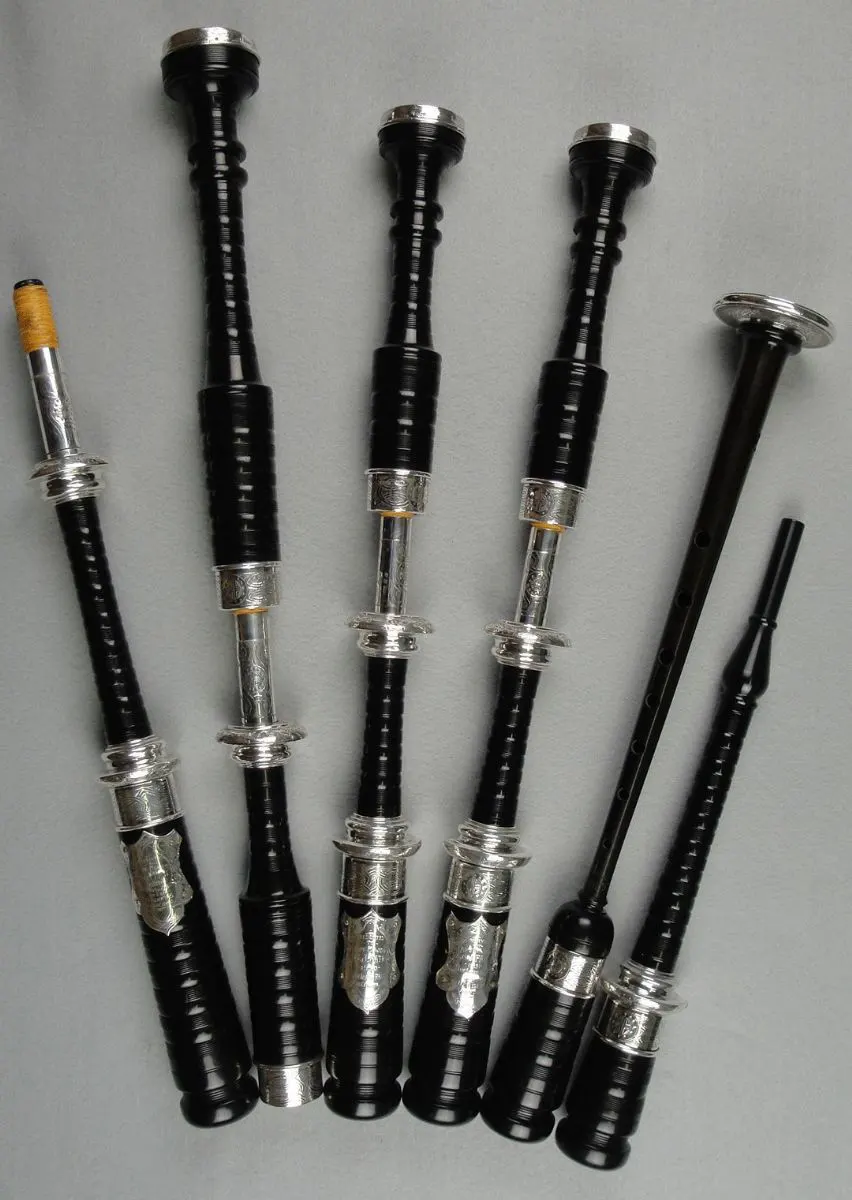
R.G. Lawrie Presentation Set, Full Silver, Hallmarked 1949
SOLD – This is a visually stunning set of Lawries that were presented in 1950 to a retiring pipe major. Three shields on the drone stocks all state, “Presented to Pipe Major G. J. Pate, 1950, The Irish Regiment of Canada.”
The pipes are in superb condition. They were refinished, and no cracks were found, except for the blowstick, which has been replaced with a poly-lined blackwood replica. One nice feature of the pipes is that while they are full silver, the projecting mounts aren’t solid. so they don’t weigh a ton the way some full silvers do.
The chanter that came with the pipes is an old Hardie, and the engraving pattern on the sole is not a match for the pipes.
During this period, Lawrie was still producing some vintage classics, and this set seems to be one of them — bold and steady much like the great pre-1945 Hendersons.
If you like bling, it’s hard to beat this set, and the tone certainly supports the visuals!
-
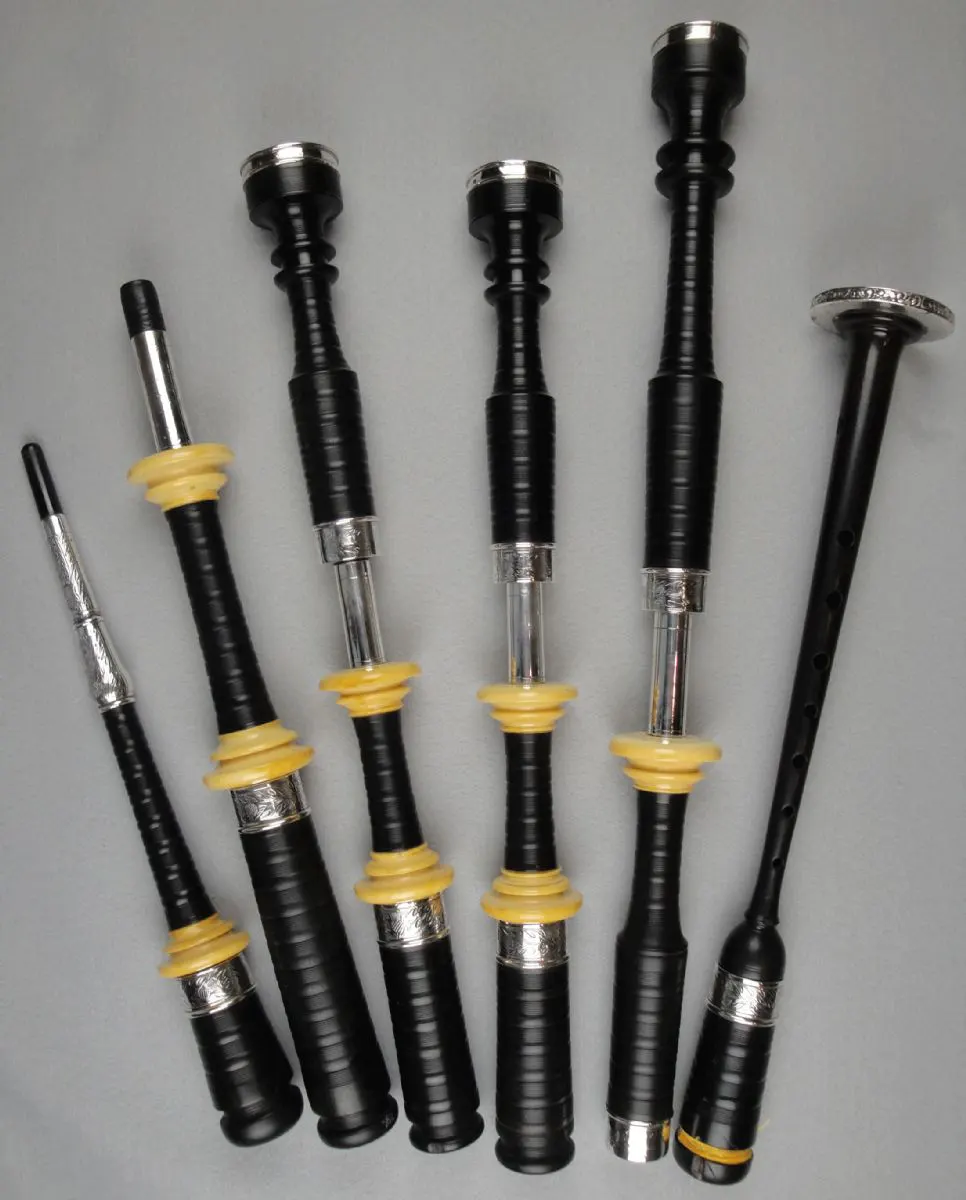
Donald MacPhee, Circa 1870s, Silver and Ivory
SOLD – This is one of the most remarkable sets to be exhibited on this site.
Donald MacPhee lived a brief but significant piping life from 1841 to 1880. He was a seminal piping figure in the 1860s and 1870s as one of the first great non-Gaelic speaking players. Robert Meldrum thought him one of the best players in Scotland, and his playing inspired a teenage John MacColl to save up enough money for a year to move from Oban to Glasgow for lessons from him. He published four important collections of music and ran a very successful bagpipe making business during the 1870s, though examples of his pipes are rare today. When he died at age 38 in 1880, Peter Henderson took over his shop.
The drones, chanter and blowstick are ebony and appear to be original. The combing and beading on the stocks match the pipes, but the stocks themselves don’t all match. The silver pattern on the stocks and mouthpiece bulb roughly match the pipes, but is a deeper cut and is hallmarked Peter Henderson 1951. It appears likely the stock ferrules and bulb and perhaps some of the stocks were made by Henderson as replacements to match the pipes at the time of the hallmark. The chanter is almost certainly the original with its barely visible “D McPHEE” stamped across the top. It is low-pitched but remarkably true.
The pipes were owned for many years by Hector MacLean, a pupil of Willie MacLean and John MacDonald of Inverness, and a prominent member of the Scottish Pipers’ Association during the 1940s and 1950s.
The tone is full, but smooth and refined, and the overall visual effect of this set is elegant and distinctive.
-
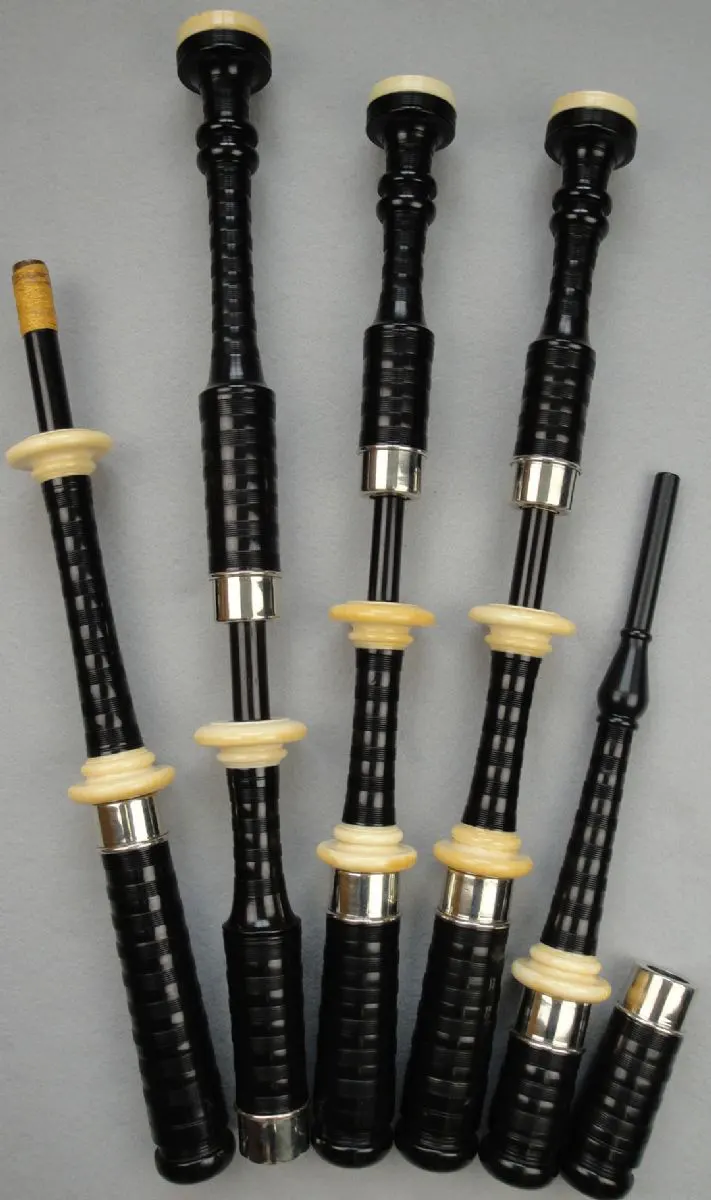
Robertson, 1939, Full Ivory Mounts, with Original Chanter
SOLD – This iconic Robertson set displays all the classic Robertson traits, including the massive mushroom-shaped projecting mounts, square bells and robust, rich, steady sound.
The previous owner knew the history of these pipes and dated them to 1939, and the pattern of scribe lines on the ferrules would attest to 1930s manufacture.
The pipes are in superb condition with no replacement pieces or cracks, and the finish is original. The set comes with its original chanter.
Robertson is one of the most consistent makers I know of, both in terms of manufacturing standards and tone. They are easy to reed, and produce an exemplary tone with great chanter blend. If you’re looking for a classic full-ivory Robertson bagpipe, you won’t do better than this one.
-
R. G. Lawrie, 1920s, Ivory, Nickel
SOLD – Most Lawries of this ilk from the 1920s are in ebony, but this set is blackwood. As such, the drones are crack-free, but for one invisible repair to the tuning pin on the bass mid-joint.
The ivory is in great shape except for some minor staining, and the nickel ferrules are free of dings and dents.
The set has been refinished. The drones display the usual full and steady tone Lawries from this era are famous for. They played beautifully with both Ezeedrone reeds and Cannings, so they will certainly take a wide variety of drone reeds. They locked into tune nicely with both makes. If you’re looking for a very affordable instrument with the same tone of high-end vintage Lawries, this may be your set….
-

Hendersons, Pre-WWI, Ebony, Full Ivory
SOLD – This is one of the earliest Henderson sets we’ve had on the site. The mounts, profiles and ivory patina suggest they are pre-WWI, likely 1910-1915 vintage.
All pieces are original except the blowstick, which has been replaced with a replica stick and the original mount. The pipes were refurbished and refinished by David Naill & Company just before I acquired them. There is some staining in the ivory and the odd wood chip typical of 100-year-old instruments.
There is not much more to say about this set. It is as fine a set of ivory-mounted classic vintage Hendersons as you’ll find. Tonally they are top-drawer: robust and steady, with a locked-in seamlessness unique to Henderson.
-
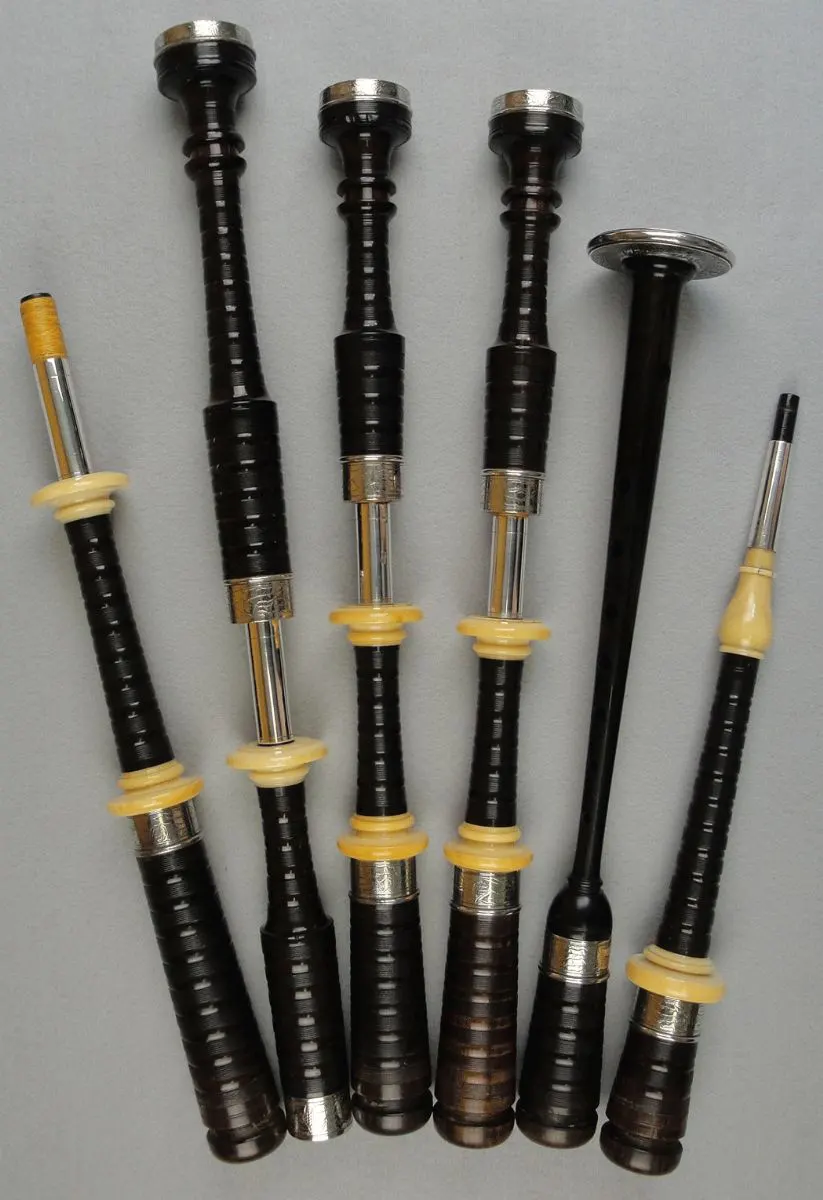
Henderson, 1912, Cocuswood, Engraved Silver, Ivory
SOLD – I acquired this Henderson set as “1920s” era, the previous owner having gone on various estimates from previous owners. However, the fact that the pipes are cocuswood suggests that the 1912 hallmark on the plain silver slides could in fact date the pipes.
The silver ferrules are engraved, though none are closed at the bottom. Oddly, the silver ferrule on the bass top lacks a bead wire, though it is almost certainly original to the rest of the engraved silver. This is barely noticeable, and I only found it as I checked how secure each mount was. The silver cap on the bass has a small dent on the corner.
All pieces are crack-free and original, except the blowpipe, which is not original to the set, but is quite a nice match nonetheless. As you can see in the photo below, the sole may or may not be original. It is not glued to the Henderson chanter as the previous owner had it on a different chanter.
The tone of this set is as good as Hendersons get — bold, seamless and steady in a way only old cocuswood can give.
The wood was not refinished.
-
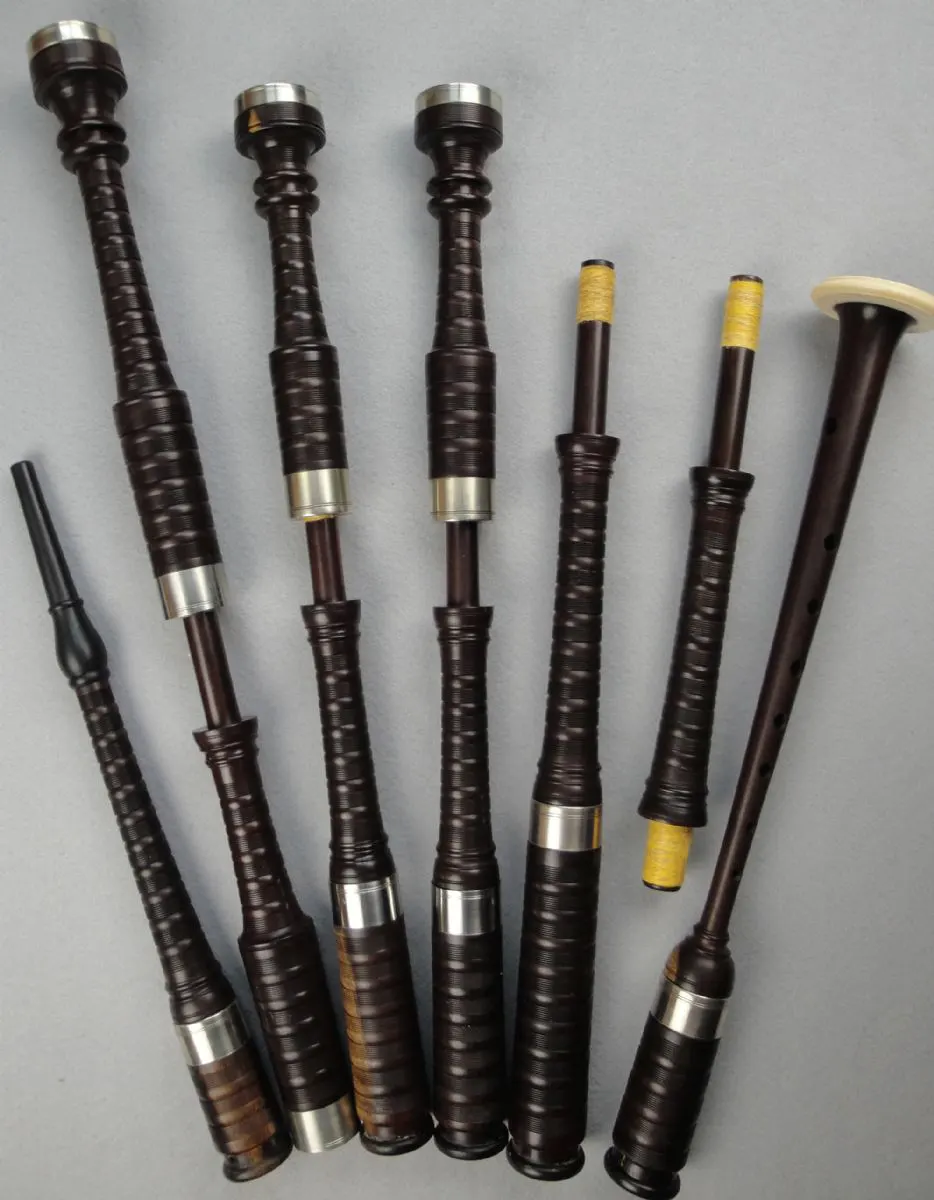
David Glen, Circa 1890s, Cocuswood, Nickel, with Original Chanter and Extra Bass Bottom
SOLD – These old Glen pipes are tonal classics. Though known for their “mellow” sound, David Glen drones in cocuswood are extremely rich in harmonics, steady as a rock, and very air efficient.
This set was likely made in the 1890s and comes with the original ivory-soled chanter. Unusually, for David Glen sets, there is no stamp on either the drones or the chanter, but the pipes appear to have been lightly sanded and refinished at some point, and this often erases the maker’s stamp. (Shame on any refurbisher who lets this happen!) The previous owner thought one tenor top might have been from another set from the same period, but I’m hard-pressed to see evidence of that.
The bass drone tunes quite low. This is not something I have ever considered a problem (my MacPhee bass tunes an inch above the mount), but the previous owner had a matching replica bass bottom made in stained mopane but with a narrower bore so that the bass would tune higher. Both pieces work very well.
These old cocuswood pipes have a visual appeal all their own, and David Glen’s attention to the details of craftsmanship and the nuances of tone make them classics
-
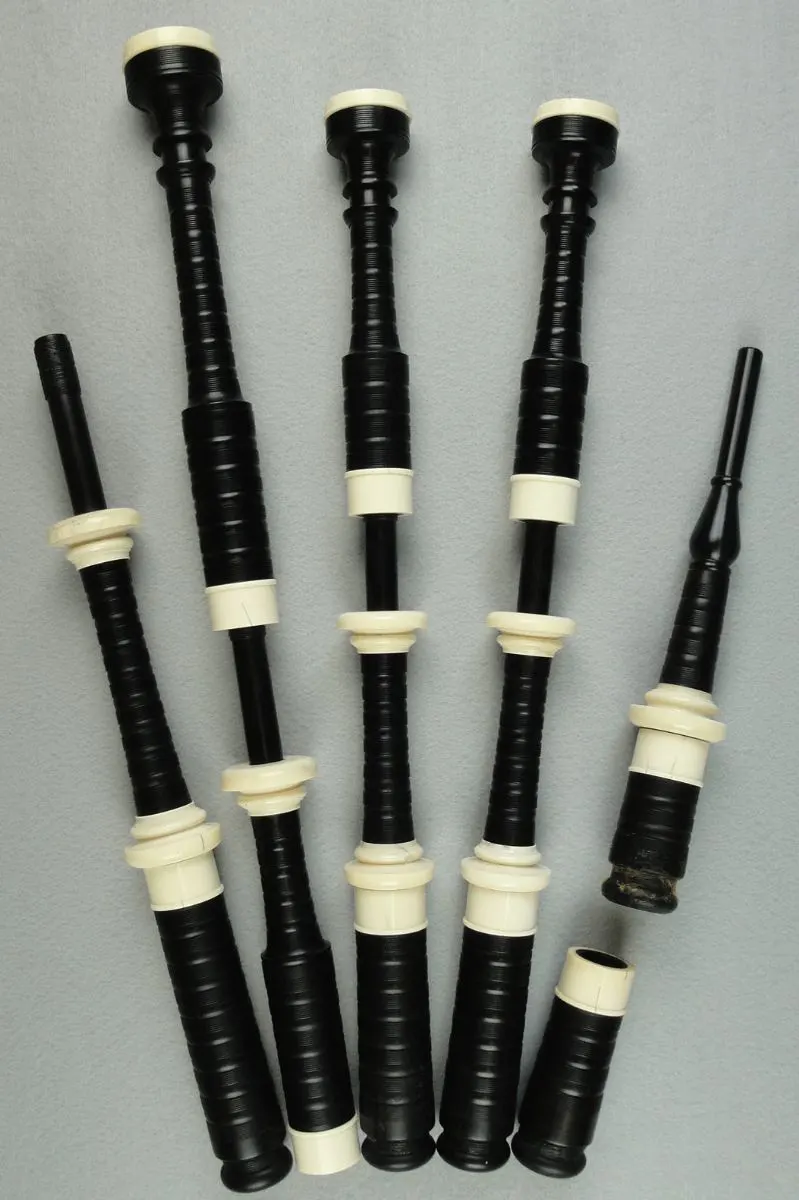
Duncan Macdougall, Aberfeldy (Stamped), in Ebony, Full Ivory, Circa 1890s
SOLD – This set is stamped “Dn MacDougall Aberfeldy” under the projecting mount on the bass bottom, dating the set to between 1888 and 1898. The pipes are ebony with what appear to be elephant ivory mounts, though the bushes display the translucence of marine ivory.
The finish is superb, suggesting they have been refinished in recent times. The chanter stock had a hairline crack that has been invisible whipped. There are no other visible cracks in the pipes.
There are several small chips in the ivory. On the upper projecting mount on the bass bottom in particular there is a chattering patch for an inch or so on each side of the mount, like it got sandwiched between something abrasive. It’s more apparent to the hand than the eye.
The blowstick is quite short, and with the longest mouthpiece will only extend to 9.5.” A longer poly Walsh extendable with an imitation ivory mount that matches quite well can be provided if a longer blowpipe is needed.
The pipes are quite bold, even by MacDougall standards. They are steady and seamless with a great bass. With a set of Canning reeds the tenors tuned just below the hemp. This 120-year-old MacDougall set is really a lovely find.
-
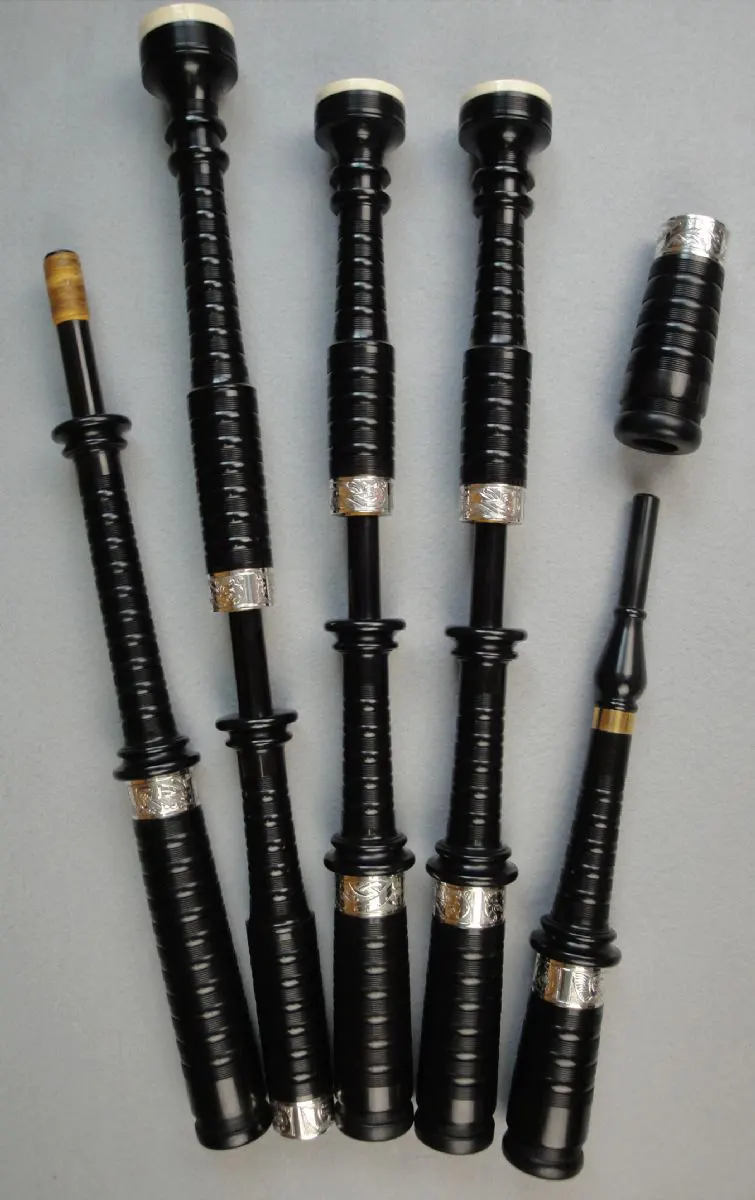
Atherton, 2011, Macdougall Bores, Engraved Silver Ferrules, Ivory Ring Caps
SOLD – This Atherton set was made in 2011 of blackwood, with engraved silver ferrules, legal ivory ring caps and blackwood projecting mounts.
They are in pristine condition and feature Dave’s brass-lined blowpipe. The zoomorphic silver pattern is elegant and beautifully excecuted. The reclaimed ivory is of exceptional quality.
Dave Atherton captured the Duncan MacDougall sound better than any other reproduction maker, then retired from bagpipe making with around 170 sets to his credit. This is one of his less common designs, #50 on Dave’s website gallery.
The tone is bold and rich, with a big, dominating bass sound, and great chanter blend.
-
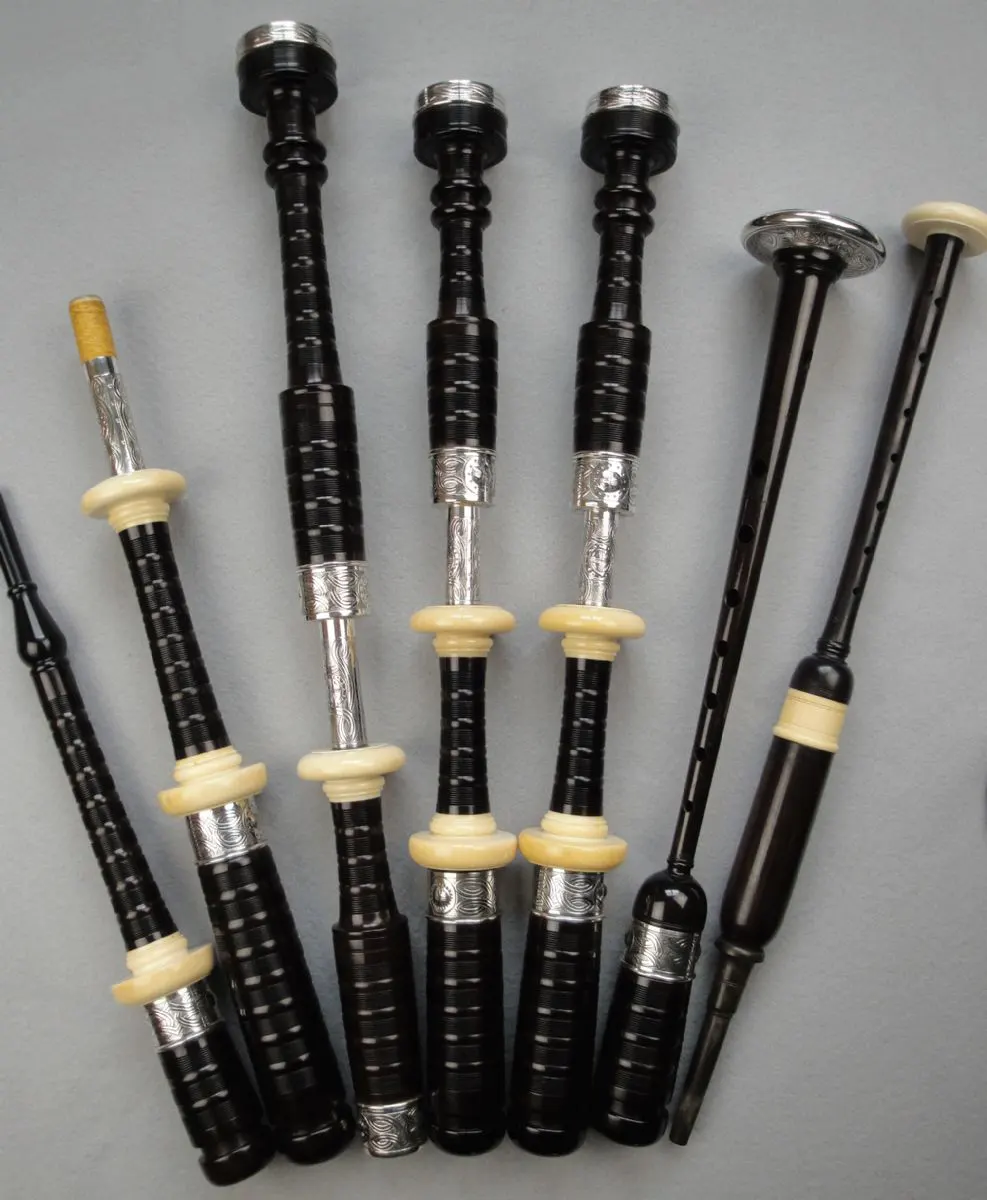
Robertson, Silver and Ivory, Circa 1962, with Original Chanter and Practice Chanter
SOLD – These Robertsons were thought to have been purchased new in 1962. They are in superb condition and come with the original chanter and sole, as well as the original owner’s ivory-mounted Robertson practice chanter.
This set was owned by a gentleman whose wife owned a set of Robertsons as well. One of the sets was much, much older. At some point it’s possible that a couple of the pieces got switched around. The silver ferrule on one tenor stock is the same pattern, but much older, though the stock appears to be original. The bass stock is a Robertson, but with a tapered bore typical of older Robertsons. However, the silver ferrule on the bass is original to the set. Suffice to say that all parts are Robertson and the set suffers no tonal or visual ill effects from the switcharoo!
The pipes have been refinished and the ivory and silver are all in immaculate condition. The pipes play with typically bold Robertson timbre — rich, steady and with a dominant bass sound.
This is really a gorgeous and exceptional pipe, free of cracks or blemishes, though missing the original engraved mouthpiece and ivory bulb.
-
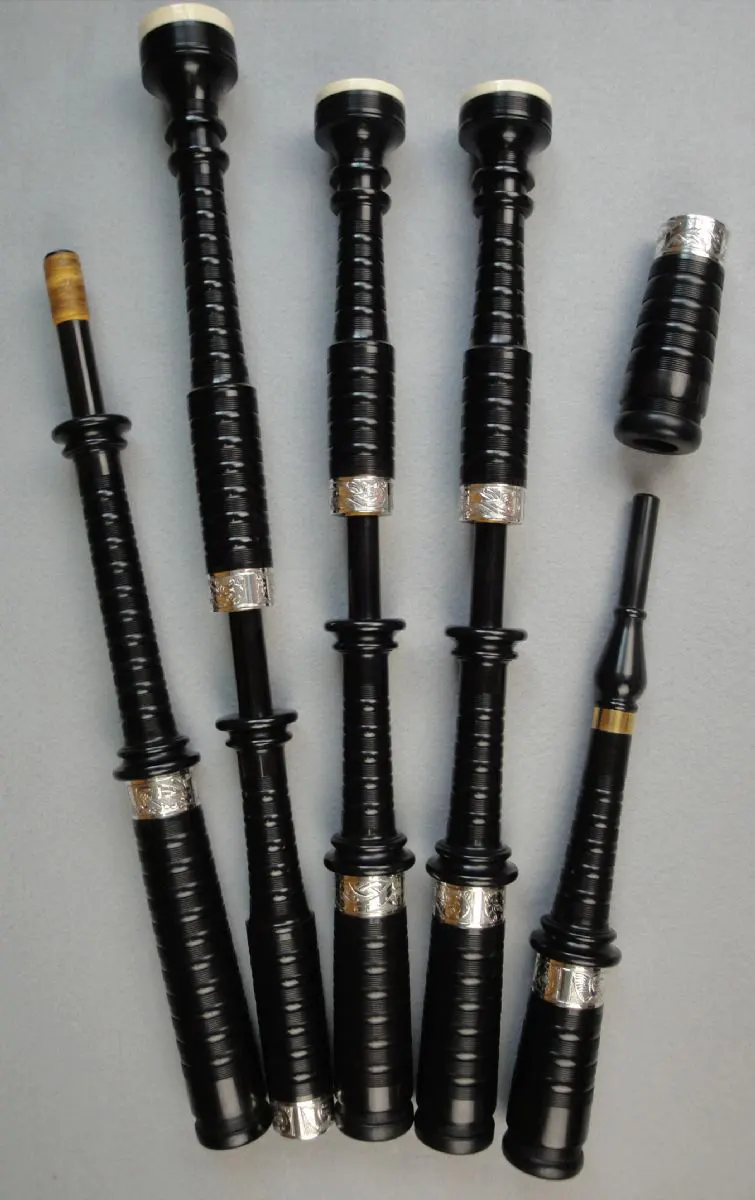
Atherton, 2011, Macdougall Bores, Engraved Silver Ferrules, Ivory Ring Caps
SOLD – This Atherton set was made in 2011 of blackwood, with engraved silver ferrules, legal ivory ring caps and blackwood projecting mounts.
They are in pristine condition and feature Dave’s brass-lined blowpipe. The zoomorphic silver pattern is elegant and beautifully executed. The reclaimed ivory is of exceptional quality.
Dave Atherton captured the Duncan MacDougall sound better than any other reproduction maker, then retired from bagpipe making with around 170 sets to his credit. This is one of his less common designs, #50 on Dave’s website gallery.
The tone is bold and rich, with a big, dominating bass sound, and great chanter blend.
-
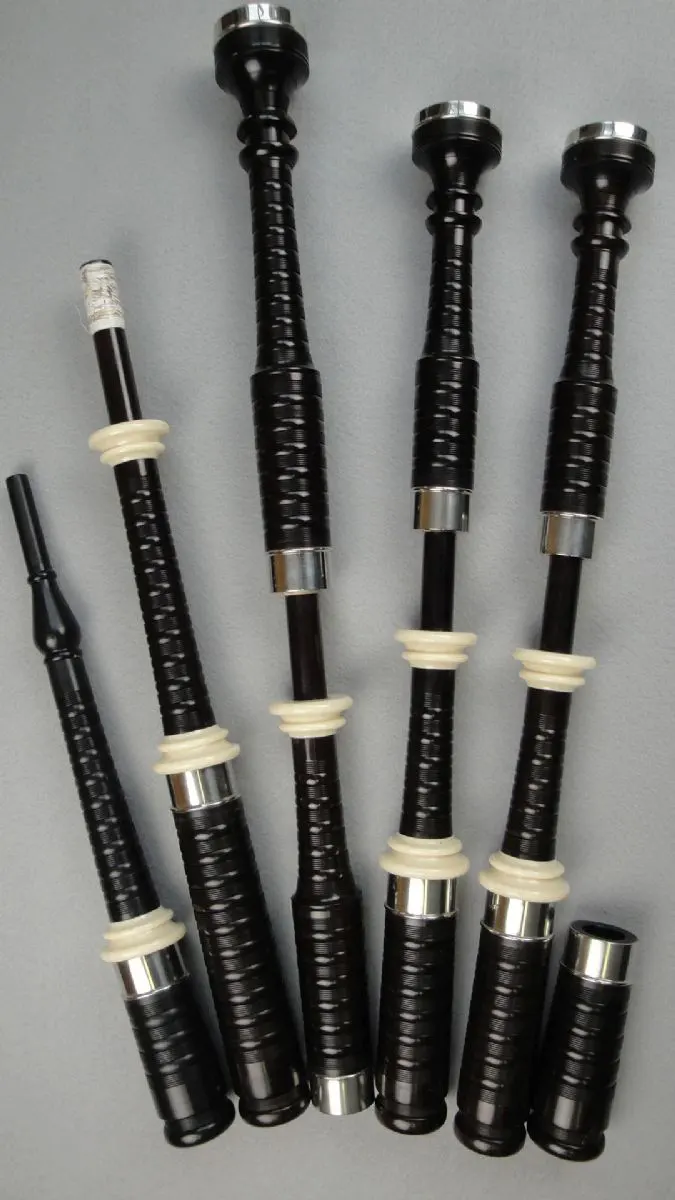
Dave Atherton MD Model, Macdougall Bores, Nickel and Imitation Ivory, 2009
SOLD – We’ve had a run of Atherton MD’s in the past month. This is the third set to come up, and coincidentally, all three were made in 2009. The photos here are of the first set. The only differences with the current set is that the blowpipe is brass lined blackwood and the chanter stock is blackwood as well. The blowstick stock is poly, as was Dave Atherton’s usual practice. The current set also comes with the original Rocket reeds and a nickel-sleeved mouthpiece
Dave Atherton is regarded by many to be the best pipemaker of modern times. His attention to detail, quality materials and perfect workmanship are legendary. He recently quit making pipes to pursue other ventures, leaving a legacy of around 170 sets, mostly reproductions of a Duncan MacDougall cocuswood bagpipe previously owned by the late Roddy MacDonald of Wilmington, Delaware, and now owned by his son Calum.
The tone is bold and steady with Canning tenors and a Kinnaird bass and the pipes are as steady as any set you will find.
This a collector’s item that plays beautifully, by a modern maker who will be remembered long after many others are forgotten.