
Working with vintage bagpipes is as much a hobby as a business for me. I enjoy the process of turning up old pipes and making sure they will be played for years to come. I think it is a good thing for piping. As such, I take great care in purchasing, examining and restoring old pipes.

My refurbisher is J. Dunbar Bagpipe Maker in St. Catharines, Ontario. Not only do they do masterful restorations, they have eagle eyes for examining 150-year-old wood and discovering replacement pieces and flaws that should be addressed before you play the pipes. If a set of pipes has a replacement or repaired piece, you will know about it before you buy.
You should know from the get-go that pretty much every bagpipe made before 1930 has required or will require repairs of some sort, especially if they are ebony. Ebony and cocuswood are superb woods from which to make bagpipes but they are less resilient than African blackwood. I suspect there is hardly an ebony bagpipe in the world made before 1920 that hasn’t experienced at least one crack.
Photos and descriptions of all instruments featured since October 2010
-
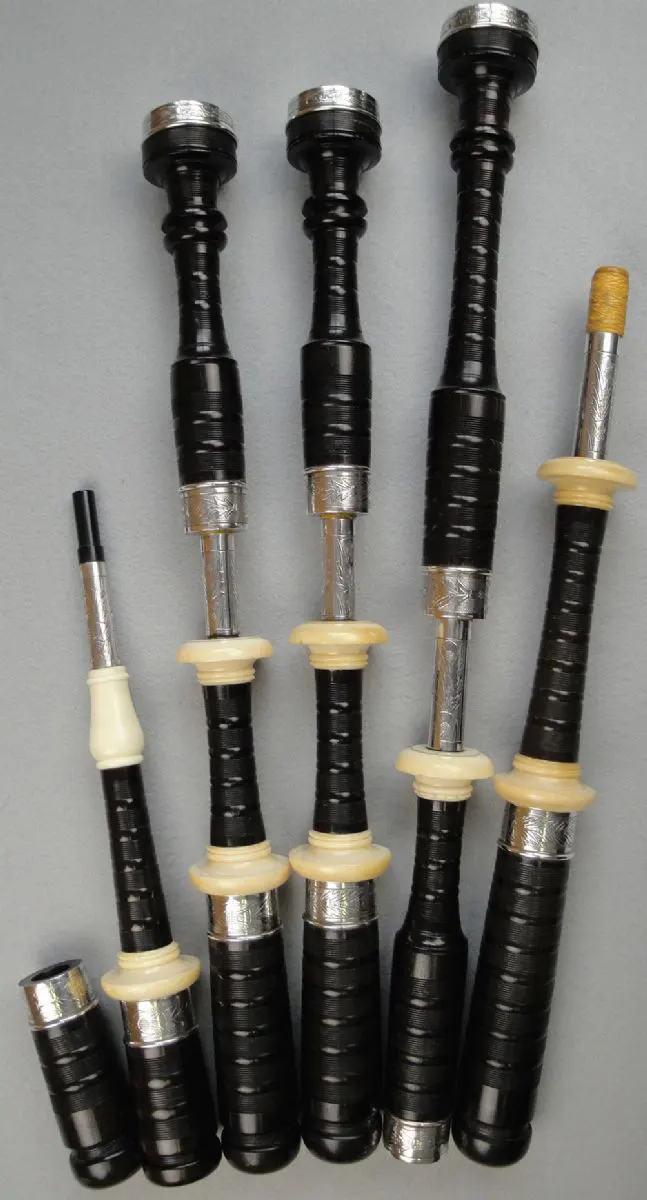
William Sinclar & Son, Silver and Ivory, Hallmarked 1956
SOLD – We’ve had a bit of a run on Sinclair pipes on the site recently, and I’m always pleased to have them. William Sinclair & Sons have been the most long-standing and consistent modern pipemaker on record, dating from the early 1930s and still making superb pipes in Edinburgh today. Their pipes have won major prizes at all levels.
This set is silver and ivory, hallmarked 1956. When I struck this set up and played it, it reminded me very much of the circa 1950 Sinclair set I played all through the 1980s and with which I won a Gold Medal and the Clasp at Inverness — same silver pattern, same steady, rich, bright sound.
The pipes are original and complete except for the blowpipe stock, which is a new poly-lined, blackwood reproduction with the original silver mount, and the blowpipe bulb, which is an imitation ivory reproduction with the original silver sleeve.
Aside from this, there are no repairs to the drones; even the original finish was in excellent shape and has been left as is. There is some chipping to the wood at the bottoms of the bells, and to the thin ivory ridge below the beads on some projecting mounts, but I would class all of these as normal wear rather than damage.
While the matching silver sole is no longer present, I do have a stock of engraved silver soles and might be able to find one with a pattern close enough to suit.
-
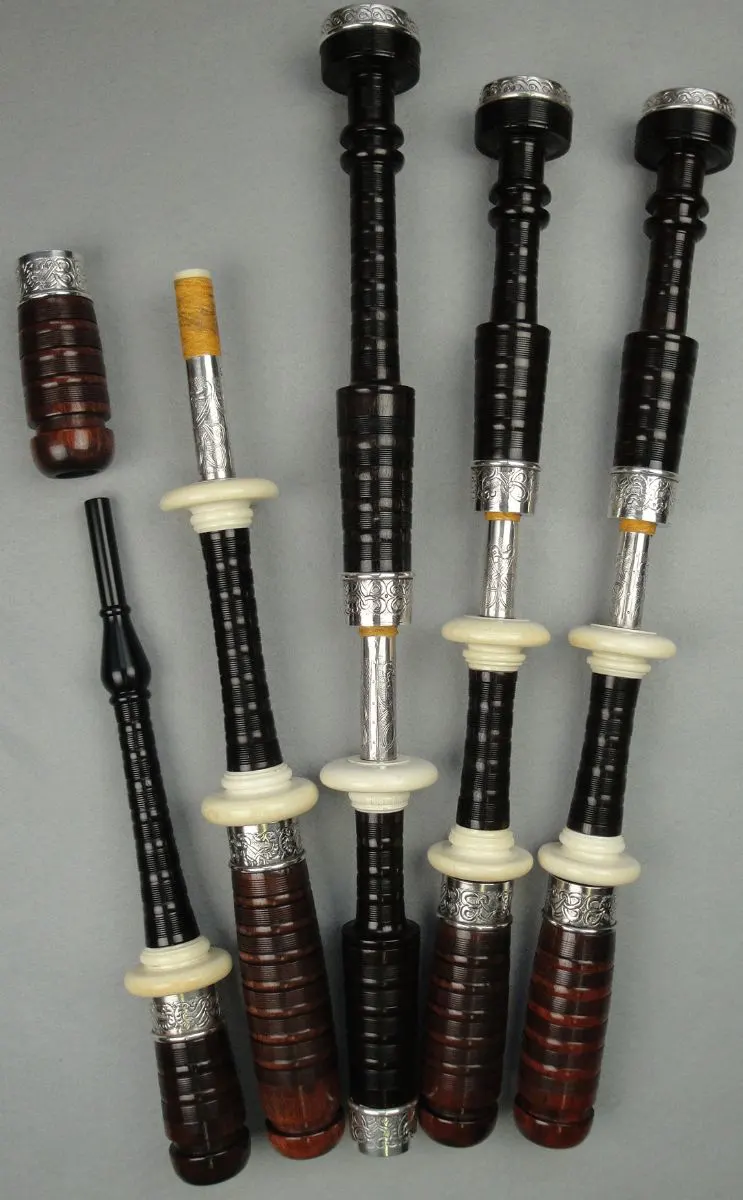
Circa 1920s Robertson, Silver and Ivory, in Brazilwood/Cocuswood Mix
SOLD – This unusual set of Robertsons was long thought to be ebony or cocuswood, and played with a rich and steady tone typical of these woods. However, after the pipes were stripped, the wood was discovered to be a mixture of cocuswood and Pernambuco Brazilwood, a superb musical wood used for the highest quality violin bows. The heartwood of this wood is quite red, thus the different coloured stocks.
The silver is hallmarked 1938. However the wood used, the shapes of the projecting mounts, and the slight ballooning in the shape of the stocks are evidence of a much earlier Robertson set — likely the 1920s or even earlier.
The bass drone top was cracked and has been whipped. This repair is undetectable. The tuning pin on the middle joint of the bass drone had an immense bore that was almost certainly a replacement. It left the bass slightly unsteady and difficult to reed. A blackwood replacement bored to proper specs eliminated this problem and the pipes play beautifully.
The Robertson drone sound is bold and steady, particularly with this wood, and this distinctive set could be played at the highest levels.
I’ve never seen another set of old Robertsons quite like this one. This is a superb and unique instrument.
-
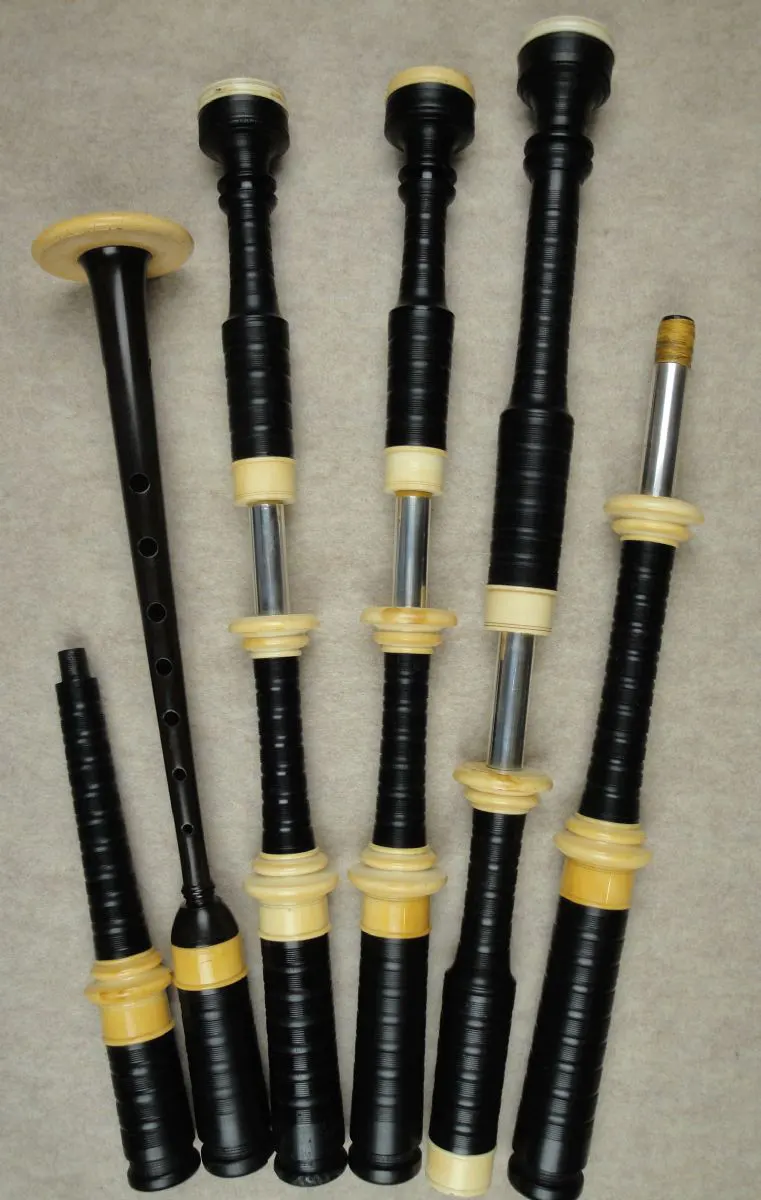
David Thow, Pre-1916, Ebony, Ivory, Plain Silver Slides Set #1
SOLD – This is first of twin Thow sets acquired at the same time, and clearly made at the same time.
The Thow pipemaking company made instruments from 1861-1953, starting with the patriarch, John, and followed by his son David, who took the company over when John died in 1879. The chanter is labelled “David Thow, Dundee.” David died in 1916, so these pipes could have been made anytime between 1879 and 1916. David and John Thow were superb pipemakers, contemporary with the MacDougalls and Centers, and made pipes of comparable quality.
Both sets of pipes appear to have been in storage for quite some time, as evidenced by the very uneven staining on the ivory. The pipes are ebony with full ivory mounts and plain silver slides, unhallmarked.
There were no cracks in the pipes themselves, though the chanter had cracked and has now been restored. The drones required no work at all, not even refinishing. There is some spider-cracking on the ivory, but this is cosmetic, and none of the pieces is threatened. One tenor stock had a hairline crack and has been invisible whipped. As seen in the photos, the cord guides and the sleeved ivory ferrules on the tuning chambers are quite distinctive, the latter being adopted later by William Sinclair.
The pipes are not as full as a MacDougall set, but not as mellow as most David Glen pipes. The tone is rich, refined and steady without being overpowering. The drones tune slightly lower on the pins that some other sets, so this set would be particularly suited to someone playing a flatter pitch. The chanter plays, but would be a challenge to reed consistently.
Thow pipes are rare, and are should be viewed as one of the prime pipes made in their day. Of the twin sets listed here, while both play equally as well, this set has more consistent ivory colouring and would be the most desirable.
-
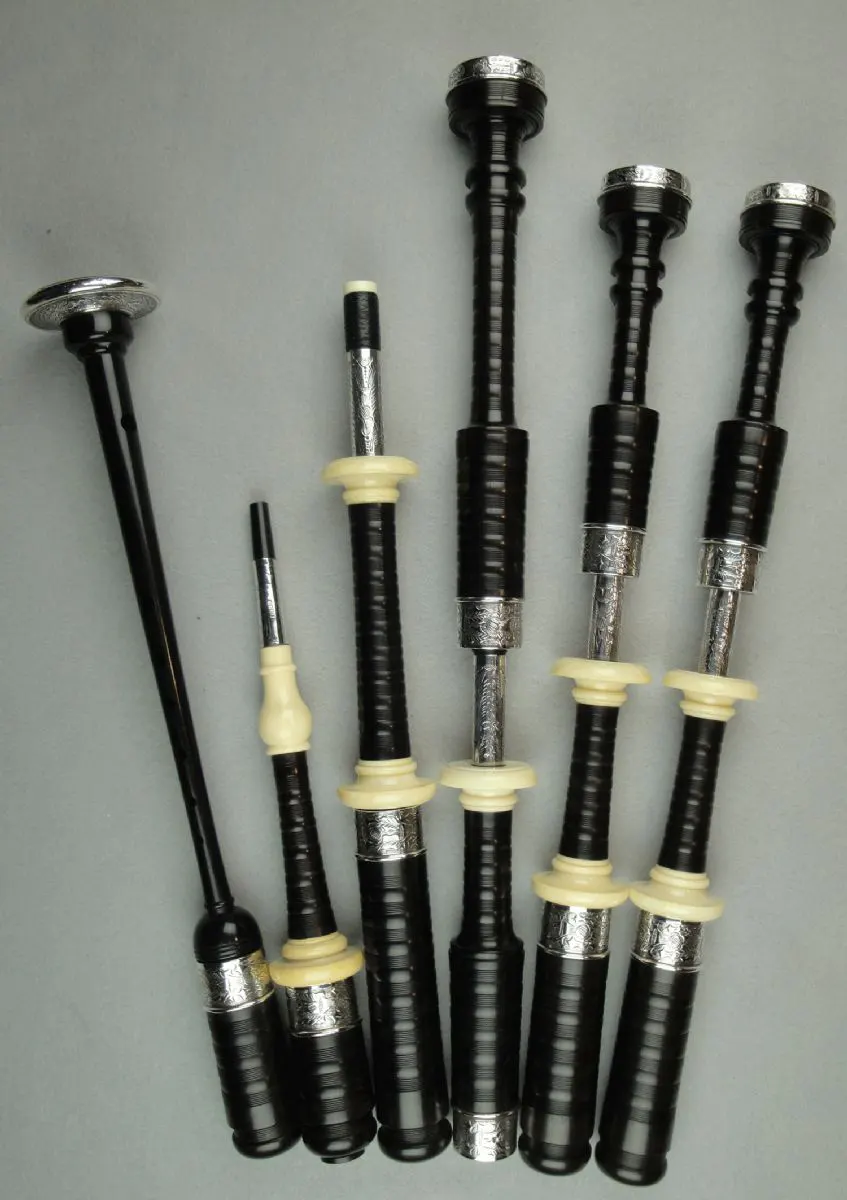
Silver and Ivory Unknown, Hallmarked 1962-63
SOLD – I acquired this set thinking it was quite a lovely Hardie set. It is hallmarked 1962-63 and all pieces are original except for the blowstick, which appears to be an older Lawrie.
When I struck the pipes up to try them, I was absolutely blown away by the tone: they were big, full, rich and just filled the room. “Hendersons!” I thought.
But the visuals didn’t say Henderson. I shared pictures with knowledgeable colleagues and all agreed: they look like several prominent makes of the time, but aren’t obviously one or the other. The hallmarks give the “PN” engraver: a common bagpipe engraver in Birmingham, but not the standard Hardie or Henderson silversmith.
I have to leave it at that and just reiterate that the tone of these pipes is remarkable, and the set is beautiful. The original sole is currently on a poly chanter of unknown make. If anyone thinks they can identify this set I’d love to hear from you.
If you’re looking for a set of silver and ivories that are stunning both tonally and visually, don’t let the lack of a maker’s name put you off this set. You could call them “Henderson” and the minute you struck up, everyone would believe you!
-
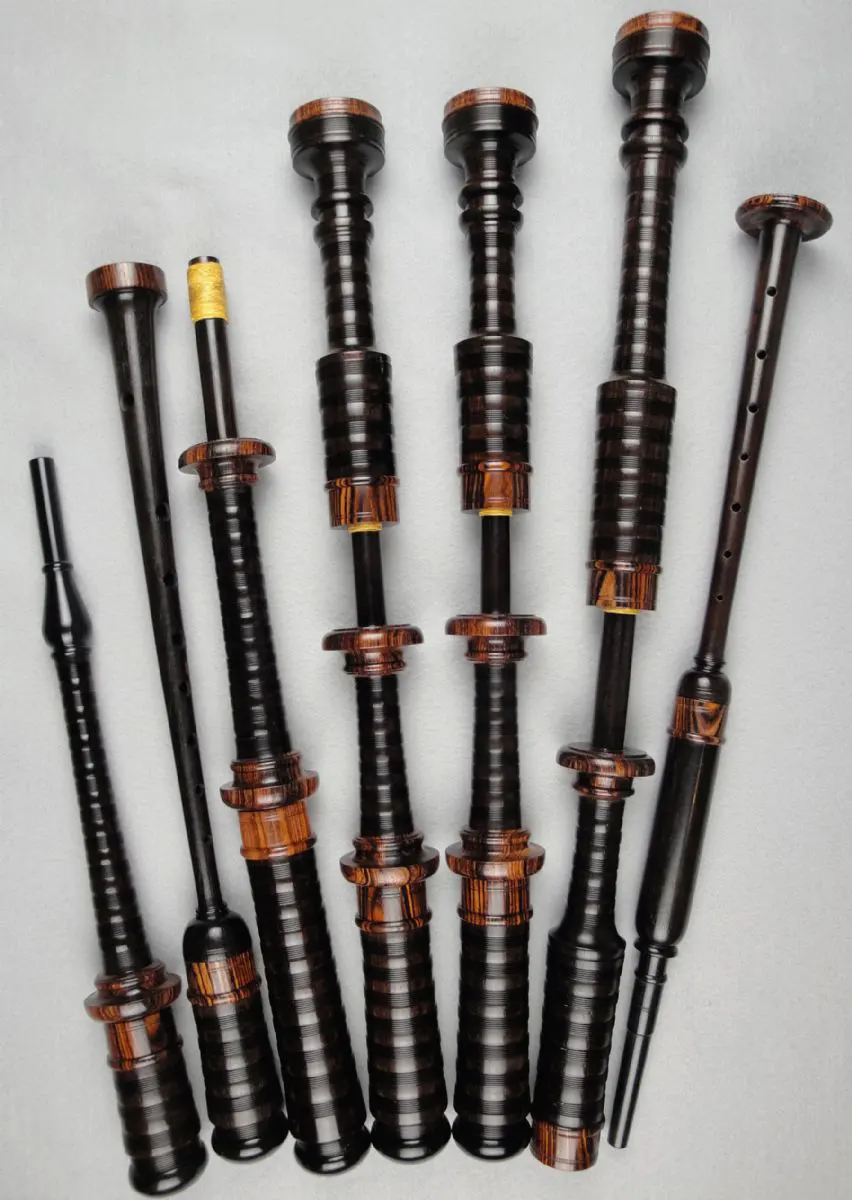
Grainger and Campbell, Circa Early 1960s, Remounted in Cocobola, with Original Practice Chanter
SOLD – This complete set of Grainger & Campbell pipes dates from the early 1960s, and comes with the original pipe chanter and practice chanter.
The set is in great shape, but was mounted in pumpkin-orange imitation ivory, which has been replaced with cocobola mounts modeled after the Grainger originals.
The tuning pin of the middle joint of the bass drone was broken and has been replaced. Hairline cracks in the bass top and one tenor top have been sealed.
The set has a full sound, quite rich, with a robust bass. They were steady with the first set of reeds used. The chanter and the practice chanter are both in good condition and will go well with modern reeds.
According to Jeannie Campbell’s book “Highland Bagpipe Makers” (an invaluable resource), Grainger & Campbell made pipes in Glasgow from 1946-1989 after taking over the Duncan MacRae shop. During the 1960s and early 1970s, premier pipers Donald MacLeod and John MacFadyen were very involved in the firm. I remember as a young piper during these days not being very impressed with “modern” pipemakers’ pipes — except for Graingers, which I’d heard played by several good piobaireachd players on the Ontario solo circuit.
-
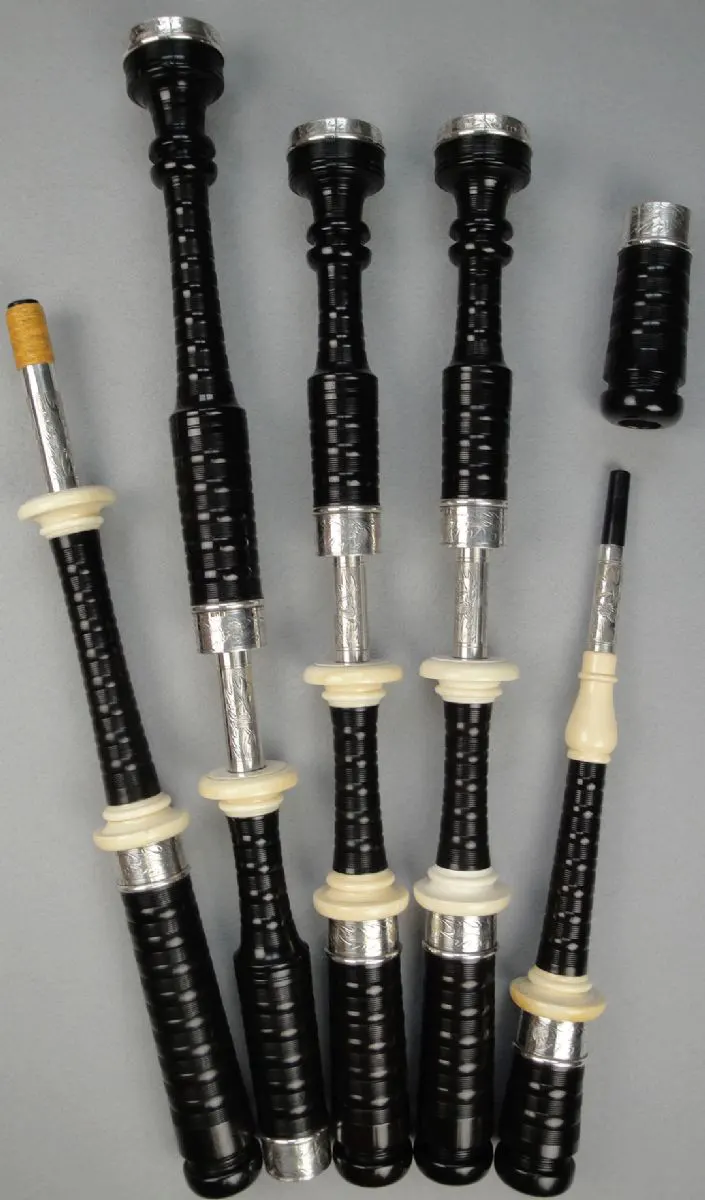
R.G. Lawrie, Hallmarked 1900, in Ebony, Silver and Ivory
SOLD – This silver and ivory R. G. Lawrie set is hallmarked 1900 and is in remarkable shape for its age. One tenor drone bottom was replaced many years ago by Charley Kron, ivory and all. It is a nearly perfect replacement, and the ivory has aged nicely so that it is very close to an ideal blend with the older ivory. The mouthpiece bulb is not original. These rarely survive. Pictured is an imitation ivory replacement that is just about perfect.
The other tenor drone top had a hairline crack that has been whipped and is completely invisible. Some of the ivory projecting mount plates show spider lines typical of old ivory.
The wood has a few nicks and chips commensurate with 113 years of age. The pipes were stripped and refinished.
The set plays beautifully — steady, big, rich, and with a seamless bass/tenor blend typical of the old Lawrie and Henderson sets. Despite the replacement piece — executed by one of the great modern pipemakers — this set remains classic Lawrie from the firm’s golden age.
-
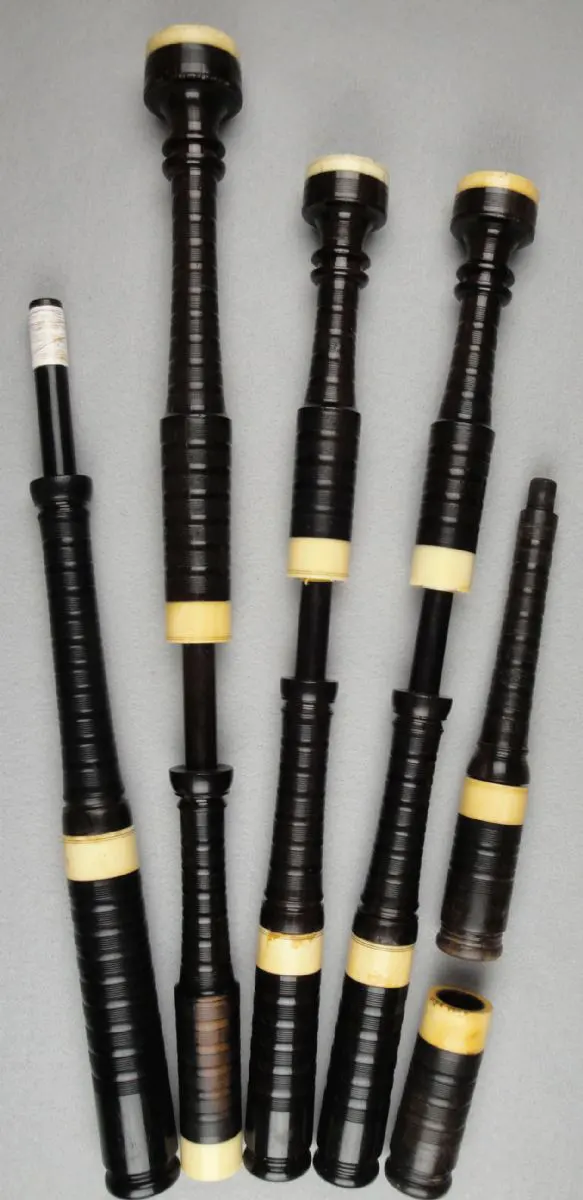
J & R Glen, Circa 1880, Cocuswood, Ivory, Button Mounts
SOLD – This unassuming looking instrument was one of the more exciting surprises of my career. I purchased them as a David Glen set, which I duly thought they were. I reeded them, plugged them into my own stocks and played them, as I do all sets here. I expected the rich but “mellow” (quieter) sound David Glen’s pipes are renown for. Instead, I was greeted with an incredibly robust set of drones. I was shocked and taken with them immediately, both by their rich volume and blend with the chanter, as well as their incredible steadiness.
Further research finally determined them — most likely — to have been made by the Edinburgh firm of J & R Glen, likely around 1880.
John and Robert Glen were the sons of Thomas Glen. Thomas was the brother of Alexander, who was David’s father. It was with Thomas and Alexander that the Glen family branched into two very different firms, each with their distinct strengths, but with one common element: exceptional craftsmanship. Thomas Glen’s pipes were very much on a par with, Duncan MacDougall’s. They are rare and high prized by knowledgeable vintage aficionados. John and Robert also made exceptional pipes, quite different from their cousin David. John and Robert took over Thomas’s firm in 1867, while David took over Alexander’s in 1873.
After John and Robert died (in 1904 and 1911 respectively) the company continued, but the pipes of that time and later never exhibited the robust and remarkable tonal quality of the earlier J & R sets.
When one tenor stock cracked shortly after I acquired these pipes, I replaced all three drone stocks with blackwood Glen stocks that date from roughly the same period.
-
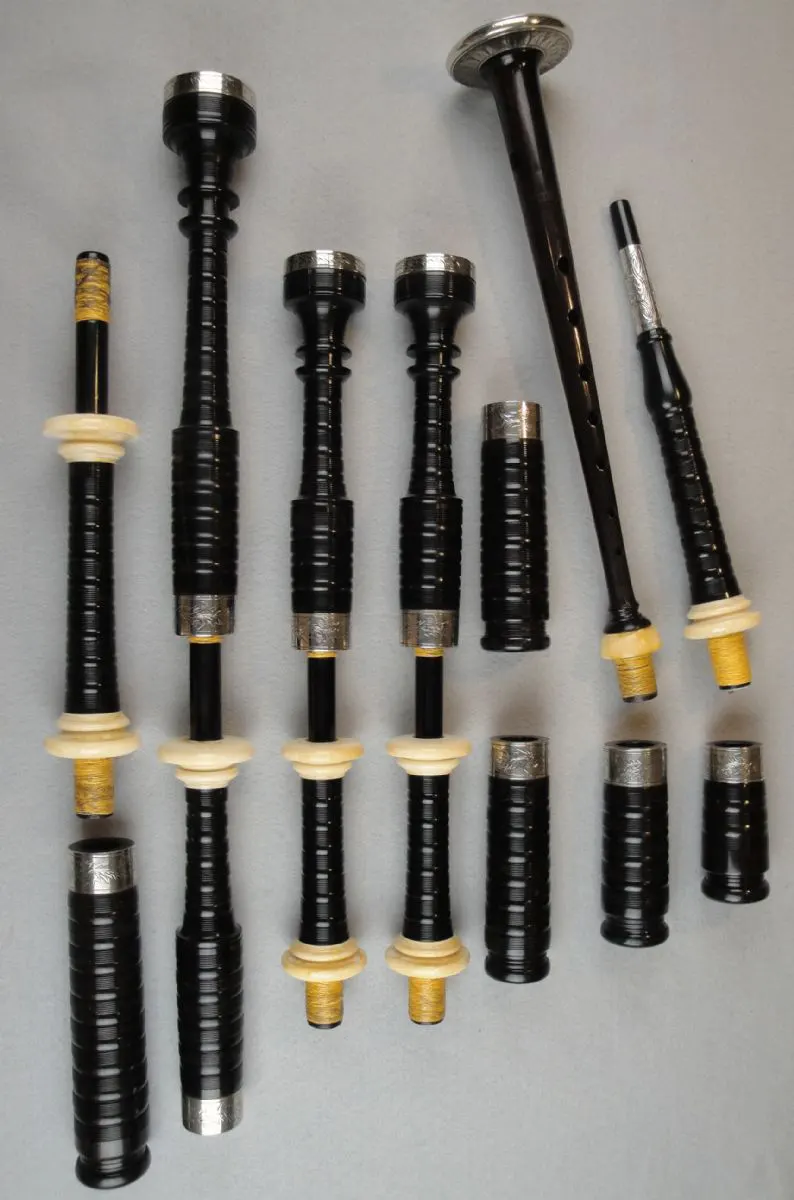
Duncan Macdougall, Breadalbane, Circa 1870s-80s, Ebony, Ivory, Engraved Silver
SOLD – I’ve only seen one other MacDougall bagpipe configured quite like this one. It was thought that the metal mounts might be a retrofit, but a careful examination indicates they are original. It is in keeping with Duncan MacDougall’s trend before the 1890s of virtually custom-building every bagpipe.
The set is ebony and mounted in ivory and engraved silver. The tuning chambers are fitted with brass slides, a practice particularly associated with the MacDougall family, though it was done by others as well.
The stamp “Dn McDougall Breadalbane” appears in three places: on the top and bottom of the chanter stick and on the top of the bass drone bottom joint, just below the ivory projecting mount. Breadalbane was the MacDougall home before the family moved to Aberfeldy, and dates the pipes between 1873 and 1887.
As is often the case with ebony pipes that contain brass inserts, each drone piece was cracked adjacent to the brass insert. As is also the case, none of the cracks leaked, and the pipes were being played in this condition by the owner on the isle of Skye until fairly recently with no issues. However, all cracks have been sealed and invisible whipped by Dunbar Bagpipes. The repairs are marvellous, as seen in the bottom right photo where the two left drone pieces have been repaired, while the right piece has not. You would be hard-pressed to detect the whipped pieces in the photos below without first knowing they were there. The blowpipe stock is a poly-lined blackwood replica. The engraving on the metal sleeve on the blowpipe does not match the rest of the pipes.
The tone is full (not quite Henderson full) and rich, with a fabulous, rich bass and a steadiness typical of the great old MacDougalls. Tuning positions are excellent.
This set has now been reproduced as “The Breadalbane” offered by McGillivray Piping as part of the attractive, toneful and affordable “Victorian Line” of nineteenth-century replicas. The Breadalbane reproductions ae made by Dunbar Bagpipe Maker to the exact specifications of this set. The previous owner of this set was well known piper Allan Beaton of London/Skye, who played them for 30 years until 2012.
-
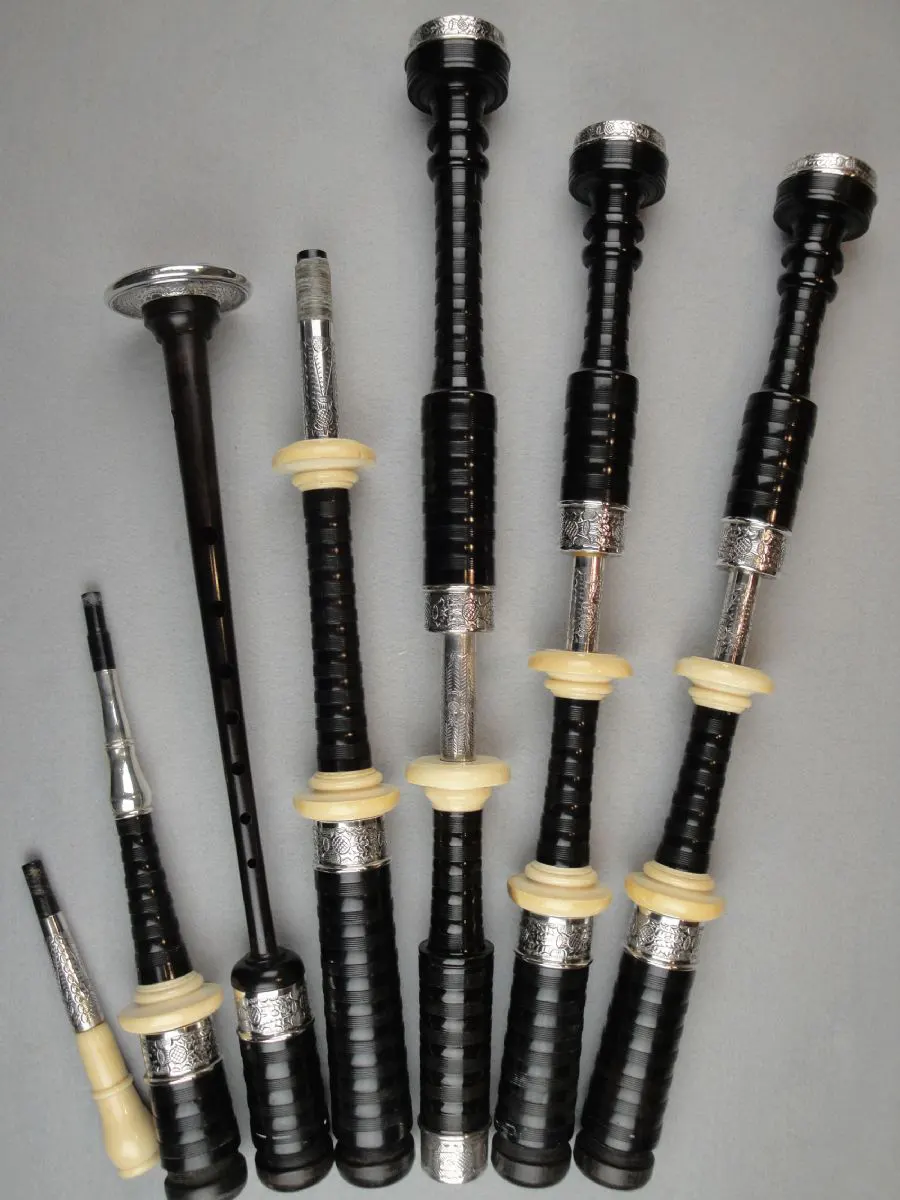
Silver and Ivory Grainger and Campbell, Hallmarked 1977, with John Kidd Bore and Stock Alterations
SOLD – This set of Grainger and Campbell silver and ivories are hallmarked as having been made in 1977 and are in pristine condition.
This firm took over the Duncan MacRae shop in Glasgow in 1946, and made pipes until 1989. Both Donald MacLeod and John MacFadyen were involved with the firm in the 1960s and 1970s and their influence on the instruments resulted in a well respected bagpipe being made for many years.
The sound is quite full, and might best be described as being similar to modern Naill pipes, though the bass in this set is particularly full.
This set had extra attention paid to it when the last owner sent them to John Kidd, an American refurbisher and student of the tonal properties of columns. John had a well-earned reputation for improving the tone of pipes by flaring stock bottoms, tuning pins and adjusting bores so that they matched one another perfectly within the bagpipe. The previous owner reports: “Once I put some playing time on them, I had John Kidd match the tenor drones, and had him do his famous flaring of the stocks and tapering of the joints. The tone really locked in after these modifications.”
The finish on the pipes was superb when I received them and has not been touched. There is some dark staining on a portion of two of the lower projecting mounts. The original silver sole had been installed onto a Kron Medallist blackwood solo chanter. The previous owner found the blowpipe too long and had John Kidd provide a cast silver replacement. The original silver and ivory mouthpiece and Grainger chanter are provided with the pipes. This is really a beautiful silver and ivory set, and the tonal alterations have upgraded its sound to “exceptional.”
Invoices documenting Mr. Kidd’s work are provided. Sad to report that John Kidd passed away in October this year.
-
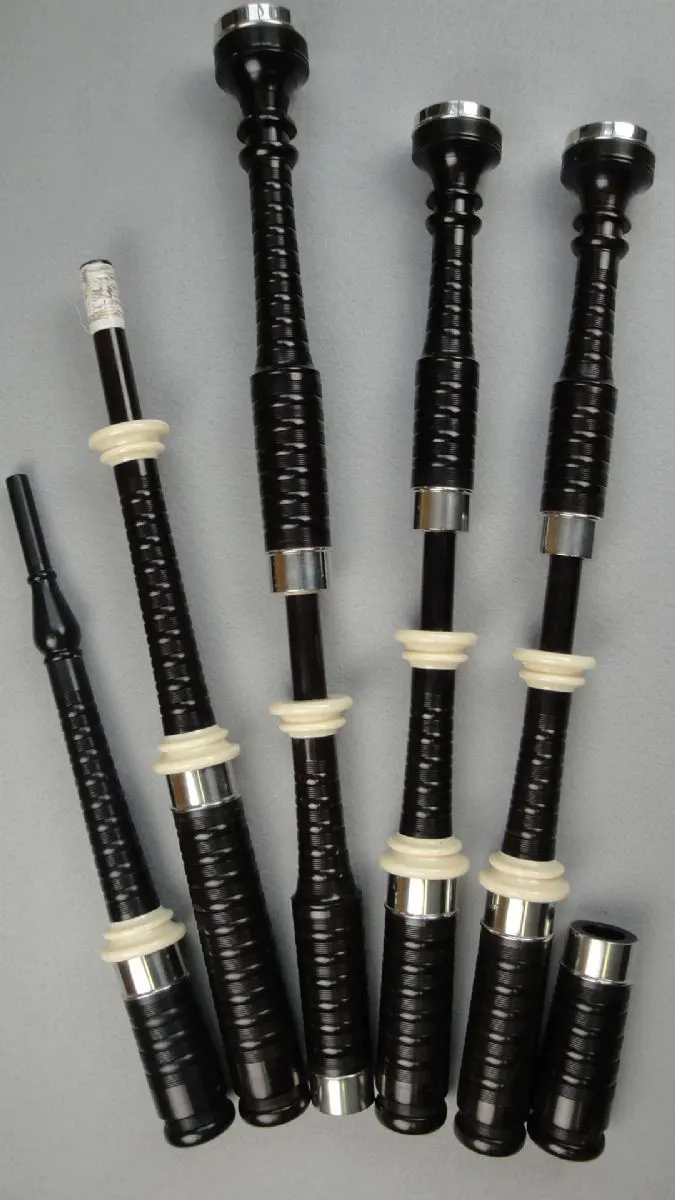
Atherton MD, 2009, Nickel, Imitation Ivory
SOLD – Dave Atherton is regarded by many to be the best pipemaker of modern times. His attention to detail, quality materials and perfectionist workmanship were obsessive. He recently quit making pipes to pursue other ventures, leaving a legacy of around 170 sets, mostly reproductions of a Duncan MacDougall cocuswood bagpipe previously owned by the late Roddy MacDonald of Wilmington, Delaware, and now owned by his son Calum.
This set was made in 2009 and has hardly been played. It is in absolutely pristine, virtually as-new condition. The mounts are nickel and imitation ivory. The blowstick and blowstick stock are poly.
The tone is bold and steady with Canning tenors and a Kinnaird bass and the pipes are as steady as any set you will find.
Consider this a collector’s item that plays beautifully, by a modern maker who will be remembered long after many others are forgotten.
-
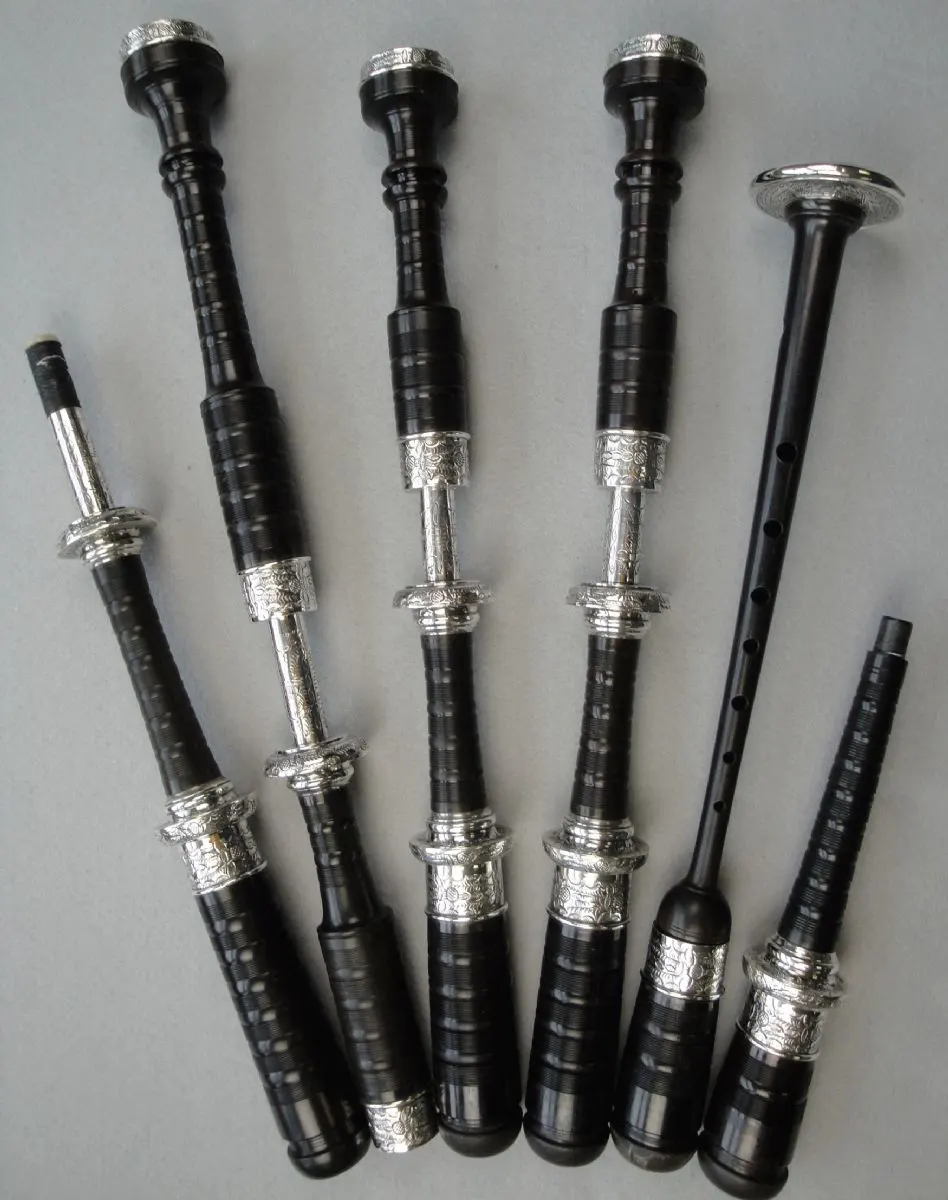
Wm. Sinclair & Son, Full Silver, Hallmarked 1972
SOLD – Here is a rare full silver set of pipes made by the Edinburgh firm of William Sinclair and Son. The pipes are hallmarked 1972.
William Sinclair started business in 1931 and still operates today. They have gained a well-earned reputation as the best and most consistent modern pipemaker. This set was likely made by William Sinclair junior. The tone is full and I was very impressed by how steady they were from the second I pulled the middle tenor into tune. This is a great high-end Sinclair set that comes with the original Sinclair chanter and silver sole.
The pipes did not need refinishing. The tenor stocks have had each had a very minor hairline crack sealed as a proactive setup. It was only when I was hemping the pipes that I realized the blowstick is a matching poly replacement, thought the projecting mount is original. The bass stock appears to be a replacement, but still has the original ferrule. The only deficiency in the set otherwise is that there is no full silver mouthpiece and bulb, though it’s possible the set was not made with one.
A nice attribute of this set is that the silver projecting mounts are formed, not solid, so the set is not much heavier than a standard silver and ivory set.
There are lots of Sinclair bagpipe devotees out there, and if you’re one of them you’ll hardly do better than this set.
-
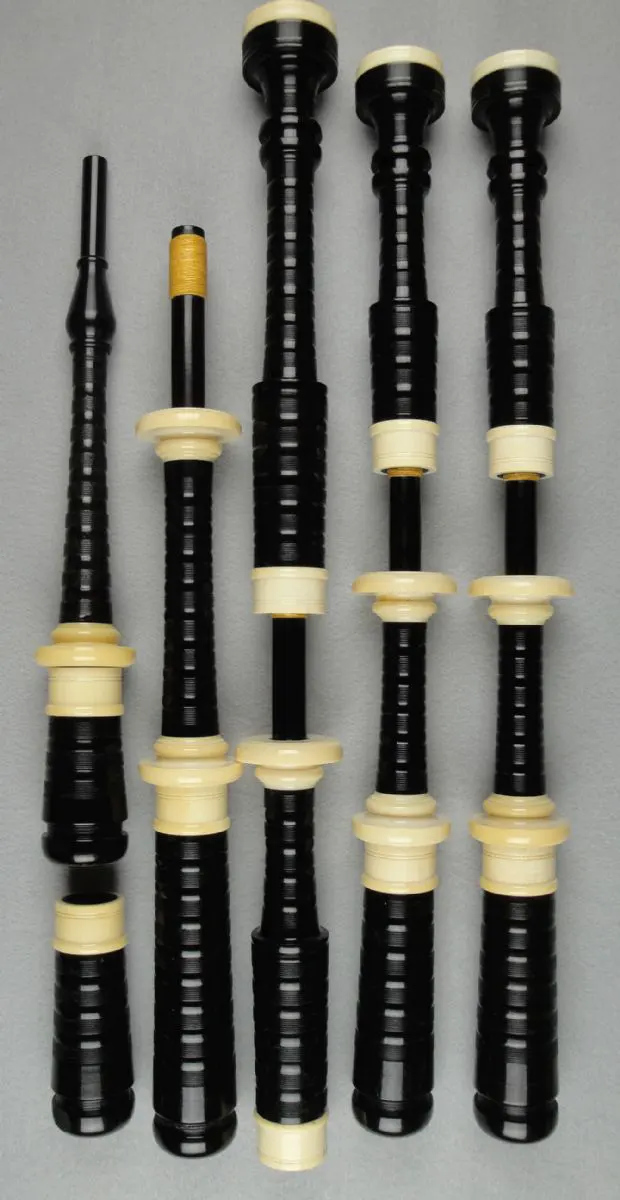
1952 R. G. Hardie, Full Ivory
SOLD – A gem of a man, and one of the great piping icons of the last 75 years, Bob Hardie made pipes beginning in 1950, and his company was one of the most prolific in the 20th century. He was an excellent craftsman, and the quality and seasoning of the wood the company used is exemplified by how many sets today still have perfectly true tuning chambers that don’t bind on the hemp.
This bagpipe had one owner who purchased it new in 1952. One tenor top had a hairline crack that has been stopped in its tracks, and the bagpipe has been refinished. The blowpipe appears to be a Lawrie with an ivory mount, and while it’s not a perfect match, neither is it distracting.
Hardie pipes are known for their subdued tone, a “mellow” sound many pipers favour. Elsewhere on this page, you will see Hardie pipes that have been rebored to Henderson specs, but the tone of this set was surprisingly rich and buzzy — much like some old Glen sets — so these bores have been left alone. Hardie pipes are well known for being steady and easy to reed.
The ivory is in absolutely immaculate condition, the tuning chambers are perfect, and the pipe is attractive and tuneful.