
Working with vintage bagpipes is as much a hobby as a business for me. I enjoy the process of turning up old pipes and making sure they will be played for years to come. I think it is a good thing for piping. As such, I take great care in purchasing, examining and restoring old pipes.

My refurbisher is J. Dunbar Bagpipe Maker in St. Catharines, Ontario. Not only do they do masterful restorations, they have eagle eyes for examining 150-year-old wood and discovering replacement pieces and flaws that should be addressed before you play the pipes. If a set of pipes has a replacement or repaired piece, you will know about it before you buy.
You should know from the get-go that pretty much every bagpipe made before 1930 has required or will require repairs of some sort, especially if they are ebony. Ebony and cocuswood are superb woods from which to make bagpipes but they are less resilient than African blackwood. I suspect there is hardly an ebony bagpipe in the world made before 1920 that hasn’t experienced at least one crack.
Photos and descriptions of all instruments featured since October 2010
-
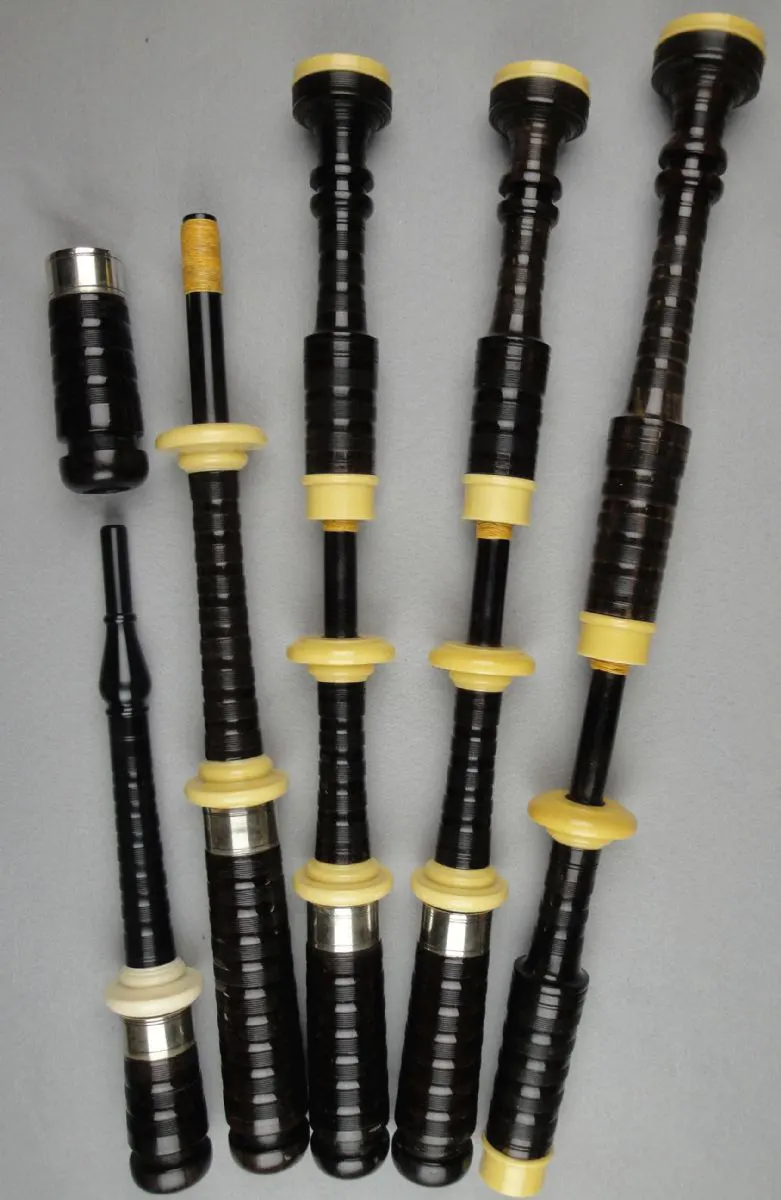
Circa 1960s R. G. Lawrie in Blackwood, Imitation Ivory, Nickel
SOLD – Though not the typical high-end vintage fare usually offered on this page, this set came to me out of the blue in good condition and played nicely, so I thought I would offer it as a very affordable ‘semi-vintage’ set. The set was likely made in the 1960s, and while some might call that vintage, to me, a set of pipes is not vintage unless it’s older than me!
This Lawrie set is typical of the firm’s offerings in the 1960s and 1970s, with the most recognizable feature being the drone ferrules with a thick bead an no scribe lines. The nickel ferrules on the stocks only are unusual, but the stocks appear to be original. They add a nice bit of variety to the appearance of the pipes. The drone bushes are ivory, which is quite common among imitation ivory pipes prior to the 1970s. I have no idea why they put ivory bushes on imitation ivory pipes, but you see it all the time.
This set is all original except for the blowpipe and mount, which were missing. No other work was required. The finish is original.
Though not the bold and magical sound of the true vintage Lawries made prior to the mid-1950s, the tone from these drones is nonetheless full and steady: a solid, work-a-day pipe, easily reeded and nicely made with well seasoned wood.
-
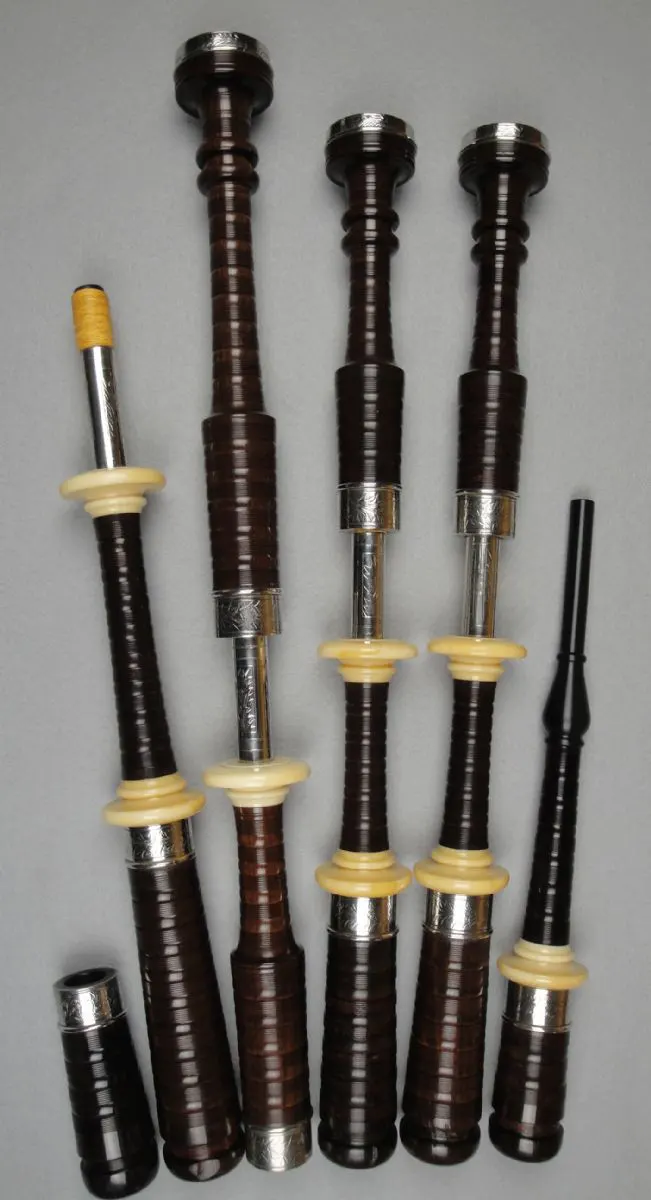
Henderson, Cocuswood, Silver and Ivory, Circa 1890s
SOLD – This is one of the old sets of Hendersons we’ve had on the vintage page.
The pipes are cocuswood, mounted in ivory and elegantly engraved silver. The silver is not hallmarked, and the silver ferrules have seams, both evidence of the pipes having been made around or before the turn of the century.
The engraving is light and tasteful, and the silver shines up beautifully. The ivory is in spectacular shape.
The tone is vintage Henderson — full, rich, and, unlike the ferrules, seamless.
There were hairline cracks in one tenor top, one tenor stock, the blowstick stock, and at the very bottom of the bass stock. These have been invisible whipped. Cocuswood is more difficult to match than blackwood or ebony, so the re-combed sections show the repairs slightly, though I like to think it has been tastefully done.
The original chanter stock was too badly split to salvage, so the mount was put on a blackwood replica stock. The seam on one tenor ferrule has separated slightly, but this is visible only up close.
This is a pretty special set. Perhaps that should go without saying.
-
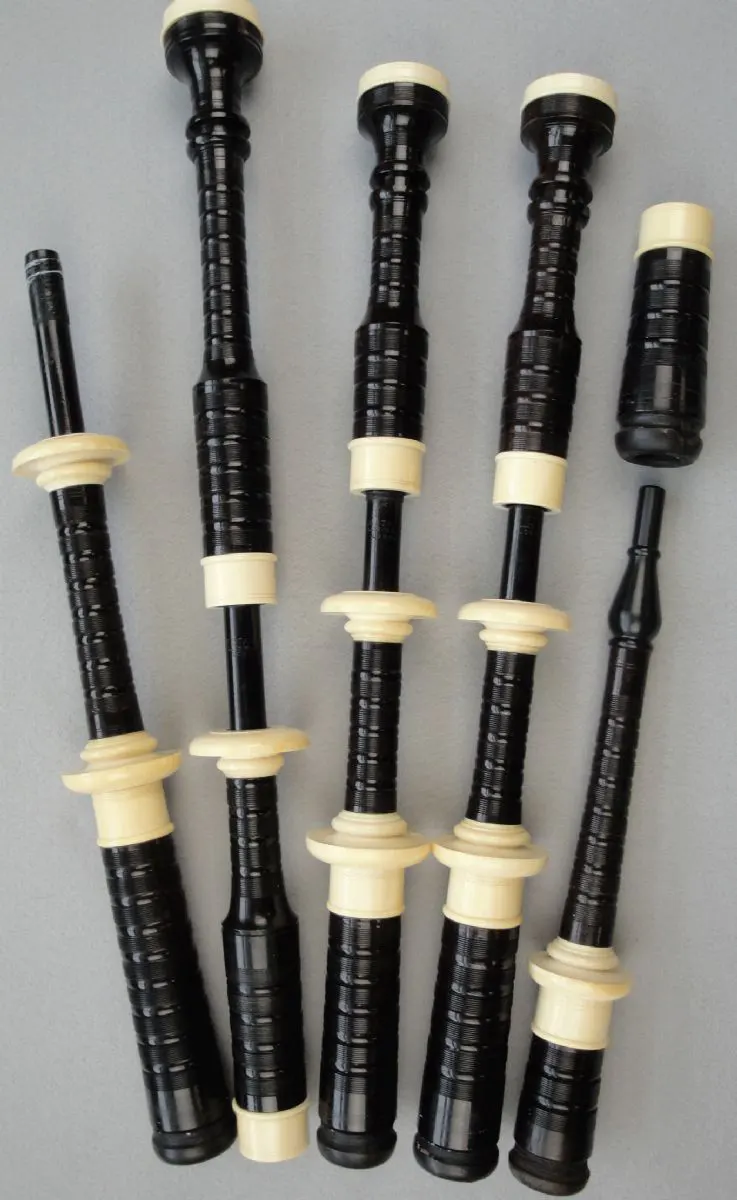
Henry Starck, Full Ivory, 1923
SOLD – Henry Starck was a descendant of a long line of 19th-century German woodwind makers. He emigrated to London in the 1880s where the Queen’s Piper, William Ross, convinced him to begin making pipes for him. Making bagpipes proved lucrative, and several generations of Starcks continued the business into the 1960s, still using Ross’s name on their pipes.
Henry and his son, also Henry, were marvelous makers, and pipemakers today still hold Starck pipes up as icons of craftsmanship. Listeners are often surprised to discover that a full and rich set of Henderson-like pipes they are hearing is in fact a Starck.
This set is blackwood, mounted in full ivory. According to a previous owner who knows the history, they were made in 1923. The pipes are in pristine condition, and the ivory is immaculate. They were likely refinished at some point, but there is no evidence of a crack or repair anywhere. The two tenors don’t appear perfectly identical. They certainly look like the same maker from the same time period. The read sets were threaded at some point in the recent past.
Each tuning pin is stamped “H. Starck, Late W. Ross, London.” The stamps are visible in some of the photos.
The tone of these pipes is big and buzzy — Starck hallmarks. They are steady. They tune in the right places. They are superb.
-
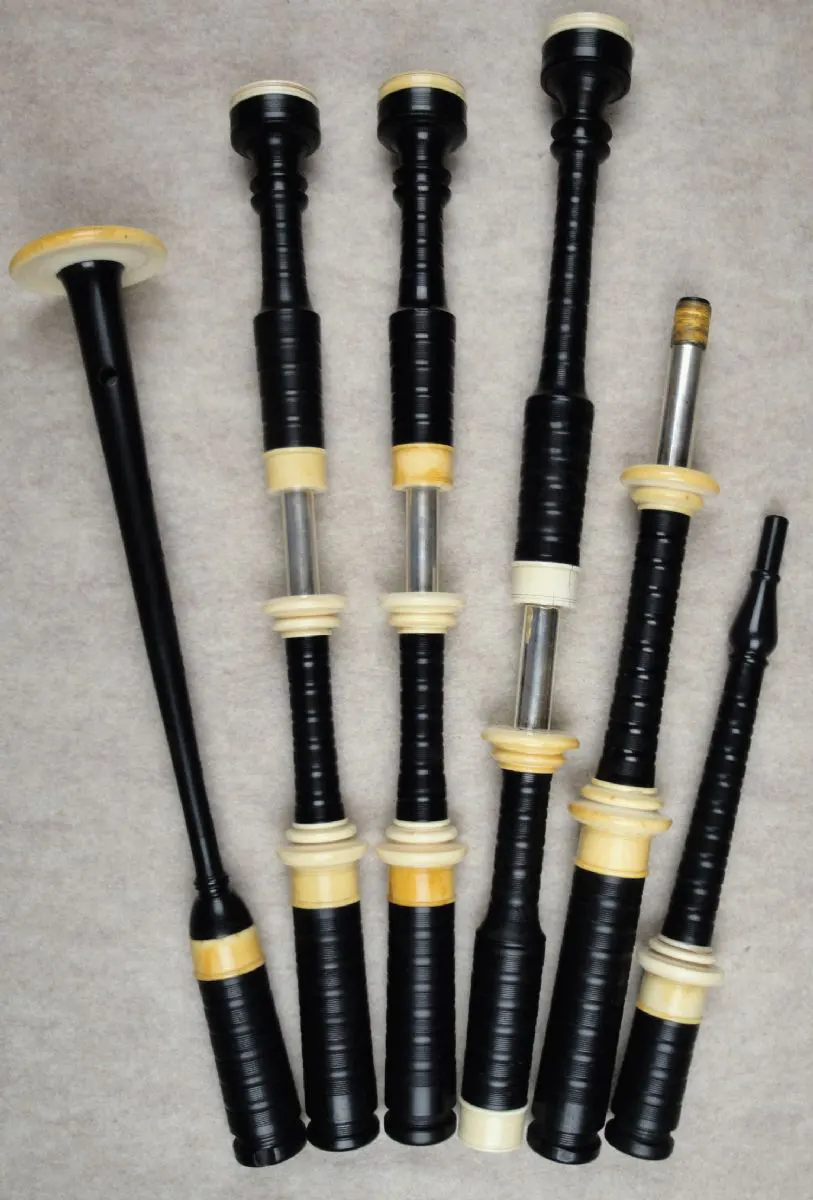
David Thow, Pre-1916, Ebony, Ivory, Plain Silver Slides, Set #2
SOLD – The Thow pipemaking company made instruments from 1861-1953, starting with the patriarch, John, and followed by his son David, who took the company over when John died in 1879. The chanter is labeled “David Thow, Dundee.” David died in 1916, so these pipes could have been made anytime between 1879 and 1916. David and John Thow were superb pipemakers, contemporary with the MacDougalls and Centers, and made pipes of comparable quality.
These pipes have been in storage for who knows how long, as evidenced by the very uneven staining on the ivory. The pipes are ebony with full ivory mounts and plain silver slides, un-hallmarked.
There were no cracks in the pipes themselves, though the chanter had been broken and primitively whipped. This has been completely restored, but the drones required no work at all, not even refinishing. There is some spider-cracking on the ivory, but this is cosmetic, and none of the pieces is threatened. As seen in the photos, the cord guides and the sleeved ivory ferrules on the tuning chambers are quite distinctive, the latter being adopted by William Sinclair.
The pipes are not as full as a MacDougall set, but not as mellow as most David Glen pipes. The tone is rich, refined and steady without being overpowering. The drones tune slightly lower on the pins that some other sets, so this set would be particularly suited to someone playing a flatter pitch. The chanter plays, but would be a challenge to reed consistently.
Thow pipes are rare, and are should be viewed as one of the prime pipes made in their day.
-

Silver and Ivory R. G Hardie, Hallmarked 1967
SOLD – This Hardie set was made in 1967 and came to me in excellent shape, so I have left the original finish intact. Though there was no original chanter sole, all other pieces, including the mouthpiece bulb and sleeve, are original
This set was fairly robust as Hardie pipes go. While I find Hardie pipes a bit “mellow” for my taste, I quite liked this set. It was certainly not a booming old Lawrie, but it was rich and locked nicely into tune.
There are a couple of very minor dings in the silver that can just be seen in the photos of the caps, and a couple of scuffs in the finish, so I’ve tried to make this set as affordable as possible for someone who might like a nice silver and ivory set without the usual price tag. I often find Hardie sets like this suit adult pipers looking for an attractive instrument that is easy to reed, easy to tune, and steady.
The silver pattern on this set is quite unusual for Hardie pipes: hand engraved rather than machine.
-
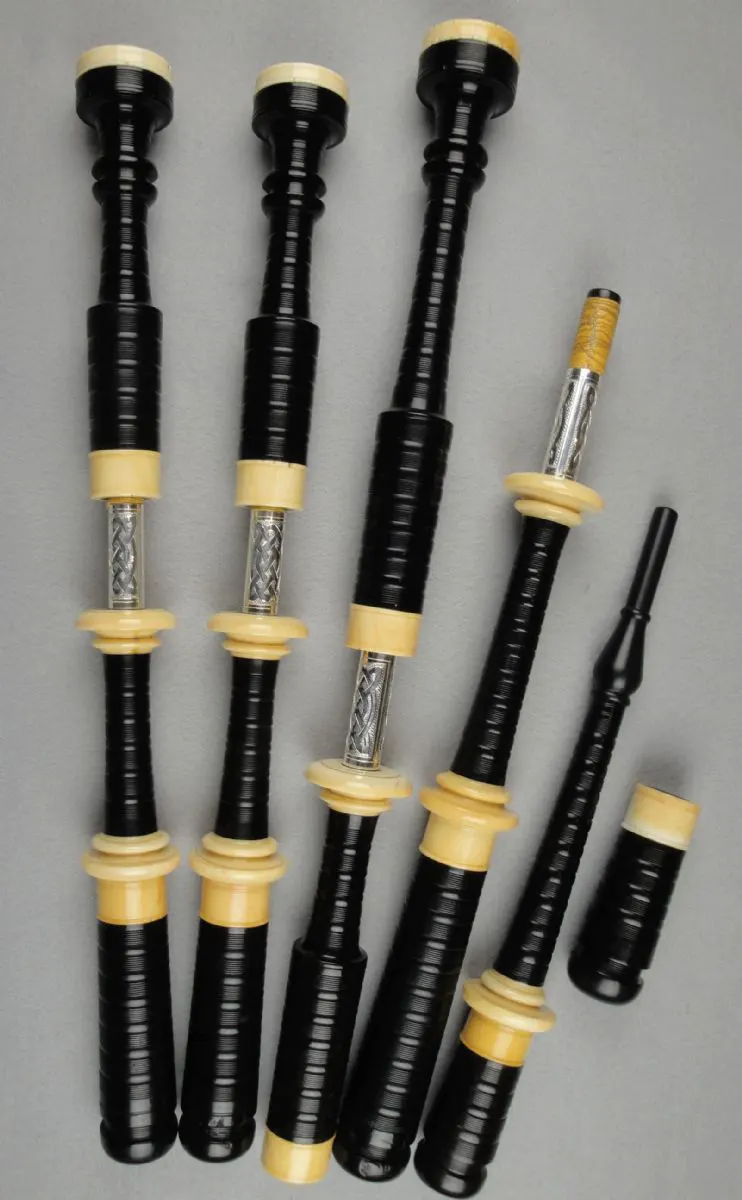
Circa 1890s, Unknown Ebony, Ivory Mounts, New Engraved Silver Slides
SOLD – This set is a bit mysterious and with a rich, deep tone. They are ebony, and mounted in full ivory. The profiles and the ivory patina, slim stocks and slender beads suggest a date in the 1890s. The original slides were plain silver but badly dented and marked, so they have been replaced by new engraved slides with a Runic pattern.
A visible crack in the bass top has been invisible whipped and is undetectable. A hairline crack in on tenor top was similarly whipped, as was the chanter stock. The blowpipe stock is new and poly lined. The ferrule on the chanter stock was missing, so a similar ivory ferrule was found, and the bead turned down slightly to match. There is a crack in the blowpipe ferrule that has been crudely filled, but left in order not to damage the mount.
The set has some Henderson and Lawrie visual characteristics, but the tone is not as full as these makes. These are not quiet pipes but the tone and steadiness is exceptional, and typical of old ebony pipes in the Center or MacDougall tradition.
The pipes have been refinished. There is lots of character and tonal excellence in this set. They have everything — except a name.
-
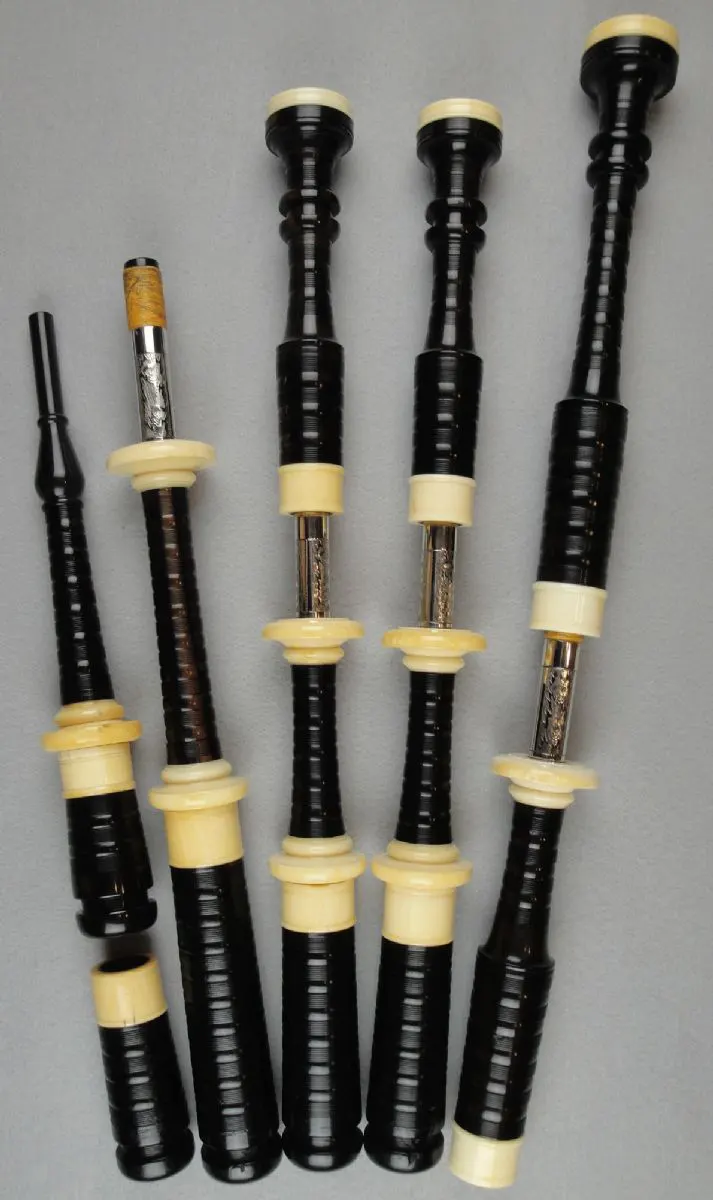
Circa 1920s Lawrie, Ebony, Full Ivory, Engraved Silver Slides
SOLD – This set of circa 1920s Lawries in ebony has full ivory mounts and engraved Sterling silver tuning slides. Though the slides display the typical “RGL” maker’s mark, there are no date marks. However, the previous owner had the pipes pegged at the 1920s, and the use of ebony and the patina of the ivory along with a few spider lines on the projecting mounts would easily support this.
The bass top section had a very visible crack that has been sealed and whipped, and while it can still just barely be seen up very close, it will pose no problems. The chanter stock and one tenor stock exhibited hairline cracks and have also been whipped. However, the wood is of exceptional quality and in exceptional condition and all pieces ran true on the lathe. The cracking is very typical of an ebony set of this age — almost impossible to avoid, but worth the added tonal qualities of ebony.
The blowstick stock is a poly-lined reproduction with the original mount. The remaining stocks may or may not be original — they are ebony and a perfect match to the set — but the ivory mounts are not original, with three in one style and two slightly different. However, the patina matches the mounts on the drones perfectly, and the overall effect is pretty seamless. The entire set has been refinished.
The tone matches the elegant look of the pipes — rich and full, though not booming. They are steady, they tune in the right places, and they blend well with the chanter. It’s a well used but beautiful set with classic Lawrie tonal character.
-
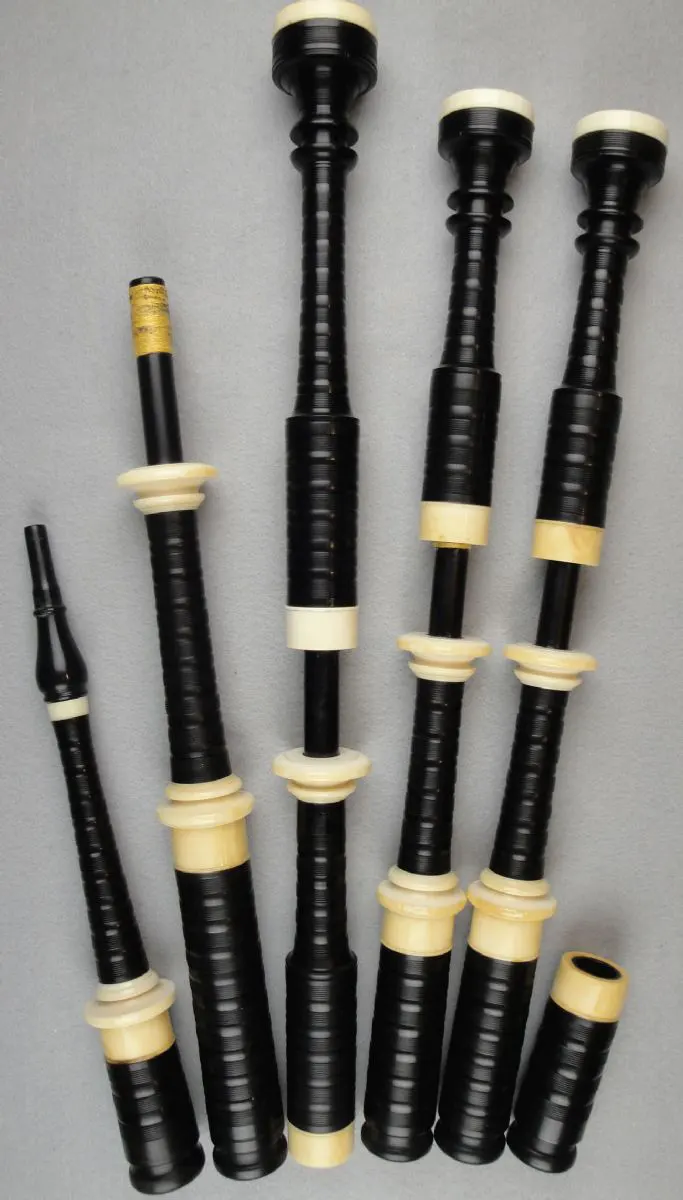
Duncan Macdougall, Edinburgh, Circa 1860s, Ebony, Full Ivory
SOLD – This Duncan MacDougall bagpipe is in remarkable condition, given its age. The middle bass drone joint is stamped “D. McDougall Edinr” just below the projecting mount. The “Edinr” is actually upside down below the maker’s name, a typical trait of this period. The stamp is clearly visible in the enlarged photo of the upper projecting mounts, bottom left. While it is difficult to know exactly where Duncan MacDougall lived at all times during the 1860s and early 1870s, a bagpipe stamped ‘Edinburgh’ can generally be thought of as having been made in the mid to late 1860s. This set was in the possession of the previous owner since 1978. Before that, they were part of the estate of Brodie Castle in Forres, Scotland.
The bagpipe is ebony and fully mounted in lovely ivory. All pieces are original except for the blowstick and blowstick stock. The stock has its original ferrule, and the blowstick has an almost perfect replica mount in ivory. You would not guess these pieces are not original without knowing.
As is typical of pipes with brass linings in the drone tuning chambers, hairline cracks have appeared adjacent to them on the tenor drone tops. There is no leakage, and these have been invisible whipped to prevent future problems.
The pipes were refinished by the previous owner.
The tone is classic Duncan. Though it is not a booming sound, the richness, the blend, and the timbre of the bass drone result in a sound that fills the room.
-
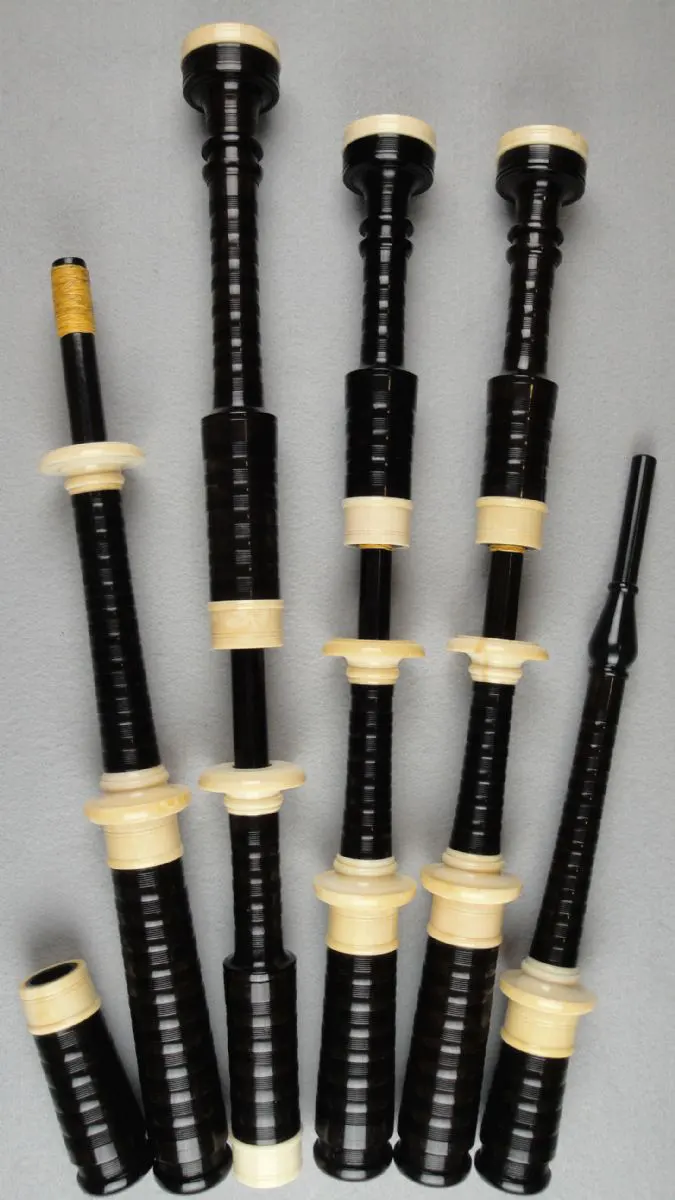
Circa 1960 R. G. Hardie with Henderson Bores, Full Ivory, Set #1
SOLD – This set of circa 1960 Hardie full-ivories has been re-bored with pre-1940s Henderson bores.
Bob Hardie’s pipes were well crafted and he used superb wood. They are favoured by pipers wanting a quieter pipe, and as a result aren’t as popular as pipes with a fuller sound. I asked the Henderson experts at Dunbar Bagpipes (Jack Dunbar worked at the Henderson shop in the 1940s) to re-bore these Hardies according to the old Henderson specs. Only the internal specs of the bells were untouched. The bass bottom joint is a slightly smaller diameter than Henderson so it tunes a bit higher on the pin. The result has been as I’d hoped, with a much fuller drone sound, but still steady and easy to reed.
The set is mounted in full ivory that is in excellent shape but for a bit of staining and chipping on the caps. The sticks were were excellent condition and have been refinished. The blowpipe was missing, so a replica was made in poly-lined blackwood with an old matching ivory mount.
I’m pleased with how this re-bore experiment has turned out, and will replicate it with other Hardie sets. It matches excellent aged wood with the resonating Henderson internal specifications.
-
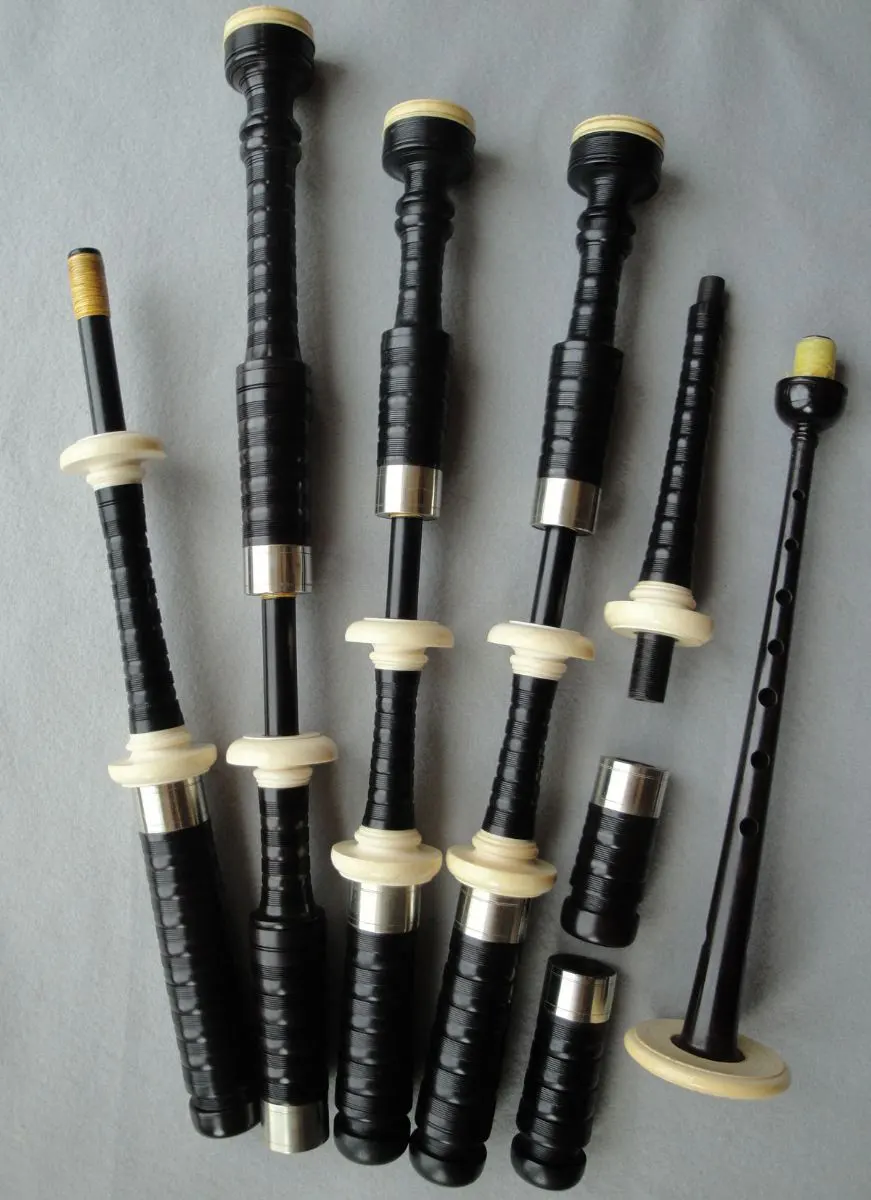
Robertson, Circa 1940, Ebony and Blackwood, Ivory and Nickel
SOLD – This is an interesting James Robertson set, in that it is a mix of ebony and blackwood, suggesting a date of manufacture of around 1940 or a bit earlier. The ivory projecting mounts are Robertson’s distinctive design; the ferrules are nickel. The chanter is likely original to the set.
The bass and blowpipe stock match the set, while the chanter and tenor stocks may be replacements, though not readily apparent to the untrained eye.
All other pieces are original. There are no cracks or repairs, and just a couple of tiny age chips in the ivory. The pipes have been refinished.
The sound is typical of Robertson consistency: big, bold and steady.
-
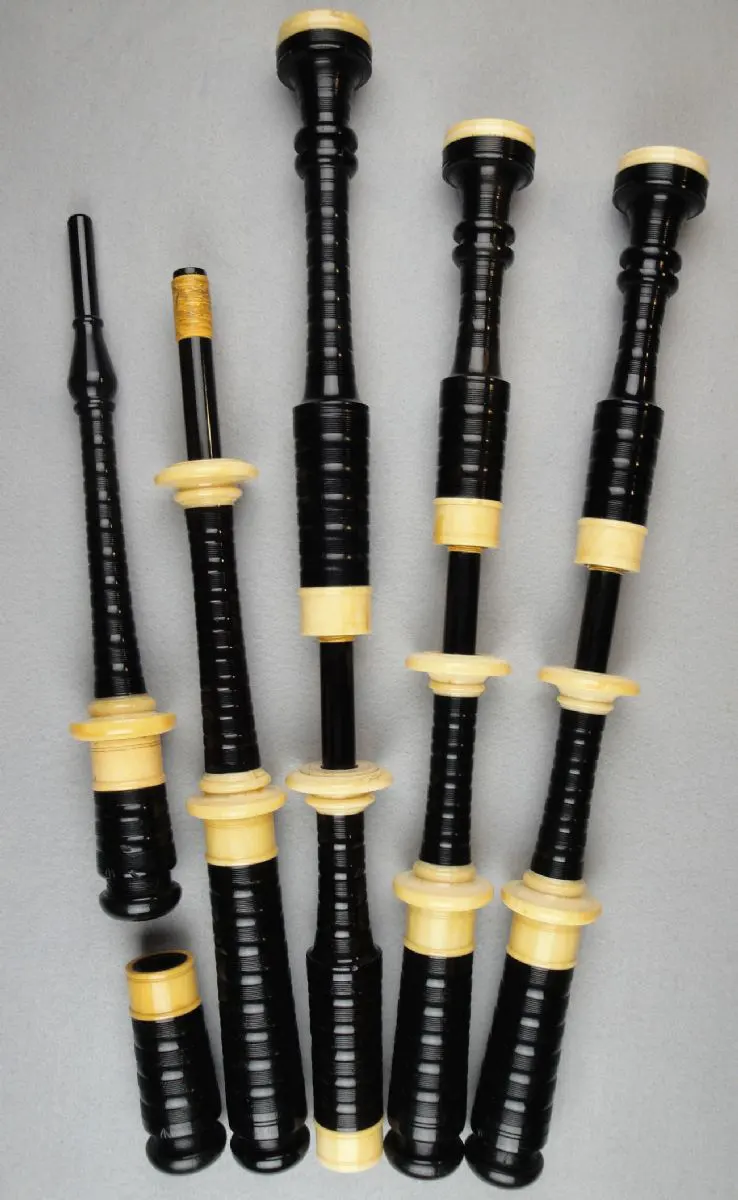
WWI-era Lawries, Ebony, Full Ivory
SOLD – What I was struck by more than anything with these pipes was the steadiness. The first set of reeds I tried in them locked in right away, and even though the chanter reed sharpened up and I eased off to compensate, the drones stayed locked. The tone was full and smooth: typical Lawrie/Henderson of this vintage.
The pipes are lovely dark ebony that has been beautifully refinished. The ivory is lovely, though slightly stained and spider-lined here and there. It is in good condition but for one chip on the blowpipe projecting mount. The chanter stock had slight a slight crack that became apparent after the finish was removed, and has been invisible whipped. The ivory ferrule from the chanter stock was missing. Another old ivory Lawrie ferrule has been installed to replace it.
There is not much more to say about this set. It is an elegant full ivory set in ebony, beautifully restored by Dunbar Bagpipe Makers. The sound and steadiness would win prizes at the highest levels, or suit the hobby piper who just wants trouble-free tone!
-
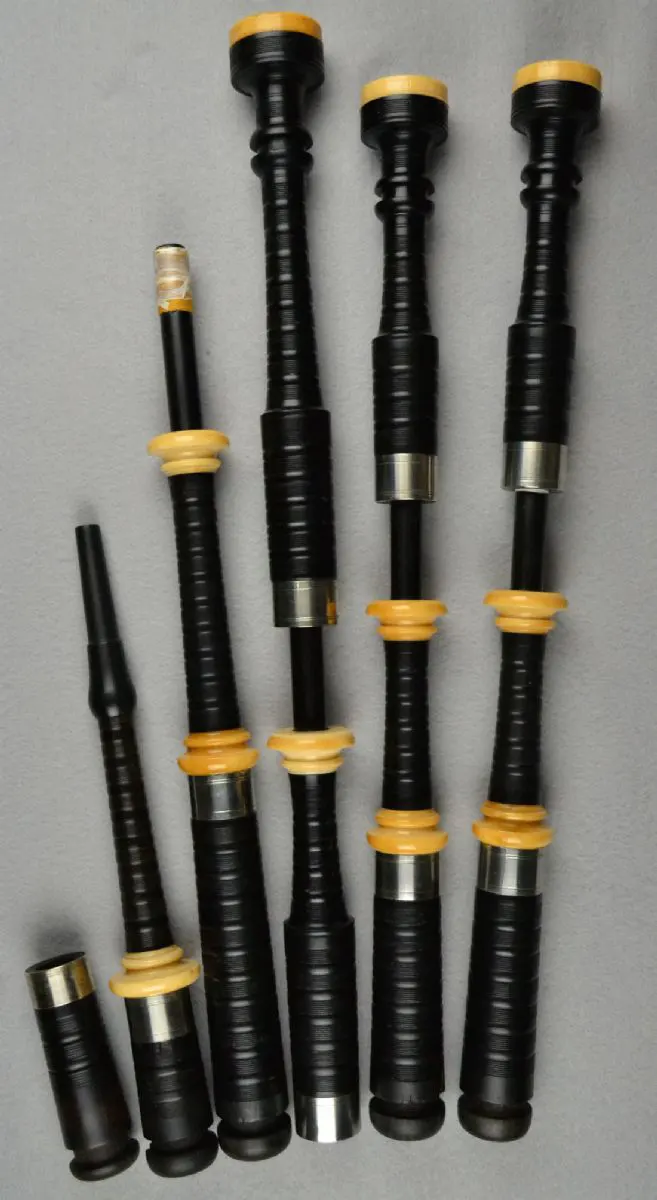
Circa 1900 John Center, Ebony, Ivory Mounts, Nickel Ferrules
SOLD – John Center was initially a professional photographer with a keen eye who began making pipes in Edinburgh in 1869. His son James joined him in the business later. The family moved to Melbourne, Australia in 1908 where they continued to make pipes. John died in 1913, and James died a young man in 1919 of the Spanish flu epidemic. A leading player, Jimmy Center was commemorated in Willie Ross’s superb jig, “Center’s Bonnet.”
John Center was renown for his workmanship and refined sound. This set is typical, with meticulous turning, lovely ivory mounts, and a tone which is steady and seamless, but not booming — not as quiet as David Glen’s pipes, and not quite as big as Duncan MacDougall’s best sets, but similar in timbre and steadiness.
All drone pieces in this set are in excellent condition. The bass stock had fine cracks that have been sealed and invisible whipped. The blowstick stock is a reproduction in blackwood with a poly lining and the original mount. The blowpipe appears to be an old Henderson, and the chanter stock is an old replacement with a slightly different combing pattern.
This is a pleasing old piece of history, both aesthetically and tonally.