
Working with vintage bagpipes is as much a hobby as a business for me. I enjoy the process of turning up old pipes and making sure they will be played for years to come. I think it is a good thing for piping. As such, I take great care in purchasing, examining and restoring old pipes.

My refurbisher is J. Dunbar Bagpipe Maker in St. Catharines, Ontario. Not only do they do masterful restorations, they have eagle eyes for examining 150-year-old wood and discovering replacement pieces and flaws that should be addressed before you play the pipes. If a set of pipes has a replacement or repaired piece, you will know about it before you buy.
You should know from the get-go that pretty much every bagpipe made before 1930 has required or will require repairs of some sort, especially if they are ebony. Ebony and cocuswood are superb woods from which to make bagpipes but they are less resilient than African blackwood. I suspect there is hardly an ebony bagpipe in the world made before 1920 that hasn’t experienced at least one crack.
Photos and descriptions of all instruments featured since October 2010
-
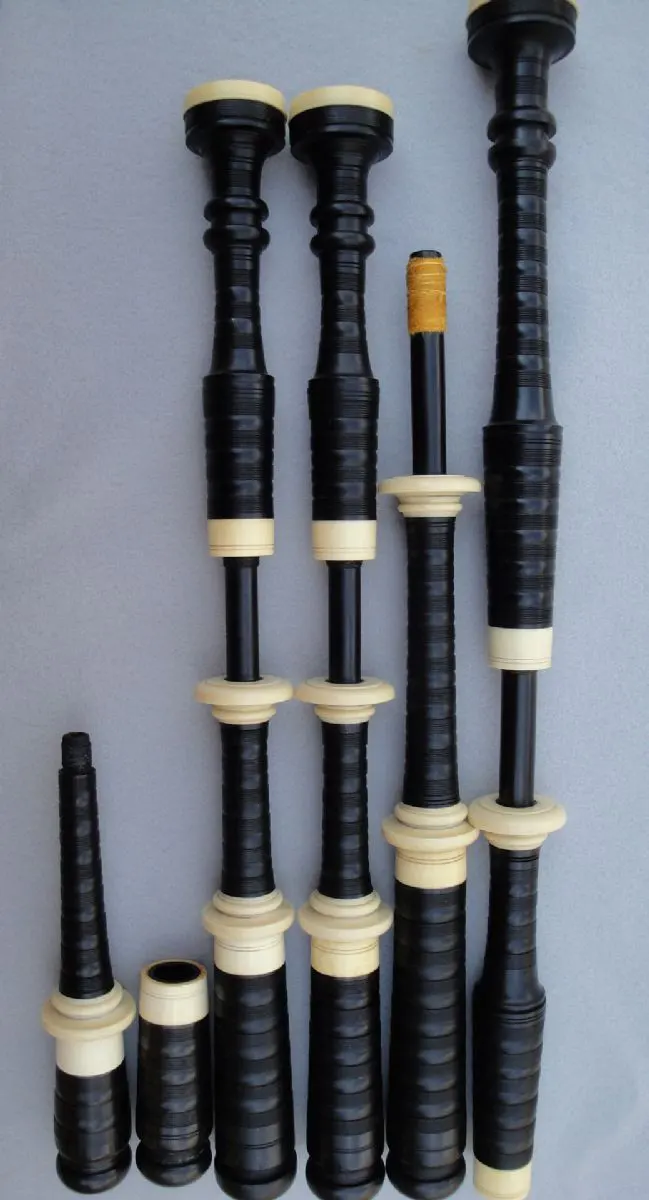
Lawrie, Circa 1900-1920, in Ebony, Ivory and Celluloid Mounted
SOLD – This set came from the estate of Captain John A. MacLellan in Edinburgh and is a lovely but curious instrument. The sticks are ebony, and the profiles are early Lawrie. The two tenors don’t match exactly. They certainly came out of the same shop, but maybe not quite at the same time. It’s possible at some point in its history, a number of the mounts were replaced, resulting in, for example, ferrules that are not typically Lawrie in design.
As has been noted often on this page, celluloid was a brilliant ivory substitute, complete with a grain and the right hue. The projecting mounts on this set appear to be ivory, as do most if not all of the ferrules. It can be difficult to tell, such is the quality of celluloid as an ivory copy.
It is possible that the chanter stock is a replacement, though the mount is original. The blowstick stock is also a replacement, including the mount.
The projecting mounts were made in two pieces: a method used by early pipemakers in order to save the wider pieces of ivory only for the widest part of the projecting mounts. The seams are visible in the photos, though the joins are solid. This implies an earlier rather than a later date. John MacLellan purchased these pipes from the Glen shop in Edinburgh and was told they were circa 1900.
The tone is rock steady, but not quite as full as the typical Lawrie. It is not a quiet sound by any means, but more toward the MacDougall than the Henderson/Lawrie sound. They may have been custom-bored for a client wanting a more refined sound. The pipes are quite distinctive in appearance and very lightweight to carry.
They are free of cracks and needed no refurbishment.
-
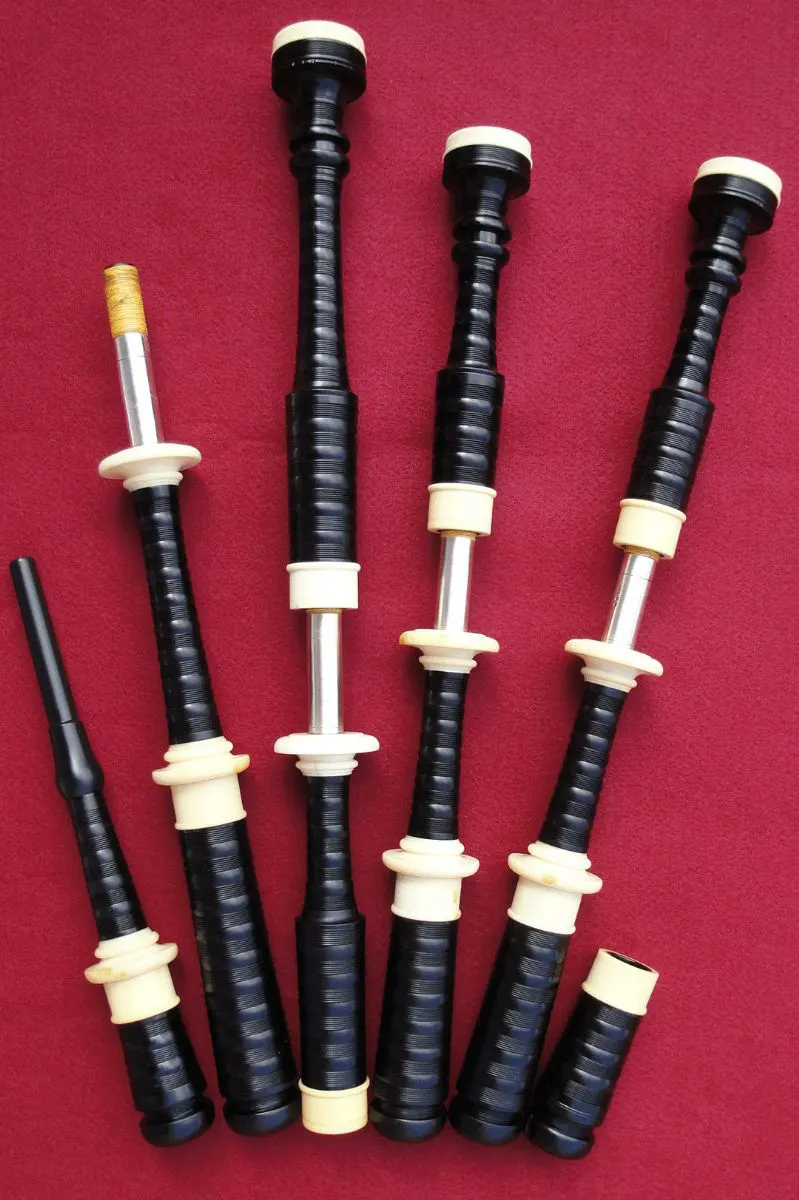
Henderson, 1952, Full Ivory with Plain Silver Slides
SOLD – This is a big, happy set of Hendersons made in 1952 and very well taken care of ever since. They are mounted fully in ivory and have hallmarked, plain silver slides. There are 1952 hallmarks on the plain silver slides.
They were most recently owned by an American serviceman who played them in Iraq for some time before his retirement. He owned them since the early 1980s and originally acquired them from Jim McIntosh in Pittsburgh.
One tenor top appears to be a replacement and does not bear the usual Henderson stamp in the cord guides. The pipes are in superb condition, though they have some slight staining on the ivory here and there.
The sound is classic Henderson. They are very full and very steady and are easily reeded.
They have been refinished.
-
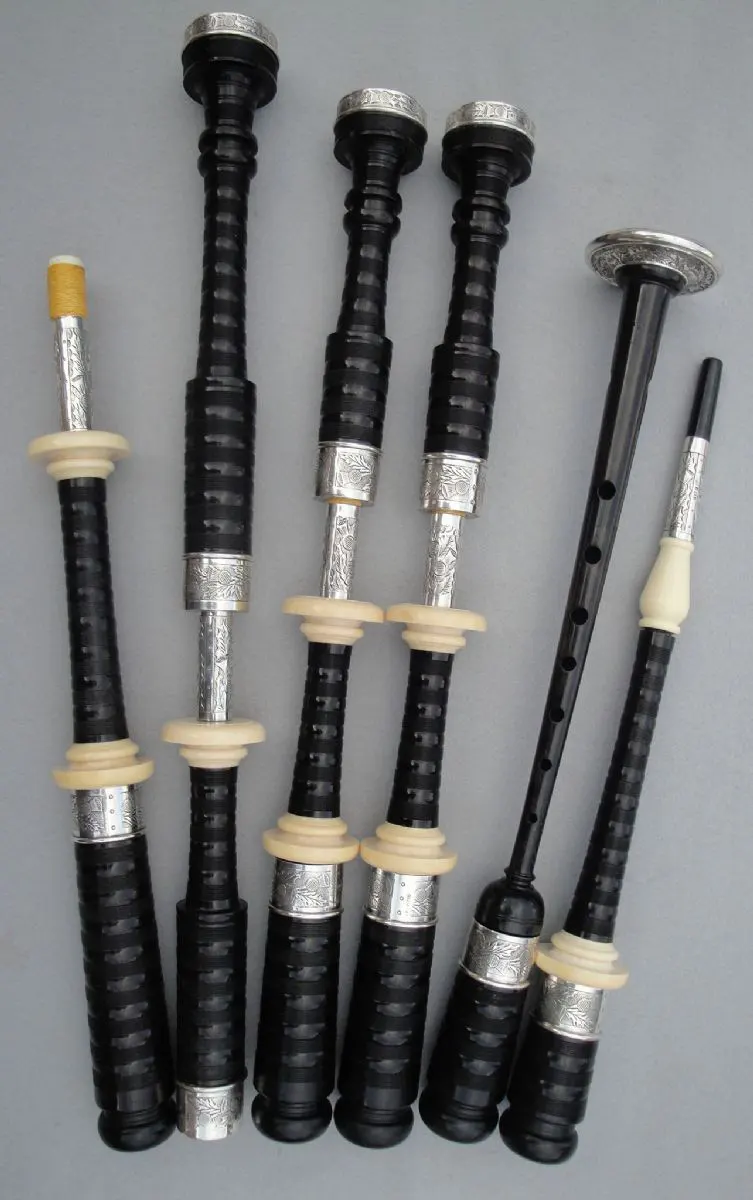
R. G. Hardie, Hand-engraved Silver and Ivory, Hallmarked 1956
SOLD – Bob Hardie was a lovely, quiet, modest man and an icon of 20th-century piping. He was a leading soloist in the 1940s and 1950s, and his band, Muirhead and Sons Ltd., won five straight World Pipe Band Championships in the 1960s. In 1950 he and John Weatherston founded one of the most successful bagpipe making companies of the time. The company continued until 2005, though Bob died in 1990.
This Hardie bagpipe was made in 1956. It is mounted in hand-engraved Sterling silver and ivory. All parts including the chanter are original except the mouthpiece bulb, which is an imitation ivory replacement. The blowpipe had a slight crack but has been glued and sealed.
Hardies were renown for using well seasoned, high quality wood. Even after 55 years, all pieces in this set are straight and true. The finish on the pipes has not been touched except for the bass bottom, which has been refinished to match.
The drones are mellow, steady and easy to reed. The chanter is flatter pitched and a little more difficult to reed because of its age, but the Hardie chanter was the chanter for both top bands and soloists during the 1950s and ’60s.
This is the loveliest Hardie instrument I have seen.
-
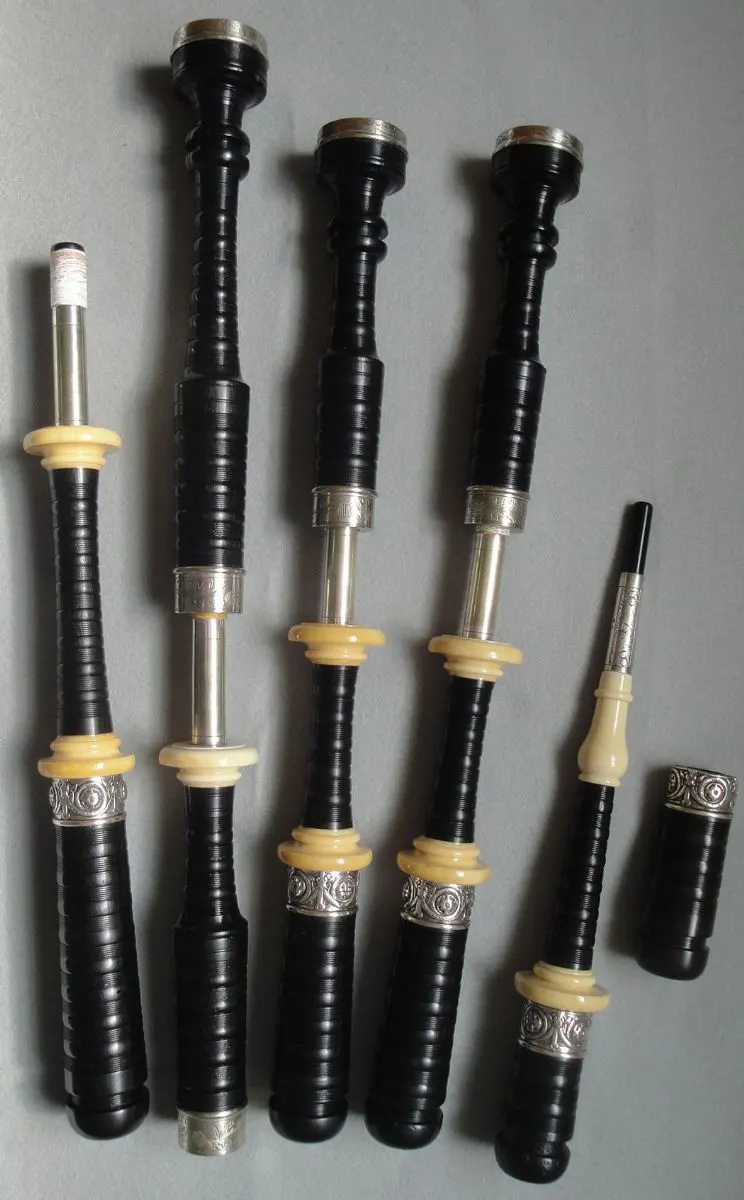
Circa 1880s Henderson, Ebony, Ivory, Engraved German Silver
SOLD – This is one of the most unique sets to come to McGillivray Piping in some time. The pipes are Peter Henderson, in ebony, thought to date from the 1880s. The projecting mounts and bushes are ivory. The drone ferrules, slides, caps and mouthpiece tube appear to be what has been called “German silver,” which was an alloy of copper (60%), nickel (20%) and zinc (20%). It was hand engraved (except for the turning slides) and then silver plated. The stocks are Sterling silver, likely cast, and quite ornate. Though the combination of two kinds of ferrules is unusual, other sets known to be from Henderson’s early years do exist like this, though in at least one other case it was the caps that were cast. For example, there are strong similarities in engraving between this instrument, and the one show on Ringo Bowen’s site as Calum Piobaire’s 1866 Prize Pipe. Of particular interest are the ornate caps.
The tuning pin on the middle bass drone joint and the chanter stock were cracked and both have been replaced with ebony reproductions. One tenor bottom had a hairline crack, so three combing sections were invisibly whipped to prevent spreading.
While all bores ran perfectly true, some had shrunk slightly and were re-reamed to original Henderson specs by Dunbar Bagpipes.
The drones are bold, steady, and blend beautifully with each other and with the chanter.
This is a remarkable instrument and artifact in superb shape.
-
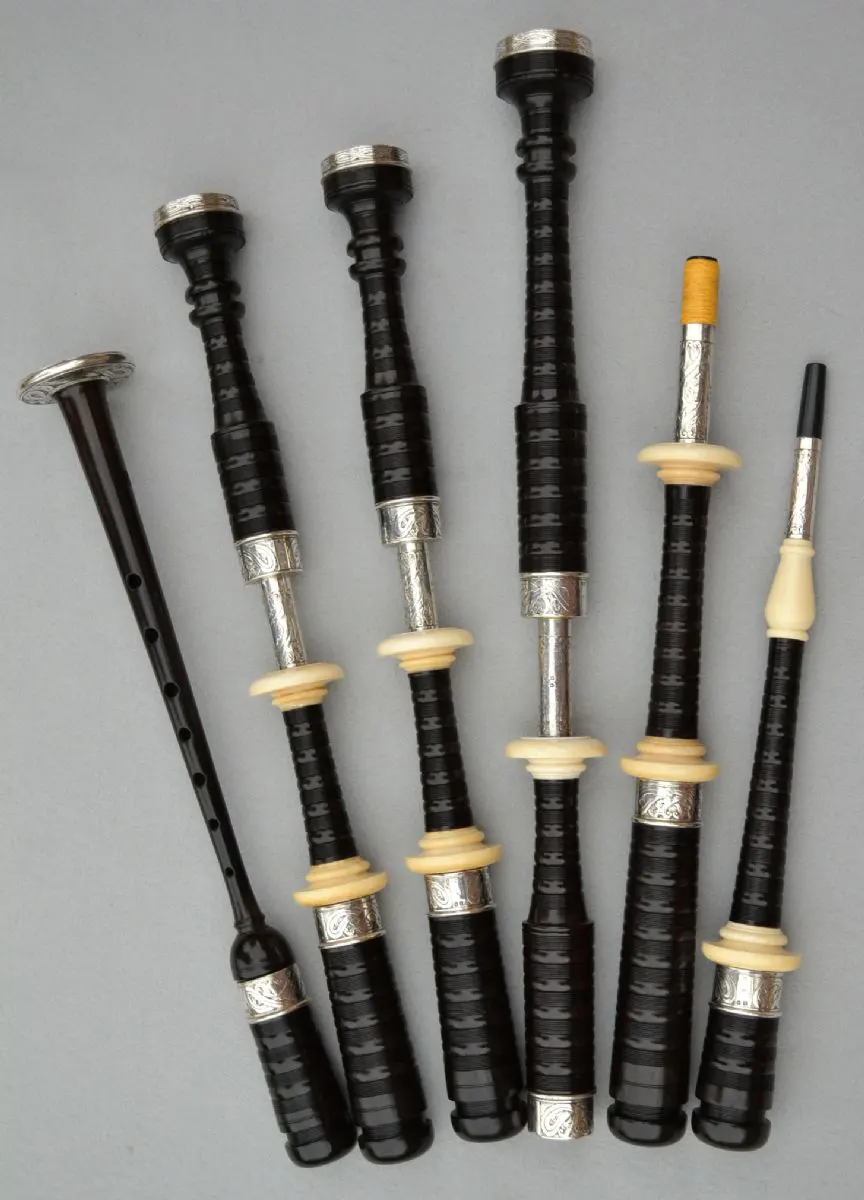
Henderson, Hallmarked 1926, Silver and Ivory
SOLD – This is one of the most stunning looking Hendersons to appear on this site, and their tone easily matches their appearance. The wood is African blackwood, mounted in ivory and Sterling silver with a gorgeous relief pattern. The silver hallmark dates the pipes to 1926.
All pieces are original except for the mouthpiece bulb, which is an imitation ivory replica. The original bulb is still with the pipes, though it is cracked.
The set is virtually pristine though hairline cracks in the bass top and bass stock have been invisibly whipped and are indeed invisible.
The pipes play like a dream and even the original chanter plays well, though close to Bb. If you’ve been waiting for THE set of Hendersons to come around, this is it!
-
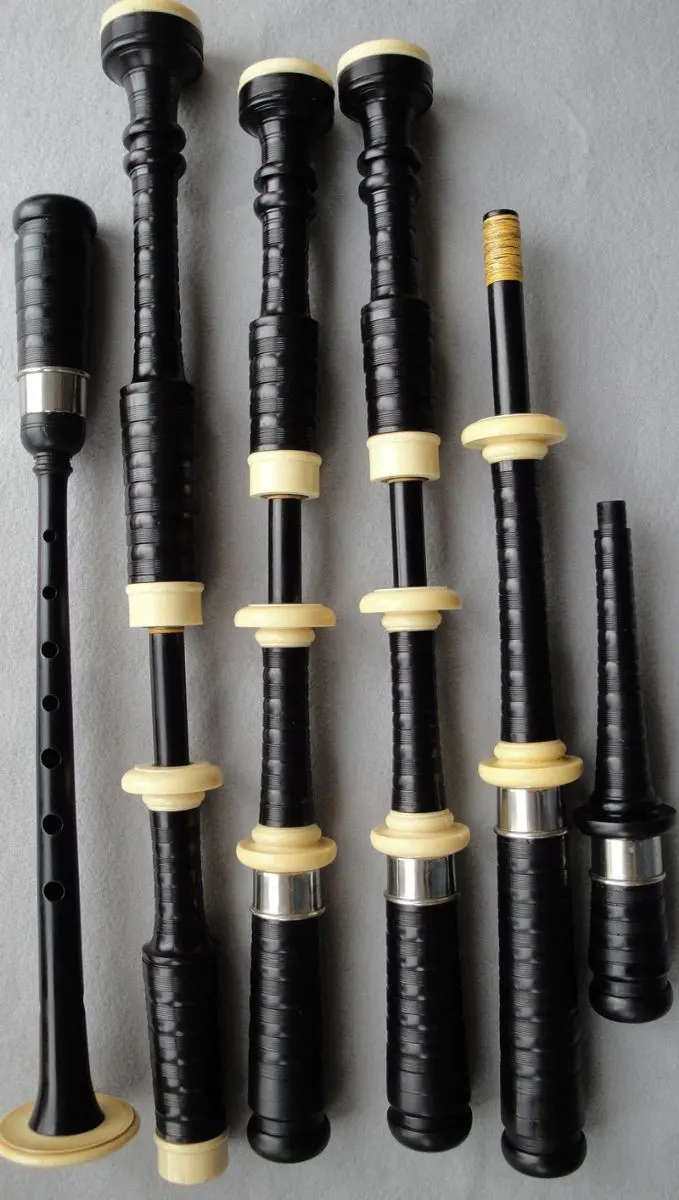
Lawrie, 1950s, Imitation Ivory, Nickel
SOLD – This African blackwood set was made by the R. G. Lawrie company, likely in the 1950s or a bit earlier. The drones are mounted fully in imitation ivory, while the stocks have classic Lawrie nickel ferrules.
All pieces are original except for the blowstick, which is a blackwood mounted replacement. The blowstick stock had a small crack, which has been whipped, almost imperceptibly. The original chanter comes with the pipes — a thick old stick typical of 1940s or 1950s chanters.
-
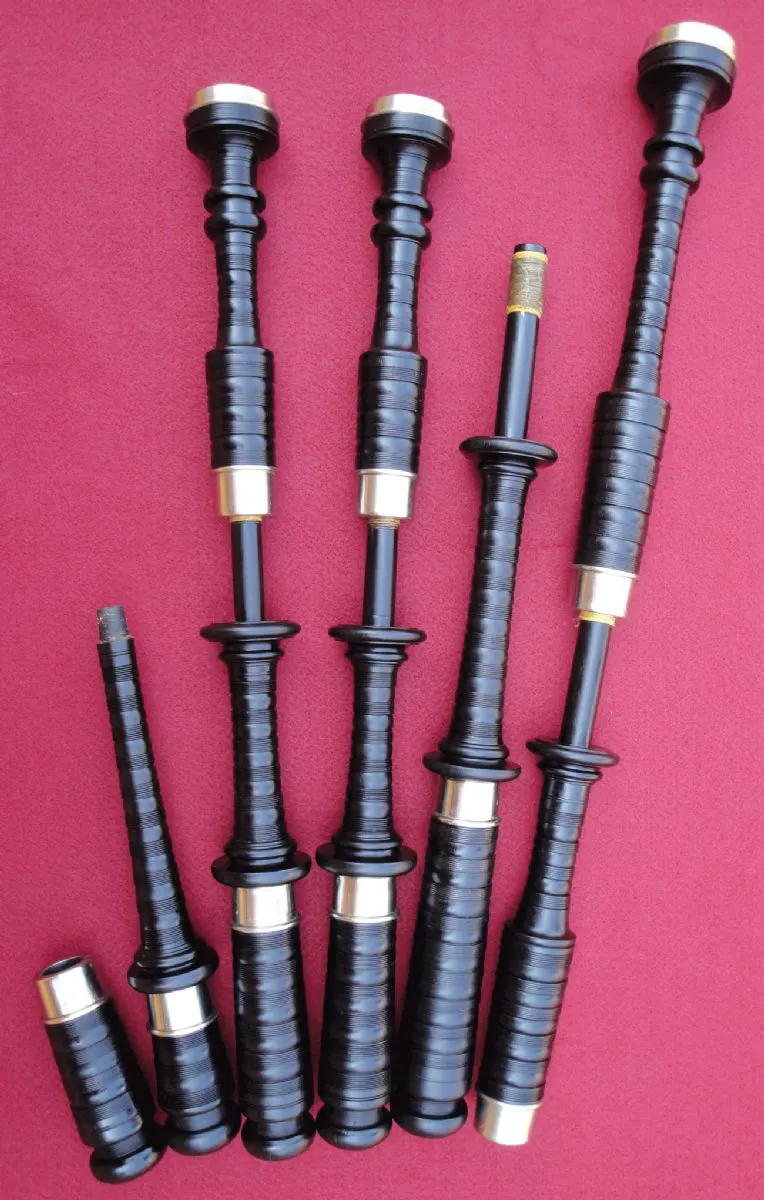
Lawrie, Circa 1920s, in Ebony, Nickel
SOLD – Lawrie drones of this ilk in ebony may be one of the most common vintage pipes available today, though it is uncommon to find one so free of major faults. They were likely made in the 1920s, though this dating could vary by a decade either way. The bells, cord guides, projecting mounts and tapered nickel ferrules are classic Lawrie.
This set has been refinished and there is invisible whipping beneath the top three combs of the bass drone stock. A couple of the ferrule tenons showed some slight checking, so these were whipped under the ferrules and will cause no problems. Blackwood hemp stops were added to all four tuning pins giving them a big Henderson/Lawrie wall of sound. The ebony material provides a level of steadiness and richness unequaled by blackwood of the same era.
-
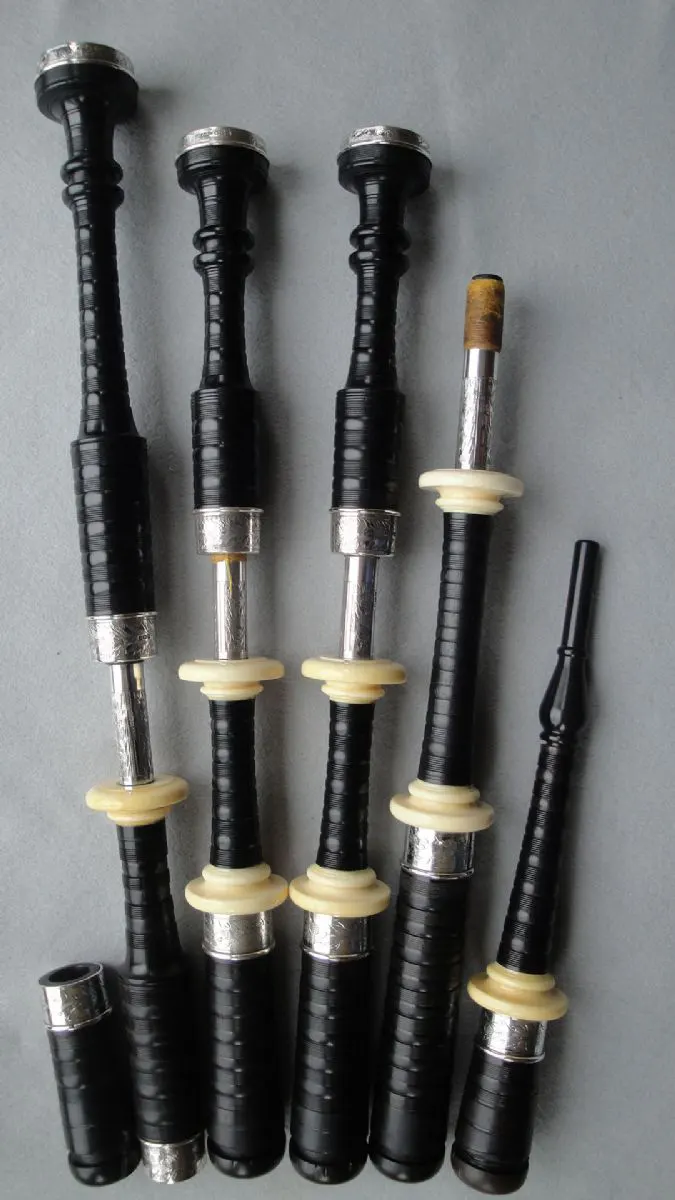
R. G. Lawrie, Ebony, Engraved Silver and Ivory, Hallmarked 1914
SOLD – This is a stunning set of ebony Lawries from the midst of John MacColl’s career with the company. It displays the classic tapered ferrules and shallow bells typical of the make. They are extremely full, rich and steady.
The previous owner was playing the pipes with hairline cracks in the bass stock, one tenor stock and the bass middle joint — not unusual for ebony pipes of this age. These have been invisible whipped to eliminate future problems.
The R. G. Lawrie company was certainly the equal of Peter Henderson in both tonal and manufacturing quality during the early part of the century. The internal specs of their pipes were virtually identical, they jobbed out to one another, and they shared some of the same turners. Tonally, their pipes are identical, with a big, rich tone and tremendous steadiness.
The number of top players who have won premier prizes with classic Lawries or Hendersons is remarkable.
This set has been refinished.
-
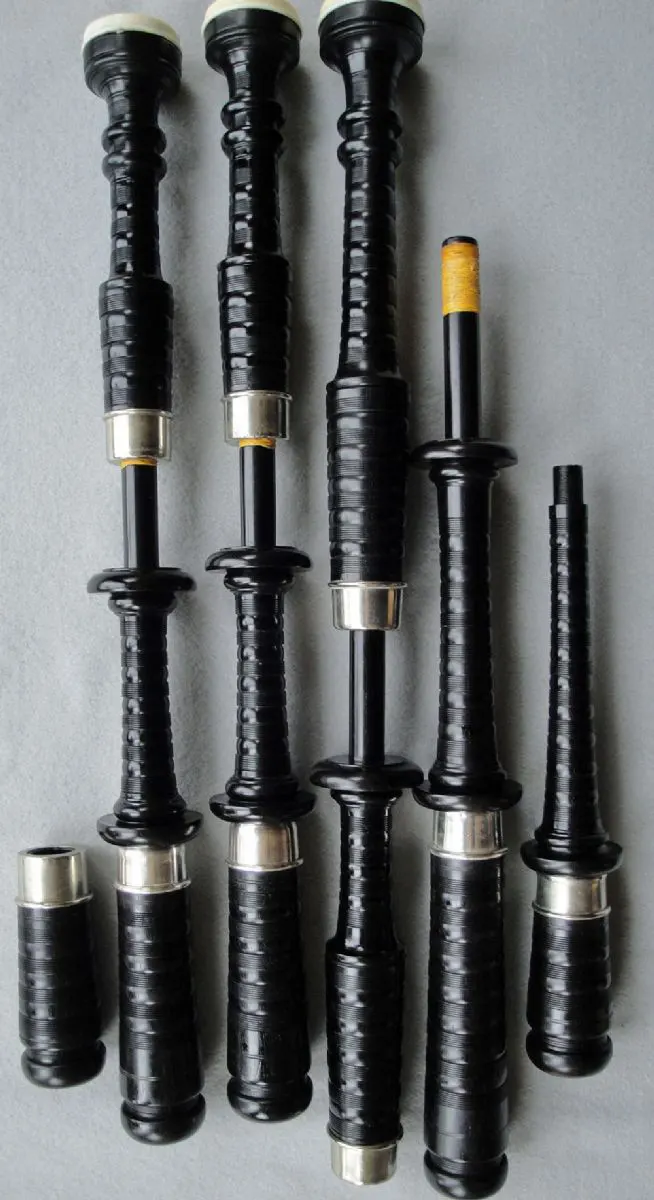
Lawries, Circa 1930s, Ebony, Nickel, Imitation Ivory
SOLD – Here is a very affordable but excellent Lawrie set in ebony, likely made in the 1930s.
It is mounted mostly in nickel, with ebony projecting mounts. The bushes are celluloid, the rest of the caps are very good imitation ivory.
The bass bottom joint is a replica in blackwood. Three of the stocks are ebony replicas. The replica pieces are all perfect matches to the set.
The set is in very good condition and has been refinished.
-
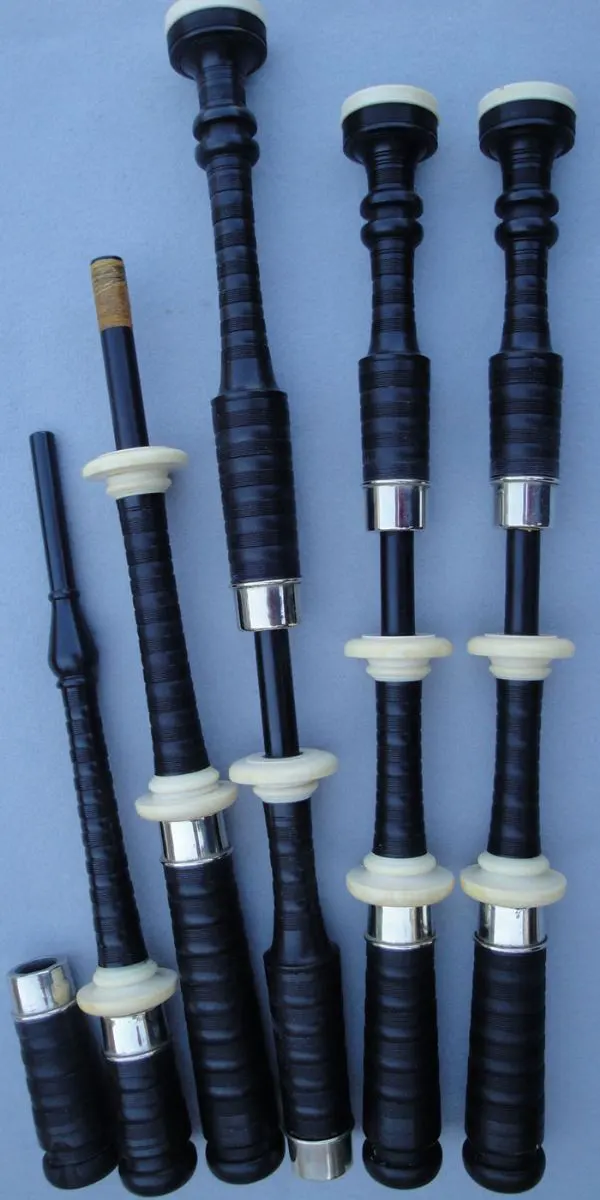
R. G. Lawrie, Ebony, Ivory, Nickel, Circa 1920s-30s
SOLD – Lawrie pipes were among the best of the early part of the 20th-century, and this includes mid-range work-a-day sets like this one. This set is superb ebony with ivory projecting mounts and caps, and classic Lawrie tapered nickel ferrules.
It can be difficult to date these models, but the use of high-grade ebony and the ivory patina on this set suggest late 1920s or early 1930s.
These pipes came back to me from a previous customer who purchased them several years ago, has added to his collection and decided it was time to downsize. I don’t have a record of what work was done during refurbishment other than refinishing. The invisible whipping I have done on pipes now is almost imperceptible, but I have gone over these with a fine tooth comb and I can’t find any whipping. The blowpipe stock was cracked when I received the pipes back and that has been invisible whipped and the blowstick bored out.
But for a couple of small age chips, the ivory and wood are all in excellent condition.
The set is bold, rich and steady in the old Lawrie tradition.
-
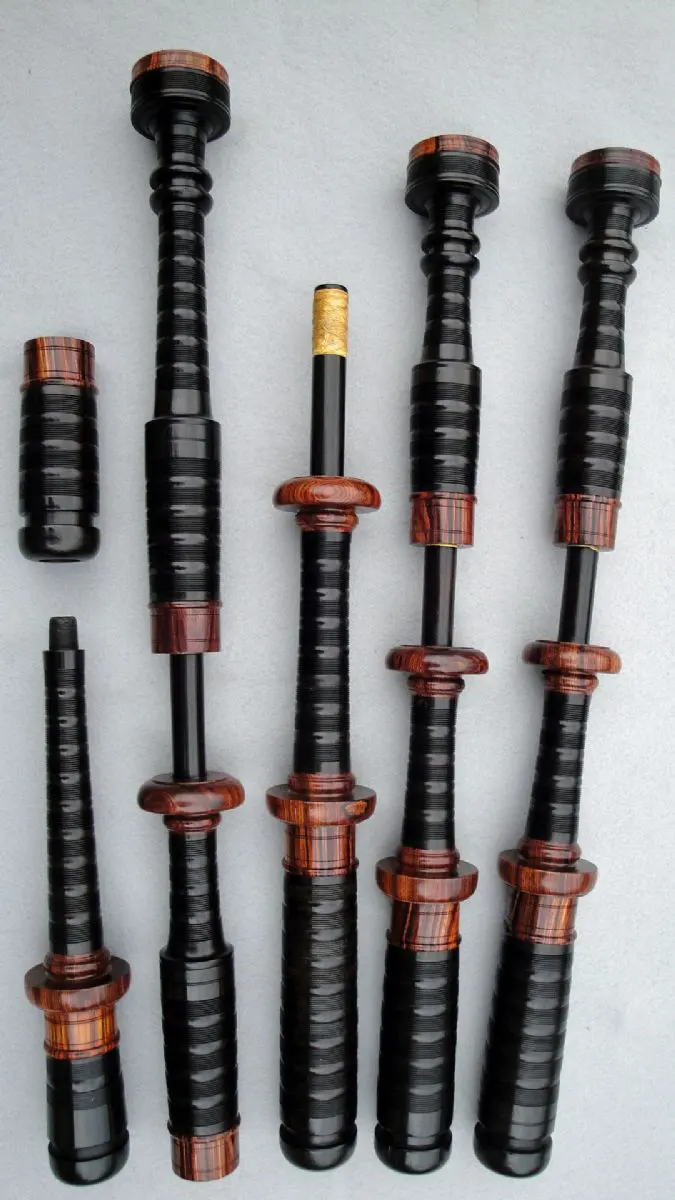
Robertsons, Circa 1940, Fully Mounted in Cocobola
SOLD – This set of Robertsons was originally mounted in casein, an imitation ivory material used in the early and mid-1900s. Casein unfortunately breaks down over time to acquire an unattractive chalky appearance. The casein on this set had deteriorated quite a bit, which would date them from the 1930s or 1940. The pipes themselves were in superb condition, so the casein mounts were removed and replaced with cocobola wood.
The pipes were stripped and refinished when they were remounted.
James Robertson made pipes from just before the Great War until he died in 1948. His company continued into the 1960s. His reputation for tonal and manufacturing consistency over this long period of time is almost unequaled. His drones are full, rich and steady, and this set is no exception.
-
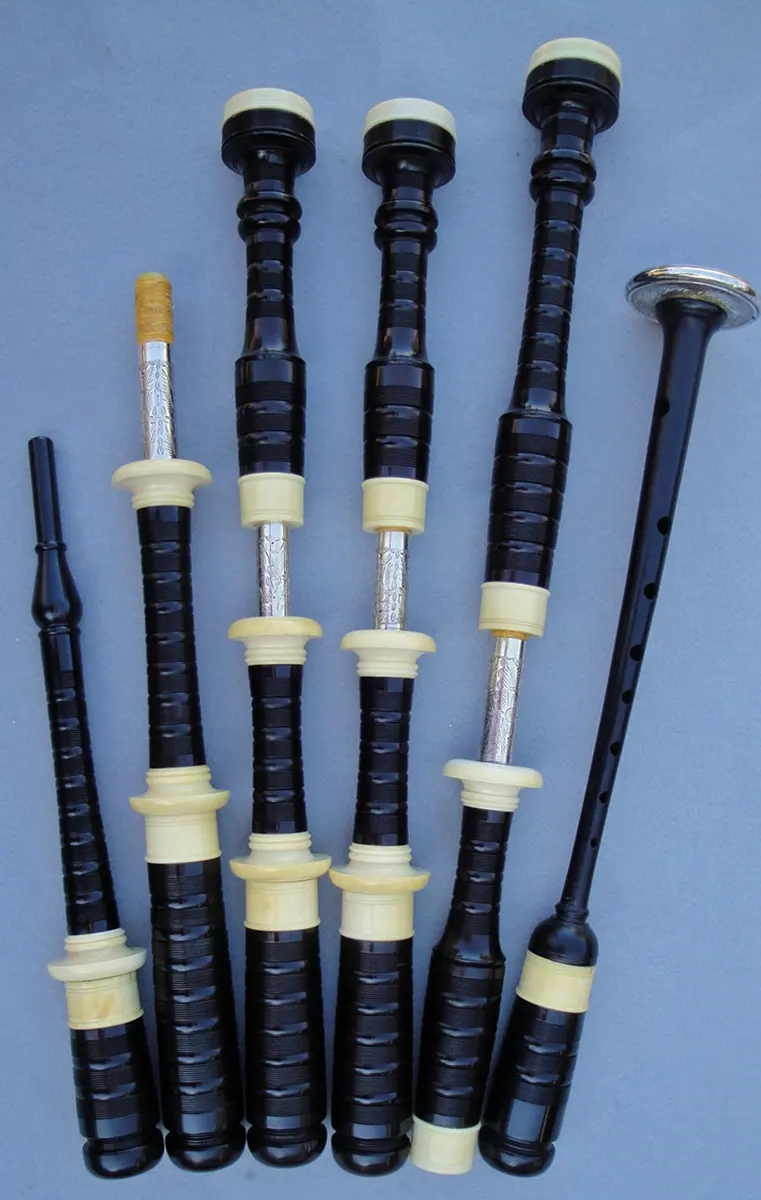
Wm. Sinclair and Son, 1945, Blackwood, Ivory, Engraved Silver Slides
SOLD – William Sinclair & Son has been a premier pipemaker since it was founded in 1931 in Edinburgh. Though the Sinclair chanter has been an iconic band chanter since the 1950s, Sinclair drones have gained an equal reputation for craftsmanship, steadiness and tonal brilliance. I won the Gold Medals at Oban and Inverness and the Clasp at Inverness on a set of silver and ivory 1948 Sinclair drones.
This is an absolutely lovely set, in superb shape, with great lines and a lovely, bright sound like my set. The slides are engraved sterling silver, hallmarked 1945. The Sinclair practice of putting serial numbers on chanters has been followed here as well. Barely visible on the top of the slide on the bass bottom is “432201-945” — the last three numbers matching the hallmark date on the silver.
A new blowpipe and stock were made with original mounts to replace the cracked originals. Both are lined with polypenco to prevent cracking.
The wood and ivory on this set are gorgeous, and they sport the distinctive one-piece-full ivory caps typical of the Sinclair brand. The pipes play beautifully — steady, rich and bright. The chanter is original and looks like it has been broken and expertly put back together again. It plays beautifully.