
Working with vintage bagpipes is as much a hobby as a business for me. I enjoy the process of turning up old pipes and making sure they will be played for years to come. I think it is a good thing for piping. As such, I take great care in purchasing, examining and restoring old pipes.

My refurbisher is J. Dunbar Bagpipe Maker in St. Catharines, Ontario. Not only do they do masterful restorations, they have eagle eyes for examining 150-year-old wood and discovering replacement pieces and flaws that should be addressed before you play the pipes. If a set of pipes has a replacement or repaired piece, you will know about it before you buy.
You should know from the get-go that pretty much every bagpipe made before 1930 has required or will require repairs of some sort, especially if they are ebony. Ebony and cocuswood are superb woods from which to make bagpipes but they are less resilient than African blackwood. I suspect there is hardly an ebony bagpipe in the world made before 1920 that hasn’t experienced at least one crack.
Photos and descriptions of all instruments featured since October 2010
-
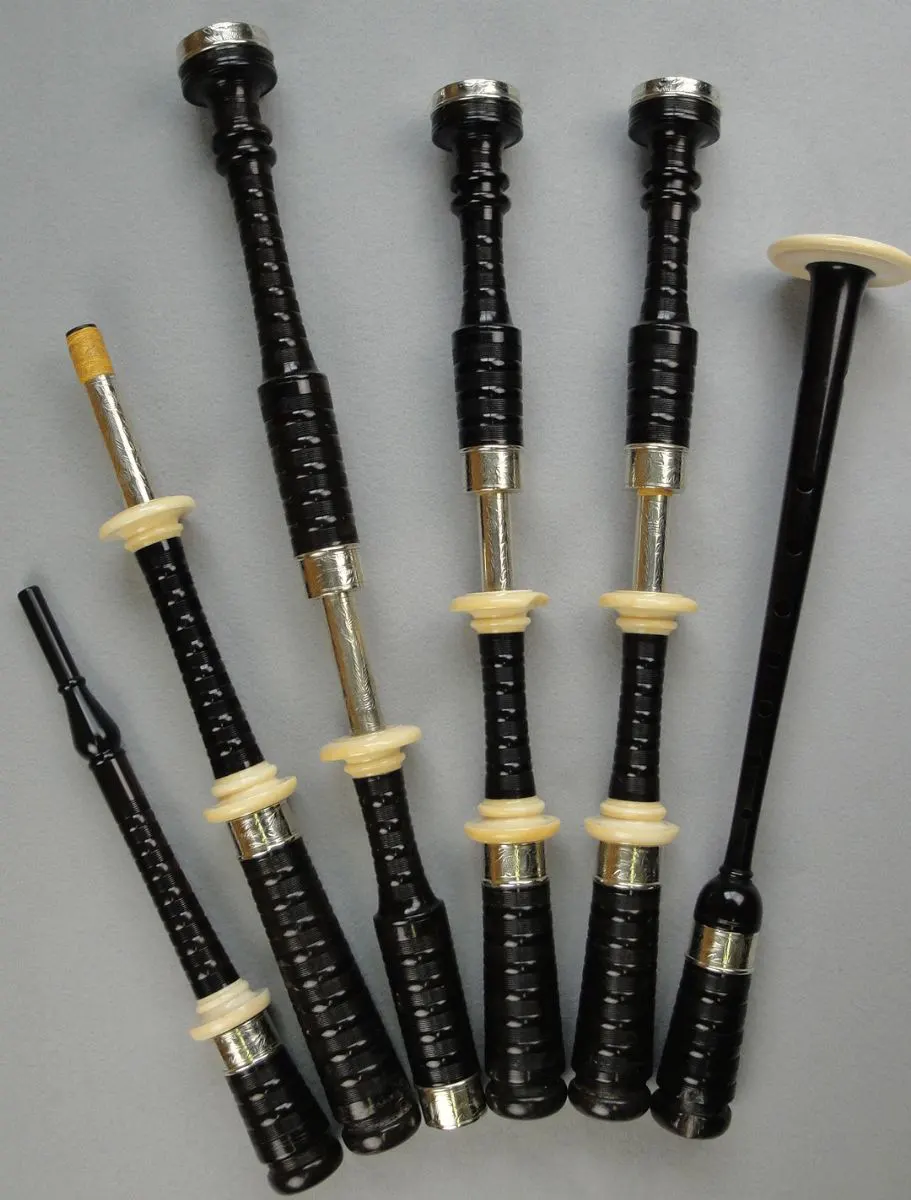
Silver and Ivory Henderson, Circa 1920
SOLD – This set is a real beauty: silver and ivory Hendersons thought to date from the early 1920s. They appear to be blackwood and are free of cracks. The only flaw, as you’ll see in the photos, is that one tenor drone projecting mount has a piece broken off the side. Someone with good sense had the break sanded straight and polished, so, while visible, it is not unsightly.
The blowstick is a poly-lined blackwood replica by Dunbar Bagpipes, with an ivory mount that is not original to the set but was taken from the previous cracked blowpipe. The mount matches the rest of the set fairly well; it just doesn’t look quite as old. The finish has been left on the set as is, though the wood, silver and ivory were all polished on a lathe.
The chanter is a Henderson, and the fact that it has an ivory sole would suggest it is not original to the pipes, though it may be.
Like the pipes directly below, this is a first-class old Henderson set. The tone is full and steady, and the pipes went brilliantly with both sets of reeds I tried.
-
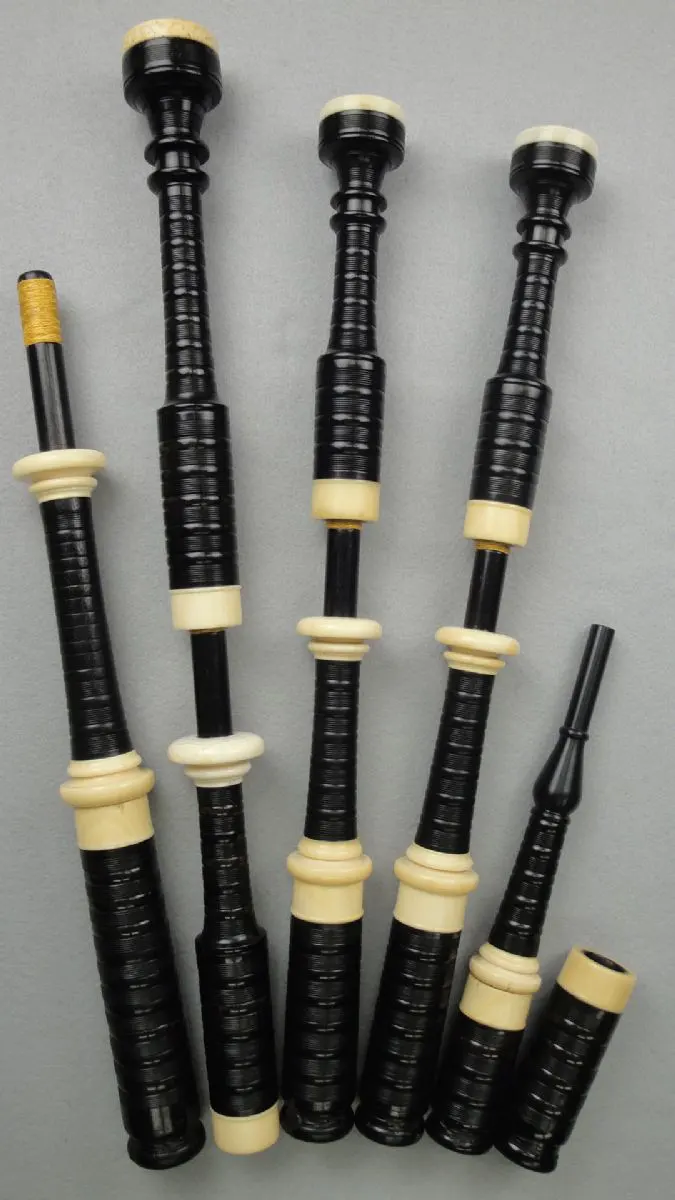
Duncan Macdougall, Circa 1880s, Full Natural
SOLD -This is one of the most exceptional sets of MacDougall pipes to appear on this site. Their pedigree is outstanding, having been played by a member of the Strathclyde Police Pipe Band during their glory years in the 1970s and 1980s, winning many World Pipe Band Championships. More recently they were owned by a leading Scottish solo competitor and won many top prizes including the Former Winners MSR at London, the Oban Silver Medal and the Oban Jig and Grade A March.
The pipes are ebony, with full ivory mounts. All pieces are original. When the pipes were stripped for refurbishment a number of hairline cracks were discovered in various pieces. None were close to going through to the bores. However, to guard against serious cracks forming in future all of these hairlines were invisible whipped, and the pipes refinished.
The pipes are classic Duncan MacDougall — rich, steady, and with a big, cradling bass.
This is a really exceptional instrument, both musically and historically, particularly for an established or aspiring competitor.
-
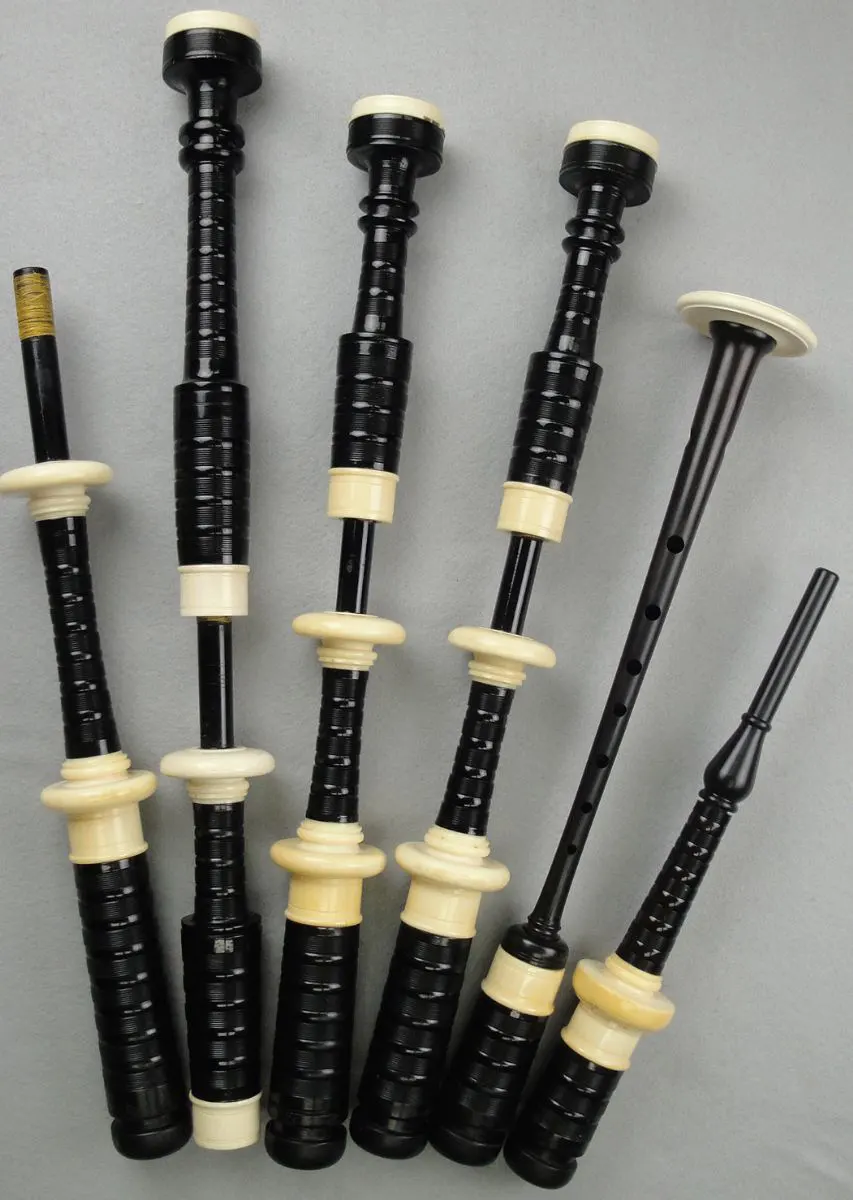
Robertson, Full Ivory, Circa 1930
SOLD – James Robertson was one of the most remarkable and consistent pipe makers of all time. He made pipes in Edinburgh from 1908 until his death in 1948, though the company continued with pretty much the same consistency after his death and until it ceased operations in the mid-1960s.
This set is one of the earlier ones we’ve had on the site in a while and was likely made around 1930.
The set required no refinishing. The blowstick is not original, and the projecting mount installed onto it was taken from a different Robertson piece.
All other pieces are original, and there are no known repairs. The ring caps on the tenors exhibit a few small chips.
The chanter is a Naill made in the last 10 years. The original Robertson sole has been installed onto it.
The tonal qualities are typical Robertson: bold, steady and easy to reed.
-
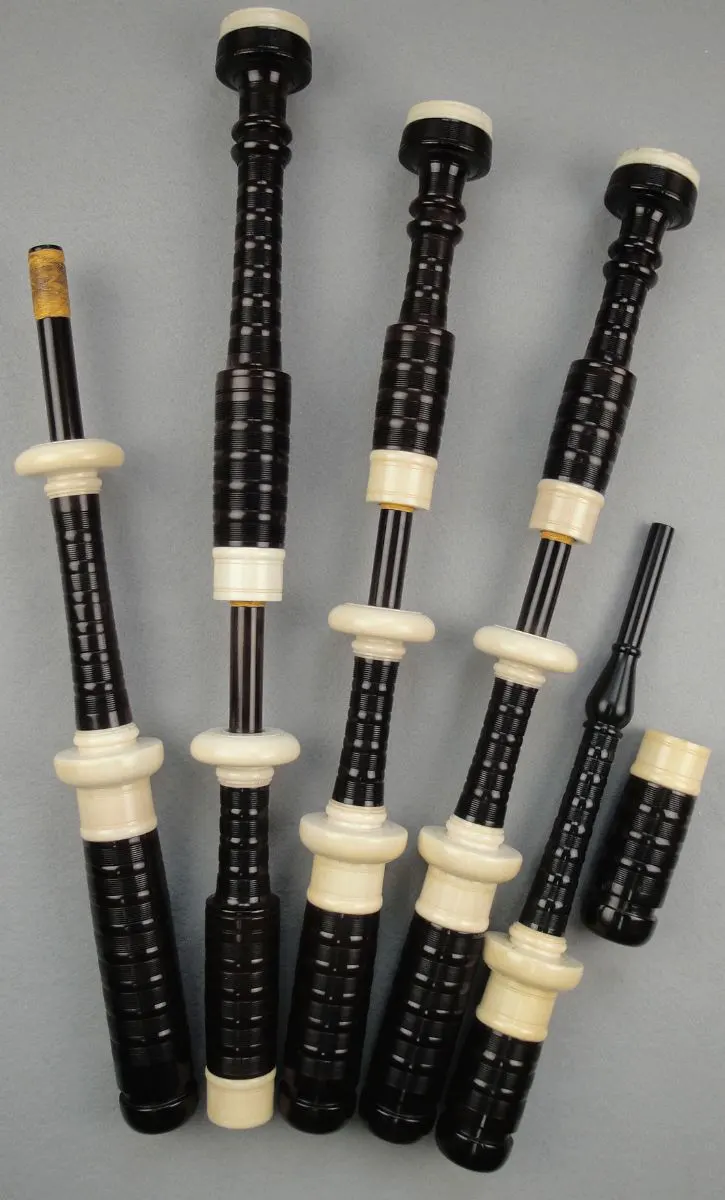
Robertson, Full Ivory, Circa 1940
SOLD – James Robertson was one of the most remarkable and consistent pipe makers of all time. He made pipes in Edinburgh from 1908 until his death in 1948, though the company continued with pretty much the same consistency after his death and until it ceased operations in the mid-1960s. This set was likely made around 1940, and exhibits the flared stock bores typical of Robertsons made during the founder’s lifetime.
Though I would never sell a set of pipes that I haven’t thoroughly tested, I have always thought I could send out a set of Robertsons that I had never played and still be confident that they would be good. They always exhibit the same full, rich and steady tone no matter when they were made. The excellent workmanship reflects the stellar tone.
This set came to me from a pupil, Pipe Major Ian McDonald of the Grade 1 Toronto Police. They were originally owned by his father John, also a former Toronto Police Pipe Major. When I taught Ian as an up-and-coming young player in the 1980s these are the pipes he played.
All pieces are original, and there are no repairs or major flaws. There are a few very minor dings in the wood, and some tiny chips in the ivory ring caps, obviously the result of close quarter countermarching at some point in the past.
The pipes required no refinishing, but both the wood and the ivory have been professionally polished on the lathe.
This is a superb set of pipes tonally and visually and they come with a solid pedigree.
This set is being used as the model for a Robertson reproduction bagpipe being produced by myself and Dunbar bagpipes, scheduled for release in May.
-
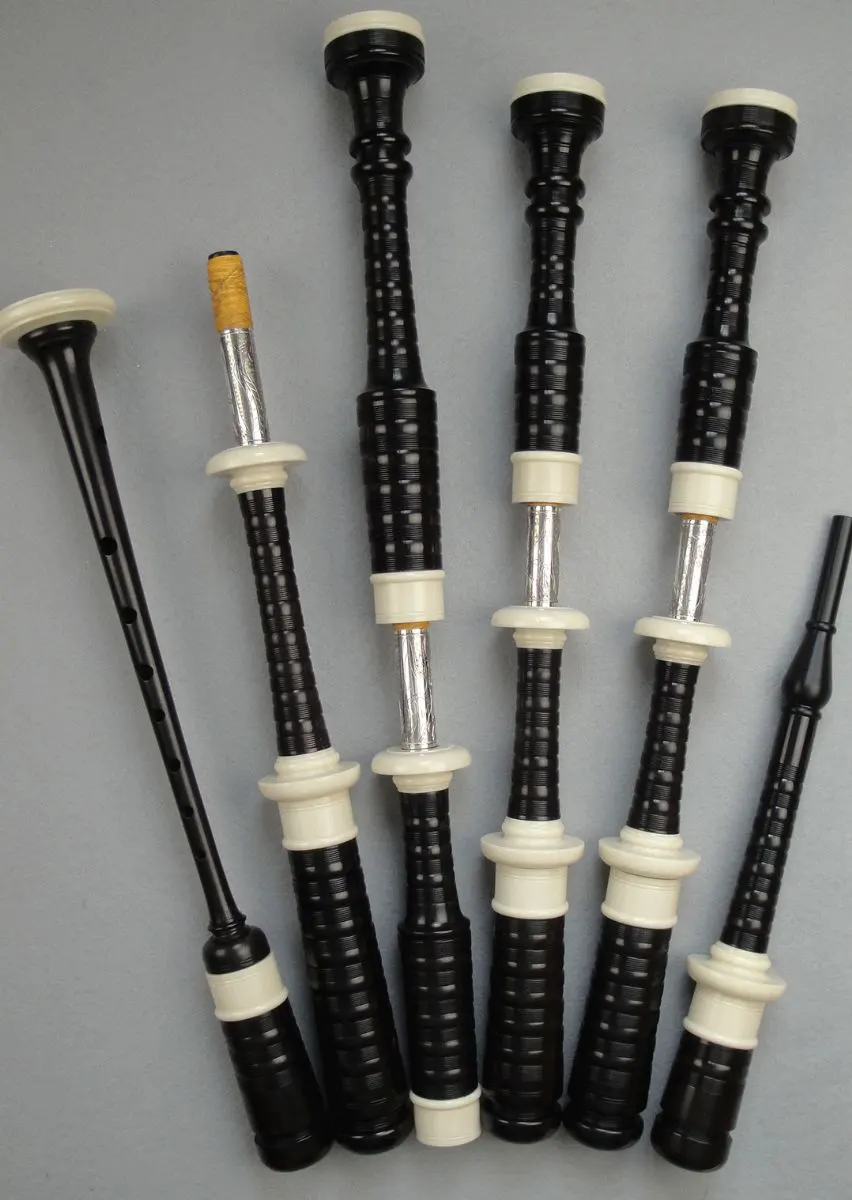
R. G. Lawrie, Circa 1930, Engraved Silver Slides, Remounted in Imitation Ivory
SOLD – This outstanding Lawrie set has been dated to around 1930. It is blackwood and came to me with a number of chipped and broken ivory mounts, so they have been completely remounted in imitation ivory. The engraved Sterling silver slides were added in the early 1990s. The chanter stock, blowpipe stock and blowpipe were missing. Blackwood replicas were made. The blowpipe and blowpipe stock are poly-lined blackwood to prevent cracking. The set has been refinished.
For someone looking for a classic, vintage Lawrie tone on an ivory-free bagpipe, you could hardly do better than these. They are rich, seamless, full and steady, with a big, cradling bass sound.
They are offered with a brand new Naill chanter with matching imitation ivory sole.
-
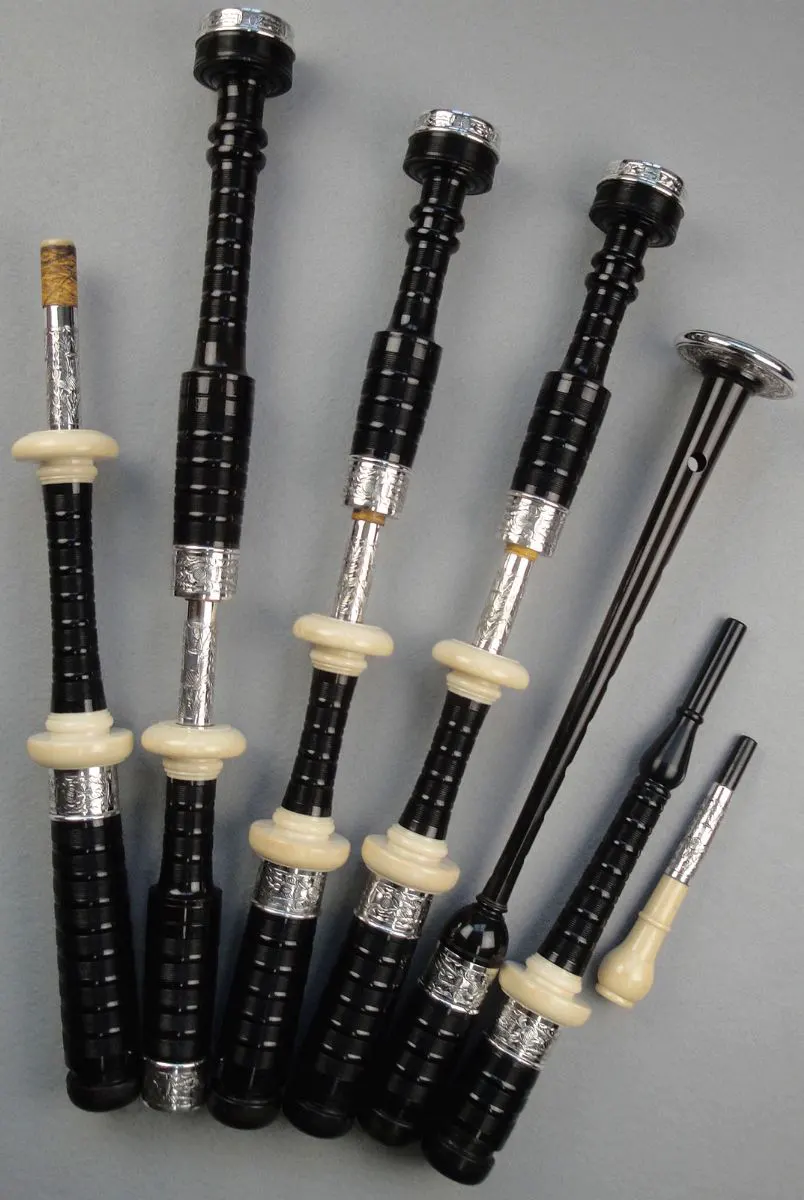
Robertson, Silver and Ivory, 1950
SOLD – This set of Lawries came in its original box. The pipes were packed in newspapers from 1950, thus the dating. The pipes have had minimal usage. They look almost brand new — perhaps owned by a new piper who gave them a short go and decided piping wasn’t for them.
They are blackwood, with iconic tapered Lawrie nickel ferrules. The projecting mounts are blackwood; caps and original chanter sole are imitation ivory.
The pipes play very well. Many Lawries from this era maintained a big, classic, seamless Lawrie/Henderson sound from the earlier part of the century, and this set is one of them — steady, easy to reed, easy to tune, rich and vibrant.
They required no refurb aside from mimimal re-hemping.They have been oiled.
-
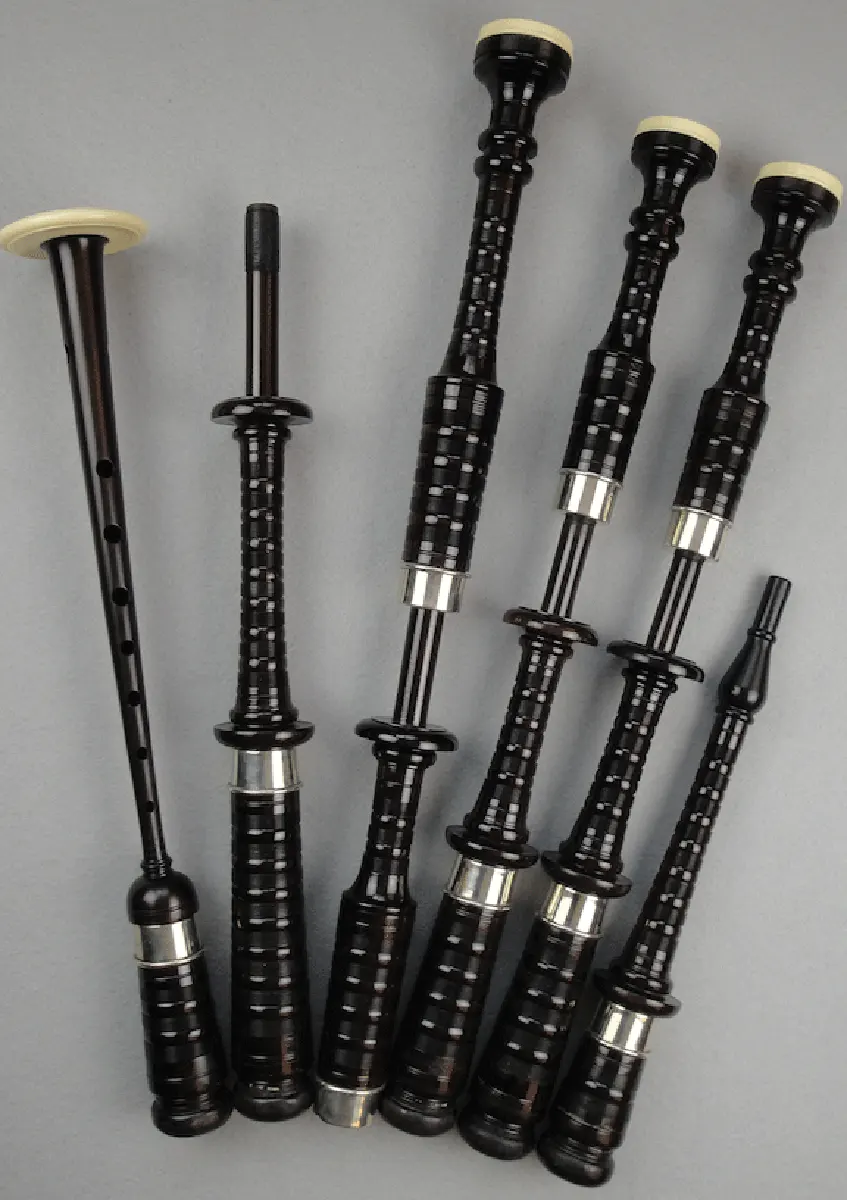
R. G. Lawrie, 1950, Nickel, Imitation Ivory
SOLD – This set of Lawries came in its original box. The pipes were packed in newspapers from 1950, thus the dating. The pipes have had minimal usage. They look almost brand new — perhaps owned by a new piper who gave them a short go and decided piping wasn’t for them.
They are blackwood, with iconic tapered Lawrie nickel ferrules. The projecting mounts are blackwood; caps and original chanter sole are imitation ivory.
The pipes play very well. Many Lawries from this era maintained a big, classic, seamless Lawrie/Henderson sound from the earlier part of the century, and this set is one of them — steady, easy to reed, easy to tune, rich and vibrant.
They required no refurb aside from mimimal re-hemping.They have been oiled.
-
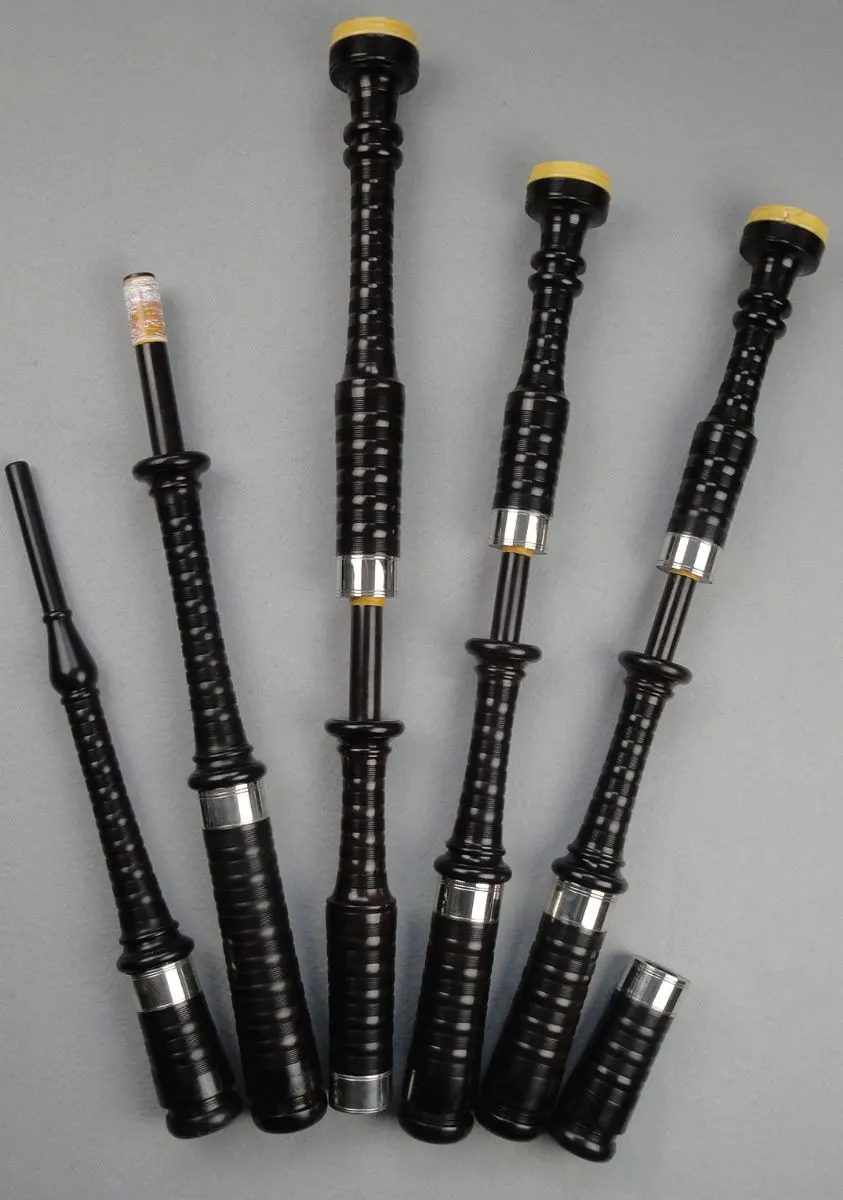
Henderson, Cocuswood, Circa 1920, Wood Mounts, Nickel Ferrules, Artificial Ivory Caps
SOLD – This is a remarkable set of Henderson pipes made of cocuswood, likely around 1920. The projecting mounts are wood and the ferrules are nickel.
Sometime in the 1990s the ivory drone caps, which apparently were badly cracked, were replaced with artificial ivory. So the great advantage in this bagpipe, aside from its tone, is that it is free of ivory. All pieces appear to be original except for the blowstick stock which is poly-lined blackwood. The cocuswood It is quite dark so the blackwood stock matches the rest of the set quite nicely.
I actually acquired this bagpipe a year or so ago and have been playing it off and on for the past eight or 10 months as my #2 set, so I can attest to its exemplary tone. While this set would be a beauty for anyone to own, it might be particularly valuable to a top-flight competitor traveling regularly across borders.
It should be noted that the artificial ivory caps are not quite as orange looking as they appear in the photos!
-

Cocuswood, Suspected Center, Circa 1880, German Silver Caps, Ferrules, Button Mounts, Bone Bushes
SOLD – These pipes were purchased as Centers, made in the late 1800s. Though they are not stamped, the wide cord quides and the lovely, rich tone and fine craftsmanship support the Center supposition. The tone is very much in the Glen/Center tradition: rich and extremely steady, though not booming like Hendersons.
The set is very finely crafted and light as a feather. They have been stripped and refinished. The blowpipe was cracked but has been invisible whipped. One tenor stock showed a small crack and two beads have been invisible whipped.
This is quite a distinctive and lovely set with great visual and tonal character, a first-class cocuswood tone, and a very affordable price.
-
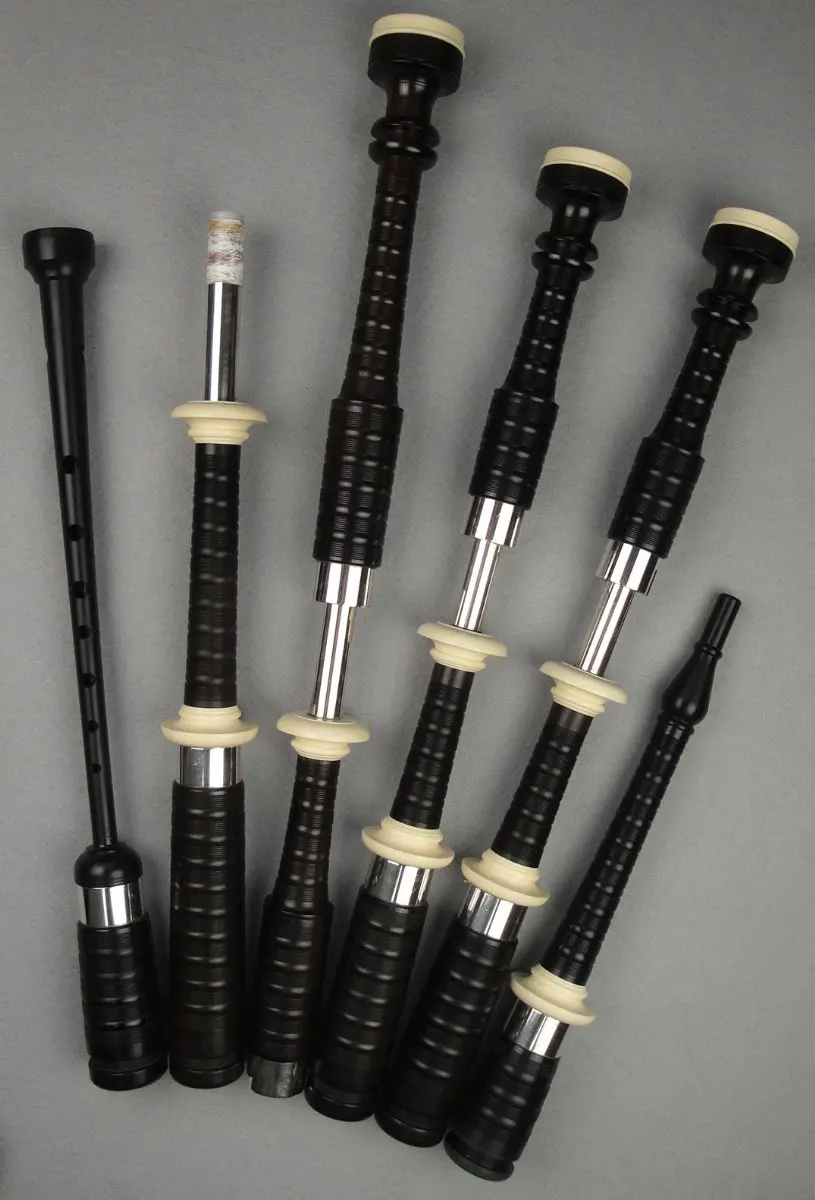
C. E. Kron “Heritage” Model, Circa 2004, Plain Silver Ferrules, Slides, Artificial Ivory Mounts, Caps
SOLD – I have a personal connection to this bagpipe. Back around 2001 I worked closely with the C.E. Kron company and then-employee Dave Atherton to help Charley Kron market a set of pipes that used the exact bore measurements of a set of lovely 1912 silver and ivory Hendersons that I was playing at that time. Kron marketed the pipes as its “Heritage” line and they became quite popular.
The line is not made anymore. The manufacturing standards for this bagpipe was extremely high and the tone was superb — a full, rich and seamless Henderson sound — and this has become a desirable bagpipe since that time.
This particular set was actually purchased by a student of mine around 2004. The mounts got quite chipped through various mishaps so around 2006 we had Dunbar bagpipes remount the pipes using their unbreakable artificial ivory. The profiles of the original mounts were retained.
The pipes are in excellent shape, but for a few tiny nicks in the wood. As was the tradition at the Kron company at the time, the blowstick and chanter stocks and the blowstick itself are polypenco plastic. The metal mounts are plain sterling silver.
This is a lovely, full-bodied set for use in competition or as a workaday bagpipe.
-
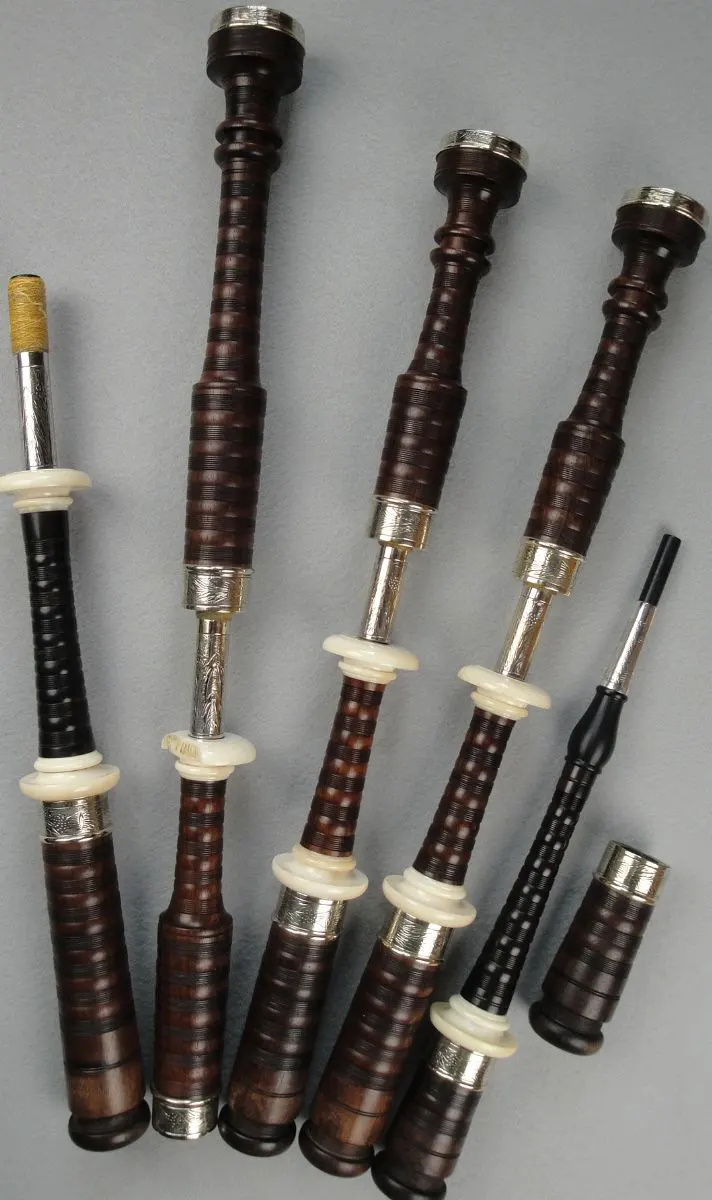
Henderson, 1920s, Cocuswood, Natural, Silver-plated Brass
SOLD – This set of circa 1920s Hendersons is tonally top-drawer, but comes with some visual compromises and is priced accordingly.
At first glance, the metal mounts appear to be engraved silver. However, there are no hallmarks, and it actually looks to be engraved brass, or perhaps German silver, and silver plated. The effect is very much like the real thing.
The pipes are cocuswood, but it appears the bass bottom joint has been stained to look more like blackwood — perhaps an abandoned effort to make the pipes look like blackwood.
The projecting mounts are in good shape except for the bass mid-joint. About a quarter of this mount has been broken off and subsequently buffed smooth. The blowstock appears to be blackwood, with the original projecting mount. The blowstick has a repaired crack near the mouthpiece.
Tonally, the pipes are excellent — full and steady in the Henderson cocuswood tradition. The tenors tune a bit lower than my own 1920s cocuswood Henderson.
These pipes are a good opportunity to acquire classic Henderson cocuswood tone without the price tag of a classic silver and ivory set.
-
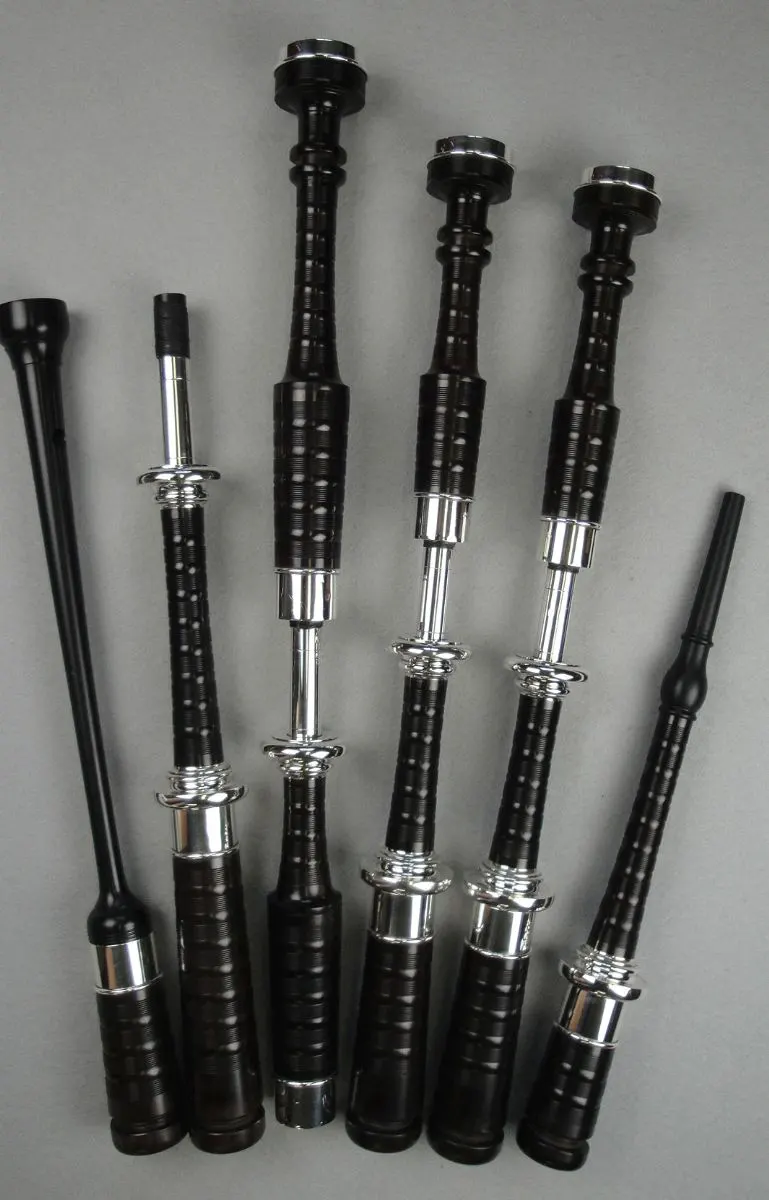
David Naill & Co., Full Plain Silver, 2009
SOLD – Though not the usual sort of item offered on this page, this particular set came to me for an exceptionally good price and can be offered here at considerable savings.
They were made by David Naill & Co. in 2009, and are hallmarked full plain silver. If they have been played it is hardly apparent from the appearance of the pipes. They are in mint condition and come with a Naill poly chanter.
Naill pipes have ben played at all levels, including the very highest, for close to 40 years. The company was founded by Les Cowell, who learned the pipemaking trade with the Henry Starck company in the 1940s.
Naill pipes are steady, full, smooth and very reliable. The company has always use the highest quality wood.